
What you will learn in about 15 minutes
- Say ㅑ as [ja] and tell it apart from ㅏ and ㅕ by ear.
- Write ㅑ in three strokes and place it correctly inside a syllable block.
- Read 야, 약, 야구, 야채 and 고양이 without romanization.
- Explain why the syllable 야 also works as a friendly “hey!”.
Before you start: you should know the vowel ㅏ and understand that a syllable block needs a consonant, which is the silent ㅇ when no sound starts the block.
What Sound Does ㅑ Make?
ㅑ makes the sound [ja], which English spellers write “ya”. Say “yard”, drop the r, and stop. The tongue starts where it sits for the English “ee”, then slides down to the open “ah” of ㅏ in a fraction of a second. The lips stay relaxed and unrounded the whole time.
Listen to the letter and two words that contain it. Say each one after the recording, and keep the y short.
Revised Romanization, the government system for writing Korean in Latin letters, spells ㅑ as “ya”. The Hangul orthography rules (한글 맞춤법), maintained with the National Institute of Korean Language (국립국어원), list ㅑ among the ten basic vowel letters. The romanization is a learning aid only, because it hides details such as the unrounded lips. The next part shows where those details come from.
How Is ㅑ Built from Simpler Vowels?
ㅑ is ㅏ with a second short stroke. ㅏ has one long vertical line and one short stroke pointing right. ㅑ keeps the vertical line and gives it two short strokes, both pointing right. The extra stroke is the visual sign of the y-sound.
The same rule works across the whole family. Add a second short stroke to ㅓ and you get ㅕ. Add one to ㅗ and you get ㅛ. Add one to ㅜ and you get ㅠ. The Korean y-vowels page shows all six pairs side by side, so ㅑ teaches you a pattern worth five more letters.
| Plain vowel | Y-vowel | Sound change | Short strokes |
|---|---|---|---|
| ㅏ [a] | ㅑ [ja] | adds a y at the start | 1 → 2, pointing right |
| ㅓ [ʌ] | ㅕ [jʌ] | adds a y at the start | 1 → 2, pointing left |
| ㅗ [o] | ㅛ [jo] | adds a y at the start | 1 → 2, pointing up |
| ㅜ [u] | ㅠ [ju] | adds a y at the start | 1 → 2, pointing down |
A historical note for the curious: the original 1446 description of Hangul, the Hunminjeongeum Haerye, explains these letters as the “second appearance” of the simple vowels, drawn with two dots where the plain vowel has one. The dots later became short strokes. A good memory trick follows from this: the y-vowels have two marks because the sound has two parts, a quick y and then the main vowel.
With the sound and the design clear, the next step is to put the letter on paper.
Writing ㅑ: Stroke Order and Typing
Write ㅑ in three strokes: one long vertical line from top to bottom, then two short horizontal strokes to the right of it, upper one first. This follows the two basic Hangul rules, top before bottom and left before right. The two short strokes are about the same length, and the lower one sits near the middle of the vertical line.
Practise on Paper
- Draw the vertical line from top to bottom.
- Draw the upper short stroke, left to right, starting at the vertical line.
- Draw the lower short stroke the same way, a little below the middle.
- Draw the vertical line from top to bottom.
- Draw the upper short stroke, left to right, starting at the vertical line.
- Draw the lower short stroke the same way, a little below the middle.
You will know it worked when the two short strokes are parallel and clearly separated. A common mistake is letting them touch, which makes the letter look like a ladder rung and can be mistaken for ㅏ at a glance. Another is drawing them on the left of the line, which is ㅕ.
Stroke counts for a few letters, such as ㅈ and ㅊ, differ slightly between school handwriting and print-style charts; this site follows the school counts. For ㅑ the common classroom order is the vertical line first. For the full set of rules, see the Hangul stroke order lesson.
How do you type ㅑ? On a computer with the standard Korean keyboard, ㅑ is the I key with no Shift. To type 야, press D for the silent ㅇ and then I. The how to type in Korean guide explains the full layout.
Now that you can write it, here is how to say it properly.
How to Pronounce the Korean Vowel ㅑ Step by Step
To pronounce the Korean vowel ㅑ, start from the “ee” position and open your mouth into “ah” in one smooth movement. The whole motion lasts about as long as one English syllable like “yah”, and the second half carries the weight. Follow these steps with a mirror if you can.
- Smile slightly and let your tongue rest behind your lower front teeth, as for English “ee”.
- Begin voicing the sound with the front of the tongue raised toward the roof of your mouth.
- Drop your jaw and let the tongue fall back and down into the open “ah” position.
- Keep your lips flat and unrounded from start to finish.
- Stop. Do not add a trailing sound such as “yah-uh”.
You will know it worked when a recording of your voice matches the clips above without a long, drawn-out first half. The first sound is a glide, a very short vowel-like sound that leads into the main vowel. Linguists call it an on-glide or semivowel, and write it [j] in the International Phonetic Alphabet.
Tongue Position from Start to Finish
The tongue travels from a high, front position to a low, central one. Touch the front of your tongue to the back of your lower teeth and say “ee”. Then keep the tip there and lower the jaw for “ah”. If you feel the middle of your tongue drop, you are doing it right.
Is ㅑ a Vowel or a Diphthong?
ㅑ is classified as a diphthong in the Standard Pronunciation rules (표준 발음법, Article 5), because it joins a glide to a vowel. In practice you can treat it as one letter with one sound. Korean speakers write and think of it as a single vowel, and so should you. A monophthong is a vowel with one steady quality, like ㅏ, and the contrast with ㅑ is exactly the extra glide.
The next question is what happens when the consonant in front of ㅑ already uses the same part of the mouth.
How Does ㅑ Change after ㅈ, ㅉ and ㅊ?
After ㅈ, ㅉ and ㅊ the y-glide of ㅑ is faint, so 쟈, 쨔 and 챠 can sound close to 자, 짜 and 차. These three consonants are made with the tongue blade pressed near the hard palate, the same place where the y-glide is formed, so the glide has little room to be heard. This is a listening observation, not a written rule for ㅑ.
The written rule exists for the sister vowel: the Standard Pronunciation rules say that 져, 쪄 and 쳐 in verb forms are said [저], [쩌] and [처], as in 가져 [가저]. The ㅕ lesson covers that rule in detail. These syllables with ㅑ are rare in spelling, so you will meet the effect mostly with ㅕ.
The opposite happens after ㅅ. Before ㅑ, ㅅ sounds like English “sh”, so 샤 [ɕa] differs from 사 [sa]. That pair is worth learning because loanwords use it often.
| Spelling | Sound | Meaning | What to notice |
|---|---|---|---|
| 사과 | [사과] | apple | plain “s” in 사 |
| 샤워 | [샤워] | shower | “sh” in 샤 |
| 샴푸 | [샴푸] | shampoo | “sh” in 샴 |
Why Do You Hear 야 in K-Dramas?
야 on its own is a casual “hey!” used between close friends or toward someone younger, as in “야, 뭐 해?” (“Hey, what are you doing?”). Said to an elder or a stranger it sounds rude. The sound ㅑ is easy to shout, which is one reason it is so common in drama dialogue.
야 also appears as a calling ending on names. After a name that ends in a vowel, Koreans add 야: 친구야 is “hey, friend”. After a name that ends in a consonant, they add 아 instead: 지민아. The casual ending -야 also appears in 나야 (“it’s me”) and 뭐야 (“what is it?”). These are grammar patterns for later, but your ear will already recognize the syllable.
Having met the sound in real speech, let us decode actual words.
Worked Example: Reading Words with ㅑ
Reading a Hangul block means asking three questions in order: what is the first consonant, which vowel is it, and is there a final consonant. Here is 야구 (baseball), decoded step by step.
- The first block is 야. It contains the silent ㅇ on top-left and ㅑ on the right. Silent means ㅇ makes no sound at the start of a block, so you hear only [ja].
- The second block is 구. It has ㄱ (a [g] sound between vowels) and ㅜ below it. You hear [gu].
- Join them: [ja-gu], written 야구. The meaning is “baseball”.
Now a harder one: 고양이 (cat). The middle block is 양, which has three parts: silent ㅇ, ㅑ, and a second ㅇ at the bottom. A final ㅇ is not silent. It is the “ng” sound of “sing”. So 양 is [jang], and the whole word is [go-yang-i].
Finally, 약 (medicine) has a final ㄱ. The mouth closes on a “k” without releasing air, so the word ends sharply: [jak̚]. Compare it with 악, which has no y-glide.
Here are more words to read aloud, with their sounds in brackets.
| Word | Sound | Meaning | Block parts |
|---|---|---|---|
| 야 | [야] | hey (casual) | ㅇ + ㅑ |
| 약 | [약] | medicine | ㅇ + ㅑ + ㄱ |
| 야구 | [야구] | baseball | 야 + 구 |
| 야채 | [야채] | vegetables | 야 + 채 |
| 양말 | [양말] | socks | 양 + 말 |
| 향수 | [향수] | perfume | 향 + 수 |
| 고양이 | [고양이] | cat | 고 + 양 + 이 |
The way a block is laid out depends on the vowel shape: vertical vowels such as ㅑ sit to the right of the consonant. The page on how syllable blocks are shaped shows the six layouts. The Hangul Syllable Builder lets you try this yourself: pick a consonant and ㅑ and watch the block form.
ㅑ vs ㅏ vs ㅕ: Which Is Which?
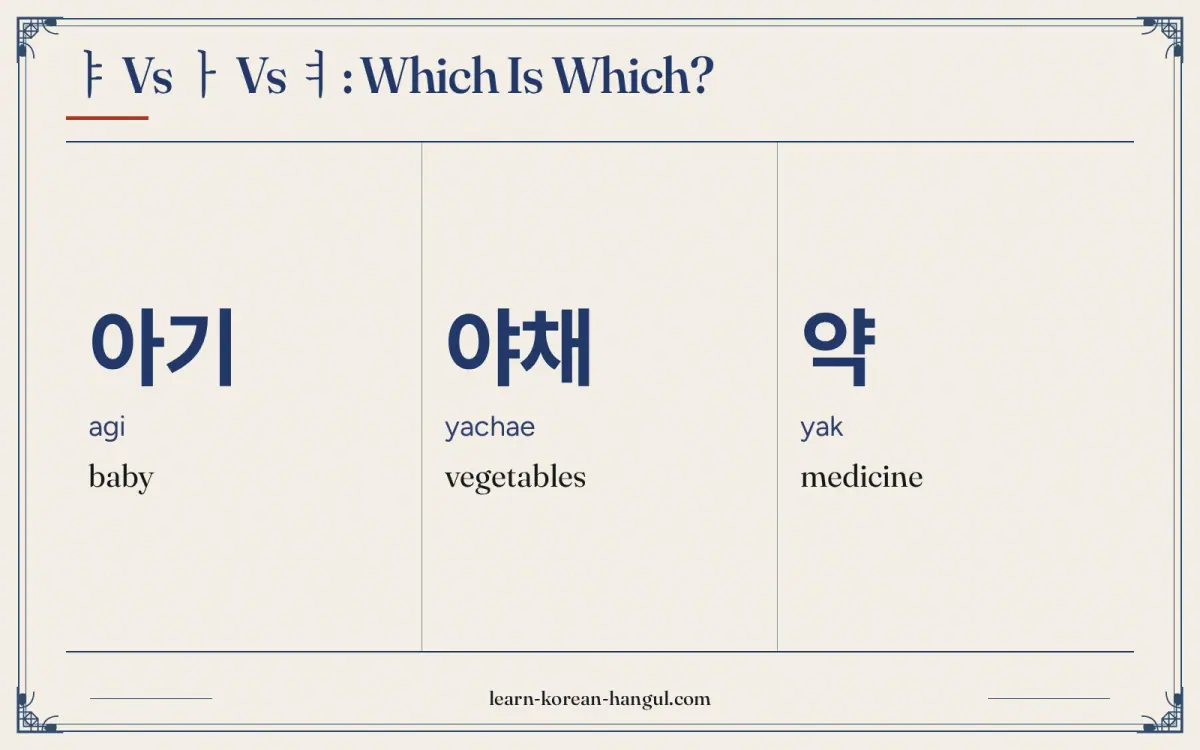
ㅑ differs from ㅏ by one stroke and one sound, and from ㅕ by direction: ㅑ points right and ㅕ points left. Learners rarely confuse the sounds of ㅏ and ㅑ, but they often misread the shapes when writing fast. The table pairs each lookalike with a real word so you can train both ears and eyes.
| Pair | Sound difference | Example words | Visual cue |
|---|---|---|---|
| 아 / 야 | [a] vs [ja] | 아기 (baby) / 야구 (baseball) | one short stroke vs two |
| 약 / 역 | [jak] vs [jʌk] | 약 (medicine) / 역 (station) | strokes right vs strokes left |
| 양 / 영 | [jaŋ] vs [jʌŋ] | 양 (sheep, amount) / 영 (zero) | strokes right vs strokes left |
| 사 / 샤 | [sa] vs [ɕa] | 사과 (apple) / 샤워 (shower) | plain s vs sh |
ㅏ Starts Open; ㅑ Starts from the Ee Position and Opens.
| Korean | Romanization | Meaning | Sound |
|---|---|---|---|
| 아기 | agi | baby | |
| 야채 | yachae | vegetables |
ㅑ Ends with the Jaw Wide Open; ㅕ Ends with the Jaw Half Open.
| Korean | Romanization | Meaning | Sound |
|---|---|---|---|
| 약 | yak | medicine | |
| 역 | yeok | station |
Same Jaw Contrast before a Final Ng.
| Korean | Romanization | Meaning | Sound |
|---|---|---|---|
| 양 | yang | sheep; amount | |
| 영 | yeong | zero |
The mouth cue for ㅑ versus ㅕ is the jaw. ㅑ ends with a wide-open jaw and flat tongue. ㅕ ends with the jaw about halfway and the tongue pulled slightly back. Hold your hand under your chin: it drops further for 야 than for 여.
Common Mistakes Learners Make with ㅑ
Learners often assume that ㅑ is a two-part sound pronounced “yuh-ah”, but it is one fast glide. Practicing it slowly teaches the wrong rhythm, so always say it at natural speed.
- Mistake: drawing out the y. English speakers say “yaaah” with a long first part. Korean gives the y only a small share of the syllable. Fix: tap the table once as you say 야.
- Mistake: rounding the lips. The English “y” often arrives with slightly rounded lips. Korean ㅑ keeps them flat. Fix: smile while you practise.
- Mistake: forgetting the silent ㅇ. ㅑ cannot stand alone in a block. Written alone it is a jamo (a letter part), not a syllable. Fix: always write 야, never a bare ㅑ, when you mean the sound.
- Mistake: mixing up direction. Short strokes on the right are ㅑ, on the left are ㅕ. Fix: think “ㅑ points the way you read”.
- Mistake: reading 샤 as 사. The “sh” in 샤워 is part of the word. Fix: match each word to its audio.
Practice: Read, Hear and Write
Work through these three short exercises, then check the answers below. Do not look at the key until you have tried all three.
Practice · 8
How is ㅑ built?
Show answer
ㅏ with a second short stroke on the right
ㅑ keeps the vertical line of ㅏ and gives it two short strokes pointing right. The extra stroke is the sign of the y-sound.
Which word means "medicine"?
Show answer
약
약 is silent ㅇ, ㅑ and a final ㄱ. 역 is station, 양 is sheep or amount, and 야구 is baseball.
What does 고양이 mean?
Show answer
cat
고양이 is read [go-yang-i] and means "cat". Baseball is 야구, socks is 양말 and vegetables is 야채.
How is the final ㅇ in 양 pronounced?
Show answer
Like "ng" in "sing"
ㅇ is silent only at the start of a block. At the bottom it is "ng", so 양 is [jang].
On which side of the vertical line are the two short strokes of ㅑ?
Show answer
The right
ㅑ points right, the way you read. Short strokes on the left make ㅕ.
How does ㅅ sound before ㅑ, as in 샤워 (shower)?
Show answer
Like English "sh"
Before ㅑ, ㅅ sounds like "sh", so 샤 differs from 사. That is why 샤워 and 샴푸 have an "sh" sound.
Who can you call out to with a casual 야 ("hey!")?
Show answer
A close friend
야 is used between close friends or toward someone younger. Said to an elder or a stranger it sounds rude.
How many strokes does ㅑ take, and which comes first?
Show answer
Three, with the vertical line first
Write the long vertical line first, then the upper short stroke and the lower one, following top before bottom and left before right.
Exercise 1: pick by sound. Listen to each clip and decide whether it contains ㅑ or ㅏ.
Exercise 2: read aloud. Say each word, then check the meaning: 야구, 야채, 양말, 향수, 샤워, 고양이.
Exercise 3: write from dictation. Listen and write each syllable, then compare your strokes with the model: 야, 약, 양, 야구.
Answers. Exercise 1: Clips A and C contain ㅑ (약, 양). Clips B and D contain ㅏ (악, 앙). Exercise 2: baseball, vegetables, socks, perfume, shower, cat. Exercise 3: check that each ㅑ has two short strokes on the right of its vertical line, parallel and clearly separated.
What to Learn Next
You now know the Korean vowel ㅑ well enough to read and write it. The natural next lesson is ㅕ (yeo), which mirrors ㅑ and adds the pronunciation rule after ㅈ, ㅉ and ㅊ. For the full picture, return to the Korean y-vowels overview.
For practice, review the vowel with the Hangul flashcard decks, test your ear in the Hangul quizzes, and build blocks in the Hangul Syllable Builder. The interactive Hangul alphabet lets you tap every letter and hear it. For mouth positions across all vowels, read the Korean vowel pronunciation guide.
This lesson does not cover the grammar of the casual ending -야, the history of Hunminjeongeum in depth, or phonetic detail beyond what a beginner needs. Those topics belong to the grammar and pronunciation sections.
Frequently Asked Questions
Frequently Asked Questions
Is ㅑ the same as English “ya”?
Almost. English “ya” in “yard” is a close match for ㅑ, so the sound is easy to reach. The differences are small: Korean ㅑ is shorter and crisper, the lips stay relaxed and unrounded, and there is no r-coloring. Think “ya” as in “yacht”, said briskly.
Can ㅑ come after any consonant?
Spelling allows it after every consonant, and you will meet 갸, 냐, 랴, 먀, 뱌, 샤 and 약 in real words. The sound is rarely a problem except after ㅈ, ㅉ and ㅊ, where the y-glide is so faint that 쟈 and 자 can be hard to tell apart.
What does 야 mean when Koreans shout it?
야 is a casual “hey!” used to call a friend or someone younger. It is rude toward elders or strangers. Added to a name that ends in a vowel, as in 친구야, it works like a friendly “hey, friend”. After a name that ends in a consonant, Koreans use 아 instead.
How do I type ㅑ on a Korean keyboard?
On the standard two-set (2-beolsik) keyboard, ㅑ sits on the I key and needs no Shift. To type the syllable 야, press D (ㅇ) and then I (ㅑ). The input method joins the two letters into one syllable block automatically, so you never type the block as a unit.
Is 쟈 a real syllable?
Yes, 쟈 is a valid Hangul block, but it is very rare in modern Korean words. Most learners will never need to read it. If it does appear, expect a sound very close to 자, because ㅈ is already made near the palate where the y-glide happens.