
What you will learn in about 15 minutes
- Say ㅕ as [jʌ] with flat lips, and keep it apart from ㅛ and ㅓ by ear.
- Write ㅕ in three strokes and place it in a block.
- Explain why 가져 is said [가저] and 다쳐 is said [다처].
- Read 여자, 여름, 겨울, 병원, 여행 and 연필 aloud.
Before you start: learn the vowel ㅓ first, because ㅕ is ㅓ with a y-glide in front.
What Sound Does ㅕ Make?
ㅕ makes the sound [jʌ], which English spellers write “yeo” or “yuh”. A good English anchor is the “yu” in “young”, said with relaxed lips. The sound has two parts: a very short “y”, then an open mid vowel pronounced with the jaw half open and the lips flat.
Listen to three words that contain ㅕ, and copy each one.
Revised Romanization, the Korean government system for writing Korean in Latin letters, spells ㅕ as “yeo”. That spelling is a convention, not a pronunciation guide. The letters “e” and “o” suggest two vowel sounds, but ㅕ has only one vowel after the glide. The Hangul orthography rules (한글 맞춤법) list ㅕ among the ten basic vowel letters.
How Is ㅕ Built from Simpler Vowels?
ㅕ is ㅓ with a second short stroke. ㅓ has a long vertical line with one short stroke on its left. ㅕ keeps the line and gives it two short strokes on the left. The extra stroke marks the y-glide, just as the second stroke in ㅑ does.
| Plain vowel | Y-vowel | Sound change | Short strokes |
|---|---|---|---|
| ㅏ [a] | ㅑ [ja] | adds a y at the start | 1 → 2, pointing right |
| ㅓ [ʌ] | ㅕ [jʌ] | adds a y at the start | 1 → 2, pointing left |
| ㅗ [o] | ㅛ [jo] | adds a y at the start | 1 → 2, pointing up |
| ㅜ [u] | ㅠ [ju] | adds a y at the start | 1 → 2, pointing down |
The Korean y-vowels overview explains the full pattern. Knowing it means ㅕ is not a new shape to memorize; it is ㅓ doubled.
With the sound and the design clear, the next step is to put the letter on paper.
Writing ㅕ: Stroke Order and Typing
Write ㅕ in three strokes: two short horizontal strokes on the left, upper one first, then one long vertical line from top to bottom. The rule is left before right, so the short strokes that sit on the left come first. Keep the two short strokes parallel and clearly separate.
Practise on Paper
- Draw the upper short stroke from left to right, ending where the vertical line will go.
- Draw the lower short stroke below it in the same direction, parallel to the first.
- Draw the long vertical line from top to bottom, touching the right ends of both short strokes.
- Draw the upper short stroke from left to right, ending where the vertical line will go.
- Draw the lower short stroke below it in the same direction, parallel to the first.
- Draw the long vertical line from top to bottom, touching the right ends of both short strokes.
You will know it worked when the two short strokes sit on the left, are parallel, and meet the line without crossing it. A common mistake is drawing them on the right, which gives ㅑ. Another is making them different lengths, which makes the letter look uneven.
Guides differ slightly on stroke order for some letters. The Hangul stroke order lesson explains the convention used on this site.
To type ㅕ on a computer with the standard Korean keyboard, press the U key without Shift. To type 여, press D for the silent ㅇ, then U. The how to type in Korean guide shows the whole layout.
Knowing the shape, the next question is how to produce the sound.
How to Pronounce the Korean Vowel ㅕ Step by Step
To pronounce the Korean vowel ㅕ, glide quickly from the “ee” position to a half-open, unrounded “uh” and keep your lips flat the whole time. The tongue pulls back and the jaw drops about halfway. Do not round your lips for any part of it.
- Smile slightly, as if saying “ee”, and touch the tip of your tongue behind your lower front teeth.
- Start voicing with the front of your tongue raised: this is the y-glide.
- Pull the tongue body back and lower the jaw about halfway, as when you say a relaxed “uh”.
- Keep the lips flat and relaxed. Check in a mirror that the lips do not push forward.
- Stop at once; do not add another vowel after it.
You will know it worked when the clip and your voice both end in an open, unrounded sound, with no “oh” colour at the end.
Why Is the Mouth Open but Not Rounded?
ㅕ is an unrounded mid-back vowel with a y-onset. “Unrounded” means the lips stay spread or neutral, and “mid-back” means the tongue body sits in the middle height at the back of the mouth. Rounding the lips changes the vowel into ㅛ. The mirror test is simple: if your lips form a small circle, you have said ㅛ.
The next question is what happens when ㅕ follows ㅈ, ㅉ or ㅊ.
Why Does ㅕ Lose Its Y after ㅈ, ㅉ and ㅊ?
After ㅈ, ㅉ and ㅊ, the Standard Pronunciation rules tell speakers to say 져, 쪄 and 쳐 as [저], [쩌] and [처]. The rule is in the Standard Pronunciation of Korean (표준 발음법), Article 5, note 1, and it is written for verb forms. The reason is physical: these consonants are made with the tongue near the hard palate, the same place the y-glide is formed, so the glide adds nothing audible.
| Verb form | Written | Said | Meaning |
|---|---|---|---|
| 가지어 → 가져 | 가져 | [가저] | take, bring |
| 찌어 → 쪄 | 쪄 | [쩌] | steam |
| 다치어 → 다쳐 | 다쳐 | [다처] | get hurt |
Spelling still keeps the ㅕ because it shows the grammar: 가지다 plus -어 becomes 가져. This is a spelling-versus-sound gap, one of the first you will meet. After other consonants, the y-glide stays: 마셔요 (drink) is said [마셔요], and 겨울 keeps its glide too.
Where Will You Meet ㅕ in Grammar?
You will meet ㅕ often in polite verb endings. 마시다 (to drink) plus -어요 becomes 마셔요, and 가지다 becomes 가져요. The formal 하여 contracts to 해, the everyday form. These are previews only; the grammar belongs to later lessons.
A short aside for curious readers: 여행 (trip) is the Sino-Korean word 旅行, where 旅 is normally read 려. At the start of a word, 려 becomes 여 under the initial sound law (두음 법칙). Likewise 女 is 여 in 여자 but 녀 in 소녀 (girl). You only need to remember that the same syllable may be spelled two ways.
Worked Example: Reading Words with ㅕ
Reading a block means asking three questions: what is the first consonant, which vowel is it, and is there a final consonant. Here is 여자 (woman), decoded step by step.
- The first block is 여: silent ㅇ plus ㅕ. You hear [jʌ].
- The second block is 자: ㅈ plus ㅏ. Between vowels ㅈ is voiced, so you hear [dʒa], with a soft “j”.
- Together: [jʌ-dʒa], romanized yeoja. The word means “woman”.
Now 겨울 (winter). The first block 겨 is ㄱ plus ㅕ, and ㄱ at the start of a word is a light [k] with a small puff of air, romanized g. The second block 울 is silent ㅇ, ㅜ and a final ㄹ, which sounds like a light “l” at the end. Together it reads gyeo-ul, with no break between the blocks.
Next, 병원 (hospital). 병 has three parts: ㅂ, ㅕ and a final ㅇ, which is the “ng” of “sing”. So 병 is [pjʌŋ]. 원 is ㅇ, ㅝ and a final ㄴ, so it is [wʌn]. The whole word is [병원].
Here are more words to read aloud.
| Word | Sound | Meaning | Block parts |
|---|---|---|---|
| 여기 | [여기] | here | 여 + 기 |
| 여름 | [여름] | summer | 여 + 름 |
| 겨울 | [겨울] | winter | 겨 + 울 |
| 여행 | [여행] | trip | 여 + 행 |
| 연필 | [연필] | pencil | 연 + 필 |
| 별 | [별] | star | ㅂ + ㅕ + ㄹ |
| 열 | [열] | ten (native number) | ㅇ + ㅕ + ㄹ |
The way a block is laid out depends on the vowel. Because ㅕ is a vertical vowel, it sits to the right of the consonant. The page on how syllable blocks are shaped shows all layouts.
ㅕ vs ㅛ: Why “Yeo” Is Not “Yo”
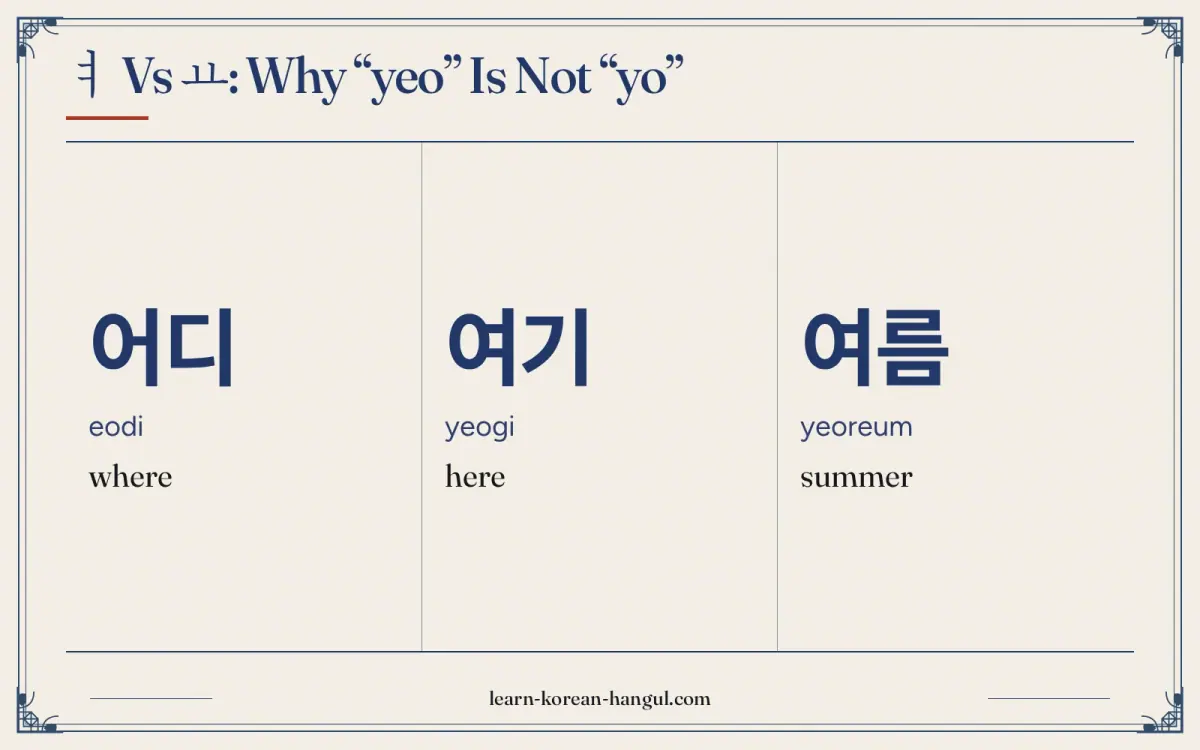
ㅕ is unrounded [jʌ] and ㅛ is rounded [jo]. Learners often hear the English “yo” in the romanization “yeo”, so they say ㅛ. The table below pairs each confusable syllable with a word.
| Pair | Sound difference | Example words | Visual cue |
|---|---|---|---|
| 어 / 여 | [ʌ] vs [jʌ] | 어디 (where) / 여기 (here) | no glide vs glide |
| 여 / 요 | [jʌ] vs [jo] | 여름 (summer) / 요리 (cooking) | flat lips vs round lips |
| 겨 / 교 | [kjʌ] vs [kjo] | 겨울 (winter) / 교실 (classroom) | strokes beside vs above |
| 녀 / 뇨 | [njʌ] vs [njo] | 소녀 (girl) / 당뇨 (diabetes) | strokes beside vs above |
No Glide vs Y-Glide
| Korean | Romanization | Meaning | Sound |
|---|---|---|---|
| 어디 | eodi | where | |
| 여기 | yeogi | here |
Flat Lips vs Round Lips
| Korean | Romanization | Meaning | Sound |
|---|---|---|---|
| 여름 | yeoreum | summer | |
| 요리 | yori | cooking |
Strokes beside vs Above
| Korean | Romanization | Meaning | Sound |
|---|---|---|---|
| 겨울 | gyeoul | winter | |
| 교실 | gyosil | classroom |
The visual cue for ㅕ against ㅛ is direction. ㅕ stands upright with short strokes on its left. ㅛ lies flat with short strokes above. The ㅛ lesson trains the rounded alternative.
Why Is ㅕ Romanized “Yeo” and Not “Yu”?
Revised Romanization spells ㅕ as “yeo” because it writes ㅓ as “eo” and then adds “y” in front. The system, issued by the Ministry of Culture, Sports and Tourism in 2000 and revised in 2014, avoids special marks such as the ŏ used by the older McCune–Reischauer system. Without a mark, it needs two Latin letters for ㅓ. It is a transcription tool for names and signs, not a pronunciation guide for English readers.
That is why the two Latin letters “eo” confuse learners: in English they usually suggest the sound in “neon” or “Leo”. In Korean they stand for one vowel, ㅓ. If you ever see “yeo” in a name or on a sign, read it as the single sound [jʌ]. Names such as Yeoju or Yeongdeungpo show the same spelling, and the guide to why Korean romanization looks wrong lists other traps of this kind.
How Can You Remember ㅕ?
The easiest way to remember ㅕ is to link its shape to its direction and its sound. Two short strokes mean two sounds, a glide and a vowel. The strokes sit on the left, so the letter “points back”, the opposite of ㅑ. Three short memory cues work for most learners.
- Count the marks: ㅓ has one short stroke and ㅕ has two, so the y-vowel has the extra mark.
- Face the other way: ㅑ points right, ㅕ points left.
- Anchor a word: 여자 (woman) and 여름 (summer) both start with ㅕ, so picture one of them whenever you see the letter.
Example Sentences with ㅕ
Short sentences help the vowel stick, because you hear it in a natural rhythm. Each line below uses a word from this lesson in a polite sentence. Listen and repeat.
- 여기 있어요. (Yeogi isseoyo.) Here it is.
- 겨울이에요. (Gyeourieyo.) It is winter.
- 여름이 좋아요. (Yeoreumi joayo.) I like summer.
The romanization in brackets is only a guide. Notice how every ㅕ keeps a clear glide, because none of them follows ㅈ, ㅉ or ㅊ.
Common Mistakes Learners Make with ㅕ
Learners often assume ㅕ is pronounced like “yo”, but it is an unrounded vowel. The romanization “yeo” causes this, so trust the Hangul and the audio rather than the Latin letters. The same page on why Korean romanization looks wrong explains the problem in general.
- Mistake: rounding the lips. English “yo” has round lips; Korean ㅕ does not. Fix: smile while you practise, and check in a mirror.
- Mistake: saying two vowels. “Yeo” is not “ye-o”. Fix: say it as one quick glide, like “young” without the “ng”.
- Mistake: over-pronouncing the y in 가져. Native speakers say 가저. Fix: learn 져, 쪄 and 쳐 as special spellings.
- Mistake: drawing short strokes on the right. That is ㅑ. Fix: think “ㅕ points back the way you came”.
- Mistake: skipping the silent ㅇ. A bare ㅕ is not a syllable. Fix: write 여.
Practice: Read, Hear and Write
Try all three exercises, then check the answers at the end.
Practice · 8
Which description fits ㅕ?
Show answer
[jʌ], a y-glide and an open, unrounded "uh"
ㅕ is a quick y-glide followed by the unrounded vowel of ㅓ, close to the "yu" in "young". The rounded [jo] is ㅛ.
Which of these verb forms keeps its y-glide in speech?
Show answer
마셔요
After ㅈ, ㅉ and ㅊ, the forms 져, 쪄 and 쳐 are said [저], [쩌] and [처]. After ㅅ the glide stays, so 마셔요 is said [마셔요].
Which word means "winter"?
Show answer
겨울
겨울 is 겨 plus 울 and means winter. 여름 is summer, 여기 is here and 연필 is pencil.
Why does Revised Romanization spell ㅕ as "yeo"?
Show answer
It writes ㅓ as "eo" and adds "y" in front
RR avoids special marks, so it needs two Latin letters for ㅓ. "Yeo" stands for the single sound [jʌ].
Where are the two short strokes of ㅕ?
Show answer
On the left of the vertical line
ㅕ points back, with both short strokes on the left. Strokes on the right make ㅑ, and strokes on top of a flat line make ㅛ.
If you round your lips while saying ㅕ, which vowel do you get?
Show answer
ㅛ
Rounding the lips turns [jʌ] into [jo], which is ㅛ. Keep the lips flat for ㅕ.
What does 병원 mean?
Show answer
hospital
병원 is 병 plus 원 and means hospital. Pencil is 연필, star is 별 and trip is 여행.
Which stroke do you write first in ㅕ?
Show answer
The upper short stroke
The short strokes sit on the left, and the rule is left before right, so start with the upper short stroke, then the lower one, then the vertical line.
Exercise 1: pick by sound. Does each clip contain ㅓ or ㅕ?
Exercise 2: read aloud, then say how it sounds. 여자, 여름, 겨울, 병원, 연필. Then explain how these verb forms are said: 가져요, 마셔요, 다쳐요.
Exercise 3: write from dictation. Listen and write the syllables.
Exercise 4: slow, then natural. Say 여자 slowly in two beats, then at normal speed in one flowing beat. The y-glide should shrink but never vanish.
Answers. Exercise 1: Clips B and D contain ㅕ (여, 연). Clips A and C contain ㅓ (어, 언). Exercise 2: woman, summer, winter, hospital, pencil. 가져요 is said [가저요], 마셔요 is said [마셔요], and 다쳐요 is said [다처요]. Exercise 3: 여, 연, 별, 여기; check that each ㅕ has two parallel short strokes on the left.
What to Learn Next
You can now say and write the Korean vowel ㅕ, and you know the one pronunciation rule that affects it. The next lesson is ㅛ (yo), the rounded cousin that tests the contrast you just practised. You can also return to the Korean y-vowels overview.
Review ㅕ with the Hangul flashcard decks, test your ear in the Hangul quizzes, and build blocks in the Hangul Syllable Builder. The interactive Hangul alphabet plays every letter. For mouth positions across all vowels, read the Korean vowel pronunciation guide.
This lesson does not cover verb conjugation, the full initial sound law, or Sino-Korean word formation. Those topics have their own sections.
Frequently Asked Questions
Frequently Asked Questions
Does ㅕ sound like “yo”?
No. ㅕ is [jʌ], an unrounded “yuh” as in “young”, while “yo” is the rounded ㅛ. The romanization “yeo” tricks English readers into saying “yo”. Keep the lips flat and the jaw half open. If your lips push forward, you are saying ㅛ.
Why is 져 pronounced 저?
The Standard Pronunciation rules (표준 발음법, Article 5, note 1) say that 져, 쪄 and 쳐 in verb forms are said [저], [쩌] and [처]. Spelling keeps the ㅕ because it shows the grammar, as in 가져 [가저]. Native speakers simply drop the y-glide after these three consonants.
Is 여 a word by itself?
Mostly 여 is a building block rather than a word. It appears inside words like 여자 and 여기. It also works as a suffix or particle: 십여 명 means “ten-odd people”, and a literary call such as 님이여 uses 여 as a poetic “O”. Beginners can treat 여 as a syllable.
Which is harder, ㅕ or ㅓ?
Most English speakers find ㅓ harder because English has no identical vowel; the nearest is the “u” in “cut”, said with the jaw a little lower. ㅕ adds only a short y-glide on top, so once ㅓ sounds right, ㅕ follows quickly. Practice ㅓ first, then add the glide.
How do I type ㅕ?
On the standard two-set (2-beolsik) Korean keyboard, ㅕ is the U key with no Shift. To type 여, press D for the silent ㅇ and then U. The input method joins them into one syllable block automatically. Use J for the plain vowel ㅓ.