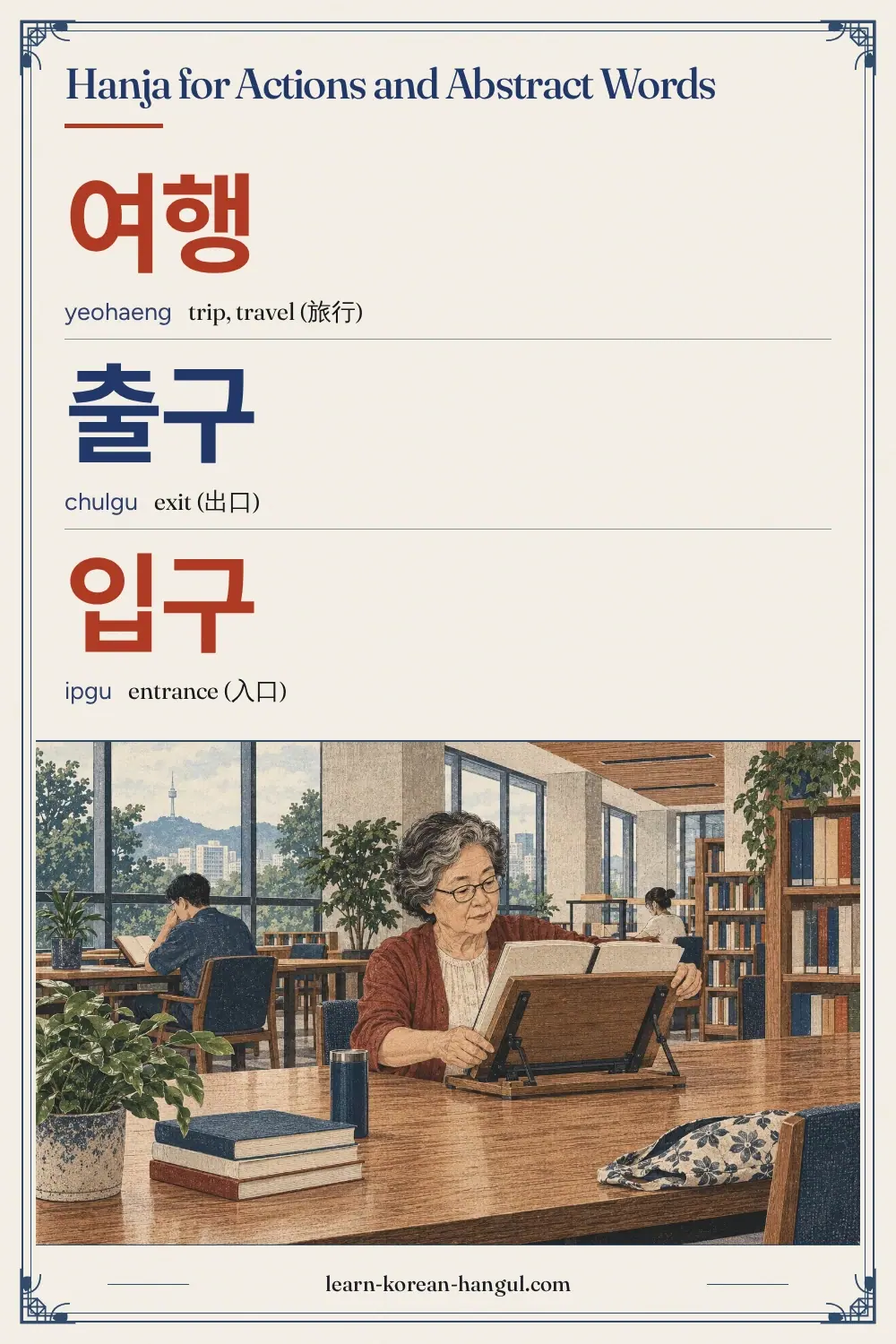
Hanja for Actions and Abstract Words: the Essentials
Each character below comes with its 음훈 (eumhun), the traditional label with a Korean meaning word and the sound. 行 is "다닐 행": "to go about" plus the reading 행. The reading is what you meet in vocabulary, because Sino-Korean words (한자어) join these syllables. The group splits into three sets: motion (行, 出, 入, 動), opposite pairs (有 and 無, 出 and 入) and abstract nouns and prefixes (事, 物, 不, 同). The table lists all ten with a Revised Romanization guide (RR) and one word each builds.
| Character | 음훈 (meaning word, sound) | Reading | RR | Core meaning | A word it builds |
|---|---|---|---|---|---|
| 行 | 다닐 행 | 행 | haeng | go, travel, do, firm | 여행 (旅行) |
| 出 | 날 출 | 출 | chul | go out, come out | 출구 (出口) |
| 入 | 들 입 | 입 | ip | enter, go in | 입구 (入口) |
| 事 | 일 사 | 사 | sa | matter, affair, work | 사실 (事實) |
| 物 | 물건 물 | 물 | mul | thing, object | 동물 (動物) |
| 不 | 아닐 불/부 | 불 (부 before ㄷ, ㅈ) | bul / bu | not, un- | 불안 (不安) |
| 無 | 없을 무 | 무 | mu | without, none | 무료 (無料) |
| 有 | 있을 유 | 유 | yu | have, exist | 유명 (有名) |
| 同 | 한가지 동 | 동 | dong | same, together | 동시 (同時) |
| 動 | 움직일 동 | 동 | dong | move, act | 운동 (運動) |
This group gives the most readable signs. 출구 and 입구 are on every station, 무료 and 유료 are on every app, and 은행 and 여행 are everyday words. The next section covers readings, then the words they build. The group is part of basic hanja, the 100 characters this site teaches in ten themes, and you can see where hanja still show up in daily Korea on does Korean use hanja.
How Do You Read Each Character?
Most characters here have one reading. The exceptions are 不 (불 or 부) and the crowded 동 sound. Watch the edges of the syllable too: a final ㅂ tenses a following ㄱ, final ㅂ before ㅎ becomes an aspirated sound, and a final consonant links to a following vowel. RR does not write tensing, and in nouns it keeps the h instead of writing the aspirated sound: 입학 is iphak.
| Character | Say it | RR | What to know about the reading |
|---|---|---|---|
| 行 | 행 | haeng | Reads 행 in all words here. |
| 出 | 출 | chul | Reads 출. Final ㄹ does not tense a following ㄱ: 출구, 출근. |
| 入 | 입 | ip | Final ㅂ tenses a following ㄱ: 입구 [입꾸]; before ㅎ it aspirates: 입학 [이팍]. |
| 事 | 사 | sa | Reads 사. Crowded sound: 社, 四, 死 are also 사. |
| 物 | 물 | mul | Reads 물. Not the native word 물 (water). |
| 不 | 불 (부 before ㄷ, ㅈ) | bul / bu | Reads 부 before ㄷ and ㅈ (부족), and 불 elsewhere (불안). |
| 無 | 무 | mu | Reads 무. Often the first part of a word: 무료, 무시. |
| 有 | 유 | yu | Reads 유. The opposite of 無. |
| 同 | 동 | dong | Reads 동. Crowded sound: 動, 東, 冬 are also 동. |
| 動 | 동 | dong | Reads 동. Not 同, which also reads 동. |
The big idea in this group is that a reading can have two forms (불 / 부) while two different characters can share one form (同 and 動). Both are normal. Hanja are not a one-to-one code, so the word is the unit of study.
Which Words Does Each Character Build?
The table collects every word on this page, with the spoken form where it differs from the spelling. 動 appears in 동물, 운동 and 이동, while 不, 無 and 有 each build two words.
| Word | Characters | RR | Spoken form | Meaning |
|---|---|---|---|---|
| 여행 | 旅行 | yeohaeng | as spelled | trip, travel |
| 은행 | 銀行 | eunhaeng | as spelled | bank |
| 출구 | 出口 | chulgu | as spelled | exit |
| 출근 | 出勤 | chulgeun | as spelled | going to work |
| 입구 | 入口 | ipgu | 입꾸 | entrance |
| 입학 | 入學 | iphak | 이팍 | entering a school |
| 사실 | 事實 | sasil | as spelled | fact, truth |
| 식사 | 食事 | siksa | 식싸 | meal |
| 동물 | 動物 | dongmul | as spelled | animal |
| 물건 | 物件 | mulgeon | 물껀 (common speech) | item, goods |
| 불안 | 不安 | buran | 부란 | anxiety, unease |
| 부족 | 不足 | bujok | as spelled | shortage, lack |
| 무료 | 無料 | muryo | as spelled | free of charge |
| 무시 | 無視 | musi | as spelled | ignoring, disregard |
| 유명 | 有名 | yumyeong | as spelled | famous |
| 유료 | 有料 | yuryo | as spelled | paid, charged |
| 동시 | 同時 | dongsi | as spelled | at the same time |
| 동료 | 同僚 | dongnyo | 동뇨 | colleague |
| 운동 | 運動 | undong | as spelled | exercise, movement |
| 이동 | 移動 | idong | as spelled | moving, transfer |
Where will you meet these words? Look for 출구 and 입구 on station signs and building doors, 무료 and 유료 on apps, parking lots and museum tickets, 은행 on street signs, and 불안, 부족 and 유명 in news and conversation. Real signs are the best practice, because the hanja are hidden but the meaning is plain once you know the parts. Below, each character has a short note and a listen button for its words.
行: 다닐 행
行 means to go, and from there to carry out and to do. 여행 (旅行) is "travel-go", a trip. 행동 (行動) combines going with moving, and means behaviour. In 은행 (銀行) the second character is a business house, the sense it has in Chinese: silver was the money standard, so a bank was a "silver firm". The same 行 appears in 행사 (行事, haengsa), an event. A rare second reading 항 appears in a few old words and is not needed for this group.
出: 날 출
出 means to go out or to come out. 출구 (出口) is an exit, "going-out mouth", and the sign you see in every station. 출근 (出勤) is going out to work, and its pair 퇴근 (退勤, toegeun) is leaving work. Another useful word is 외출 (外出, oechul), going out of the house. 날 in the 음훈 is the old sense of "to come out".
入: 들 입
入 means to enter, and 들 is the stem of the verb 들다 (to go in). 입구 (入口) is the entrance, the partner of 출구. 입학 (入學) is entering a school, with the 學 from the school group, and 입학식 is the opening ceremony. Another useful word is 입원 (入院, ibwon, being admitted to a hospital). Do not confuse 入 with 人 (person, 인): they look alike but have different strokes and sounds.
事: 일 사
事 means a matter, an affair or a task. 일 in the 음훈 is the native word for "work, matter". 사실 (事實) is a fact: "a matter that is real", with 實 meaning real or solid. 식사 (食事) is a meal, "food matter", and 식사하다 is the polite way to say you eat. The same 事 gives 사건 (事件, sageon, an incident) and 행사 (行事, an event).
物: 물건 물
物 is a thing or an object. 동물 (動物) is an animal, "a moving thing". 물건 (物件) is an item, the word you use for goods or belongings, and in everyday speech it is often said [물껀]. The syllable 물 here has nothing to do with the native Korean 물 (water). 식물 (植物, singmul, plant) and 건물 (建物, geonmul, building) are two more words in which 物 ends a compound.
不: 아닐 불/부
不 is a negative prefix, like "un-" in English. 불안 (不安) is "not at ease", anxiety, and 불편 (不便, bulpyeon) is "not convenient". The reading changes before ㄷ and ㅈ: 부족 (不足) is "not enough", and 부동산 (不動産, budongsan) is real estate, literally "property that does not move". The final ㄹ of 불 links to the vowel in 불안 [부란].
無: 없을 무
無 means without or nothing. 무료 (無料) is "without charge", free. 무시 (無視) is "without looking", to ignore something, and 무시하다 is the verb. Other words include 무관심 (無關心, mugwansim, lack of interest) and 무한 (無限, muhan, unlimited). There is a separate word 무료 (無聊) meaning bored, written with different characters, so check the context.
有: 있을 유
有 means to have or to exist. 유명 (有名) is "having a name", famous, and 유명하다 is the adjective. 유료 (有料) is "with a charge", paid, the opposite of 무료. 유무 (有無, yumu) is "existence or absence", as in 경험 유무 (whether you have experience). A good pair to remember: 有 / 無.
同: 한가지 동
同 means same or together. 한가지 is an old word for "one kind", so the 음훈 means "of one kind". 동시 (同時) is "same time", simultaneous, and 동료 (同僚) is a co-worker, said [동뇨] because ㄹ after ㅇ becomes ㄴ. 동생 (同生, dongsaeng) is a younger sibling: someone "born with" you in the family. 동 is crowded with other characters, including 動, 東 (east) and 冬 (winter).
動: 움직일 동
動 means to move. 운동 (運動) is exercise, built from 運 (carry, move) and 動 (move), and 운동하다 is the verb to work out. 이동 (移動) is moving from one place to another, as in 이동 시간 (travel time). The same character gives 행동 (behaviour) and 동물 (animal), "moving thing". It has the 力 (power) radical in it, a reminder that moving takes strength.
What Reading or Spelling Traps Should You Know?
Four points catch learners in this group.
Rule box
- 不 is 부 before ㄷ and ㅈ, and 불 elsewhere. 부족 (不足), 부동산 (不動産) but 불안 (不安), 불편 (不便), 불가능 (不可能). A few words have their own forms, so check a dictionary if a word looks odd.
- Opposites come in pairs. 出口 / 入口 (exit / entrance), 有料 / 無料 (paid / free), 有名 / 無名 (famous / unknown).
- 同 and 動 both read 동. 同 is same, 動 is move. 동시 is 同時, "same time"; 운동 is 運動, "movement".
- 物 is not water. The 물 in 동물 is 物; the native word 물 (water) is unrelated.
| Spelling | Spoken form | What happens |
|---|---|---|
| 입구 | [입꾸] | ㅂ before ㄱ: the ㄱ is tense |
| 입학 | [이팍] | ㅂ links to ㅎ and the sound is aspirated |
| 불안 | [부란] | final ㄹ links to ㅇ |
| 식사 | [식싸] | ㄱ before ㅅ: the ㅅ is tense |
| 물건 | [물껀] | the ㄱ of 건 is often tense in speech |
| 동료 | [동뇨] | ㄹ after ㅇ becomes ㄴ |
In RR, 입학 is written iphak, because nouns keep the h, and the table's spoken form is [이팍]. Also, 出 is read 출 but 퇴 is 退 (retreat), a different character, so 출근 and 퇴근 are a pair of opposites made from different first characters.
Practice This Group
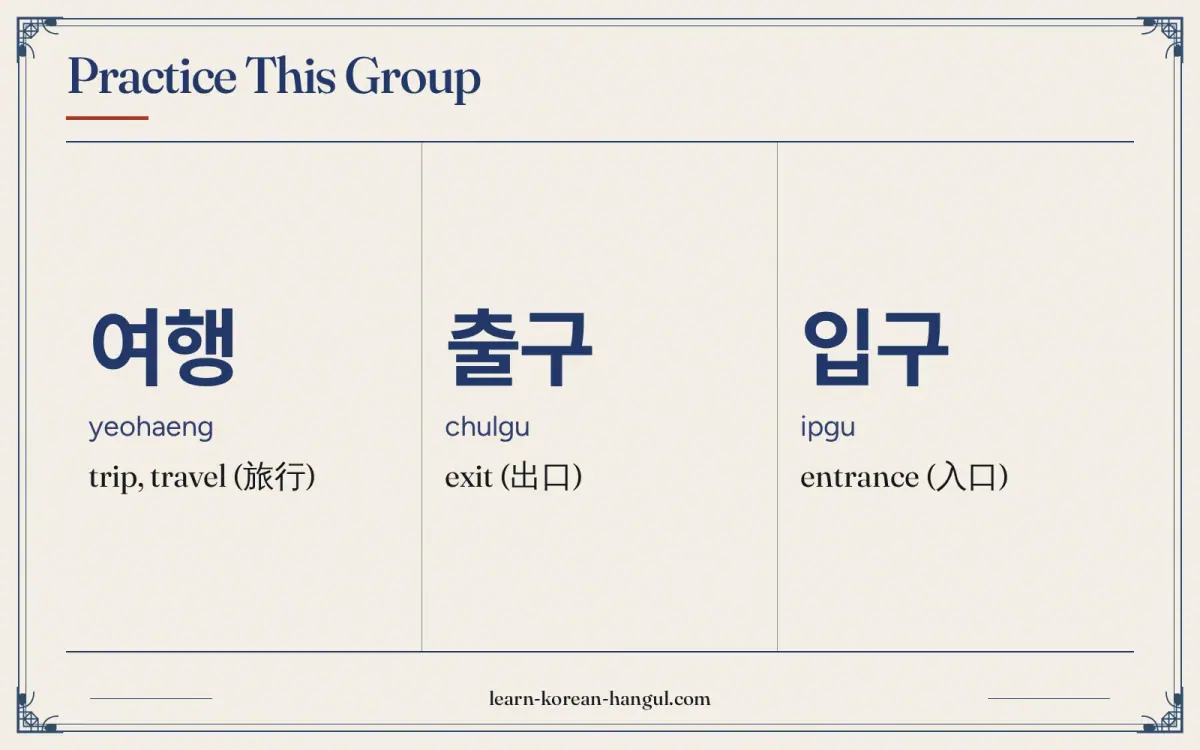
Practice in two steps. First, go through the ten flashcards, one word for each character. Say the word aloud before you reveal the meaning. The table lists every card.
| Korean | RR | Meaning | Characters |
|---|---|---|---|
| 여행 | yeohaeng | trip, travel | 旅行 |
| 출구 | chulgu | exit | 出口 |
| 입구 | ipgu | entrance | 入口 |
| 사실 | sasil | fact, truth | 事實 |
| 동물 | dongmul | animal | 動物 |
| 불안 | buran | anxiety, unease | 不安 |
| 무료 | muryo | free of charge | 無料 |
| 유명 | yumyeong | famous | 有名 |
| 동시 | dongsi | at the same time | 同時 |
| 운동 | undong | exercise, movement | 運動 |
Practice · 10
- 01여행
Show answer
yeohaeng
trip, travel (旅行)
- 02출구
Show answer
chulgu
exit (出口)
- 03입구
Show answer
ipgu
entrance (入口)
- 04사실
Show answer
sasil
fact, truth (事實)
- 05동물
Show answer
dongmul
animal (動物)
- 06불안
Show answer
buran
anxiety, unease (不安)
- 07무료
Show answer
muryo
free of charge (無料)
- 08유명
Show answer
yumyeong
famous (有名)
- 09동시
Show answer
dongsi
at the same time (同時)
- 10운동
Show answer
undong
exercise, movement (運動)
Then check yourself with six questions.
Practice · 6
Which word means "free of charge"?
Show answer
무료
無料 is without charge, free. 有料 is paid.
How is 不足 (shortage) read?
Show answer
부족
不 is read 부 before ㅈ, so 不足 is 부족.
Which word means "entrance"?
Show answer
입구
入口 is the entrance. 出口 (출구) is the exit.
Which word means "bank"?
Show answer
은행
銀行 (은행) is a bank. 旅行 is a trip, 行動 is behaviour and 運動 is exercise.
Which two characters make 動物 (animal)?
Show answer
動 and 物
動 is move and 物 is thing. 同 is a different character that is also read 동.
What does 同時 (동시) mean?
Show answer
at the same time
同 is same and 時 is time, so 同時 is at the same time.
What to Learn Next
You now have ten characters and 20 words. Revisit the word table every day for a week and use the flashcards for testing. This is the last of the ten groups, and common hanja characters puts all 100 in one table. To review, hanja for time adds 年, 前 and 後 (오전, 오후, 식사 후), and hanja for school and learning explains the 學 of 입학. The basic hanja hub has the map of all ten groups, and hanja for country and society covers the places where these actions happen.
Frequently Asked Questions
When is 不 read 부?
Before ㄷ and ㅈ. So 不足 is 부족 and 不動産 is 부동산, but 不安 is 불안 and 不便 is 불편. The rule is part of Korean spelling and is based on how the word is pronounced. A few words are exceptions, so check the dictionary entry when a word with 不 does not follow the pattern.
What is the difference between 有料 and 無料?
有料 (유료, yuryo) means paid or with a charge, and 無料 (무료, muryo) means free of charge. They are opposites built on 有 (have) and 無 (without), with the same 料 (fee, material). You will see them on parking lots, museums and apps. Say them aloud to hear that only the first syllable changes.
Are 同 and 動 both 동?
Yes. 同 means same or together, and 動 means move. They have different shapes and different meanings, but the same reading. The word around them shows which is meant: 동시 is 同時 (same time) and 운동 is 運動 (movement). The character 東 (east) is also read 동, as is 冬 (winter).
What is 銀行?
銀行 (은행, eunhaeng) is a bank. 銀 means silver and 行 means a business house or firm, so a bank was first a "silver firm", from the time when silver served as money. The word is used in Korea, China and Japan with the same characters.
Does 無料 always mean free?
Mostly yes: 무료 (無料) is the sign for free admission, free delivery and free use. Another word 무료 (無聊) means bored, as in 무료하다, but it is written with different characters and is much less common in daily talk.