Hanja for School and Learning: the Essentials
Each character below comes with its 음훈 (eumhun), the traditional Korean label for a hanja. It has two parts: a Korean word for the meaning, then the sound. So 學 is "배울 학": "to learn" and the reading 학. Korean dictionaries and school books use this format, which is why it appears here. The reading is the part you will meet in vocabulary, because Sino-Korean words (한자어) are built by joining these syllables. The table lists all ten in the order the characters were chosen for this group, with a Revised Romanization guide (RR) and one word each builds.
| Character | 음훈 (meaning word, sound) | Reading | RR | Core meaning | A word it builds |
|---|---|---|---|---|---|
| 學 | 배울 학 | 학 | hak | learn, study | 학교 (學校) |
| 校 | 학교 교 | 교 | gyo | school (the institution) | 학교 (學校) |
| 敎 | 가르칠 교 | 교 | gyo | teach | 교실 (敎室) |
| 書 | 글 서 | 서 | seo | writing, book | 도서관 (圖書館) |
| 文 | 글월 문 | 문 | mun | writing, sentence, culture | 문학 (文學) |
| 字 | 글자 자 | 자 | ja | written character, letter | 한자 (漢字) |
| 語 | 말씀 어 | 어 | eo | language, words | 국어 (國語) |
| 先 | 먼저 선 | 선 | seon | first, earlier, before | 선생 (先生) |
| 生 | 날 생 | 생 | saeng | be born, live, raw | 생일 (生日) |
| 讀 | 읽을 독 | 독 | dok | read | 독서 (讀書) |
Notice how often the same syllable appears. 교 is used twice (校 and 敎), and 學 and 生 both sit inside 학생. That overlap is a feature: when you meet 학교, 교실 and 교사 you can see why they feel related. The next section covers how to read each character, then the words they build. The group is part of basic hanja, the 100 characters this site teaches in ten themes, and the wider picture of where hanja are used is on does Korean use hanja.
How Do You Read Each Character?
Every character in this set has a single main Korean reading, so reading them is easier than in some other groups. The only things that change are sounds at the edges of the syllable, where Korean pronunciation rules apply: final ㄱ tenses a following consonant, and a final consonant moves onto a following vowel. RR follows the spoken sound for linking but does not write tensing, so the bracketed forms below show what you will actually hear.
| Character | Say it | RR | What to know about the reading |
|---|---|---|---|
| 學 | 학 | hak | Final ㄱ tenses the next consonant: 학교 [학꾜], 학생 [학쌩]. |
| 校 | 교 | gyo | Always 교. Ends many school names: 대학교 [대학꾜]. |
| 敎 | 교 | gyo | Same sound as 校. 교실 [교실], 교사 [교사]. |
| 書 | 서 | seo | Reads 서 in every word here. 독서 [독써] tenses after ㄱ. |
| 文 | 문 | mun | Sounds the same as 門 (gate) and 問 (ask). |
| 字 | 자 | ja | Reads 자. In 한자 the first syllable is 漢, a different character. |
| 語 | 어 | eo | Links to the next syllable: 국어 [구거], 외국어 [외구거]. |
| 先 | 선 | seon | Reads 선 in every word. 선배 [선배]. |
| 生 | 생 | saeng | Always 생. The ㅅ after a final ㄱ tenses: 학생 [학쌩]. |
| 讀 | 독 | dok | Final ㄱ tenses the next sound: 독서 [독써], 독자 [독짜]. |
Two of the readings are shared: 校 and 敎 are both 교, and 文 is one of several characters read 문. When two characters sound the same, the word around them decides which one you mean. That is the main skill hanja study builds, and it is why this page teaches characters inside words, not alone.
Which Words Does Each Character Build?
The table collects every word used on this page. Characters shown twice, such as 學 and 生 in 學生, are the shared parts to look for. The "spoken form" column shows the pronunciation in brackets where it differs from the spelling.
| Word | Characters | RR | Spoken form | Meaning |
|---|---|---|---|---|
| 학교 | 學校 | hakgyo | 학꾜 | school |
| 학생 | 學生 | haksaeng | 학쌩 | student |
| 교장 | 校長 | gyojang | as spelled | principal, head of a school |
| 교실 | 敎室 | gyosil | as spelled | classroom |
| 교사 | 敎師 | gyosa | as spelled | teacher (a job title) |
| 도서관 | 圖書館 | doseogwan | as spelled | library |
| 서점 | 書店 | seojeom | as spelled | bookstore |
| 문학 | 文學 | munhak | as spelled | literature |
| 문장 | 文章 | munjang | as spelled | sentence |
| 한자 | 漢字 | hanja | as spelled | hanja, Chinese characters |
| 문자 | 文字 | munja | as spelled | letters, writing; also a text message |
| 국어 | 國語 | gugeo | 구거 | Korean as a school subject; "national language" |
| 영어 | 英語 | yeongeo | as spelled | English |
| 선생 | 先生 | seonsaeng | as spelled | teacher |
| 선배 | 先輩 | seonbae | as spelled | senior (at school or work) |
| 생일 | 生日 | saengil | as spelled | birthday |
| 생활 | 生活 | saenghwal | as spelled | daily life |
| 독서 | 讀書 | dokseo | 독써 | reading (books) |
| 독자 | 讀者 | dokja | 독짜 | reader |
Below, each character gets a short note and a listen button for its words. Where a word has already appeared under an earlier character, it is not repeated.
學: 배울 학
學 is the most productive character in this set. It opens 학교 and 학생, and it also works as the ending -학, meaning "the study of", as in 언어학 (eoneohak, linguistics). The final ㄱ of 학 tenses the next consonant, so 학교 sounds like [학꾜] and 학생 like [학쌩]. Korean dictionaries print the traditional form 學; Japan and mainland China print 学. The whole family has its own page: hanja 學 and its word family.
校: 학교 교
The 음훈 of 校 is 학교 교, which defines the character with the very word it builds. In a dictionary the left part 木 (tree) is the radical, so 校 is filed under 木. Look for 校 at the end of school names: 대학교 (daehakgyo, university), 초등학교 (elementary school) and 고등학교 (high school). A person who runs the school is the 교장 (校長), where 長 means "head".
敎: 가르칠 교
敎 means "teach", and it shares the sound 교 with 校 (school). It opens 교과서 (敎科書, gyogwaseo, textbook), a "teaching-subject book". 교실 (敎室) is "teaching room", the classroom, and 교사 (敎師) is the formal word for a teacher as a profession. The shape 教 also exists as a variant; see the traps section for which one to expect.
書: 글 서
書 covers "to write", "writing" and "book". In 도서관 (圖書館) the three parts are 圖 (picture, plan), 書 (book) and 館 (hall), so a library is a "picture-book hall". In 서점 (書店) the second character 店 means "shop", so the word is a "book shop". 書 also hides inside 교과서 (textbook) and 독서 (reading). Everyday Korean uses the native word 책 for a book, so 書 shows up mostly in compound words.
文: 글월 문
文 is writing as a body of text. 글월 is an old Korean word for a piece of writing, now heard mainly in this 음훈. Two useful words: 문학 (文學) joins "writing" and "study" to name literature, and 문장 (文章) is a written sentence. The same character gives 문화 (文化, munhwa, culture), with 化 "change", and it appears in the subject 한문 (漢文). Note that 문 is a very crowded sound: 門 (gate), 問 (ask) and 聞 (hear) are all read 문 as well.
字: 글자 자
字 is one written character. The word 한자 (漢字) is made of 漢 (the Han people, Chinese) and 字 (character), so the name of the subject you are studying means "Han characters". 문자 (文字) means letters or a writing system, and in everyday speech it also means a text message: 문자 보내다 is "to send a text". The daily word 글자 (geulja, letter) joins the native word 글 (writing) to 字, a mix of native and Sino-Korean parts.
語: 말씀 어
語 ends the names of languages: 영어 (English), 일본어 (Japanese), 중국어 (Chinese) and 한국어 (Korean). 말씀 is the polite form of 말 (speech), and in the 음훈 it simply means words or speech. 國語 (국어) is "national language". In Korean schools this is the name of the Korean-language subject, so a student who says 국어 숙제 means homework for Korean class. The final ㄱ of 국 links to the vowel of 어, so the word is said [구거].
先: 먼저 선
先 means first or earlier. 先生 (선생) is "born earlier", the Korean word for a teacher, and you add the honorific 님 to say 선생님 when you speak to or about one. 先輩 (선배) uses 輩 (a group of peers) and means someone who entered school or work before you. The opposite is 후배 (後輩), a junior, which uses 後 from the time group.
生: 날 생
生 has several meanings that all grow from "to be born": life, living, raw and fresh. 날 in the 음훈 is the modifier form of 나다, "to be born". In 생일 (生日) it is "birth day", and in 생활 (生活) it combines with 活 (lively) to mean the life you live every day. In 학생 and 선생 it ends up meaning a person: "a person who studies" and "a person born earlier".
讀: 읽을 독
讀 means "read". 독서 (讀書) is reading books as an activity, and a 독서실 is a quiet study room where students pay to study. 독자 (讀者) joins "read" and "person" to name a reader. 讀 also appears in 구독 (購讀, gudok), the word used for subscribing to a newspaper or channel. In two old terms it is read 두, as in 이두 (吏讀, idu), the historic system of writing Korean with Chinese characters. Learn 독 first and treat 두 as an exception.
What Reading or Spelling Traps Should You Know?
Four things catch learners in this group. Read the rule box first, then the table of spoken forms.
Rule box
- 校 and 敎 are different characters with the same reading. 校 is the school, 敎 is to teach. Read the whole word to know which.
- 敎 and 教 are the same character in two printed forms. Korean dictionaries and the Ministry of Education list print 敎. The shape 教 is a variant you may see in fonts, Japanese and Chinese texts. Meaning and reading are the same.
- Final ㄱ tenses the next consonant. After 學 and 讀 and 國, a following ㄱ, ㅅ or ㅈ sounds tense: 학교 [학꾜], 학생 [학쌩], 독서 [독써], 독자 [독짜].
- A final consonant links to a vowel. 국어 is said [구거], not [국어].
| Spelling | Spoken form | What happens |
|---|---|---|
| 학교 | [학꾜] | ㄱ before ㄱ tenses |
| 학생 | [학쌩] | ㄱ before ㅅ tenses |
| 독서 | [독써] | ㄱ before ㅅ tenses |
| 독자 | [독짜] | ㄱ before ㅈ tenses |
| 국어 | [구거] | final ㄱ links to ㅇ |
| 학년 | [항년] | ㄱ before ㄴ becomes ㅇ |
The last row is a bonus word: 학년 (學年, hangnyeon) means school year, and RR writes the nasal sound. Two more notes. First, 先生 on its own is a plain teacher, while 선생님 is the polite form you say to them. Second, 書 is the character in 서점, but the everyday word for "book" is the native 책, so do not expect to see 書 alone.
Practice This Group
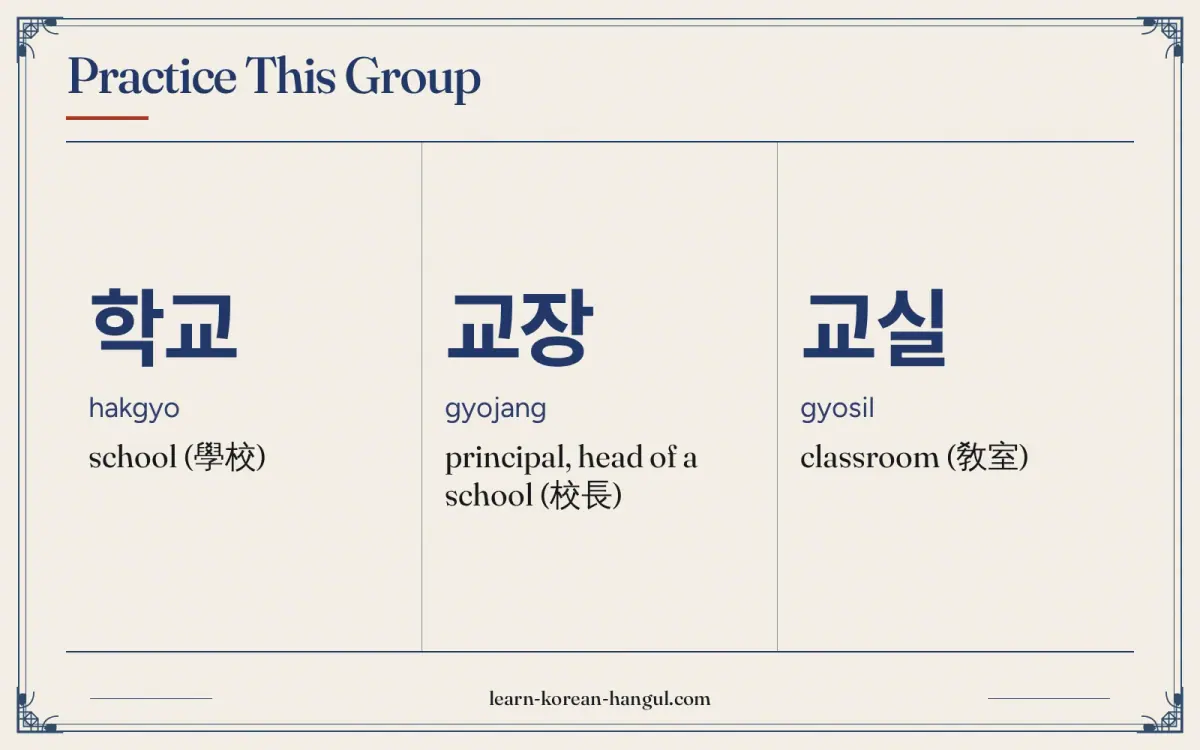
Practice in two steps. First, flip through the ten flashcards, which pair one word with each character. Say the word out loud before you reveal it. The table below shows every card, so you can print or copy it.
| Korean | RR | Meaning | Characters |
|---|---|---|---|
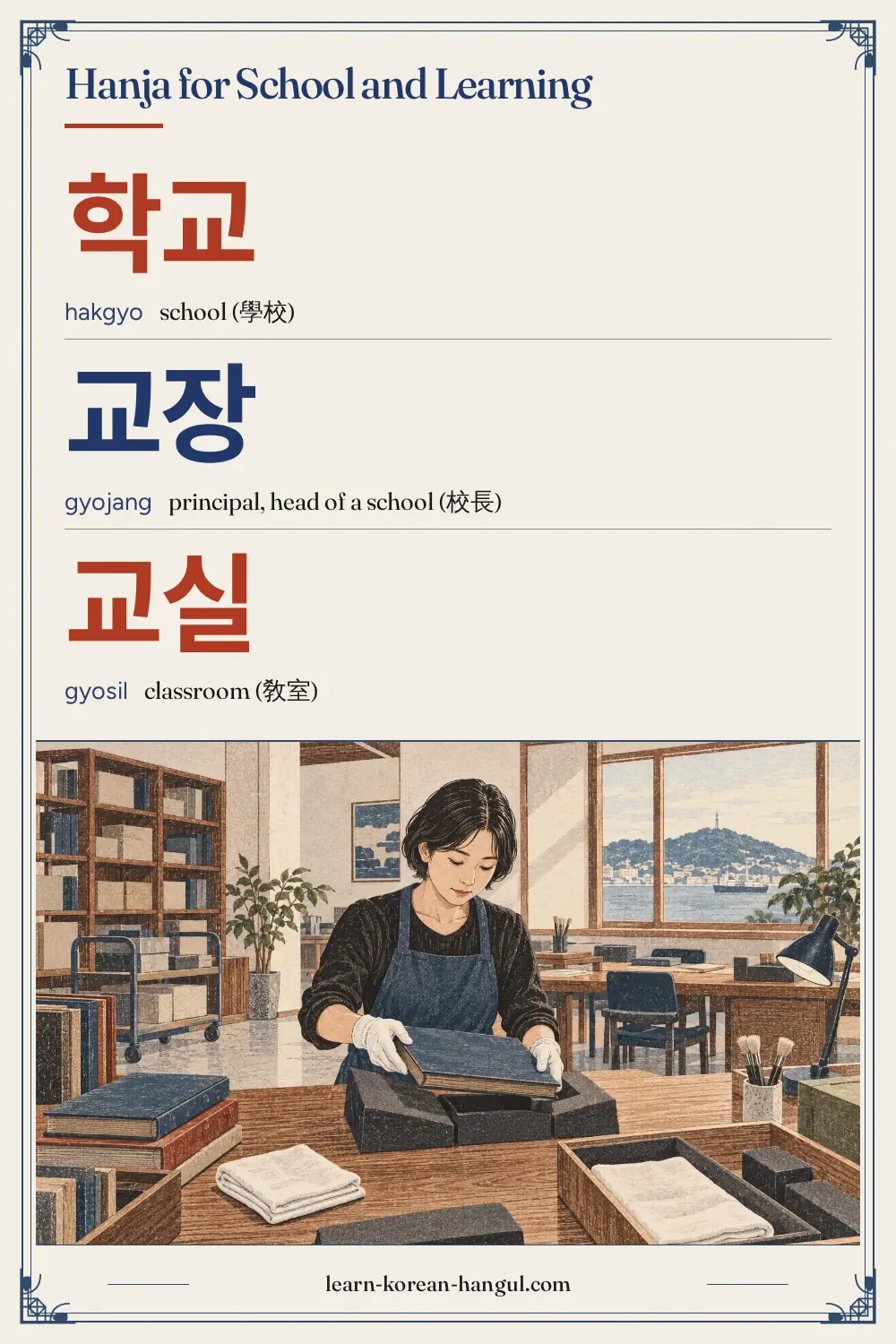
| 학교 | hakgyo | school | 學校 |
| 교장 | gyojang | principal, head of a school | 校長 |
| 교실 | gyosil | classroom | 敎室 |
| 도서관 | doseogwan | library | 圖書館 |
| 문학 | munhak | literature | 文學 |
| 한자 | hanja | hanja, Chinese characters | 漢字 |
| 국어 | gugeo | Korean as a school subject; "national language" | 國語 |
| 선생 | seonsaeng | teacher | 先生 |
| 생일 | saengil | birthday | 生日 |
| 독서 | dokseo | reading (books) | 讀書 |
Practice · 10
- 01학교
Show answer
hakgyo
school (學校)
- 02교장
Show answer
gyojang
principal, head of a school (校長)
- 03교실
Show answer
gyosil
classroom (敎室)
- 04도서관
Show answer
doseogwan
library (圖書館)
- 05문학
Show answer
munhak
literature (文學)
- 06한자
Show answer
hanja
hanja, Chinese characters (漢字)
- 07국어
Show answer
gugeo
Korean as a school subject; "national language" (國語)
- 08선생
Show answer
seonsaeng
teacher (先生)
- 09생일
Show answer
saengil
birthday (生日)
- 10독서
Show answer
dokseo
reading (books) (讀書)
Then check yourself with six questions.
Practice · 6
What does 先生 (선생) mean when you read it character by character?
Show answer
born earlier
先 means earlier and 生 means born, so 先生 is "born earlier". 學生 is the one that means "study person".
Which character means "teach"?
Show answer
敎
敎 means teach. 校 is school, 讀 is read and 字 is a written character.
How is 학교 pronounced in standard Korean?
Show answer
[학꾜]
The final ㄱ of 학 tenses the next ㄱ, so the word is said [학꾜].
Which word contains 書 and means "library"?
Show answer
도서관
도서관 (圖書館) is a library. 서점 is a bookstore and 독서 is reading, and 국어 contains neither.
In 한자 (漢字), what does 字 mean?
Show answer
a written character
字 is one written character, so 漢字 means Han (Chinese) characters.
Which character ends language names such as 영어 and 국어?
Show answer
語
語 means language or words and ends the names of languages: 영어, 일본어, 한국어.
What to Learn Next
You now have ten characters and 19 words. To keep them, read the words aloud once a day for a week and test yourself with the flashcards. Then move to the next theme: hanja for country and society builds on 學 and 語 with words such as 사회 and 한국어, and hanja for time adds the year, clock and day-part words you use in every conversation. The full set of 100 is on 100 useful hanja, and the guide to how to learn hanja explains the method. The basic hanja hub is your map. If you want one character in depth, 學 has a complete family on hanja 學.
Frequently Asked Questions
Why is a teacher called 先生?
先 means earlier or first and 生 means to be born, so 先生 is literally "born earlier". The word treats a teacher as someone who came into the subject before you. In Korean you add the honorific 님 and say 선생님 when you speak to a teacher. The same two characters are also used in Japanese for a teacher, but in Chinese xiānsheng means Mr or sir, so the meaning of the same characters depends on the language.
Is 敎 the same as 教?
Yes. Both are the character for "teach", read 교 in Korean. Korean dictionaries and the Ministry of Education list of basic hanja print the shape 敎. The shape 教 is a variant found in some fonts and in Japanese and Chinese typography. You can treat them as one character with two printed forms.
What does 書 mean in 書店?
書 means book or writing, and 店 means shop. So 書店 (서점, seojeom) is a book shop, the Korean word for a bookstore. 書 appears in 도서관 (library) and 교과서 (textbook) with the same meaning of books and writing.
Which characters appear in school subject names?
語 appears in 국어 (Korean) and 영어 (English). 學 appears in 수학 (mathematics), 과학 (science) and 화학 (chemistry). 文 appears in 문학 (literature). The subject 한문 (classical Chinese) uses 文 as well. Once you know these three characters, many subject names explain themselves.
Do I need to write these characters by hand?
No. This page teaches recognition: seeing 學 and knowing it stands for 학 and "study". Handwriting is only needed for hanja tests and calligraphy, and it takes much longer. If you want to try, start with the simplest characters and learn the stroke order rules first.