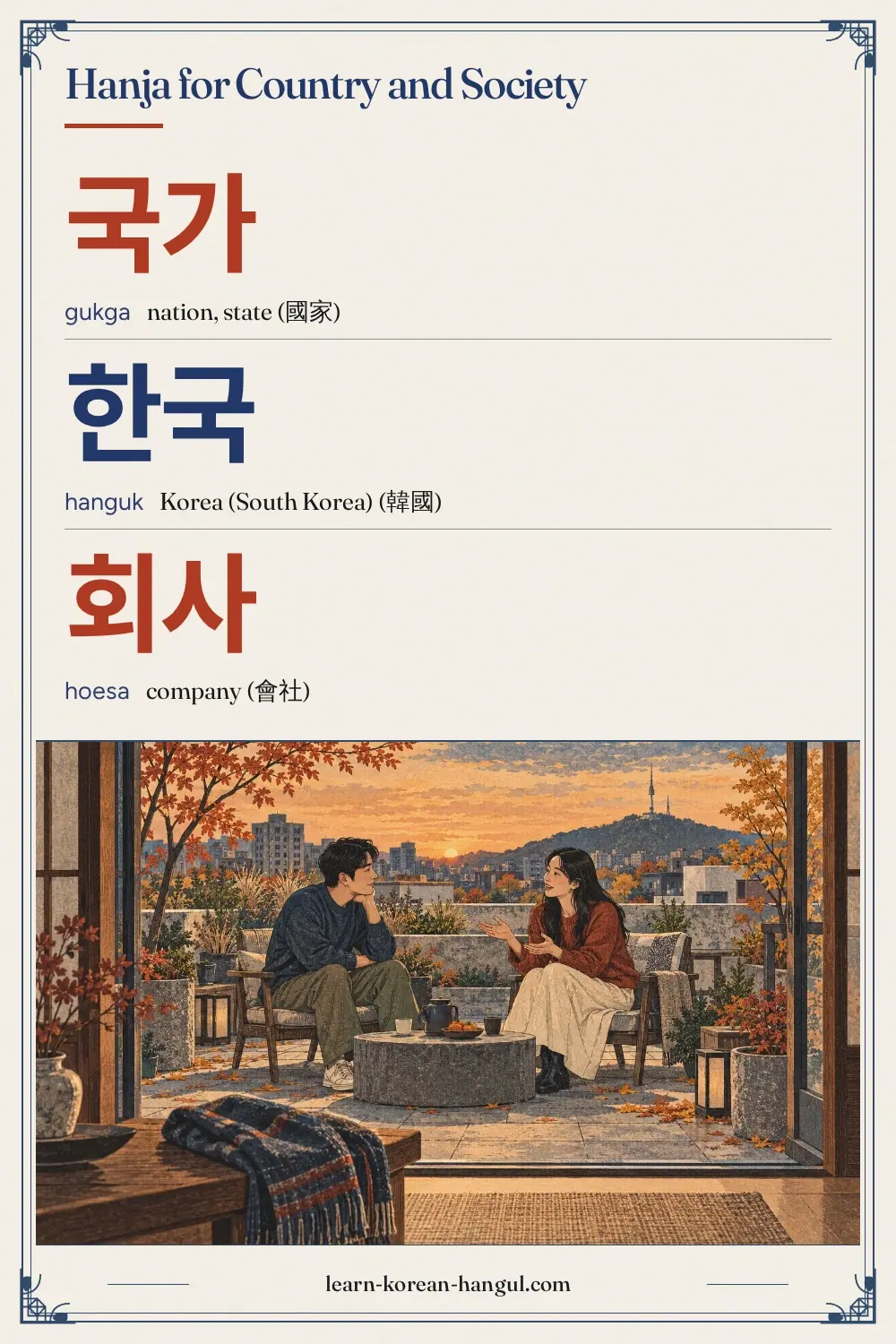
Hanja for Country and Society: the Essentials
Each character here is shown with its 음훈 (eumhun), the traditional label that pairs a Korean meaning word with the sound. 國 is "나라 국": "country" plus the reading 국. The reading is what you meet inside vocabulary, because Sino-Korean words (한자어) join these syllables. Most of the ten are about shared places and shared life: a nation, a company, a meeting, a park, a market, a city. The table gives all ten with a Revised Romanization guide (RR) and one word each builds.
| Character | 음훈 (meaning word, sound) | Reading | RR | Core meaning | A word it builds |
|---|---|---|---|---|---|
| 國 | 나라 국 | 국 | guk | country, nation | 국가 (國家) |
| 韓 | 나라 한 | 한 | han | Korea | 한국 (韓國) |
| 社 | 모일 사 | 사 | sa | company, society, group | 사장 (社長) |
| 會 | 모일 회 | 회 | hoe | meet, gathering, association | 회의 (會議) |
| 公 | 공평할 공 | 공 | gong | public, fair | 공원 (公園) |
| 場 | 마당 장 | 장 | jang | place, open space | 시장 (市場) |
| 市 | 저자 시 | 시 | si | city, market | 도시 (都市) |
| 門 | 문 문 | 문 | mun | gate, door | 대문 (大門) |
| 世 | 인간 세 | 세 | se | world, age, generation | 세상 (世上) |
| 界 | 지경 계 | 계 | gye | boundary, realm | 세계 (世界) |
Two pairs in the table already look like twins. 國 and 韓 both have the meaning word 나라, "country", because both are used as country names, and 社 and 會 both mean "gather". The next section covers readings, then the words they build. This group is part of basic hanja, where the 100 characters are grouped in ten themes, and you can see where hanja are still visible in modern Korea on does Korean use hanja.
How Do You Read Each Character?
All ten characters have one main reading each, so there is nothing to choose between. The things to watch are the sounds around the syllable. A final ㄱ, as in 國, tenses a following ㄱ, and a final consonant moves onto a vowel that follows it. RR writes linked sounds as they are spoken but does not write tensing, so use the bracketed forms to hear the real word.
| Character | Say it | RR | What to know about the reading |
|---|---|---|---|
| 國 | 국 | guk | Final ㄱ tenses a following ㄱ: 국가 [국까]. Links to a vowel: 한국어 [한구거]. |
| 韓 | 한 | han | Reads 한. Not the same as 漢 in 한자, which is also 한. |
| 社 | 사 | sa | Reads 사. Same sound as 事, 四 and 死. |
| 會 | 회 | hoe | Reads 회. 회의 is [회의], and [훼이] is also standard: ㅚ may be said as [ㅞ], and 의 after the first syllable as [이]. |
| 公 | 공 | gong | Reads 공. Crowded sound: 工, 空 and 共 are also 공. |
| 場 | 장 | jang | Reads 장. Often a word ending: 운동장, 주차장, 공장. |
| 市 | 시 | si | Reads 시. Same sound as 時 (time). |
| 門 | 문 | mun | Reads 문. The 음훈 repeats because the Korean word 문 is this character. |
| 世 | 세 | se | Reads 세. Do not confuse with the native number 세 (three). |
| 界 | 계 | gye | Reads 계. [게] is also standard: 세계 [세계/세게]. |
Three readings are shared with other characters you will meet soon: 시 with 時 (time), 문 with 文 (writing) and 사 with 事 (matter). Treat every reading as a hint, not a proof. The word it sits in tells you which character is behind it.
Which Words Does Each Character Build?
The table lists every word on this page. Look at the "Characters" column to see how the ten pieces recombine. 市, 會 and 社 each appear in three words.
| Word | Characters | RR | Spoken form | Meaning |
|---|---|---|---|---|
| 국가 | 國家 | gukga | 국까 | nation, state |
| 외국 | 外國 | oeguk | as spelled | foreign country |
| 한국 | 韓國 | hanguk | as spelled | Korea (South Korea) |
| 한복 | 韓服 | hanbok | as spelled | traditional Korean clothing |
| 사장 | 社長 | sajang | as spelled | company president, boss |
| 회사 | 會社 | hoesa | as spelled | company |
| 회의 | 會議 | hoeui | as spelled | meeting |
| 사회 | 社會 | sahoe | as spelled | society |
| 공원 | 公園 | gongwon | as spelled | park |
| 공휴일 | 公休日 | gonghyuil | as spelled | public holiday |
| 시장 | 市場 | sijang | as spelled | market |
| 운동장 | 運動場 | undongjang | as spelled | sports ground, playing field |
| 도시 | 都市 | dosi | as spelled | city |
| 시청 | 市廳 | sicheong | as spelled | city hall |
| 대문 | 大門 | daemun | as spelled | front gate |
| 정문 | 正門 | jeongmun | as spelled | main gate |
| 세상 | 世上 | sesang | as spelled | world, the world around us |
| 세대 | 世代 | sedae | as spelled | generation |
| 세계 | 世界 | segye | as spelled | world |
| 한계 | 限界 | hangye | as spelled | limit |
Below, each character has a short note and a listen button for its words.
國: 나라 국
國 is the character for a country, and it ends the names of many: 한국 (Korea), 중국 (China), 미국 (the United States), 영국 (the United Kingdom). 국가 (國家) is the formal word for a nation or state, and the ㄱ after 국 is tense, so you hear [국까]. 외국 (外國) uses 外 (outside), so it is "outside country", a foreign country. In Korea and Taiwan the character is printed 國; in Japan and mainland China it is 国. Newspapers shorten the country names in this family to one character in headlines, as the page on does Korean use hanja shows.
韓: 나라 한
韓 is the character for Korea, and its 음훈 "나라 한" labels it simply as a country name. 한국 (韓國) is the name South Korea uses for itself. 한복 (韓服) is "Korean clothing", the traditional dress, and the same 韓 begins 한식 (韓食, hansik, Korean food). The name goes back to the Samhan (三韓), three early groups of communities in the south of the Korean peninsula, and the name Daehan (大韓) was adopted by the Korean Empire in 1897 and is still used in the official name of the country.
社: 모일 사
社 appears in company words. 사장 (社長) is the head of a company, and 사장님 is how employees address a boss. 회사 (會社) is a company. In older Chinese, 社 was an altar to the god of the land, and people gathered at it, which is why the 음훈 is "모일", gather. Its parts are 示 (altar) and 土 (earth). The same 사 also stands for 事 (matter), 四 (four) and 死 (death), so context matters.
會: 모일 회
會 is gathering. 회의 (會議) is a meeting: "gathering discussion", with 議 meaning discuss. 사회 (社會) is society, the community of people who gather. 會 also gives 회원 (會員, member), 회식 (會食, a staff dinner after work) and 회화 (會話, conversation). Japan and mainland China print the shape 会. Korea prints 會.
公: 공평할 공
公 means public, shared and fair, the opposite of private. A 공원 (公園) is a public garden, the Korean word for a park. A 공휴일 (公休日) is a "public rest day", an official holiday. You will also see 公 in 공무원 (公務員, civil servant) and 공공장소 (公共場所, public place). The reading 공 is shared with 工 (work, as in 공부 工夫), 空 (empty, as in 공기 空氣) and 共 (together).
場: 마당 장
場 is a place where something happens, and 마당 is the native word for a yard. In Korean words it works as an ending that means "place for": 운동장 (運動場, sports ground), 주차장 (駐車場, parking lot) and 공장 (工場, factory). 시장 (市場) is a market, "city place". The place word 장소 (場所, jangso) is itself built from 場.
市: 저자 시
市 means a city or a market. 저자 is an old word for a market place, and the character first meant market before it came to mean city. 도시 (都市) is a city. 시청 (市廳) is a city hall, and Seoul City Hall is a landmark with a station named after it. In place names 市 follows the city name as a unit: 서울시 (Seoul-si, the city of Seoul). 시 is also the reading of 時 from the time group.
門: 문 문
門 is both the meaning and the sound: the everyday word 문 for a door is this character, which is why the 음훈 reads "문 문". 대문 (大門) is a big gate, the front gate of a house. 정문 (正門) is a main gate, such as the gate at the front of a school or a company. In Seoul the old city gate commonly called 남대문 (Namdaemun, "great south gate") has the official name 숭례문 (Sungnyemun, [숭녜문]).
世: 인간 세
世 means a generation or an age, and from that, the human world. 세상 (世上) is the world as people live in it, and it is the word in 세상에! ("my goodness", literally "in the world!"). 세대 (世代) is a generation. The syllable 세 is crowded: it is also the native Korean number three, as in 세 시 (three o'clock), and 歲 in 이십 세 (age twenty). They are different words that happen to sound alike.
界: 지경 계
界 is a boundary or a realm, and 지경 is an old word for a border. 世界 (세계) is the standard word for the world as the whole globe: "ages plus boundaries". 한계 (限界) means a limit, from 限 (limit) plus 界 (boundary), and it appears in phrases such as 한계가 있다 (there is a limit). Compare 세상, which is the world of human life, with 세계, which is the planet or the world in a large sense.
What Reading or Spelling Traps Should You Know?
Learners most often slip on the next four points.
Rule box
- 社會 and 會社 are different words. 사회 is society, 회사 is a company. The characters swap places and the meaning changes.
- 市場 and 市長 are both 시장. One is a market and the other is a mayor. The sentence tells you which: 시장에 가요 (I go to the market) against 시장님 (Mr Mayor).
- 韓 and 漢 are both 한. 韓 is Korea. 漢 is the Han people, as in 한자 (漢字), the word for hanja itself.
- Final ㄱ tenses the next consonant, and links to vowels. 국가 is said [국까], and 한국어 is said [한구거].
| Spelling | Spoken form | What happens |
|---|---|---|
| 국가 | [국까] | ㄱ before ㄱ tenses |
| 한국어 | [한구거] | final ㄱ links to ㅇ |
| 외국어 | [외구거] | final ㄱ links to ㅇ |
| 숭례문 | [숭녜문] | ㄹ after ㅇ becomes ㄴ |
| 세계 | [세계] or [세게] | ㅖ may be said as ㅔ |
One more point: 大韓民國 (대한민국, daehanminguk) has four characters, 大 (big), 韓 (Korea), 民 (people) and 國 (country). Two of them, 韓 and 國, are in this set. 大 comes from the size and quantity group and 民 from the people and family group, so the full name is a good test once you have covered those groups.
Practice This Group
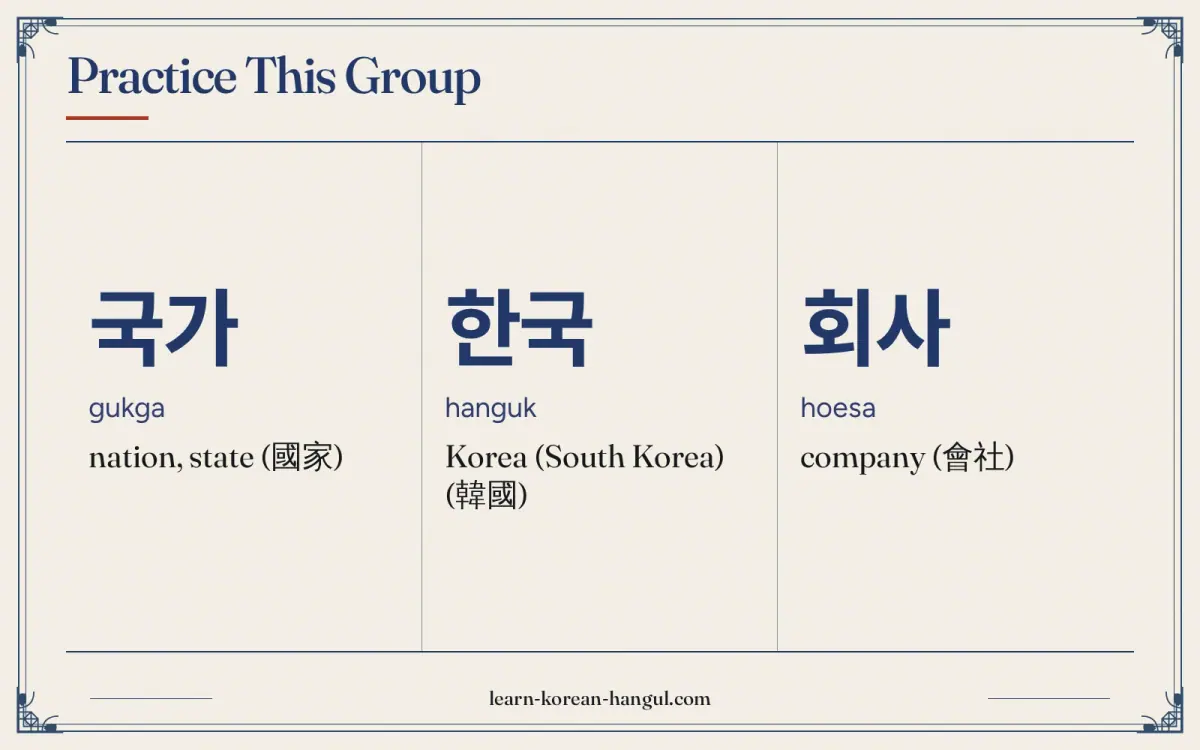
Practice in two steps. First, go through the ten flashcards, one word for each character. Say the Korean aloud before you reveal the meaning. The table lists every card.
| Korean | RR | Meaning | Characters |
|---|---|---|---|
| 국가 | gukga | nation, state | 國家 |
| 한국 | hanguk | Korea (South Korea) | 韓國 |
| 회사 | hoesa | company | 會社 |
| 회의 | hoeui | meeting | 會議 |
| 공원 | gongwon | park | 公園 |
| 시장 | sijang | market | 市場 |
| 도시 | dosi | city | 都市 |
| 대문 | daemun | front gate | 大門 |
| 세상 | sesang | world, the world around us | 世上 |
| 세계 | segye | world | 世界 |
Practice · 10
- 01국가
Show answer
gukga
nation, state (國家)
- 02한국
Show answer
hanguk
Korea (South Korea) (韓國)
- 03회사
Show answer
hoesa
company (會社)
- 04회의
Show answer
hoeui
meeting (會議)
- 05공원
Show answer
gongwon
park (公園)
- 06시장
Show answer
sijang
market (市場)
- 07도시
Show answer
dosi
city (都市)
- 08대문
Show answer
daemun
front gate (大門)
- 09세상
Show answer
sesang
world, the world around us (世上)
- 10세계
Show answer
segye
world (世界)
Then check yourself with six questions.
Practice · 6
Which word means "company"?
Show answer
회사
會社 is a company. The reversed order 社會 is society.
Which two characters make up 한국 (韓國)?
Show answer
韓 and 國
韓國 is 韓 (Korea) plus 國 (country). 漢 is the Han in 漢字, a different character.
How is 국가 pronounced?
Show answer
[국까]
Final ㄱ tenses the following ㄱ, so the word is said [국까].
Which pair of characters is in 大韓民國 and in this set?
Show answer
韓 and 國
大韓民國 contains 大, 韓, 民 and 國. Of those, 韓 and 國 belong to this set.
In the Seoul gate name 남대문, which character means "gate"?
Show answer
門
南大門 is South + Great + Gate. 門 is the gate. 南 is south and 大 is big.
What does 市場 (시장) mean?
Show answer
a market
市場 is a market, "city place". The mayor is 市長, also said 시장.
What to Learn Next
You now have ten characters and 20 words. Re-read the word table once a day for a week, then test yourself with the flashcards. Next, hanja for time covers the year, clock and day-part words, and hanja for actions and abstract words completes the 100 with signs such as 출구 and 무료. If you skipped it, hanja for school and learning adds 學, 校 and 語, which sit inside 한국어 and 대학교. The basic hanja hub has the full map of the ten groups. If you want to look characters up in a dictionary, the guide to Korean hanja lookup shows how.
Frequently Asked Questions
What is the difference between 社會 and 會社?
They use the same two characters in reverse order. 社會 (사회, sahoe) is society, the community of people. 會社 (회사, hoesa) is a company, a business. The order matters: swapping the characters gives a different word, so learn each word as a whole. Say them aloud once each and the sounds will separate them.
Why does 韓國 use 韓?
韓 is the character used for Korea. It goes back to the Samhan (三韓), three early groups in the south of the peninsula. The name Daehan (大韓) was taken up by the Korean Empire in 1897, and the Republic of Korea still uses it in its official name, 대한민국. Do not confuse 韓 with 漢, the Han of 漢字, which is also read 한.
Which characters are in 大韓民國?
Four: 大 (big, great), 韓 (Korea), 民 (people) and 國 (country). Together they make 대한민국, the official name of South Korea, which means roughly the "great Han people's country". Two of the four, 韓 and 國, belong to this set. The other two are taught in the size and people groups of basic hanja.
What is 世界 made of?
世 means an age or generation and the human world, and 界 means a boundary or realm. Together 世界 (세계) is the world as a whole, the globe and all people in it. Compare 세상 (世上), which is the world of everyday human life.
Is 市場 the same as 市長?
No. They are written differently, but both are said 시장. 市場 is a market, with 場 meaning place. 市長 is a mayor, with 長 meaning head. A sentence nearly always makes the meaning clear: 시장에서 사과를 샀어요 is about buying apples at a market.