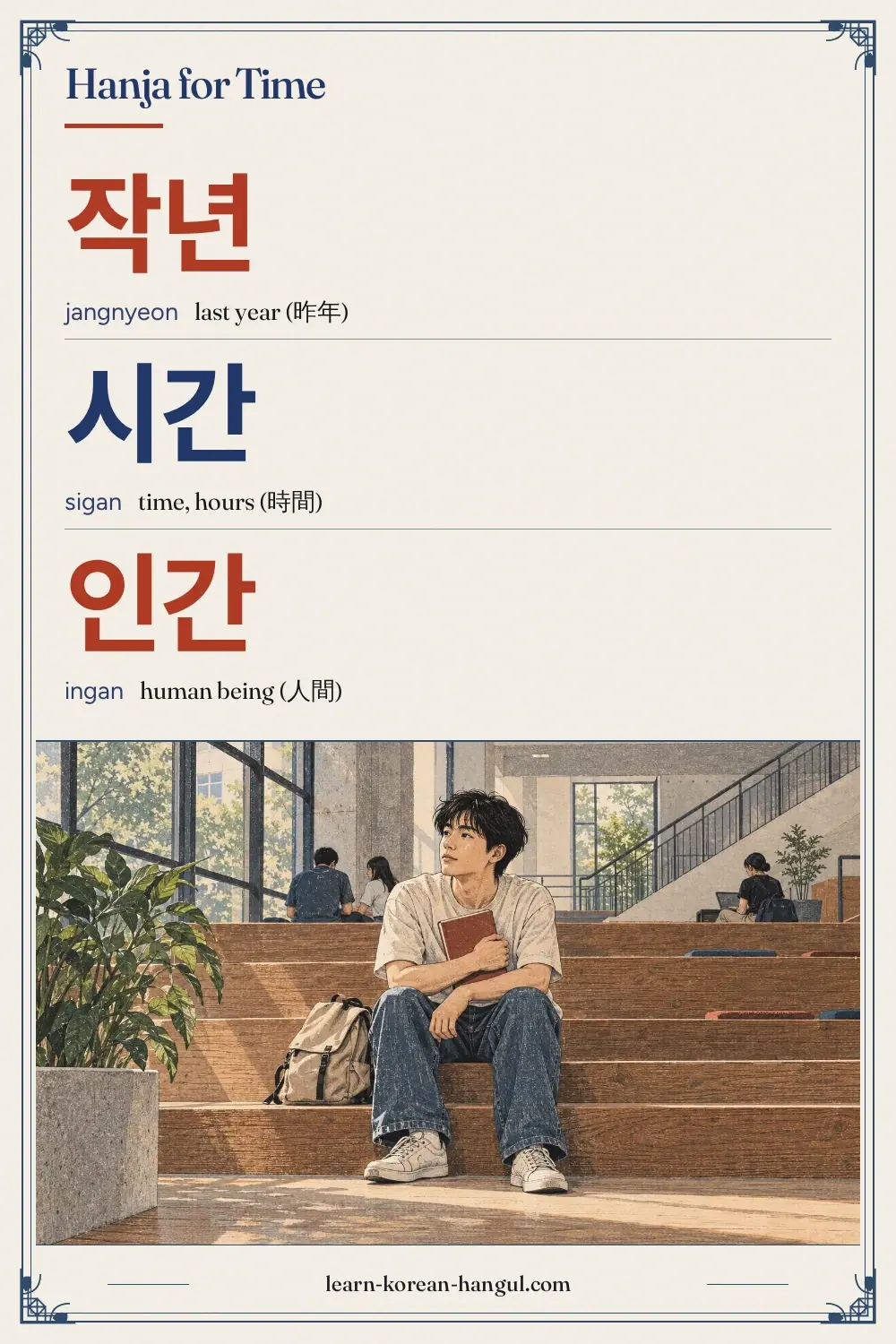
Hanja for Time: the Essentials
Each character below comes with its 음훈 (eumhun), the traditional label made of a Korean meaning word and the sound. 時 is "때 시": "time" plus the reading 시. The reading is what you meet inside vocabulary, because Sino-Korean words (한자어) join these syllables. The group falls into three small families: units of time (年, 時, 間), positions in time (今, 前, 後, 午, 夜) and quality of time (新, 古). The table lists all ten with a Revised Romanization guide (RR) and one word each builds.
| Character | 음훈 (meaning word, sound) | Reading | RR | Core meaning | A word it builds |
|---|---|---|---|---|---|
| 年 | 해 년 | 년 (연 at the start of a word) | nyeon / yeon | year | 작년 (昨年) |
| 時 | 때 시 | 시 | si | time, hour | 시간 (時間) |
| 間 | 사이 간 | 간 | gan | space between, interval | 인간 (人間) |
| 今 | 이제 금 | 금 | geum | now, the present | 금년 (今年) |
| 前 | 앞 전 | 전 | jeon | before, front | 오전 (午前) |
| 後 | 뒤 후 | 후 | hu | after, behind | 오후 (午後) |
| 午 | 낮 오 | 오 | o | noon, midday | 정오 (正午) |
| 夜 | 밤 야 | 야 | ya | night | 야경 (夜景) |
| 新 | 새 신 | 신 | sin | new | 신문 (新聞) |
| 古 | 예 고 | 고 | go | old, ancient | 고대 (古代) |
Notice how the pairs work. 前 and 後 are opposites, as are 新 and 古, and 午 splits the day into the morning and afternoon words. Once you know that structure, a new word such as 午前 or 以後 can be read at sight. The next section covers readings, then the words. This group belongs to basic hanja, the 100 characters this site teaches in ten themes, and the question of where hanja still appear in Korean life is on does Korean use hanja.
How Do You Read Each Character?
Nine of the ten characters have one reading each. The exception is 年, which changes between 년 and 연 depending on its position. Sound changes also happen at the edges of the syllable: a final ㄱ before ㄴ turns into ㅇ, and a final consonant moves onto a vowel that follows it. RR writes these sounds as spoken and does not write tensing, so the bracketed forms show what you hear.
| Character | Say it | RR | What to know about the reading |
|---|---|---|---|
| 年 | 년 (연 at the start of a word) | nyeon / yeon | Reads 연 at the start of a word (연말) and 년 elsewhere (작년 [장년], 삼 년). |
| 時 | 시 | si | Reads 시. Also the o'clock word: 세 시 (3:00). |
| 間 | 간 | gan | Reads 간. Sits at the end of 시간, 공간, 인간. |
| 今 | 금 | geum | Reads 금. 금년 is said [금년]. |
| 前 | 전 | jeon | Reads 전. After a noun it means before: 식사 전. |
| 後 | 후 | hu | Reads 후. After a noun it means after: 식사 후. |
| 午 | 오 | o | Reads 오. Not the number five (五), which is also 오. |
| 夜 | 야 | ya | Reads 야. 야식 is said [야식]. |
| 新 | 신 | sin | Reads 신. 신입생 is said [시닙쌩]. |
| 古 | 고 | go | Reads 고. Sounds like 高 (tall) and 苦 (bitter). |
The one rule worth memorising is the initial sound rule. In Sino-Korean words, a syllable that would begin with 녀 is spelled 여 at the start of a word, which is why 年末 is 연말 but 昨年 is 작년. The same rule changes other characters: 력 becomes 역 and 리 becomes 이 at the start of a word, as you will see in later groups.
Which Words Does Each Character Build?
The table collects every word on this page. The "spoken form" column gives the pronunciation in brackets where it differs from the spelling. Several words reuse characters from other groups: 신입생 uses 入 and 生, and 시계 uses a measure character 計.
| Word | Characters | RR | Spoken form | Meaning |
|---|---|---|---|---|
| 작년 | 昨年 | jangnyeon | 장년 | last year |
| 연말 | 年末 | yeonmal | as spelled | end of the year |
| 시간 | 時間 | sigan | as spelled | time, hours |
| 시계 | 時計 | sigye | as spelled | clock, watch |
| 인간 | 人間 | ingan | as spelled | human being |
| 공간 | 空間 | gonggan | as spelled | space, room |
| 금년 | 今年 | geumnyeon | as spelled | this year (formal) |
| 지금 | 只今 | jigeum | as spelled | now |
| 오전 | 午前 | ojeon | as spelled | morning, AM |
| 이전 | 以前 | ijeon | as spelled | before, previously |
| 오후 | 午後 | ohu | as spelled | afternoon, PM |
| 이후 | 以後 | ihu | as spelled | after that, since then |
| 정오 | 正午 | jeongo | as spelled | noon |
| 야경 | 夜景 | yagyeong | as spelled | night view |
| 야식 | 夜食 | yasik | as spelled | late-night meal |
| 신문 | 新聞 | sinmun | as spelled | newspaper |
| 신입생 | 新入生 | sinipsaeng | 시닙쌩 | new student, freshman |
| 고대 | 古代 | godae | as spelled | ancient times |
| 고궁 | 古宮 | gogung | as spelled | old palace |
Below, each character gets a short note and a listen button for its words. A word that has already appeared is not repeated.
年: 해 년
年 is the year. Its reading has two forms because of the initial sound rule (두음법칙, dueum beopchik): at the beginning of a word a Sino-Korean 녀 is spelled and said 여, so 年末 is 연말 (yeonmal), but after another syllable it stays 년, as in 작년 (昨年, last year), where the ㄱ turns the sound into [장년]. After a number, 년 is a separate counting word and keeps its form: 삼 년 (sam nyeon, three years). The other characters in 작년 are 昨 (yesterday, the previous), so 昨年 is "the previous year".
時: 때 시
時 is time, and also the hour of the clock. The word you use to tell the time, as in 세 시 (se si, three o'clock), is this character. 시계 (時計) is a clock or watch: "time measure", with 計 meaning to measure. 시 is a very crowded sound, shared by 市 (city, from the society group), 詩 (poem) and others, so the whole word is what makes the meaning clear.
間: 사이 간
間 is the gap between two things: 사이 means "between". In 시간 (時間) it is the gap in time, which is why one word covers "time" and "hours": 한 시간 is one hour and 세 시 is three o'clock, with the same 時 but a different structure. In 인간 (人間) it means the space among people, so the word became "human being". In 공간 (空間, gonggan) the first character 空 means empty, so the word is a space. The character is 門 (gate) with a sun 日 in it, as if light shines through a gap in the gate.
今: 이제 금
今 means now. 이제 in the 음훈 is the native word for "now". 지금 (只今) is the everyday word now, and the first character 只 means only, so it is "only now". 금년 (今年) is this year in a formal register, as on notices and in speeches; in conversation people say 올해. In the same way, 금일 (今日, geumil) means today in formal notices, where speech uses 오늘.
前: 앞 전
前 is both "in front" and "before". 오전 (午前) is the morning, before noon. 이전 (以前) is "from before", an earlier time. As a free-standing word, 전 follows a noun to mean before: 식사 전 (before a meal). It sounds like 電 (electricity, in 전화) and 全 (whole, in 전부), so check the word before you guess the character.
後: 뒤 후
後 is the partner of 前: "behind" and "after". 오후 (午後) is the afternoon, after noon. 이후 (以後) means from that time on, as in 그 이후 (since then). 식사 후 is "after a meal", mirroring 식사 전. The same character gives 후배 (後輩, junior) in the school group, the opposite of 선배.
午: 낮 오
午 is midday. 정오 (正午) is "exact noon": 正 means correct or exact. 午前 (오전) is "before noon" and 午後 (오후) is "after noon". Both begin with 오, but this 오 is not the number five (五) and not 오 (the first syllable of 오늘). In the old twelve-branch system 午 is the seventh branch, the horse, and it names the hours around midday.
夜: 밤 야
夜 is night. 야경 (夜景) is a night view, and Seoul has many viewpoints known for it. 야식 (夜食) is a late-night meal or snack, a cultural habit in Korea: delivery apps list 야식 as a category. Other words with 夜: 야근 (夜勤, yageun, working late or at night) and 야간 (夜間, yagan, night-time). Do not confuse 夜 with 野 (field), also read 야.
新: 새 신
新 is new. 새 is the native word for new in the 음훈, as in 새 집 (a new house). Sino-Korean words use 신: 신문 (新聞) is a newspaper, literally "new hearing", because 聞 means to hear and a paper brings the news you hear. 신입생 (新入生) is a first-year student: 新 (new) + 入 (enter) + 生 (student). The 入 comes from the actions group. Use 새 in native phrases and 신 inside Sino-Korean words.
古: 예 고
古 is old in the sense of ancient. 예 in the 음훈 is an old Korean word for olden times, related to 옛 in 옛날 (the old days). 고대 (古代) is ancient times, and 고궁 (古宮) is an old palace, the word used for the grand palaces of Seoul. 중고 (中古, jungo) means second-hand, as in 중고차 (a used car). The sound 고 is shared with 高 (tall) and 苦 (bitter), so be careful.
What Reading or Spelling Traps Should You Know?
Five points catch learners in this group.
Rule box
- 年 is 연 at the start of a word and 년 elsewhere. 연말, 연도 (年度, fiscal or school year) start with 연. 작년, 내년 (來年, next year), 신년 (新年, new year) have 년.
- After a number, 년 is a separate word. Write 삼 년 (three years) with a space. With Arabic numerals you can write 3년.
- 午 is noon, not five. 오전 is 午前, "before noon". The 오 is not 五.
- 新 is for Sino-Korean words, 새 for native ones. 새 집 but 신문, 신년, 신입생.
- 時 is both time and o'clock. 시간 means time or hours, while the o'clock 시 stands alone after a number: 세 시.
| Spelling | Spoken form | What happens |
|---|---|---|
| 작년 | [장년] | ㄱ before ㄴ becomes ㅇ |
| 신입생 | [시닙쌩] | ㄴ links to 입, ㅂ before ㅅ tenses |
| 정오 | [정오] | final ㅇ never links to the next vowel |
Also note the number-and-counter difference: 한 시간 is one hour (a length of time) and 한 시 is one o'clock (a point in time). Korean uses the native number before 시 in both, so the difference rests on the word 시간.
Practice This Group
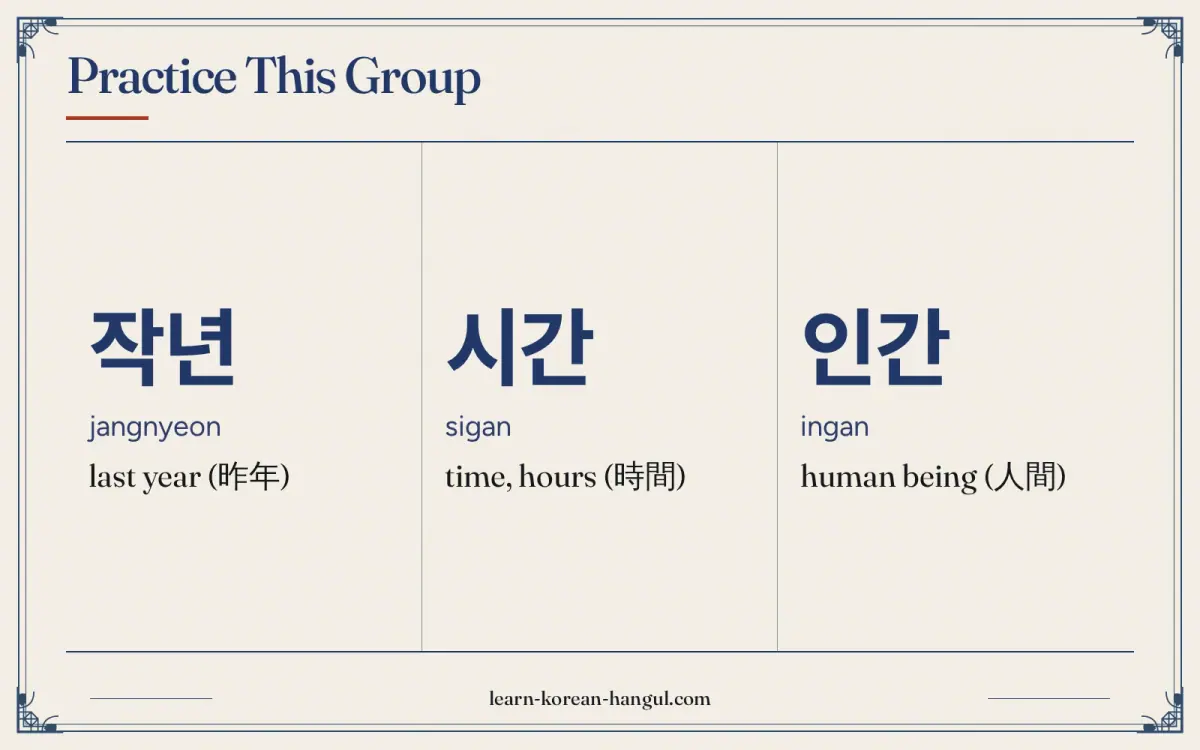
Practice in two steps. First, go through the ten flashcards, one word for each character. Say the word aloud before you reveal the meaning. The table lists every card.
| Korean | RR | Meaning | Characters |
|---|---|---|---|
| 작년 | jangnyeon | last year | 昨年 |
| 시간 | sigan | time, hours | 時間 |
| 인간 | ingan | human being | 人間 |
| 금년 | geumnyeon | this year (formal) | 今年 |
| 오전 | ojeon | morning, AM | 午前 |
| 오후 | ohu | afternoon, PM | 午後 |
| 정오 | jeongo | noon | 正午 |
| 야경 | yagyeong | night view | 夜景 |
| 신문 | sinmun | newspaper | 新聞 |
| 고대 | godae | ancient times | 古代 |
Practice · 10
- 01작년
Show answer
jangnyeon
last year (昨年)
- 02시간
Show answer
sigan
time, hours (時間)
- 03인간
Show answer
ingan
human being (人間)
- 04금년
Show answer
geumnyeon
this year (formal) (今年)
- 05오전
Show answer
ojeon
morning, AM (午前)
- 06오후
Show answer
ohu
afternoon, PM (午後)
- 07정오
Show answer
jeongo
noon (正午)
- 08야경
Show answer
yagyeong
night view (夜景)
- 09신문
Show answer
sinmun
newspaper (新聞)
- 10고대
Show answer
godae
ancient times (古代)
Then check yourself with six questions.
Practice · 6
Why does 오전 mean "morning" (AM)?
Show answer
午前 means "before noon"
午 is noon and 前 is before, so 오전 is "before noon". The 오 is not the number five.
How is 작년 (last year) pronounced?
Show answer
[장년]
Final ㄱ before ㄴ becomes ㅇ, so 작년 is said [장년].
Which reading does 年 take at the start of a word?
Show answer
연
At the start of a word 년 changes to 연, as in 연말 (year-end).
What does 新聞 mean literally?
Show answer
new hearing
新 is new and 聞 is hear, so 新聞 is "new hearing", which became the word newspaper.
Which word means "night view"?
Show answer
야경
夜景 (야경) is a night view. 古代 is ancient times, 新年 is new year and 時計 is a clock.
Which character means "old, ancient"?
Show answer
古
古 is old. 新 is new, 今 is now and 前 is before.
What to Learn Next
You now have ten characters and 19 words. Revisit the word table every day for a week, and use the flashcards to test yourself. Next, hanja for actions and abstract words completes the 100 with 出, 入 and signs such as 출구 and 입구. If you skipped them, hanja for school and learning covers 學, 校 and 生, the characters behind 학교 and 학생, and hanja for country and society turns 國 and 市 into place words. The basic hanja hub shows the whole map of ten groups. The full set of 100 is on 100 useful hanja, and how to learn hanja explains the method.
Frequently Asked Questions
Why is AM 오전?
午前 means "before noon": 午 is noon and 前 is before. Its partner 오후 (午後) is "after noon", the afternoon, and 정오 (正午) is exact noon. Korean time words follow this logic, so you can read 오전 9시 as "before noon, nine o'clock". The 오 in these words is not the number five.
Is 年 pronounced 년 or 연?
Both, depending on position. At the beginning of a word the reading is 연, as in 연말 (year-end). After another syllable it is 년, as in 작년 (last year) and 신년 (new year). As a counting word after a number, it stays 년: 삼 년. The change is called the initial sound rule (두음법칙).
What does 新聞 mean literally?
It means "new hearing" or "news that is heard". 新 is new and 聞 is to hear. The word 신문 (sinmun) names the newspaper, the printed form of the news. The word for news itself in Korean is 뉴스, a loanword, so 신문 appears chiefly in the name of the paper.
What is 間 in 時間?
間 is the space between two points, so 時間 is a span of time. This is why 시간 is both "time" and "hours" in Korean. Use it with native numbers to count hours, as in 두 시간 (two hours), and with a clock hour in 두 시 (two o'clock).
Is there a way to remember 前 and 後?
Think of them as a pair that mirror each other in every word: 오전 and 오후, 이전 and 이후, 식사 전 and 식사 후. Learn them in pairs, and you will learn two characters for the price of one.