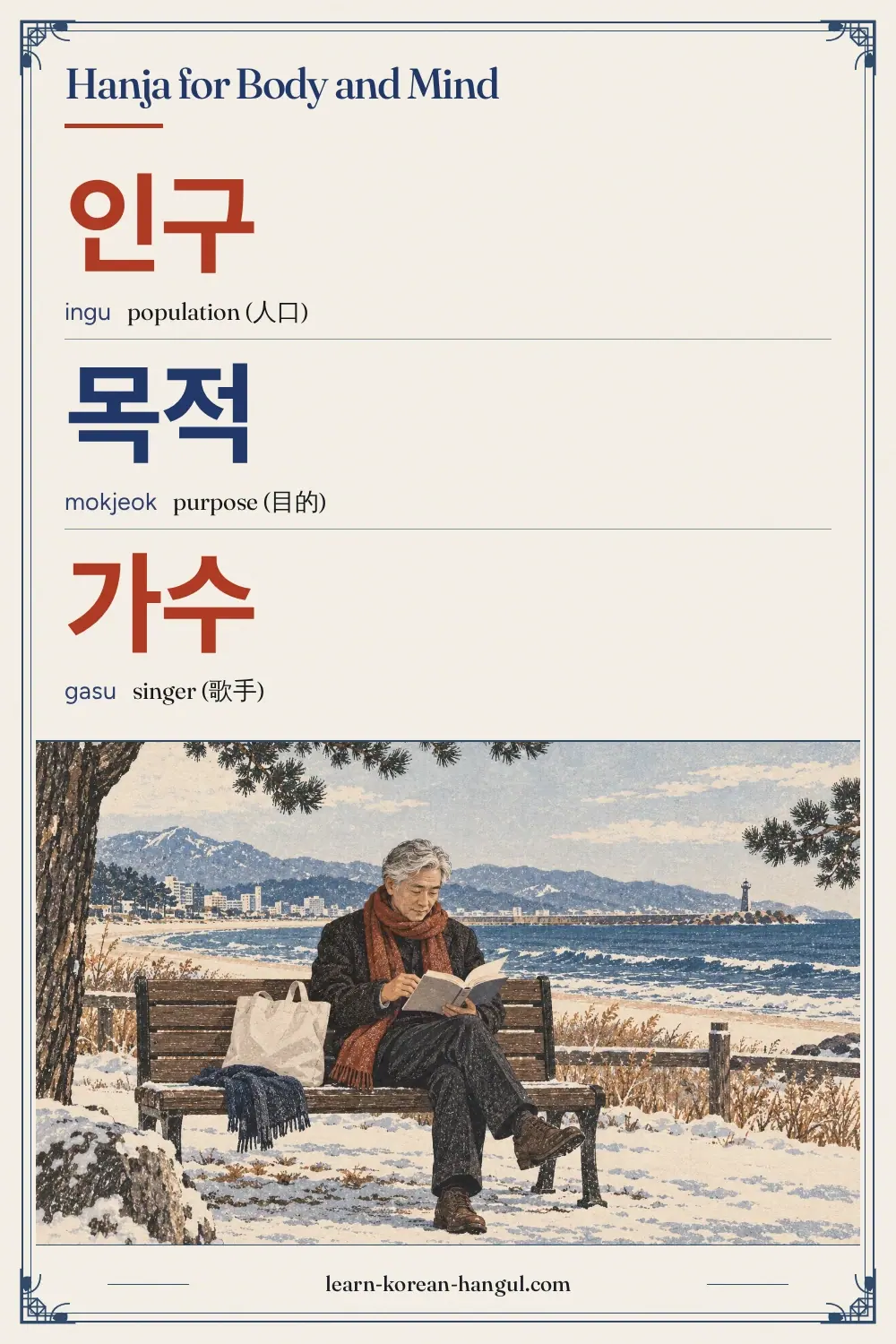
Hanja (한자) are Chinese characters used in Korean. You do not write them every day, but they explain Sino-Korean words, which commonly cited estimates put at roughly half or more of dictionary words. Body characters are useful because they appear in two worlds: everyday life (signs and clinics) and abstract ideas (feelings and ability).
This is the fifth of ten theme groups in the basic hanja set. Plan about 20 minutes. For body-part vocabulary in native Korean, such as 눈, 코 and 입, see body words in Korean.
Hanja for Body and Mind: the Essentials
The table gives each character with its 음훈, the traditional way Korean dictionaries teach a character: a native meaning word, then the Sino-Korean sound. So 手 is "손 수", "hand, sound su". Notice that the meaning word is the plain native Korean body word: 입, 눈, 손, 발, 귀, 몸. The Sino-Korean character is its formal, compound-building twin.
| Character | 음훈 (meaning word + sound) | Reading | Core meaning | Two words it builds |
|---|---|---|---|---|
| 口 | 입 구 | 구 | mouth; opening | 인구, 입구 |
| 目 | 눈 목 | 목 | eye; item | 목적, 목표 |
| 手 | 손 수 | 수 | hand; skilled person | 가수, 선수 |
| 足 | 발 족 | 족 | foot; enough | 부족, 만족 |
| 心 | 마음 심 | 심 | heart; mind | 관심, 심리 |
| 耳 | 귀 이 | 이 | ear | 이비인후과, 이목 |
| 身 | 몸 신 | 신 | body | 신체, 출신 |
| 面 | 낯 면 | 면 | face; surface | 면접, 장면 |
| 氣 | 기운 기 | 기 | air; energy | 공기, 기분 |
| 力 | 힘 력 | 력 | power; effort | 능력, 노력 |
The set splits into seven body characters (口 目 手 足 耳 身 面) and three characters for the inside (心 氣 力). Body characters mostly appear in compounds that describe the person (신체, 출신), a job or role (가수, 선수), or a place or event (입구, 장면). The three inside characters appear in abstract words about attention, mood and ability. That is why 心 氣 力 will turn up in far more words than the body parts.
How Do You Read Each Character?
Each character has one reading in Korean. The notes give a picture and the one sound fact worth knowing. The pictures are memory aids, not strict word histories.
- 口 구 (입 구). A square, the shape of an open mouth. It also means any opening: 입구 is the "enter-opening", an entrance, and 출구 is the exit. 인구 is literally "people mouths", the number of mouths to feed, so population. On signs you will also see 비상구, the emergency exit.
- 目 목 (눈 목). An eye turned on its side, with the pupil in the middle. It also means "item, title": 제목 (題目) is a title and 과목 (科目) is a school subject. In 목적 the ㅈ after ㄱ is tense, [목쩍], and the word is 目 "eye" + 的 "target": what your eye is aimed at. It has two bars inside where 日 has one.
- 手 수 (손 수). A hand with five fingers fanned out. It also works as a suffix for a person with a skill: 가수 is a song-person and 선수 is a chosen-person, an athlete. 수술 (手術) is surgery, a "hand technique". It is also the sound of 水 (water) and 數 (number).
- 足 족 (발 족). A mouth-like box over a foot. It has two meanings, "foot" and "enough", and the second one builds the words: 부족 is 不 "not" + 足 "enough", and 만족 is 滿 "full" + 足, which is satisfaction. 족발 (pig's trotters) puts 足 next to its native twin 발. Do not mix it up with 族 (족, family or tribe).
- 心 심 (마음 심). A heart drawn as a bowl with three dots. In Korean it means mind and feelings more than the organ: 관심 is 關 "concern" + 心 "heart", so interest, and 안심 is relief. In 심리 the ㄹ after ㅁ becomes ㄴ, [심니]. It can sound like 深 (deep) and 甚 (very).
- 耳 이 (귀 이). An ear drawn as a curve with a lobe. You see it on clinic signs in 이비인후과, which stacks four body parts: 耳 "ear", 鼻 "nose", 咽 "throat" and 喉 "larynx", plus 科 "department". In 이목 ("ear and eye") it describes public attention: 이목을 끌다 means to draw attention. It is the same sound as 二 (two).
- 身 신 (몸 신). A figure in profile with a rounded belly, a common memory picture for the body. 신체 is the formal word for body, as in 신체검사 (physical examination), and 출신 is "where you come from": 서울 출신 means from Seoul. The ㅅ of 신 after ㄹ is tense, [출씬]. It sounds like 新 (new).
- 面 면 (낯 면). A box with marks inside, an outline of a face. It broadens to "surface" and "side": 표면 is a surface and 장면 is a scene. In 면접 it is the face you meet: 面 "face" + 接 "meet". Do not confuse it with 면, noodles (麵), which uses a different character.
- 氣 기 (기운 기). Steam (气) rising over rice (米): the energy that rises. It is air in 공기 (empty-air), mood in 기분 (氣分) and energy in 기운. It is also the 기 in 인기 (popularity), 용기 (courage), 기온 (temperature) and 분위기 (atmosphere). Its sound is shared with 記 (record) and 器 (instrument).
- 力 력 (힘 력). A flexed arm, the picture of strength. Its dictionary sound is 력, but at the start of a word it becomes 역: 역량 (ability) and 역도 (weightlifting). After another syllable it stays 력: 능력, 노력, 체력 (stamina). In 능력 the ㄹ after ㅇ turns into ㄴ, so the word is [능녁].
The native Korean body words (입, 눈, 손, 발, 귀, 몸, 얼굴) are what you say in a sentence; the Sino-Korean sounds are what you see in compounds. You say 손이 아파요 (my hand hurts) but 가수 for a singer. Do not swap them: 수이 아파요 is not Korean.
Which Words Does Each Character Build?
Each character builds two common words. The "Said" column shows the pronunciation where it differs from the spelling, and the romanization follows the official Revised Romanization rules.
| Character | Word | Hanja | Revised Romanization | Said | Meaning |
|---|---|---|---|---|---|
| 口 | 인구 | 人口 | ingu | as spelled | population |
| 口 | 입구 | 入口 | ipgu | [입꾸] | entrance |
| 目 | 목적 | 目的 | mokjeok | [목쩍] | purpose |
| 目 | 목표 | 目標 | mokpyo | as spelled | goal |
| 手 | 가수 | 歌手 | gasu | as spelled | singer |
| 手 | 선수 | 選手 | seonsu | as spelled | athlete, player |
| 足 | 부족 | 不足 | bujok | as spelled | shortage |
| 足 | 만족 | 滿足 | manjok | as spelled | satisfaction |
| 心 | 관심 | 關心 | gwansim | as spelled | interest |
| 心 | 심리 | 心理 | simni | [심니] | psychology |
| 耳 | 이비인후과 | 耳鼻咽喉科 | ibiinhugwa | [이비인후꽈] | ear, nose and throat clinic |
| 耳 | 이목 | 耳目 | imok | as spelled | attention, notice |
| 身 | 신체 | 身體 | sinche | as spelled | body |
| 身 | 출신 | 出身 | chulsin | [출씬] | origin, background |
| 面 | 면접 | 面接 | myeonjeop | as spelled | interview |
| 面 | 장면 | 場面 | jangmyeon | as spelled | scene |
| 氣 | 공기 | 空氣 | gonggi | as spelled | air |
| 氣 | 기분 | 氣分 | gibun | as spelled | mood, feeling |
| 力 | 능력 | 能力 | neungnyeok | [능녁] | ability |
| 力 | 노력 | 努力 | noryeok | as spelled | effort |
Four of the twenty words belong to places and events (입구, 이비인후과, 장면, 면접), four describe a person (가수, 선수, 출신, 신체), and the rest are abstract (목적, 목표, 부족, 만족, 관심, 심리, 기분, 능력, 노력, 이목, 공기, 인구). In other words, a short body character takes you from the clinic to the interview room to the language of motivation.
Listen to the first word of each pair in the flashcard deck below, and to the second words here:
How Do the Characters Build Abstract Words?
The three inner characters 心 氣 力 each head a small family you can read at a glance.
| Character | Words | Meaning |
|---|---|---|
| 心 | 관심, 안심, 결심, 조심 | interest, relief, resolve, care |
| 氣 | 공기, 기분, 인기, 용기, 기온 | air, mood, popularity, courage, temperature |
| 力 | 능력, 노력, 체력, 협력, 역도 | ability, effort, stamina, cooperation, weightlifting |
The body characters combine with other characters too: 目 and 的 give 목적 (purpose), and 面 and 接 give 면접 (interview). Many body words are Sino-Korean twins of a native word: 입 and 구, 눈 and 목, 귀 and 이. Learn the pair and you know the word in both registers, the plain one for daily speech and the formal one for reading and writing. See Sino-Korean vocabulary for the wider pattern.
What Reading or Spelling Traps Should You Know?
- The initial-sound rule (두음법칙). 力 is 력 inside a word and 역 at the start: 능력, 노력 but 역량, 역도. The same rule affects 女 (녀 → 여) and 六 (륙 → 육), so one habit helps with many characters.
- Nasal changes. After ㅇ or ㅁ, an initial ㄹ becomes ㄴ: 능력 is [능녁] and 심리 is [심니]. Revised Romanization shows the nasal change (neungnyeok, simni).
- Tense sounds. 입구 is [입꾸] (ㅂ + ㄱ), 목적 is [목쩍] (ㄱ + ㅈ) and 출신 is [출씬] (ㄹ + ㅅ in a Sino-Korean word). Revised Romanization does not mark the tense sound: ipgu, mokjeok, chulsin.
- Homophones. 口 and 九 are both 구. 目 and 木 are both 목. 手 and 水 are both 수. 耳 and 二 are both 이. 身 and 新 are both 신. 氣 and 記 are both 기. In Hangul only the word tells you which is which.
- Native versus Sino-Korean. Use the native body words in sentences (손, 눈, 입) and the Sino-Korean characters in compounds. 구 does not mean "mouth" by itself in speech.
- Look-alike characters. 目 (eye) and 日 (sun) differ by one bar. Count the bars before you decide.
Practice This Group
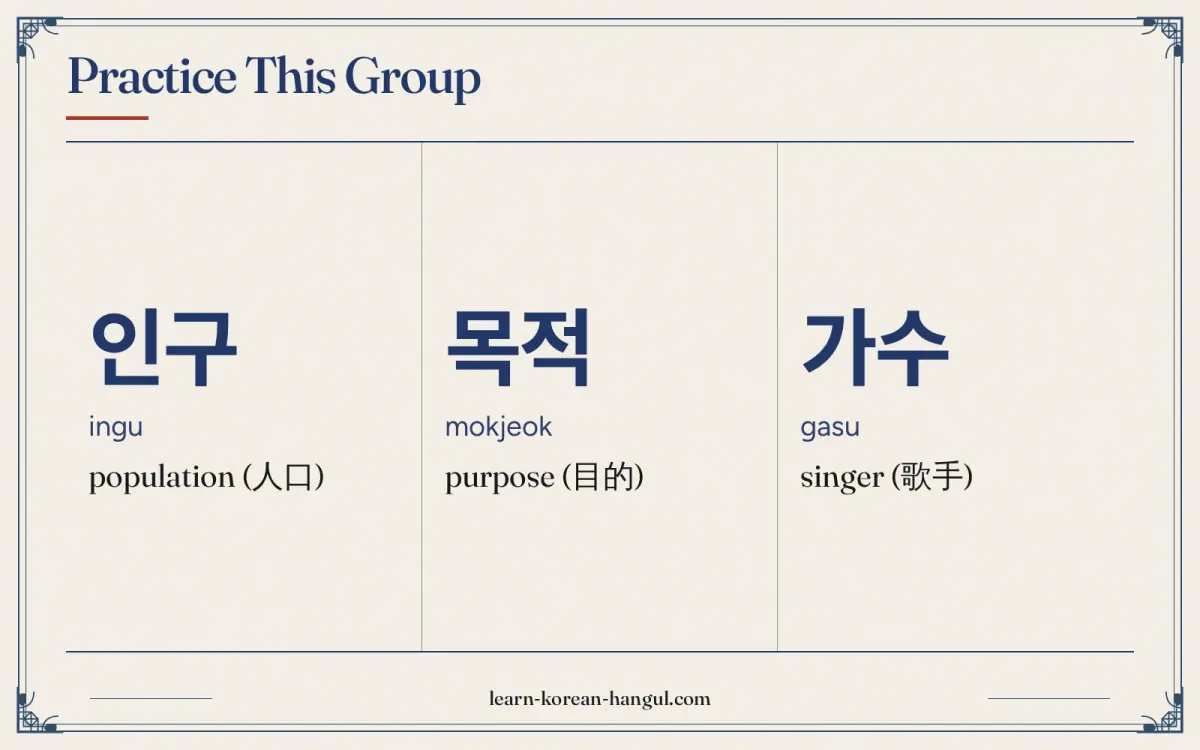
The deck uses the first word from each pair, and the table shows exactly what is in it. Read the table, run the deck and then answer the questions.
| # | Korean | Revised Romanization | Meaning | Character note |
|---|---|---|---|---|
| 1 | 인구 | ingu | population (人口) | 口 (입 구). A square mouth, also any opening. 入口 = entrance. |
| 2 | 목적 | mokjeok | purpose (目的) | 目 (눈 목). An eye on its side. 目的 = the "eye-target", a purpose. |
| 3 | 가수 | gasu | singer (歌手) | 手 (손 수). A hand with fingers. -手 names a skilled person. |
| 4 | 부족 | bujok | shortage (不足) | 足 (발 족). A foot. Also "enough": 不足 = not enough. |
| 5 | 관심 | gwansim | interest (關心) | 心 (마음 심). A heart. 關心 = "concern of the heart", interest. |
| 6 | 이비인후과 | ibiinhugwa | ear, nose and throat clinic (耳鼻咽喉科) | 耳 (귀 이). An ear. 耳鼻咽喉科 = the clinic for ear, nose and throat. |
| 7 | 신체 | sinche | body (身體) | 身 (몸 신). A body in profile. 出身 = where you come from. |
| 8 | 면접 | myeonjeop | interview (面接) | 面 (낯 면). A face in a box. 面接 = "face meeting", an interview. |
| 9 | 공기 | gonggi | air (空氣) | 氣 (기운 기). Steam over rice: energy. 空氣 = air; 氣分 = mood. |
| 10 | 능력 | neungnyeok | ability (能力) | 力 (힘 력). A flexed arm. 력 inside words, 역 at the start. |
Practice · 10
- 01인구
Show answer
ingu
population (人口)
- 02목적
Show answer
mokjeok
purpose (目的)
- 03가수
Show answer
gasu
singer (歌手)
- 04부족
Show answer
bujok
shortage (不足)
- 05관심
Show answer
gwansim
interest (關心)
- 06이비인후과
Show answer
ibiinhugwa
ear, nose and throat clinic (耳鼻咽喉科)
- 07신체
Show answer
sinche
body (身體)
- 08면접
Show answer
myeonjeop
interview (面接)
- 09공기
Show answer
gonggi
air (空氣)
- 10능력
Show answer
neungnyeok
ability (能力)
Recall drill. Cover the right-hand columns and, for each word, say the character, the meaning and the pronunciation aloud. Then sort the twenty words into three piles: signs and places, people, and ideas. Finally, say one sentence with a word from each pile, such as 입구는 어디예요? (Where is the entrance?) and 열심히 노력했어요. (I made an effort.)
Check Yourself
Practice · 6
Which word means "population"?
Show answer
인구
人口 is 인구: "people mouths". 입구 is an entrance, 출구 an exit and 비상구 an emergency exit.
How is 입구 (entrance) actually pronounced?
Show answer
[입꾸]
After a final ㅂ, the ㄱ of 구 becomes tense, so 입구 is said [입꾸].
How is 능력 (ability) pronounced?
Show answer
[능녁]
The ㄹ after ㅇ becomes ㄴ, so 능력 is [능녁].
What does 手 add to 歌 (song) and 選 (choose) in 가수 and 선수?
Show answer
a skilled person
手 works as a suffix for a person with a skill: 가수 is a singer and 선수 is an athlete.
Which word means "air" (空氣)?
Show answer
공기
空氣 is 공기, "air". 기분 is mood, 인기 is popularity and 용기 is courage.
What does 力 become at the start of a word, as in 역량?
Show answer
역
Because of the initial-sound rule, 력 becomes 역 at the start of a word: 역량 (ability), 역도 (weightlifting).
A Four-Day Plan for This Group
- Day 1. Learn 口 目 手 with 인구, 입구, 목적 and 가수.
- Day 2. Learn 足 耳 身 面 with 부족, 이비인후과, 신체 and 면접.
- Day 3. Learn 心 氣 力 and the second word of each pair, and play the ten audio buttons.
- Day 4. Run the flashcards, then the quiz. Revisit missed characters after one day.
What to Learn Next
The next group is hanja for directions and places, where 東西南北 and 上下 give you the words on maps and signs. To see all hundred characters in one table, open common hanja characters. For body vocabulary in native Korean, see body words in Korean. If you want to see how one character such as 心 or 力 grows into a family of words, go to hanja word families.
Frequently Asked Questions
Why is 人口 인구 "mouths"?
口 means mouth, and counting people by their mouths is an old way to count the people a place has to feed. So 人口 is literally "person-mouth", the population. The same character is an opening in 입구 (entrance) and 출구 (exit), which is a good reminder that 口 means "mouth" and "opening".
Which characters change sound in this group?
Only 力 changes by position: 력 inside a word (능력, 노력) and 역 at the start (역량). The other nine keep their reading. Many words show sound changes of the whole word, such as linking, tense sounds and nasal sounds, but these are spoken changes that leave the spelling the same.
Is 氣 about air or spirit?
Both. The picture is steam rising from cooked rice, and the meaning grows from there: air in 공기, mood in 기분, energy in 기운, popularity in 인기 and courage in 용기. When you meet 기 in a word, think "something moving or felt in the air", then check the other character.
What does 手 add to 歌手?
手 means "hand", but at the end of a word it often means "a person skilled at". So 歌手 is a song-person (가수, singer) and 選手 is a chosen-person (선수, athlete). In 수술, the word for surgery, it keeps the literal sense, "hand work".
Are these words used in everyday Korean?
Yes, all of them. 입구 and 출구 are on signs, 가수 and 선수 are in the news, 이비인후과 is on clinic windows, 면접 is the job interview, and 노력 is a word every learner hears. Learning the characters lets you read these signs and recognise the same parts in new words.