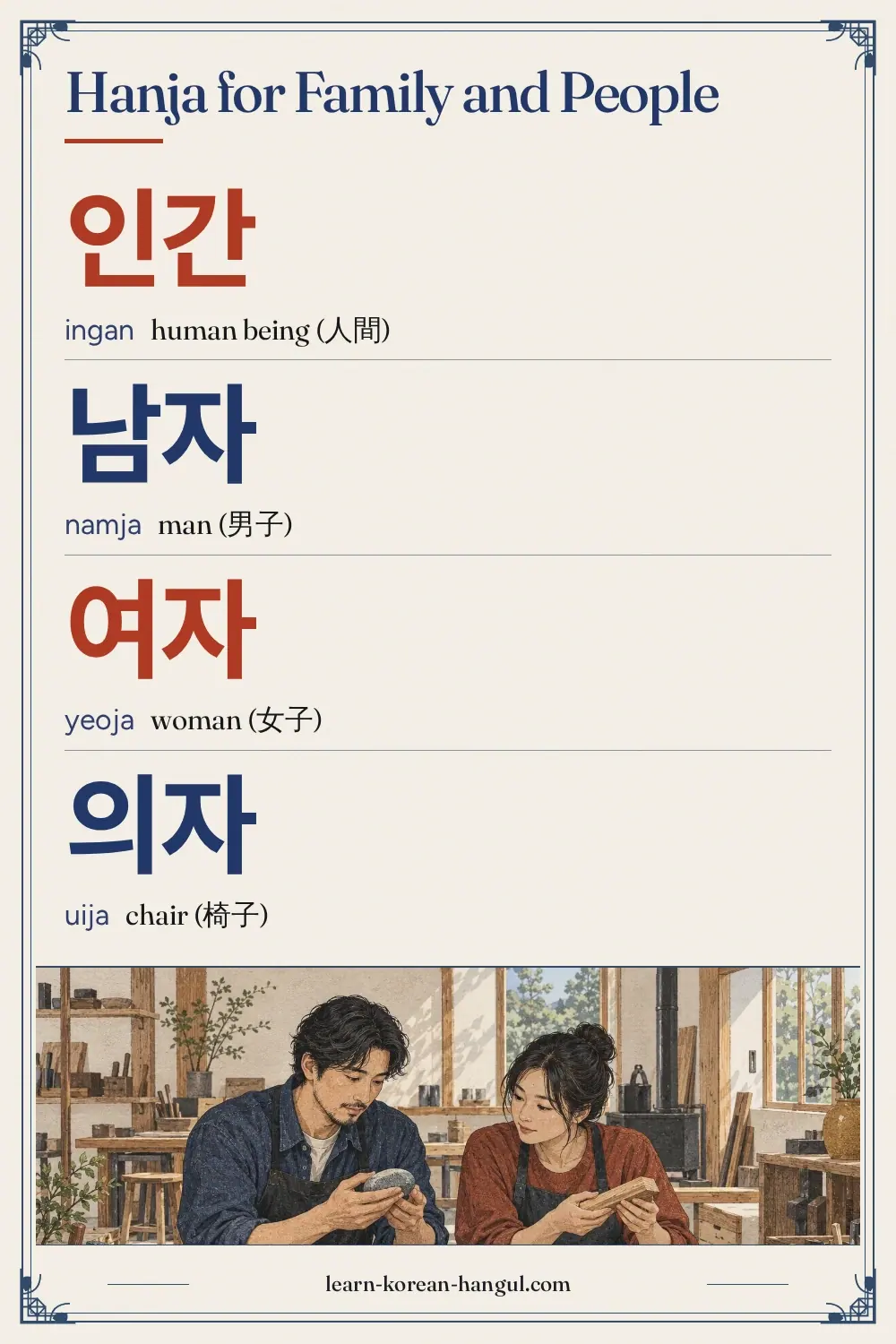
Hanja (한자) are Chinese characters used in Korean. You do not write them in daily life, but they show why Sino-Korean words mean what they do. People words are an ideal topic because the characters come in matching pairs and you already know most of the words.
This is the fourth of ten theme groups in the basic hanja set. Plan about 20 minutes. For the everyday family vocabulary with audio and example sentences, see Korean family words.
Hanja for Family and People: the Essentials
The table gives each character with its 음훈, the traditional way Korean dictionaries teach a character: a native meaning word, then the Sino-Korean sound. So 父 is "아비 부", "father, sound bu". Some meaning words, such as 계집 for 女 and 백성 for 民, are old-fashioned, so learn the reading and the core meaning in the next column.
| Character | 음훈 (meaning word + sound) | Reading | Core meaning | Two words it builds |
|---|---|---|---|---|
| 人 | 사람 인 | 인 | person | 인간, 외국인 |
| 男 | 사내 남 | 남 | man; male | 남자, 남녀 |
| 女 | 계집 녀 | 녀 | woman; female | 여자, 자녀 |
| 子 | 아들 자 | 자 | child; son | 의자, 모자 |
| 父 | 아비 부 | 부 | father | 부모, 부자 |
| 母 | 어미 모 | 모 | mother | 모국어, 모녀 |
| 兄 | 형 형 | 형 | older brother | 형, 형제 |
| 弟 | 아우 제 | 제 | younger brother; pupil | 제자, 처제 |
| 家 | 집 가 | 가 | house; family | 가족, 작가 |
| 民 | 백성 민 | 민 | people; citizens | 국민, 민족 |
The ten fall into three sets. The singles are 人 (person), 子 (child) and 家 (house, family). The three pairs are 男/女 (male, female), 父/母 (father, mother) and 兄/弟 (older, younger brother). 民 (people, citizens) completes the set. Pairs are the fastest way to learn: one half calls up the other, and they combine into words of their own, such as 男女, 父母 and 兄弟.
How Do You Read Each Character?
Each character has one reading. The notes give a picture and one useful sound fact, and the notes for 女 and 母 cover the one real trap in this set. The pictures are memory aids, not strict word histories.
- 人 인 (사람 인). Two legs, the picture of a person walking. It is the most useful single character in the set: 인간 is 人 "person" + 間 "between", a human among others, and 외국인 is 外 "outside" + 國 "country" + 人. As a suffix -인 it names people from a place or job: 한국인 (a Korean), 군인 (a soldier).
- 男 남 (사내 남). 田 (a field) over 力 (strength): a man who works the field with strength. 남자 is the plain word for a man, and 남녀 puts the two sexes together. You see it on public signs: 남자 화장실 is the men's toilet, and 남녀노소 is "men, women, old and young".
- 女 녀 (계집 녀). A kneeling figure with crossed arms. This is the star of the initial-sound rule (두음법칙): the dictionary sound is 녀, but at the start of a word it becomes 여, so 여자 begins with 여, while inside a word, as in 자녀 or 남녀, it stays 녀. The meaning word 계집 is old-fashioned, so rely on the sound and the examples.
- 子 자 (아들 자). A child with arms stretched out. 子 means "son" and "child", and it also works as a noun-ending in Chinese-based words, as in 의자 (chair) and 모자 (hat). Because it is so common, it also appears inside words that are not about children, so treat it as a small noun marker as well as a word.
- 父 부 (아비 부). Often explained as a hand holding an axe, the head of the family. 부모 is the formal word for parents, and 부모님 is the respectful form, used when talking about someone's parents. 부자 (父子) is spelled the same as 부자 (富者, a rich person), so context decides.
- 母 모 (어미 모). A character that looks like 女 with two extra dots. 모국어 (母國語) is "mother-country language", a person's first language; the final ㄱ links on, [모구거]. In 모녀 the 녀 keeps its ㄴ because it is not at the start of the word. 母子 is 모자, the same sound as the hat 帽子.
- 兄 형 (형 형). A mouth over legs, the older brother who speaks for the family. 형 is the word a man uses for his older brother; a woman says 오빠 for the same relationship. In 형제 (brothers), 兄 and 弟 come as a pair, and the word can include sisters in formal use: 형제자매 means siblings.
- 弟 제 (아우 제). A rope winding round a stake, a younger sibling in line behind the older. 제자 (弟子) is the word for a student of a teacher: 弟 "junior" + 子 "child". In 처제 it names a wife's younger sister. The meaning word 아우 is the old native word for a younger brother.
- 家 가 (집 가). A roof over a pig (豕), the old picture of a household. 가족 is the everyday word for family, and 가 at the end of a word marks an expert: 작가 (writer), 음악가 (musician), 화가 (painter). In 작가 the ㄱ before ㄱ is tense, [작까].
- 民 민 (백성 민). An old character for common people, which is why the meaning word 백성 is old-fashioned. Today it means "people" in the sense of a nation. In 국민, the ㄱ before ㅁ becomes nasal, [궁민]. 민족 is the word behind 한민족 (the Korean people).
Other characters also read 자: 字 (letter, in the school group), 自 (self) and 者 (person). For now, look for the picture of a child in 子 and a roof in 家.
Which Words Does Each Character Build?
Each character builds two common words. The "Said" column shows the pronunciation where it differs from the spelling, and the romanization follows the official Revised Romanization rules.
| Character | Word | Hanja | Revised Romanization | Said | Meaning |
|---|---|---|---|---|---|
| 人 | 인간 | 人間 | ingan | as spelled | human being |
| 人 | 외국인 | 外國人 | oegugin | [외구긴] | foreigner |
| 男 | 남자 | 男子 | namja | as spelled | man |
| 男 | 남녀 | 男女 | namnyeo | as spelled | men and women |
| 女 | 여자 | 女子 | yeoja | as spelled | woman |
| 女 | 자녀 | 子女 | janyeo | as spelled | children |
| 子 | 의자 | 椅子 | uija | as spelled | chair |
| 子 | 모자 | 帽子 | moja | as spelled | hat |
| 父 | 부모 | 父母 | bumo | as spelled | parents |
| 父 | 부자 | 父子 | buja | as spelled | father and son |
| 母 | 모국어 | 母國語 | mogugeo | [모구거] | mother tongue |
| 母 | 모녀 | 母女 | monyeo | as spelled | mother and daughter |
| 兄 | 형 | 兄 | hyeong | as spelled | older brother (said by a man) |
| 兄 | 형제 | 兄弟 | hyeongje | as spelled | brothers |
| 弟 | 제자 | 弟子 | jeja | as spelled | disciple, student |
| 弟 | 처제 | 妻弟 | cheoje | as spelled | wife's younger sister |
| 家 | 가족 | 家族 | gajok | as spelled | family |
| 家 | 작가 | 作家 | jakga | [작까] | writer |
| 民 | 국민 | 國民 | gungmin | [궁민] | citizens, the people |
| 民 | 민족 | 民族 | minjok | as spelled | nation, ethnic group |
Most of the twenty words are nouns for people (인간, 외국인, 남자, 여자, 자녀, 형제, 제자), and a few are things (의자, 모자) or ideas (모국어, 민족, 가족). That mix shows how general these characters are: 子 helps you read a chair, 人 a foreigner, and 民 a nation.
Listen to the first word of each pair in the flashcard deck below, and to the second words here:
How Do the Characters Combine into Family Words?
Chinese-based compounds put two characters together, and the people characters make their own set of pair words:
| Pair | Word | Meaning |
|---|---|---|
| 男 + 女 | 남녀 (namnyeo) | men and women |
| 父 + 母 | 부모 (bumo) | parents |
| 兄 + 弟 | 형제 (hyeongje) | brothers, siblings |
| 子 + 女 | 자녀 (janyeo) | children |
| 母 + 女 | 모녀 (monyeo) | mother and daughter |
| 父 + 子 | 부자 (buja) | father and son |
The suffix 家 follows the same logic in the other direction, naming an expert: 작가 (writer), 음악가 (musician) and 화가 (painter). The respectful ending 님 attaches to any family word to make it honorific: 부모님 (your parents), 형님 (older brother, respectfully). Everyday family words, native and Sino-Korean, are on Korean family words, and more Sino-Korean word patterns are on Sino-Korean vocabulary.
What Reading or Spelling Traps Should You Know?
- The initial-sound rule (두음법칙). The dictionary sound of 女 is 녀. At the start of a word it becomes 여: 여자, 여성. Inside a word it stays 녀: 자녀, 남녀, 모녀. The same pattern affects 력 → 역 (역량) and 리 → 이 (이유).
- Homophones. 父子 is 부자, and so is 富者 (a rich person). 母子 is 모자, and so is 帽子 (a hat). 子 and 字 and 自 are all 자. Context decides.
- Linking. In 모국어 the final ㄱ moves to the next syllable, [모구거]. In 외국인 the same happens: [외구긴]. The spelling stays the same.
- Tense and nasal changes. 작가 is [작까], with a tense ㄱ after ㄱ, and 국민 is [궁민], with a nasal ㅇ before ㅁ.
- Sino-Korean versus native words. 부모 is formal, and 엄마 and 아빠 are the casual words. Mixing registers in one sentence sounds odd, so match the word to the situation.
- Honorifics. Add 님 to the family word when you talk about someone else's family: 부모님 (your parents), but just 부모 for a general statement.
Practice This Group
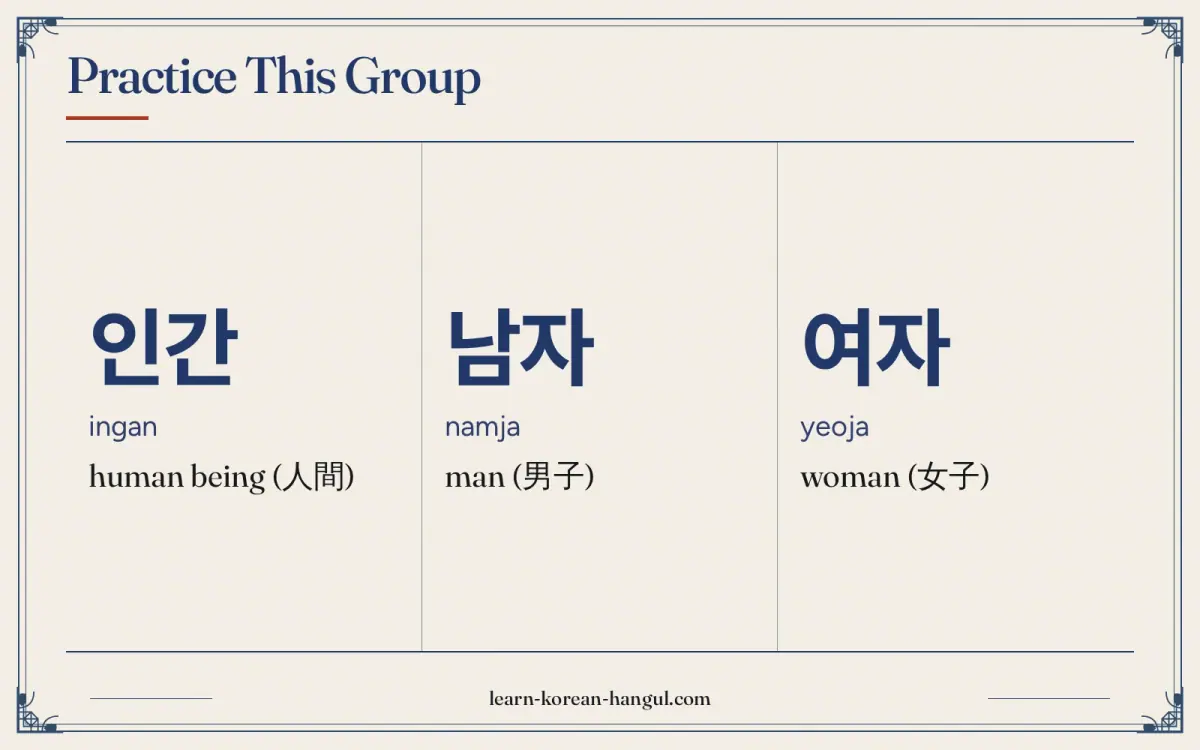
The deck uses the first word from each pair, and the table shows exactly what is in it. Read the table, run the deck and then answer the questions.
| # | Korean | Revised Romanization | Meaning | Character note |
|---|---|---|---|---|
| 1 | 인간 | ingan | human being (人間) | 人 (사람 인). Two legs: a person. As a suffix, -人 names a kind of person. |
| 2 | 남자 | namja | man (男子) | 男 (사내 남). A field above strength. 男子 = man; 男女 = men and women. |
| 3 | 여자 | yeoja | woman (女子) | 女 (계집 녀). A kneeling figure. 녀 inside a word, 여 at the start. |
| 4 | 의자 | uija | chair (椅子) | 子 (아들 자). A child with open arms. Also a noun ending: 椅子, 帽子. |
| 5 | 부모 | bumo | parents (父母) | 父 (아비 부). A hand with an axe: head of the family. 父母 = parents. |
| 6 | 모국어 | mogugeo | mother tongue (母國語) | 母 (어미 모). 女 with two dots: a mother. 母國語 = mother tongue. |
| 7 | 형 | hyeong | older brother (said by a man) (兄) | 兄 (형 형). A mouth over legs: the older one. 형 is an older brother. |
| 8 | 제자 | jeja | disciple, student (弟子) | 弟 (아우 제). A rope on a stake: second in line. 弟子 = pupil. |
| 9 | 가족 | gajok | family (家族) | 家 (집 가). A roof over a pig: a household. -家 names an expert. |
| 10 | 국민 | gungmin | citizens, the people (國民) | 民 (백성 민). Citizens of a country: 國民. 民族 = a people or nation. |
Practice · 10
- 01인간
Show answer
ingan
human being (人間)
- 02남자
Show answer
namja
man (男子)
- 03여자
Show answer
yeoja
woman (女子)
- 04의자
Show answer
uija
chair (椅子)
- 05부모
Show answer
bumo
parents (父母)
- 06모국어
Show answer
mogugeo
mother tongue (母國語)
- 07형
Show answer
hyeong
older brother (said by a man) (兄)
- 08제자
Show answer
jeja
disciple, student (弟子)
- 09가족
Show answer
gajok
family (家族)
- 10국민
Show answer
gungmin
citizens, the people (國民)
Recall drill. Cover the right-hand columns and say the character, the meaning and the pronunciation for each word. Then pair them up from memory: say 男 and 女, 父 and 母, 兄 and 弟. Finally, say a sentence for each of five words, such as 가족이 몇 명이에요? (How many people are in your family?) and 저는 외국인이에요. (I am a foreigner.)
Check Yourself
Practice · 6
Which two characters make 부모 (parents)?
Show answer
父母
父 (father) + 母 (mother) = 父母, 부모. 兄弟 is 형제, 男女 is 남녀 and 子女 is 자녀.
What is the correct word for "children" (子女)?
Show answer
자녀
女 keeps its dictionary sound 녀 inside a word, so 子女 is 자녀. It changes to 여 only at the start of a word, as in 여자.
Why is 女子 read 여자 and not 녀자?
Show answer
Korean words do not normally start with 녀
The initial-sound rule (두음법칙) changes 녀 to 여 at the start of a word. Inside a word, as in 자녀 or 남녀, the 녀 stays.
Which character means "house, family" and is read 가?
Show answer
家
家 is read 가, as in 가족 (family) and 작가 (writer).
Which meaning goes with 母子, the same sound as the hat 모자?
Show answer
mother and child
母 (mother) + 子 (child) = 母子, mother and child. The hat is 帽子, and both are spelled 모자 in Hangul.
What does 국민 (國民) mean?
Show answer
citizens
國 "country" + 民 "people" = citizens. It is said [궁민].
A Four-Day Plan for This Group
- Day 1. Learn the singles 人 子 家 with 인간, 의자 and 가족.
- Day 2. Learn the pair 男/女 with 남자, 여자, 남녀 and 자녀, and learn the 두음법칙 rule.
- Day 3. Learn 父/母 and 兄/弟 and the second word of each pair, and play the ten audio buttons.
- Day 4. Learn 民, run the flashcards, then the quiz. Revisit missed characters after one day.
What to Learn Next
Next is hanja for body and mind, where 口目手足心耳身面氣力 give you the vocabulary of health and feelings. To see all hundred characters in one table, open common hanja characters. For the family vocabulary with example sentences, see Korean family words. If you want more on how single characters build whole sets of words, go to hanja word families, where 人 and 子 are among the most productive characters.
Frequently Asked Questions
Why is 女 sometimes 여 and sometimes 녀?
Korean sound rules (두음법칙, the initial-sound rule) do not allow 녀 at the start of a word, so it becomes 여 there: 여자 (woman). Inside a word it keeps 녀: 자녀 (children), 남녀 (men and women) and 모녀 (mother and daughter). The same rule changes 력 to 역 and 륙 to 육, so one habit helps with many characters.
Is 子 "son" or "child"?
Both. The 음훈 gives "아들 자", "son", but in modern words 子 means a child of either sex (자식, one's children) and is often just a noun ending, as in 의자 (chair) and 모자 (hat). In a name, the meaning depends on the full word, so check the other character.
What is the difference between 家族 and 가족?
There is none. 가족 is the standard Hangul spelling of the word, and 家族 is the same word in hanja. You see the hanja form in dictionaries, in textbooks that gloss word origins, and in a few formal documents. In everyday writing, Korean uses Hangul only.
Which is more formal, 부모 or 엄마 아빠?
부모 (父母) is formal and written, as in 부모님의 동의 (parents' consent). 엄마 and 아빠 are the warm, spoken words a child uses. 어머니 and 아버지 sit in the middle: respectful and native Korean. Choose the word to fit the person you speak to and the situation.
Why do the pairs put the male or older character first?
In Chinese-based compounds the order is usually male before female and older before younger: 男女 (not 女男), 父母 and 兄弟. It is a convention of the word, not a rule you must apply to new words. Native Korean words can run differently: 엄마 아빠 puts the mother first.