Hanja (한자) are Chinese characters used in Korean. You do not write them in everyday life, but they explain the meaning of Sino-Korean words, which commonly cited estimates put at roughly half or more of dictionary words. Each character below is a small piece of vocabulary that appears in many words.
This is the second of ten theme groups in the basic hanja set. Plan about 20 minutes. If you have not yet met the characters for one to ten, start with Korean numbers in hanja.
Hanja for Size and Quantity: the Essentials
The table gives each character with its 음훈, the traditional Korean way of teaching a character: a native meaning word, then the Sino-Korean sound. So 大 is "큰 대", "big, sound dae". The group splits naturally into three small sets: number units (百千萬), opposite pairs (大小, 多少) and single qualities (長高重).
| Character | 음훈 (meaning word + sound) | Reading | Core meaning | Two words it builds |
|---|---|---|---|---|
| 百 | 일백 백 | 백 | hundred | 백화점, 백만 |
| 千 | 일천 천 | 천 | thousand | 천만, 천년 |
| 萬 | 일만 만 | 만 | ten thousand | 만일, 만능 |
| 大 | 큰 대 | 대 | big | 대학, 대소 |
| 小 | 작을 소 | 소 | small | 소설, 소형 |
| 多 | 많을 다 | 다 | many | 다양, 다수 |
| 少 | 적을 소 | 소 | few | 소년, 다소 |
| 長 | 긴 장 | 장 | long; leader | 장점, 성장 |
| 高 | 높을 고 | 고 | high | 고등학교, 고속도로 |
| 重 | 무거울 중 | 중 | heavy; important | 중요, 체중 |
Learn them in those three sets rather than in a line. The number units are the easiest, because you already say 백, 천 and 만. The opposite pairs teach themselves once you know one half: 小 follows 大, and 少 follows 多. The last three, 長 (long, senior), 高 (high) and 重 (heavy, important), carry the most abstract meanings and appear in the most words.
How Do You Read Each Character?
Every character in this group has one reading in Korean. The notes give a picture for each shape and one useful fact about its sound. The pictures are memory aids, not strict word histories.
- 百 백 (일백 백). A stroke over 白 (white). In 백화점 the ㄱ and ㅎ blend into an aspirated ㅋ, [배콰점], and the word is 百 "hundred" + 貨 "goods" + 店 "shop": a shop with a hundred kinds of goods. In 백만 the ㄱ turns nasal before ㅁ, [뱅만].
- 千 천 (일천 천). A short stroke across a vertical, almost like a plus sign with a hat. As numbers, 천만 is 1,000 × 10,000 = 10,000,000. The same two characters form 천만에요, the polite "not at all" you say after thanks. Its sound 천 is shared with 川 (river) and 天 (heaven).
- 萬 만 (일만 만). A crowded character with a grass-like top. Korean counts in units of 만 (10,000), so 만 is the unit behind 3만 원 (30,000 won). In 만일 ("one in ten thousand", so "if by chance") the ㄴ links on, [마닐]. In 만능 the meaning is "ten thousand abilities", so all-purpose.
- 大 대 (큰 대). A person (人) standing with arms stretched wide: a big person. 대학 is 大 "big" + 學 "study", and 대학교 is the usual word for a university. In 대소 it sits next to its opposite, 小. Keep it apart from 太 (태, as in 태양, sun), which has an extra dot.
- 小 소 (작을 소). A vertical stroke with a dot on each side. In 소설 (novel) it pairs with 說 "tale": a minor tale, which is how the Chinese-based word for fiction came about. 소형 is used for small cars and small appliances. It sounds the same as 少 (few).
- 多 다 (많을 다). Two 夕 (evening) stacked on each other, and a handy way to remember "many": evening upon evening. 다양 is the root of 다양하다 (to be diverse), and 다수 is the "many" in "the majority". Its opposite is 少.
- 少 소 (적을 소). 小 with one extra slanting stroke below it. 소년 is a young person, a boy, while 다소 puts 多 and 少 together: "many and few" gives "to some extent". In a sentence, 다소 is an adverb: 다소 비싸요 (it is somewhat expensive).
- 長 장 (긴 장). A tall, complex shape. 長 has two senses, "long" and "the one who is senior" (as in 교장, school principal). In 장점 the ㅈ of 점 is tense, [장쩜]; the opposite is 단점 (weak point). In 성장 it means to grow long, so to grow up.
- 高 고 (높을 고). Looks like a tall building with a roof, a door and a window. 고등학교 is 高 "high" + 等 "level" + 學校 "school", and the ㄱ of 교 is tense after the ㄱ of 학, [고등학꾜]. In 고속도로 the ㄷ after ㄱ becomes tense: [고속또로]. Do not confuse it with 古 (old).
- 重 중 (무거울 중). A packed, heavy-looking character. Its core idea is weight, then "weighty", then "important": 중요 is 重 "weighty" + 要 "need". In 체중 (body weight) it keeps the literal sense. It is also read 중 in 이중 (double, layered).
Several readings sound alike across groups, so listen for the word, not the syllable: 소 is 小 or 少, 천 is 千, 川 or 天, and 중 is 重 or 中 (middle). Seeing which character sits in a word is what turns a sound into a meaning.
Which Words Does Each Character Build?
Each character builds two common words. The "Said" column shows the pronunciation where it differs from the spelling, and the romanization follows the official Revised Romanization rules, which do not show tensing that happens only in speech.
| Character | Word | Hanja | Revised Romanization | Said | Meaning |
|---|---|---|---|---|---|
| 百 | 백화점 | 百貨店 | baekhwajeom | [배콰점] | department store |
| 百 | 백만 | 百萬 | baengman | [뱅만] | one million |
| 千 | 천만 | 千萬 | cheonman | as spelled | ten million |
| 千 | 천년 | 千年 | cheonnyeon | as spelled | a thousand years |
| 萬 | 만일 | 萬一 | manil | [마닐] | if, in case |
| 萬 | 만능 | 萬能 | manneung | as spelled | all-purpose |
| 大 | 대학 | 大學 | daehak | as spelled | university |
| 大 | 대소 | 大小 | daeso | as spelled | large and small |
| 小 | 소설 | 小說 | soseol | as spelled | novel |
| 小 | 소형 | 小型 | sohyeong | as spelled | small-sized |
| 多 | 다양 | 多樣 | dayang | as spelled | diverse |
| 多 | 다수 | 多數 | dasu | as spelled | majority |
| 少 | 소년 | 少年 | sonyeon | as spelled | boy |
| 少 | 다소 | 多少 | daso | as spelled | somewhat |
| 長 | 장점 | 長點 | jangjeom | [장쩜] | strength, good point |
| 長 | 성장 | 成長 | seongjang | as spelled | growth |
| 高 | 고등학교 | 高等學校 | godeunghakgyo | [고등학꾜] | high school |
| 高 | 고속도로 | 高速道路 | gosokdoro | [고속또로] | expressway |
| 重 | 중요 | 重要 | jungyo | as spelled | important |
| 重 | 체중 | 體重 | chejung | as spelled | body weight |
Look at how often you can guess the meaning from the characters: 고속도로 is 高 "high" + 速 "speed" + 道路 "road", a high-speed road.
Listen to the first word of each pair in the flashcard deck below, and to the second words here:
How Do the Size Characters Pair Up?
Opposites are the shortest route to learning size words, because the pair forms a new word on its own.
| Pair | Word | Meaning |
|---|---|---|
| 大 + 小 | 대소 (daeso) | large and small |
| 多 + 少 | 다소 (daso) | to some extent |
| 長 + 短 | 장단 (jangdan) | length; strengths and weaknesses |
| 高 + 低 | 고저 (gojeo) | high and low |
The last two pairs use 短 (짧을 단, short) and 低 (낮을 저, low), which are outside the 100 but easy to add. Number units combine by multiplying: 백만 is 100 × 10,000 = 1,000,000, and 천만 is 1,000 × 10,000 = 10,000,000. So 삼백만 원 (3,000,000 won) is 三百萬. Korean builds big numbers around the unit 만, not around thousands, which is why you must think of 30,000 as 3만 and 1,000,000 as 100만. The numbers lessons use this daily, and the Sino-Korean numbers page shows prices and phone numbers.
What Reading or Spelling Traps Should You Know?
- Homophones. 小 and 少 are both 소, 千 and 川 and 天 are all 천, and 重 and 中 are both 중. In Hangul they look identical, so rely on the word, not the syllable.
- Aspiration and nasal changes. 백화점 is said [배콰점] (ㄱ + ㅎ = ㅋ) and 백만 is [뱅만] (ㄱ before ㅁ becomes ㅇ). Revised Romanization keeps the h in nouns (baekhwajeom) and shows the nasal as ng (baengman).
- Tense sounds in Sino-Korean words. Some words simply have a tense sound that you learn as spoken: 장점 is [장쩜]. A ㄷ after ㄱ is tense in 고속도로, [고속또로]. In 고등학교 the ㄱ of 교 is tense, [고등학꾜].
- Linking. 만일 is [마닐], with the ㄴ moving to the next syllable. It is a spoken change; the spelling stays 만일.
- Number units. Korean groups digits by ten thousands: 10,000 is 만, not "ten thousand" built from 십 + 천. Say 12,000 as 만 이천 (in speech there is no 일 before 만), written 1만 2천.
- Look-alike characters. 大 (big) and 太 (태, extra big) differ by one dot; 小 and 少 differ by one stroke; 高 and 古 (old) share a roof. A close look at the top and the middle usually settles it.
Practice This Group
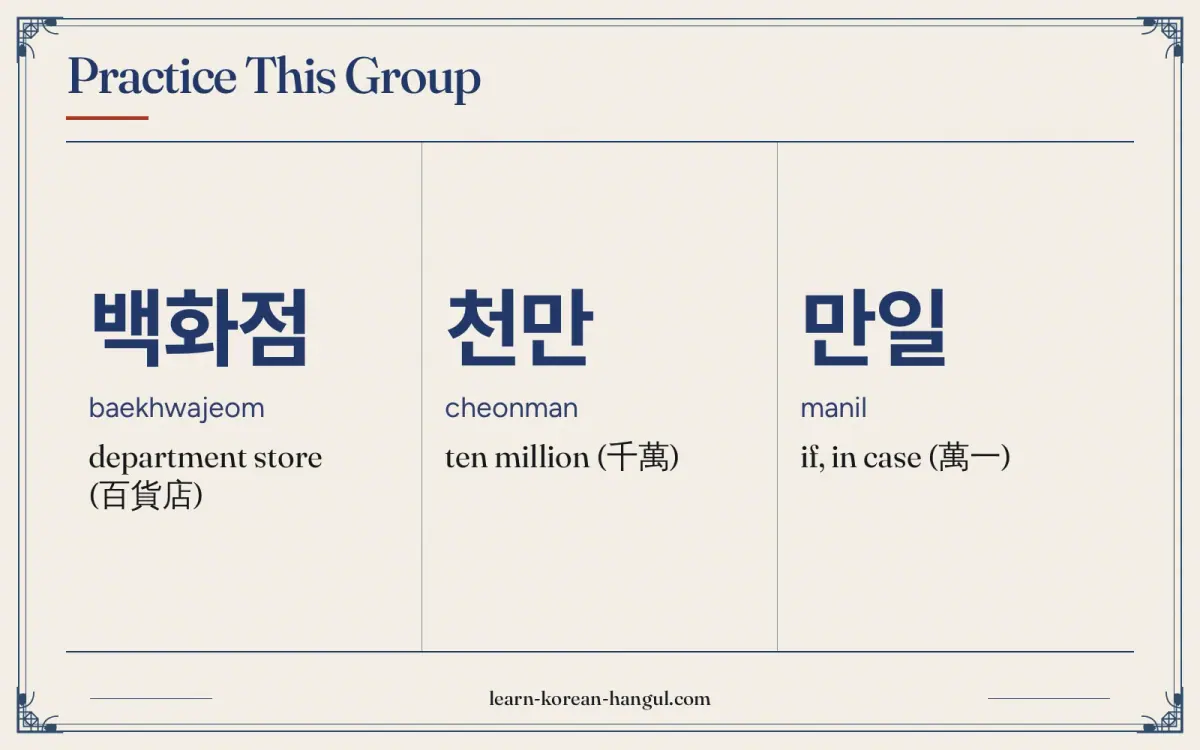
The flashcard deck uses the first word of each pair, and the table shows exactly what is in it. Read the table, then run the deck, then try the questions underneath.
| # | Korean | Revised Romanization | Meaning | Character note |
|---|---|---|---|---|
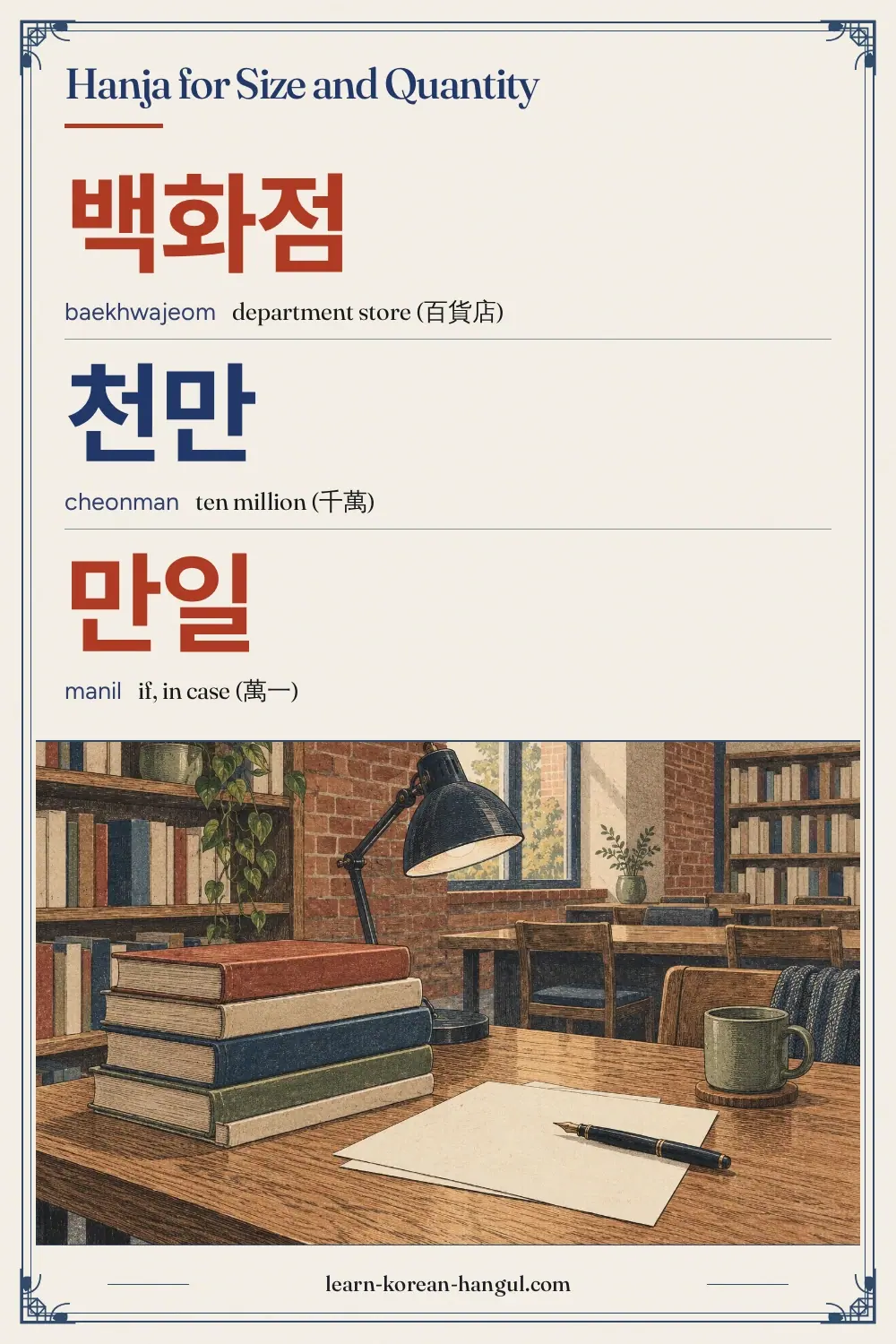
| 1 | 백화점 | baekhwajeom | department store (百貨店) | 百 (일백 백). A stroke over 白. 百貨店 = "hundred-goods shop". |
| 2 | 천만 | cheonman | ten million (千萬) | 千 (일천 천). A hat on a cross. 천만 = 10,000,000; 천만에요 = "not at all". |
| 3 | 만일 | manil | if, in case (萬一) | 萬 (일만 만). Korean counts in 만 (10,000): 만 원 = 10,000 won. |
| 4 | 대학 | daehak | university (大學) | 大 (큰 대). A person with arms spread wide. 大學 = "big learning". |
| 5 | 소설 | soseol | novel (小說) | 小 (작을 소). A vertical stroke with two dots. 小說 = a novel. |
| 6 | 다양 | dayang | diverse (多樣) | 多 (많을 다). Two 夕 stacked: many on many. 多樣 = diverse. |
| 7 | 소년 | sonyeon | boy (少年) | 少 (적을 소). 小 with an extra slash. 多少 = "many-few" = somewhat. |
| 8 | 장점 | jangjeom | strength, good point (長點) | 長 (긴 장). Long hair on a head. 長點 = a "long point", a strength. |
| 9 | 고등학교 | godeunghakgyo | high school (高等學校) | 高 (높을 고). A tall building with a roof. 高速道路 = "high-speed road". |
| 10 | 중요 | jungyo | important (重要) | 重 (무거울 중). A heavy-looking block. 重要 = "weighty need", important. |
Practice · 10
- 01백화점
Show answer
baekhwajeom
department store (百貨店)
- 02천만
Show answer
cheonman
ten million (千萬)
- 03만일
Show answer
manil
if, in case (萬一)
- 04대학
Show answer
daehak
university (大學)
- 05소설
Show answer
soseol
novel (小說)
- 06다양
Show answer
dayang
diverse (多樣)
- 07소년
Show answer
sonyeon
boy (少年)
- 08장점
Show answer
jangjeom
strength, good point (長點)
- 09고등학교
Show answer
godeunghakgyo
high school (高等學校)
- 10중요
Show answer
jungyo
important (重要)
Recall drill. For each word above, cover the Korean and say it from the English, then cover the English and give the meaning from the Korean. Next, make a pair for each opposite: say 大 and name 小, say 多 and name 少. Finally, say these amounts aloud in Korean, using the number units: 30,000 won (삼만 원), 1,000,000 won (백만 원) and 10,000,000 won (천만 원).
Check Yourself
Practice · 6
Which pair of characters are both read 소?
Show answer
小 and 少
小 (small) and 少 (few) are both 소. 소설 uses 小, and 소년 uses 少.
How is 백화점 (department store) actually pronounced?
Show answer
[배콰점]
The final ㄱ of 백 and the ㅎ of 화 blend into an aspirated ㅋ, giving [배콰점].
What amount is 백만 원?
Show answer
1,000,000 won
백 (100) × 만 (10,000) = 1,000,000. Ten million would be 천만 원.
Which word means "strength, good point"?
Show answer
장점
장점 (長點) is a strength, said [장쩜]. 체중 is body weight, 성장 is growth and 다소 means somewhat.
What does 다소 (多少) mean in a sentence such as 다소 비싸요?
Show answer
somewhat
多 "many" + 少 "few" gives "to some extent". 다소 비싸요 means "it is somewhat expensive".
Which character is the first one in 重要 (important), read 중?
Show answer
重
重 is read 중 and means weighty, so 중요 is 重 + 要. The others are read 고, 장 and 대.
A Four-Day Plan for This Group
- Day 1. Learn 百 千 萬 with 백만 원 and 천만 원, plus the idea that Korean counts in 만.
- Day 2. Learn 大 小 多 少 as two pairs. Say 대학, 소설, 다양 and 소년.
- Day 3. Learn 長 高 重 and play all the audio buttons.
- Day 4. Run the flashcards, then the quiz. Revisit missed characters after one day.
What to Learn Next
The next group continues with nature and days of the week, where 日月火水木金土 turn out to be the weekday names. To see all hundred characters at once, open common hanja characters. If you have not yet learned the ten number characters, Korean numbers in hanja sets them out, and the Sino-Korean numbers page shows how to say money and phone numbers. For how one character grows into a family of words, see hanja word families.
Frequently Asked Questions
Is 大 always read 대?
In modern Korean words, yes: 대학 (university), 대부분 (most) and 대소 (large and small) all use 대. The look-alike 太 is read 태, as in 태양 (sun) and 태평양 (Pacific Ocean), and the dotted 犬 (dog) is read 견. If a word seems to use 大 but sounds like 태, check whether the character has an extra dot.
What is the difference between 小 and 少?
Both are read 소, but 小 means small in size and 少 means few in number or young. 소설 (novel) and 소형 (small-sized) use 小, and 소년 (boy) and 다소 (somewhat) use 少. When you meet 소 in a word you cannot tell which one it is from Hangul alone, so learn each word with its meaning.
Is 重 always read 중?
In Korean it is read 중 in every word on this page: 중요 (important), 체중 (body weight) and 이중 (double). The ideas "heavy", "important" and "layered" all grow from the same picture of something with weight, so one reading covers them.
Do I need 百 千 萬 to read numbers?
You do not need them to say numbers, because Hangul 백, 천 and 만 are enough. The characters help when you read prices on traditional signs or in older writing. They also explain why Korean counts in units of 만 (10,000): 3만 원 is 30,000 won, and 백만 is 1,000,000.
Why are long/short and high/low missing pairs here?
Opposites are taught in twos, but 長 (long) and 高 (high) need partners from outside the 100: 短 (짧을 단, short) and 低 (낮을 저, low). Together they give 장단 (long and short, strengths and weaknesses) and 고저 (high and low, as in pitch). Both are common characters, and the Ministry of Education's 1,800 list is the next place to find them.