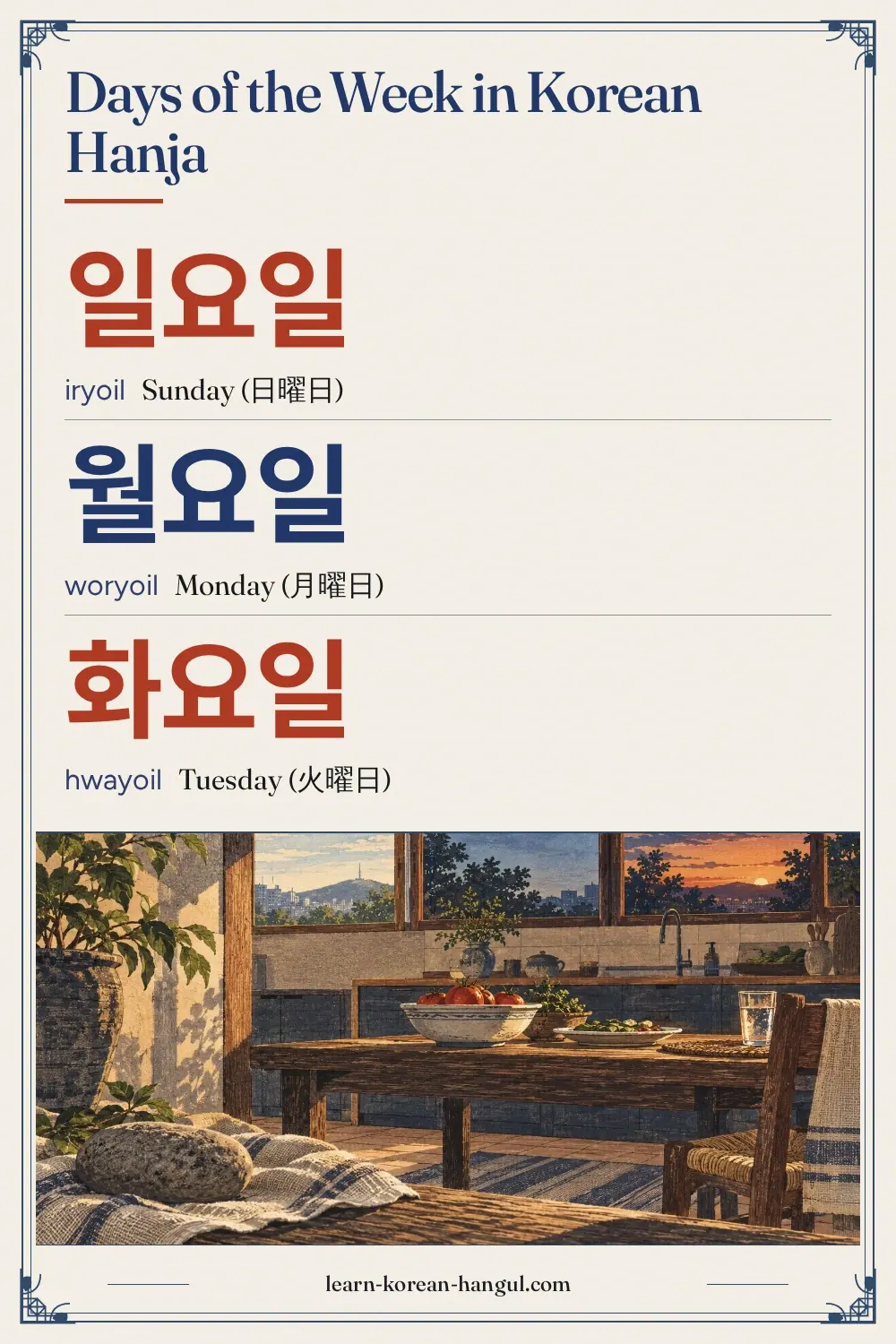
Hanja (한자) are Chinese characters used in Korean. You do not need them to say the weekdays, because the Hangul is simple, but they turn seven syllables you have memorised into seven pictures with meanings. That is the quickest way to see how Sino-Korean words work.
This is the third of ten theme groups in the basic hanja set. Plan about 20 minutes. If you want the weekdays as everyday vocabulary with audio and example sentences, go to days of the week in Korean; this page explains the characters behind those names.
Days of the Week in Korean Hanja: the Essentials
The table gives each character with its 음훈, the traditional way Korean dictionaries teach a character: a native meaning word, then the Sino-Korean sound. So 火 is "불 화", "fire, sound hwa". The first seven rows are the weekday characters in the order of the memory string 日月火水木金土, which starts with Sunday. The last three are nature characters.
| Character | 음훈 (meaning word + sound) | Reading | Core meaning | Two words it builds |
|---|---|---|---|---|
| 日 | 날 일 | 일 | sun; day | 일요일, 생일 |
| 月 | 달 월 | 월 | moon; month | 월요일, 월급 |
| 火 | 불 화 | 화 | fire | 화요일, 화재 |
| 水 | 물 수 | 수 | water | 수요일, 수영 |
| 木 | 나무 목 | 목 | tree; wood | 목요일, 식목일 |
| 金 | 쇠 금 | 금 | metal; gold; money | 금요일, 현금 |
| 土 | 흙 토 | 토 | earth; soil | 토요일, 토지 |
| 山 | 메 산 | 산 | mountain | 등산, 화산 |
| 川 | 내 천 | 천 | stream; river | 산천, 하천 |
| 天 | 하늘 천 | 천 | sky; heaven | 천국, 천재 |
The memory string starts with Sunday, so learn it as a rhyme: 일 월 화 수 목 금 토. Say it aloud once and you have said the syllable of every weekday. To get the weekday, add 요일: 일요일, 월요일, 화요일, 수요일, 목요일, 금요일, 토요일.
How Do You Read Each Character?
Each character has one main reading, except 金, which also has a surname reading. The notes give a picture and the one sound fact worth knowing. The pictures are memory aids, not strict word histories.
- 日 일 (날 일). A box with a bar inside, the picture of the sun. Its two meanings, "sun" and "day", explain 일요일 (sun-day) and 생일 (the day of birth). It is shorter than 目 (eye) and has one bar inside where 目 has two. It shares the sound 일 with 一 (one): 일월 (一月, January) and 일요일 (日曜日) start alike but use different characters.
- 月 월 (달 월). A crescent with two bars inside. Like 日, it carries two meanings: "moon" and "month". 월요일 is literally moon-day. In 월급 it means monthly pay: 月 "month" + 給 "give". In 월요일 the ㄹ links to the next syllable, [워료일].
- 火 화 (불 화). A flame with two sparks flying off. Tuesday is the day of Mars, which is 화성 (火星, "fire star"). 화재 is a fire disaster, so you will see it on safety notices: 화재 발생 means a fire has broken out. Do not confuse it with 花 (flower) or 話 (talk), both also 화.
- 水 수 (물 수). A central stroke with drops on each side, like a stream. Wednesday is the day of Mercury, 수성 (水星). In 수영 (swimming) it pairs with 泳 "swim". Note the homophones: 手 (hand) and 數 (number) are also 수.
- 木 목 (나무 목). A trunk, branches and roots, so this is literally a tree. Thursday is the day of Jupiter, 목성 (木星). In 목요일 the ㄱ moves to the next syllable, [모교일]. In 식목일 (tree-planting day) the ㄱ of 식 turns nasal before ㅁ, so the word is [싱모길].
- 金 금 (쇠 금). A roof over earth and two small dots, the nuggets inside the ground. It means metal, gold and money. Friday is the day of Venus, 금성 (金星). As a surname it is read 김, the surname Kim, one of Korea's most common. In 금요일 the ㅁ simply links to the next syllable, [그묘일], with no added ㄴ.
- 土 토 (흙 토). A cross standing on a ground line, a sprout growing out of the soil. Saturday is the day of Saturn, 토성 (土星). 토지 means a piece of land. Do not mix it up with 士 (scholar): in 土 the lower line is longer, and in 士 the upper one is.
- 山 산 (메 산). Three peaks on a base, exactly a mountain. 메 is an old native word for mountain, and the 음훈 uses it. In 등산 it follows 登 "climb": climb a mountain. In 화산 (volcano) it follows 火: a fire mountain, a clear picture.
- 川 천 (내 천). Three vertical strokes of flowing water. 산천 (mountains and rivers) is a poetic word for the countryside, as in 산천초목, nature. 하천 is the plain word for a stream or small river. It shares the sound 천 with 千 (thousand) and 天 (heaven), so the three are easy to confuse by ear.
- 天 천 (하늘 천). A person (大) with a line above: what is over a person's head, the sky. 천국 (heaven) is 天 + 國 (country). 천재 is 天 "heaven" + 才 "talent", someone born with a gift from above. Compare 千 and 川: the same sound, three different shapes and meanings.
The seven weekday characters are the same seven syllables you hear in the weekday names, so you can use the days themselves as your memory aid. Match each to a day you know, then check the character against the picture in the note.
Which Words Does Each Character Build?
Each character builds two common words. The "Said" column gives the pronunciation where it differs from the spelling, and the romanization follows the official Revised Romanization rules: 금요일 is geumyoil, with no inserted ㄴ.
| Character | Word | Hanja | Revised Romanization | Said | Meaning |
|---|---|---|---|---|---|
| 日 | 일요일 | 日曜日 | iryoil | [이료일] | Sunday |
| 日 | 생일 | 生日 | saengil | as spelled | birthday |
| 月 | 월요일 | 月曜日 | woryoil | [워료일] | Monday |
| 月 | 월급 | 月給 | wolgeup | as spelled | monthly salary |
| 火 | 화요일 | 火曜日 | hwayoil | as spelled | Tuesday |
| 火 | 화재 | 火災 | hwajae | as spelled | fire (disaster) |
| 水 | 수요일 | 水曜日 | suyoil | as spelled | Wednesday |
| 水 | 수영 | 水泳 | suyeong | as spelled | swimming |
| 木 | 목요일 | 木曜日 | mogyoil | [모교일] | Thursday |
| 木 | 식목일 | 植木日 | singmogil | [싱모길] | Arbor Day |
| 金 | 금요일 | 金曜日 | geumyoil | [그묘일] | Friday |
| 金 | 현금 | 現金 | hyeongeum | as spelled | cash |
| 土 | 토요일 | 土曜日 | toyoil | as spelled | Saturday |
| 土 | 토지 | 土地 | toji | as spelled | land |
| 山 | 등산 | 登山 | deungsan | as spelled | hiking |
| 山 | 화산 | 火山 | hwasan | as spelled | volcano |
| 川 | 산천 | 山川 | sancheon | as spelled | mountains and rivers |
| 川 | 하천 | 河川 | hacheon | as spelled | stream |
| 天 | 천국 | 天國 | cheonguk | as spelled | heaven |
| 天 | 천재 | 天才 | cheonjae | as spelled | genius |
Seven of the twenty words are weekday names. The other thirteen show the same characters at work in different places: money (현금, 월급), nature (화산, 하천), life events (생일), sport (수영, 등산) and ideas (천국, 천재). That spread is the lesson: one short character, many uses.
Listen to the first word of each pair in the flashcard deck below, and to the second words here:
Why Do the Weekdays Match the Planets and Elements?
East Asian astronomy named seven bright bodies in the sky: the sun, the moon and five planets. Each of the five planets was linked to one of the five elements, and Korean uses the same characters for the planet and for the weekday. That is why the weekday table and the planet table share five syllables.
| Character | Weekday | Planet | Element |
|---|---|---|---|
| 月 | 월요일 (Monday) | the moon, 달 | moon |
| 火 | 화요일 (Tuesday) | 화성 (Mars) | fire |
| 水 | 수요일 (Wednesday) | 수성 (Mercury) | water |
| 木 | 목요일 (Thursday) | 목성 [목썽] (Jupiter) | wood |
| 金 | 금요일 (Friday) | 금성 (Venus) | metal |
| 土 | 토요일 (Saturday) | 토성 (Saturn) | earth |
| 日 | 일요일 (Sunday) | the sun, 해 | sun |
English also names Sunday and Monday for the sun and the moon, and Saturday for the planet Saturn. Korean keeps the East Asian version of the same idea. The space and planets page lists the planets with audio.
What Reading or Spelling Traps Should You Know?
- Linking in 월요일, 일요일 and 목요일. A final consonant moves onto the next vowel sound: 월요일 is [워료일], 일요일 is [이료일] and 목요일 is [모교일]. The spelling does not change.
- No inserted ㄴ in 금요일. The standard pronunciation is [그묘일] (geumyoil): the ㅁ simply links to the next syllable.
- Nasal change in 식목일. The ㄱ of 식 becomes ㅇ before ㅁ, so 식목일 is [싱모길].
- Homophones. 日 and 一 are both 일. 木 and 目 are both 목. 金 and 今 are both 금. 水 and 手 are both 수. 火, 花 (flower) and 話 (talk) are all 화. 千, 川 and 天 are all 천. In Hangul only the word tells you which.
- Look-alike characters. 日 (sun) and 目 (eye) differ by one bar; 土 and 士 differ in which line is longer; 木 (tree) and 末 (end) differ in the length of the upper bar.
- Two meanings in one character. 日 means both "sun" and "day", and 月 means both "moon" and "month". Korean uses the same characters for the month names: 삼월 is 三月.
Practice This Group
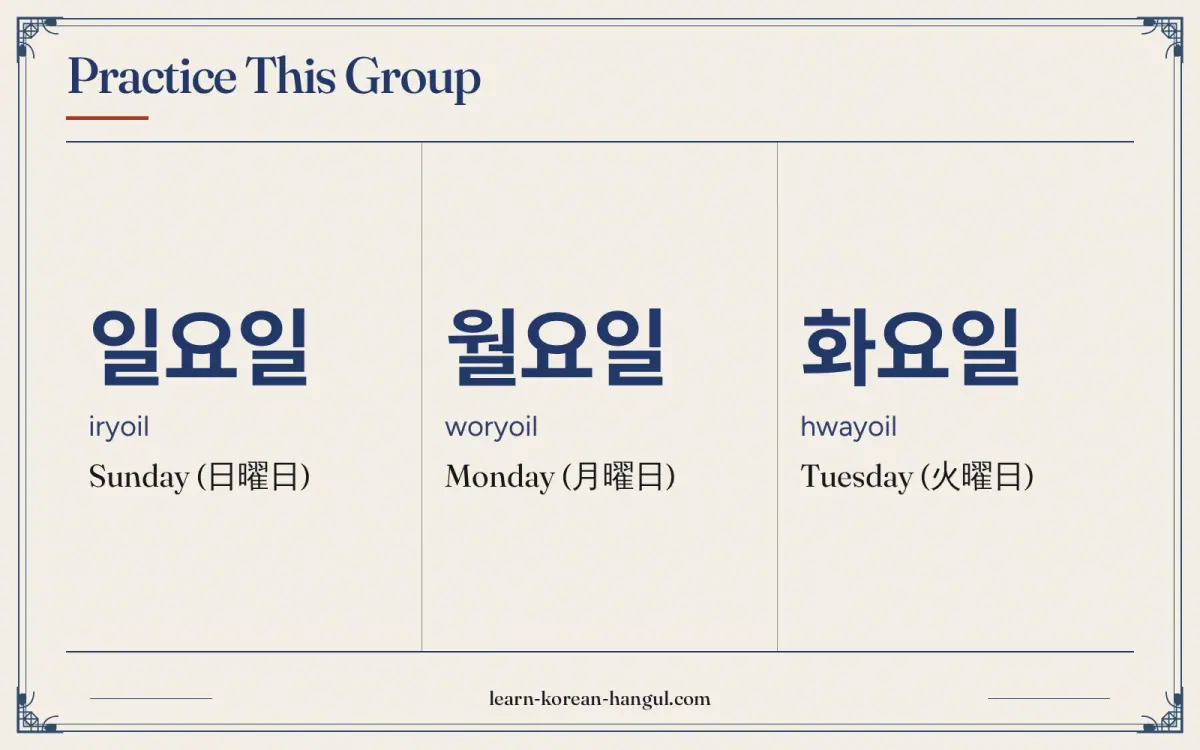
The deck uses the first word from each pair, which are the seven weekday names first and then three nature words. The table shows exactly what is in the deck.
| # | Korean | Revised Romanization | Meaning | Character note |
|---|---|---|---|---|
| 1 | 일요일 | iryoil | Sunday (日曜日) | 日 (날 일). A box with a bar: the sun. Also "day", as in 生日. |
| 2 | 월요일 | woryoil | Monday (月曜日) | 月 (달 월). A crescent moon. Also "month": 月給 = monthly pay. |
| 3 | 화요일 | hwayoil | Tuesday (火曜日) | 火 (불 화). A flame with sparks. Tuesday = fire day. |
| 4 | 수요일 | suyoil | Wednesday (水曜日) | 水 (물 수). A stream with drops. Wednesday = water day. |
| 5 | 목요일 | mogyoil | Thursday (木曜日) | 木 (나무 목). A tree with branches and roots. Thursday = wood day. |
| 6 | 금요일 | geumyoil | Friday (金曜日) | 金 (쇠 금). Dots of metal under a roof. 現金 = cash. As a surname, 김. |
| 7 | 토요일 | toyoil | Saturday (土曜日) | 土 (흙 토). A sprout on a ground line. Saturday = earth day. |
| 8 | 등산 | deungsan | hiking (登山) | 山 (메 산). Three peaks. 登山 = climb a mountain; 火山 = volcano. |
| 9 | 산천 | sancheon | mountains and rivers (山川) | 川 (내 천). Three flowing lines. 山川 = mountains and rivers. |
| 10 | 천국 | cheonguk | heaven (天國) | 天 (하늘 천). A line above a big person: the sky. 天才 = a gifted person. |
Practice · 10
- 01일요일
Show answer
iryoil
Sunday (日曜日)
- 02월요일
Show answer
woryoil
Monday (月曜日)
- 03화요일
Show answer
hwayoil
Tuesday (火曜日)
- 04수요일
Show answer
suyoil
Wednesday (水曜日)
- 05목요일
Show answer
mogyoil
Thursday (木曜日)
- 06금요일
Show answer
geumyoil
Friday (金曜日)
- 07토요일
Show answer
toyoil
Saturday (土曜日)
- 08등산
Show answer
deungsan
hiking (登山)
- 09산천
Show answer
sancheon
mountains and rivers (山川)
- 10천국
Show answer
cheonguk
heaven (天國)
Recall drill. Say the weekday rhyme 일 월 화 수 목 금 토 without looking. Then write the character for each (or point to it in the table) and add 요일: 일요일, 월요일, 화요일 and so on. Next, from the nature set, say aloud what 화산 (fire + mountain), 산천 (mountain + stream) and 천국 (sky + country) mean, using the picture in each character.
Check Yourself
Practice · 6
Which seven characters are the weekday names, in Korean order from Monday to Sunday?
Show answer
月火水木金土日
Monday is 月 (월요일), then 火 (화), 水 (수), 木 (목), 金 (금), 土 (토) and 日 (일, Sunday). The memory string 日月火水木金土 starts with Sunday.
What does 曜日 (요일) mean in 월요일?
Show answer
day of the week
曜日 means "day of the week". 월요일 is 月 + 曜日, the moon day.
Which weekday has 金 in it?
Show answer
금요일
金 is read 금, so 금요일 (Friday) uses it. 수요일 uses 水, 목요일 uses 木 and 토요일 uses 土.
How is 목요일 (Thursday) actually pronounced?
Show answer
[모교일]
The final ㄱ of 목 moves onto the 요 syllable, giving [모교일]. No weekday name has an inserted ㄴ: 금요일 is [그묘일].
What does 화산 (火山) mean?
Show answer
a volcano
火 "fire" + 山 "mountain" = a fire mountain, a volcano.
Which of these three characters is NOT read 천?
Show answer
山
山 is read 산. The three that share 천 are 千 (thousand), 川 (stream) and 天 (sky).
A Four-Day Plan for This Group
- Day 1. Learn 日 月 火 and the three weekday names they make: 일요일, 월요일, 화요일.
- Day 2. Learn 水 木 金 土 and the other four names. Say the rhyme 일 월 화 수 목 금 토.
- Day 3. Learn 山 川 天 and the second word of each pair. Play the ten audio buttons.
- Day 4. Run the flashcards, then the quiz. Revisit missed characters after one day.
What to Learn Next
The next group is hanja for family and people, where 男女, 父母 and 兄弟 come in pairs. To see the whole set, open common hanja characters. If you want these weekdays as everyday vocabulary with example sentences, go to days of the week in Korean. The month names use the same characters as the numbers on Korean numbers in hanja, and hanja word families shows how one character like 日 or 山 opens a family of words.
Frequently Asked Questions
Why are Korean weekdays named after elements?
The Korean day names came from the East Asian seven-day system that pairs the sun, the moon and the five visible planets with the five elements: fire, water, wood, metal and earth. Mars is the fire star (화성), Mercury the water star (수성), Jupiter the wood star (목성), Venus the metal star (금성) and Saturn the earth star (토성). The weekdays take those same syllables.
What does 曜日 mean in the weekday names?
曜日 (요일) means "day of the week". Each weekday is one of the seven characters plus 요일: 月 + 曜日 is 월요일 (Monday), 火 + 曜日 is 화요일 (Tuesday), and so on. Leave out the 요일 and you get the bare element or luminary, such as 월 (moon, month) or 화 (fire).
Why does 金 read 김 in a surname?
金 has two readings in Korean. As "metal, gold, money" it is 금, as in 금요일 (Friday) and 현금 (cash). As a surname it is read 김, so the family name Kim is written 金 in hanja. The same character is thus 김 in a person's name and 금 in a word.
Do all weekdays use hanja?
Yes. Standard Korean has no native Korean weekday names, so all seven are Sino-Korean: each is one character plus 요일. Because of this, the weekdays are some of the easiest hanja to learn: you already know the Hangul syllable, so you only add the picture.
Is 日 read 일 or 날?
日 is read 일 in Korean words. 날 is the native Korean word for "day" and is the meaning word in its 음훈 (날 일), so you will see it in sentences like 오늘은 무슨 날이에요? (What day is today?). In weekday names and in compounds like 생일, the character is 일.