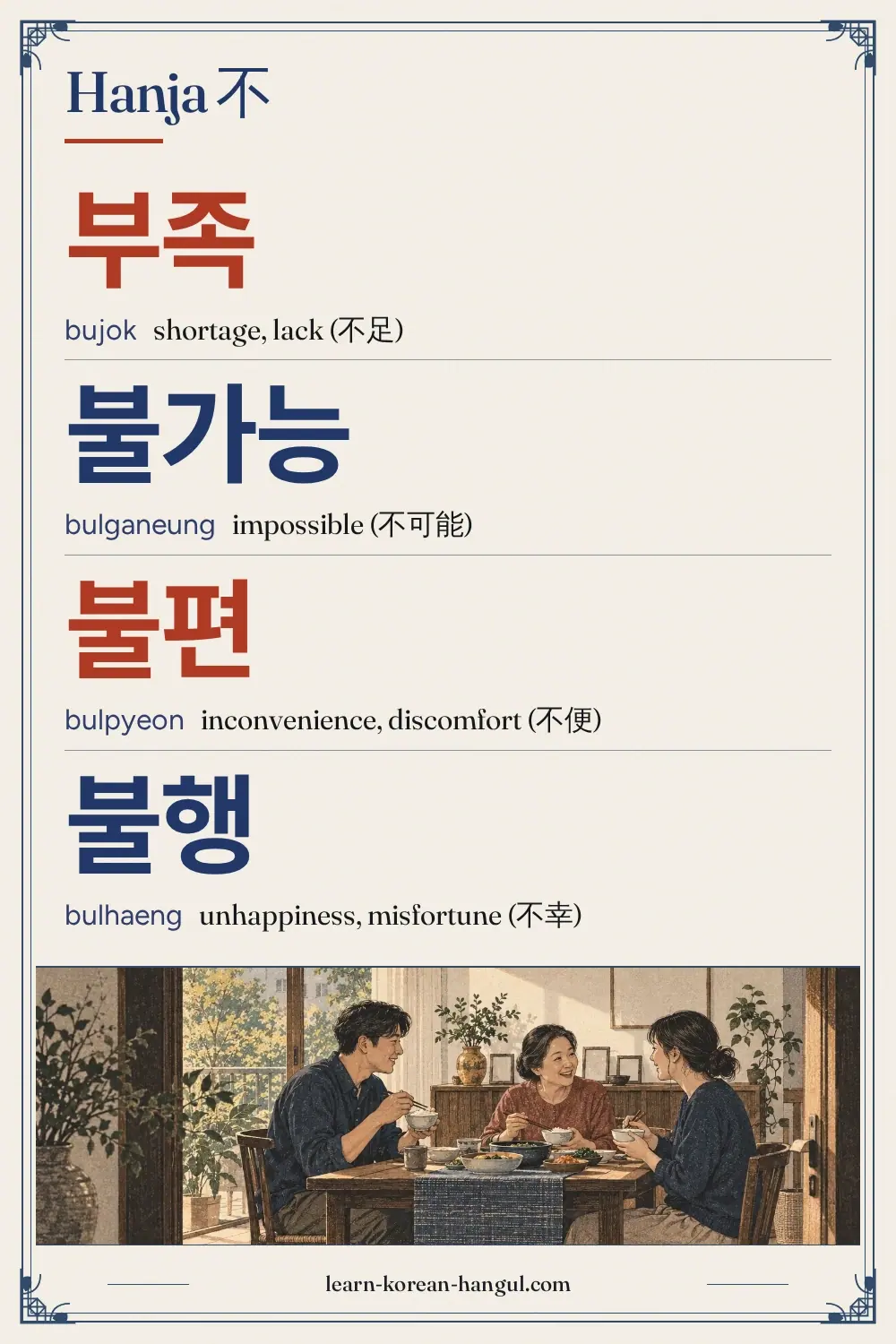
Hanja 不: the Essentials
Hanja 不 is one of the shortest and most productive characters in Korean. Its 음훈 (the pair of the native meaning word and the Korean reading, as dictionaries list it) is 아닐 불/부. The meaning word 아닐 is the adnominal form of the native verb 아니다 (to not be), so it is a way of explaining the character, not a word you would say. The readings 불 and 부 are the sounds you hear in Sino-Korean words.
The character is simple: a horizontal stroke on top, a vertical stroke below it and two short strokes beside the vertical. Dictionaries file it under 一, the radical for "one", because of the top stroke. The shape is easy to remember as a line with a tail, but its two readings need attention.
In practice 不 does one job: it negates the meaning of the character that follows. 安 (safe) becomes 不安 (not safe, anxiety), 便 (convenient) becomes 不便 (inconvenience) and 幸 (happy) becomes 不幸 (unhappiness). The card below sums up the character and its two readings.
| Item | Detail |
|---|---|
| Character | 不 |
| 음훈 | 아닐 불/부 |
| Readings | 불 (bul) and 부 (bu) |
| Core meanings | not; un-; non- |
| Radical | 一 (one) |
| Strokes | 4 |
| Words on this page | 12 |
Of the 12 words in the list, eight use 불 and four use 부. The four with 부 all have a ㄷ or ㅈ right after it: 부족, 부동산, 부정, 부당. The next sections show the pattern and why it matters.
Which Words Does 不 Build?
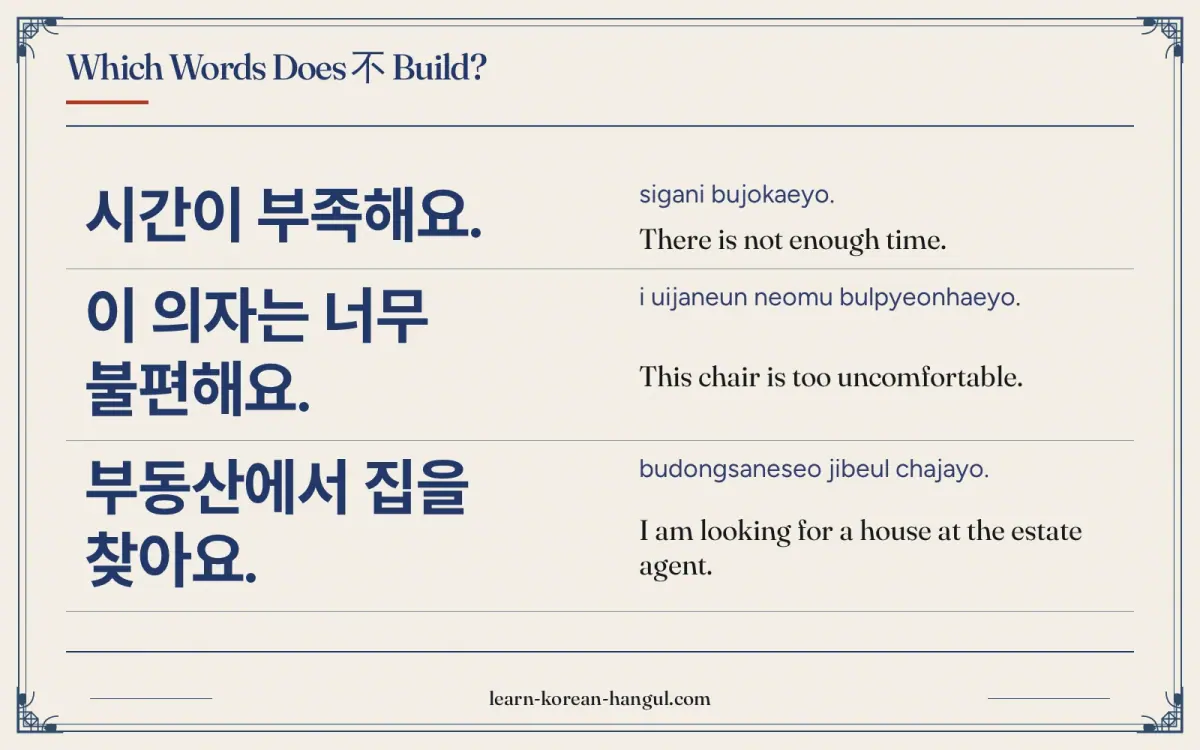
These 12 words are the best ones to learn first. They cover feelings, shortage, ability, comfort, money and fairness. Revised Romanization (RR) appears only as a learning aid, and square brackets show the spoken form where it differs from the spelling.
| Word | Characters | RR | Meaning | How the characters add up |
|---|---|---|---|---|
| 불안 [부란] | 不安 | buran | anxiety, unease | 不 not + 安 safe |
| 부족 | 不足 | bujok | shortage, lack | 不 not + 足 enough |
| 불가능 | 不可能 | bulganeung | impossible | 不 not + 可能 possible |
| 불편 | 不便 | bulpyeon | inconvenience, discomfort | 不 not + 便 convenient |
| 불행 | 不幸 | bulhaeng | unhappiness, misfortune | 不 not + 幸 happy |
| 부동산 | 不動産 | budongsan | real estate, property | 不 not + 動 move + 産 property |
| 부정 | 不正 | bujeong | dishonesty, wrongdoing | 不 not + 正 right |
| 불만 | 不滿 | bulman | dissatisfaction, complaint | 不 not + 滿 full |
| 불황 | 不況 | bulhwang | recession, slump | 不 not + 況 situation |
| 불량 | 不良 | bullyang | defective, bad quality | 不 not + 良 good |
| 부당 | 不當 | budang | unjust, unfair | 不 not + 當 right |
| 불신 [불씬] | 不信 | bulsin | distrust | 不 not + 信 trust |
Two patterns are worth knowing. First, 不 always comes at the front of the word and negates the part that follows, much like un- or in- in English: 불가능, 불편, 불행, 부당. Second, it attaches to both one-character and two-character partners, as in 不可能 (不 + 可能). Other common words are 불필요 (unnecessary), 불친절 (unkind), 불공평 (unfair) and 부적절 (inappropriate). When you see 불- or 부- at the start of a Sino-Korean word, check whether it is the negative before you look for another meaning.
The 12 Words One by One
불안 [부란] (不安, buran): anxiety, unease. The feeling of not being at ease: 불안하다 (to feel anxious), 불안감 (a sense of anxiety), 마음이 불안해요 (my mind is uneasy). The final ㄹ of 불 moves to the empty ㅇ of 안, so it is said [부란]. RR writes the sound: buran.
부족 (不足, bujok): shortage, lack. Not enough: 시간이 부족해요 (there is not enough time), 부족하다 (to be lacking), 수면 부족 (lack of sleep). Here 不 is read 부 because the next sound is ㅈ. The spoken form of the predicate is 부족해요 [부조캐요]. 足 (족) also appears in 만족 (satisfaction).
불가능 (不可能, bulganeung): impossible. The negative of 가능 (possible): 불가능하다 (to be impossible) and 불가능한 일 (an impossible thing). Here 不 attaches to a two-character word, 可能. The opposite is 가능. A softer neighbour is 불가 (不可, not allowed), as in 출입 불가 (no entry).
불편 (不便, bulpyeon): inconvenience, discomfort. Not convenient, not comfortable: 불편하다 (to be inconvenient), 불편한 의자 (an uncomfortable chair). It is a gentle word, used for things and for situations, and also for feeling awkward: 그 사람과 있으면 불편해요. The opposite is 편하다 (comfortable).
불행 (不幸, bulhaeng): unhappiness, misfortune. Bad luck or unhappiness as a state: 불행한 일 (an unfortunate event), 불행하다 (to be unhappy). The opposite is 행복 (幸福, happiness). It is a fairly formal word. In daily speech people usually say 행복하지 않아요 (I am not happy).
부동산 (不動産, budongsan): real estate, property. Property that cannot be moved, so land and buildings: 부동산에 가요 (I go to the estate agent), 부동산 중개 (real estate brokerage). 不 is 부 because 동 begins with ㄷ. The opposite is 동산 (動産, movable property), a legal term.
부정 (不正, bujeong): dishonesty, wrongdoing. Not right, so cheating or illegal: 부정행위 (cheating, misconduct), 부정 선거 (a rigged election). It is one of three words written 부정. The others are 否定 (denial) and 不定 (uncertain). 不 is 부 before ㅈ here too.
불만 (不滿, bulman): dissatisfaction, complaint. Not being satisfied, "not full": 불만이 있어요 (I have a complaint), 불만족 (dissatisfaction) and 불평 (complaining out loud). The final ㄹ of 불 and the ㅁ of 만 stay apart: [불만].
불황 (不況, bulhwang): recession, slump. A bad period for the economy: 경제 불황 (an economic slump), 불황기 (a time of recession). 況 (황) means a condition and also appears in 상황 (situation) and 현황 (current state). The opposite is 호황 (好況, a boom).
불량 (不良, bullyang): defective, bad quality. Not good in quality or behaviour: 불량품 (a defective product), 불량 식품 (unsafe food), 불량 학생 (a delinquent student). The ㄹ of 불 and the ㄹ of 량 meet and make a long ㄹ, so RR writes bullyang. The opposite is 양호 (良好, good).
부당 (不當, budang): unjust, unfair. Not right or not fair, as a judgement: 부당한 대우 (unfair treatment), 부당 해고 (unfair dismissal), 부당하다 (to be unjust). It is a formal word used in law and the news. 不 is 부 before ㄷ.
불신 [불씬] (不信, bulsin): distrust. Lack of trust: 불신이 커지다 (distrust grows), 정치 불신 (distrust of politics). After the final ㄹ, a Sino-Korean ㅅ is tense, so it is said [불씬]. RR does not mark this tense sound and writes bulsin. The opposite is 신뢰 (信賴, trust).
Sentences to Hear the Words in Use
Six of the words appear in short sentences. Listen to each one first, then read it aloud with the audio. The brackets in the word table show how the words are said in connected speech.
요즘 불안해서 잠이 안 와요.
yojeum buranhaeseo jami an wayo.
I am anxious lately, so I cannot sleep.
시간이 부족해요.
sigani bujokaeyo.
There is not enough time.
이 일은 혼자서는 불가능해요.
i ireun honjaseoneun bulganeunghaeyo.
This job is impossible to do alone.
이 의자는 너무 불편해요.
i uijaneun neomu bulpyeonhaeyo.
This chair is too uncomfortable.
부동산에서 집을 찾아요.
budongsaneseo jibeul chajayo.
I am looking for a house at the estate agent.
서비스에 불만이 있어요.
seobiseue bulmani isseoyo.
I have a complaint about the service.
How Is 不 Read in Different Words?
The reading of 不 is the main reason for this page. It is read 불 in most words and 부 in some, and the choice depends on the sound that comes right after it.
Rule box: 불 or 부. In words from Sino-Korean, 不 is read 부 before ㄷ or ㅈ, and 불 before other sounds.
- Before ㅈ: 不足 부족, 不正 부정. Before ㄷ: 不動産 부동산, 不當 부당.
- Before other sounds: 不安 불안 (ㅇ), 不便 불편 (ㅍ), 不幸 불행 (ㅎ), 不滿 불만 (ㅁ), 不信 불신 (ㅅ), 不可能 불가능 (ㄱ).
The rule comes from the history of the sound. The ㄹ of 불 is not written before ㄷ and ㅈ, and the spelling follows the way these words came to be said. The result is that you can read most 不 words from the second syllable. If it begins with ㄷ or ㅈ, say 부; otherwise say 불. The pattern is not complete, so treat it as a strong guide: learn each new word with its reading, as the dictionary gives it.
Sound changes in the list:
- 불안 → [부란]: the final ㄹ moves onto the empty ㅇ of 안 (liaison). RR writes buran.
- 불신 → [불씬]: in Sino-Korean words, a final ㄹ makes a following ㅅ tense. RR writes bulsin.
- 불량 → [불량]: the ㄹ of 불 and the ㄹ of 량 meet and are said as one long ㄹ. RR writes bullyang.
- 부족해요 → [부조캐요]: in a verb or adjective, ㄱ and ㅎ merge into ㅋ. RR writes bujokaeyo.
In the other words nothing happens: [불가능], [불편], [불행], [불만], [불황], [부동산], [부정], [부당]. For English speakers, 불 ends with a clear ㄹ: keep your tongue tip on the ridge behind the upper teeth at the end of the syllable. 부 has the vowel ㅜ, like "oo" in "moon", and is short.
What Is Easy to Confuse with 不?
不, 無 and 非. All three make a negative, but they do not work in the same way. 不 (불/부) negates an action or a quality: 불안 (not safe). 無 (무) means "without" or "there is none": 무료 (free, without charge) and 무관심 (indifference). 非 (비) means "non-" or "wrong": 비공개 (non-public) and 비상 (emergency). 未 (미) means "not yet": 미완성 (unfinished). The meanings overlap a little, so learn each word as a whole.
Three words 부정. The sound 부정 is three words. 不正 (부정) is wrongdoing, 否定 (부정) is denial, and 不定 (부정) means uncertain or not fixed. Only the first is in the list. The sentence shows which one: 부정행위 (cheating) is 不正, 부정적 (negative) is 否定, and 주거 부정 (no fixed residence) is 不定.
불행 and 부정 are not the same. 불행 (不幸) is misfortune or unhappiness. 부정 (不正) is dishonesty. One is about luck or feeling, and the other is about wrong behaviour. Both are "not" words, which is why they look alike.
불 (fire) and 不. The native word 불 means fire, as in 불이 났어요 (there is a fire). It has no hanja and is not a negative. In a few words 불 is also the character 佛 (Buddha), as in 불교 (Buddhism). 불교 and 불편 look alike in Hangul but are unrelated.
不 and 아니다. The native word 아니다 (to not be) and 안 (not) do the same job as 不 in plain Korean: 안 편해요 (it is not comfortable) and 불편해요 (it is inconvenient). The native pair is used in daily speech. The hanja version feels more fixed and formal.
Practice This Family
The 12 Words as Flashcards
The deck below has one card for each of the 12 words, with audio. The table shows the same cards, so you can study from either one.
| # | Korean | RR | Meaning | Character and note |
|---|---|---|---|---|
| 1 | 불안 [부란] | buran | anxiety, unease (不安) | 不 (아닐 불) + 安 (편안할 안). Said [부란]. 불안하다 = feel anxious. |
| 2 | 부족 | bujok | shortage, lack (不足) | 不 + 足 (족할 족). 不 is 부 before ㅈ. 수면 부족 = lack of sleep. |
| 3 | 불가능 | bulganeung | impossible (不可能) | 不 + 可能 (가능). The negative of 가능. 출입 불가 = no entry. |
| 4 | 불편 | bulpyeon | inconvenience, discomfort (不便) | 不 + 便 (편할 편). Not convenient. Opposite: 편리 / 편하다. |
| 5 | 불행 | bulhaeng | unhappiness, misfortune (不幸) | 不 + 幸 (다행 행). Unhappiness. Opposite: 행복. |
| 6 | 부동산 | budongsan | real estate, property (不動産) | 不 + 動 (움직일 동) + 産 (낳을 산). Immovable property = real estate. |
| 7 | 부정 | bujeong | dishonesty, wrongdoing (不正) | 不 + 正 (바를 정). Cheating: 부정행위. Other 부정: 否定 = denial. |
| 8 | 불만 | bulman | dissatisfaction, complaint (不滿) | 不 + 滿 (찰 만). Not full, not satisfied. 불만이 있다 = have a complaint. |
| 9 | 불황 | bulhwang | recession, slump (不況) | 不 + 況 (상황 황). A slump. Opposite: 호황 (boom). |
| 10 | 불량 | bullyang | defective, bad quality (不良) | 不 + 良 (어질 량). Defective. 불량품 = defective goods. |
| 11 | 부당 | budang | unjust, unfair (不當) | 不 + 當 (마땅 당). Unfair. 부당 해고 = unfair dismissal. |
| 12 | 불신 [불씬] | bulsin | distrust (不信) | 不 + 信 (믿을 신). Said [불씬]. Opposite: 신뢰 (trust). |
Practice · 12
- 01불안 [부란]
Show answer
buran
anxiety, unease (不安)
- 02부족
Show answer
bujok
shortage, lack (不足)
- 03불가능
Show answer
bulganeung
impossible (不可能)
- 04불편
Show answer
bulpyeon
inconvenience, discomfort (不便)
- 05불행
Show answer
bulhaeng
unhappiness, misfortune (不幸)
- 06부동산
Show answer
budongsan
real estate, property (不動産)
- 07부정
Show answer
bujeong
dishonesty, wrongdoing (不正)
- 08불만
Show answer
bulman
dissatisfaction, complaint (不滿)
- 09불황
Show answer
bulhwang
recession, slump (不況)
- 10불량
Show answer
bullyang
defective, bad quality (不良)
- 11부당
Show answer
budang
unjust, unfair (不當)
- 12불신 [불씬]
Show answer
bulsin
distrust (不信)
Decode Three Unseen Words
不必要 불필요 (bulpiryo). 不 "not" + 必要 "necessary". It means unnecessary, as in 불필요한 비용 (unnecessary cost). The word is said [불피료]: a clear ㄹ before the aspirated ㅍ, and the ㄹ of 필 moves onto the empty ㅇ of 요.
不親切 불친절 (bulchinjeol). 不 "not" + 親切 "kind". It means unkind, rude service, as in 불친절한 직원. The word is said [불친절], and 不 is 불 because 친 starts with ㅊ.
不適切 부적절 (bujeokjeol). 不 "not" + 適切 "suitable". It means inappropriate. Here 不 is 부, because 適切 begins with ㅈ: 적 (jeok) starts with ㅈ. The sound is [부적쩔], with tense ㅉ in 절 after the ㄱ.
Check Yourself
Each question asks you to decode a word or answer a question about 不. The answers are checked as you go.
Practice · 6
Why is 不足 read 부족 and not 불족?
Show answer
Because 不 is read 부 before ㅈ
不 is read 부 before ㄷ and ㅈ. 足 starts with ㅈ (족), so the word is 부족.
How is 불안 (anxiety) said in normal speech?
Show answer
[부란]
The final ㄹ of 불 moves onto the empty ㅇ of 안, so the word is said [부란]. RR writes buran.
Which word means "impossible"?
Show answer
불가능
不可能 is the negative of 可能, so 불가능 is impossible. 불편 is inconvenient, 부당 is unjust and 불만 is dissatisfaction.
Which character means "without" or "there is none", unlike 不?
Show answer
無
無 (무) means without, as in 무료 (free of charge). 不 negates a quality, 非 means non- and 未 means not yet.
부동산 is 不 + 動 "move" + 産 "property". What is it?
Show answer
real estate
Property that cannot move is land and buildings, so 부동산 is real estate.
Which of these is NOT a negative made with 不?
Show answer
불꽃
불꽃 (a spark, a flame) is a native word from 불 (fire) and 꽃. The others are made with 不.
What to Learn Next
You now have 12 words and the two readings of 不. A good next step is the family for 力 (력/역), the other character in this set with two readings, where the choice depends on the position in the word. The family for 氣 (기) covers more words for feelings and moods, such as 기분 (mood). The tense ㅆ in 불신 [불씬] is explained in Sino-Korean tensification. The method behind these pages is set out in how to learn hanja, and a longer list of common hanja characters is on the page of the 100 most useful hanja. To choose another character, return to the hanja word families page. For the big picture, see Does Korean use hanja? and the hanja hub.
Frequently Asked Questions
When is 不 read 부?
In most Sino-Korean words, 不 is read 부 when the next syllable begins with ㄷ or ㅈ, and 불 before other sounds. So 不足 is 부족, 不動産 is 부동산, 不正 is 부정 and 不當 is 부당, while 不安 is 불안 and 不便 is 불편. The rule is a strong guide but not a complete one, so check the reading when you learn a new word.
Is 불행 the same as 부정?
No. 불행 (不幸) means unhappiness or misfortune. 부정 is a sound shared by three words: 不正 (wrongdoing, cheating), 否定 (denial) and 不定 (uncertain). Both 불행 and the first 부정 contain 不, but 불행 is about luck or feeling and 不正 is about wrong behaviour. They are not interchangeable.
What is the difference between 不 and 無?
不 (불/부) means "not" and negates a quality: 불안 (not at ease), 불편 (not convenient). 無 (무) means "without" or "none": 무료 (free), 무관심 (no interest). Many learners find it helpful to think of 不 as "not" and 無 as "nothing". The two do not swap, so each word has to be learned with the right one.
How is 不 related to the word 아니다?
The two do the same job in different layers of the language, but they are not the same word. 아니다 (to not be) and 안 (not) are native Korean words used in everyday speech. 不 is a Sino-Korean character used inside compounds. The dictionary meaning word for 不 is 아닐, the adnominal form of 아니다, which is why its 음훈 is 아닐 불/부.