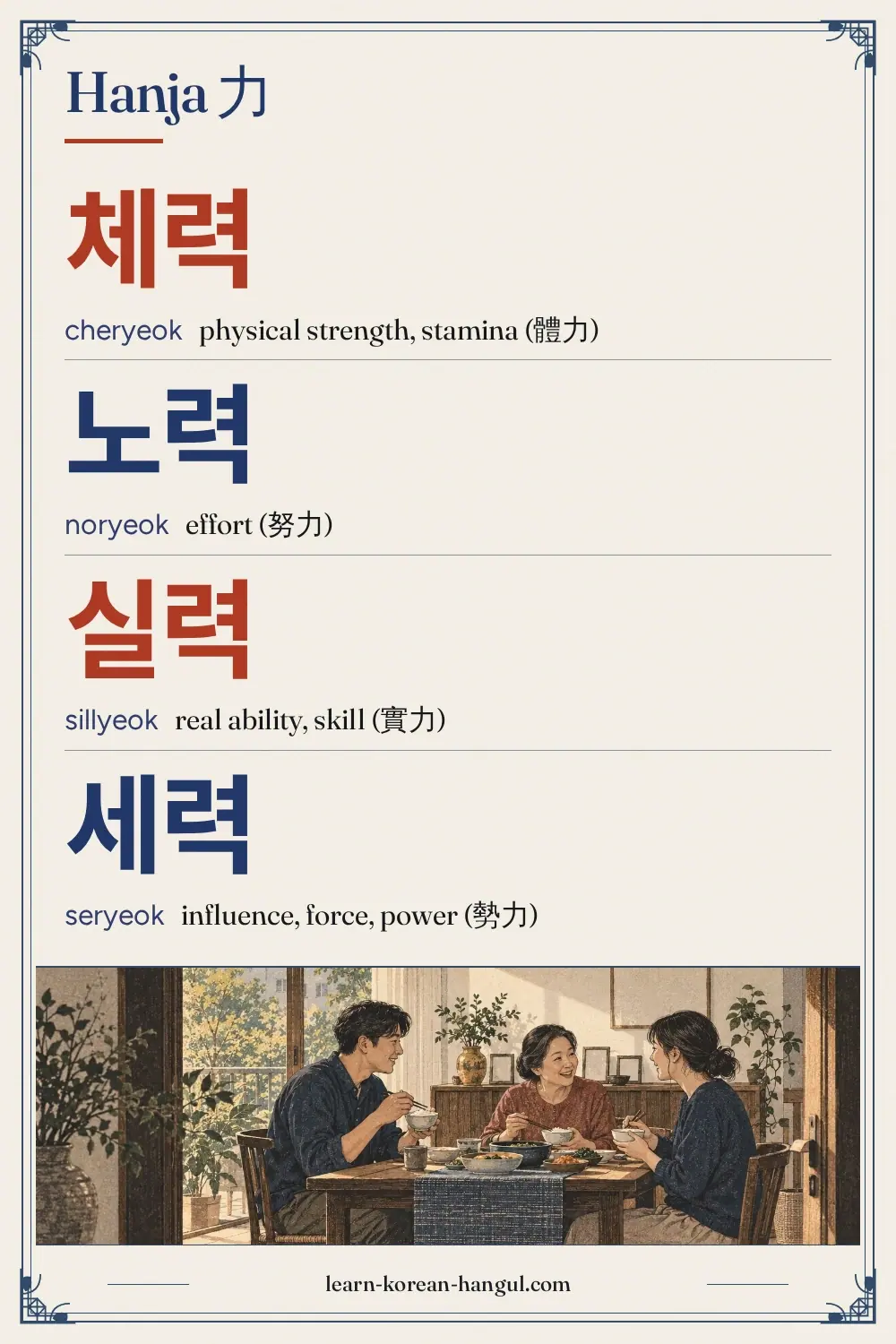
Hanja 力: the Essentials
Hanja 力 is one of the simplest characters to write and one of the most productive. Its 음훈 (the pair of the native meaning word and the Korean reading, as dictionaries list it) is 힘 력, and it is read 역 in some words. The meaning word 힘 is the native Korean word for strength: you say 힘이 세다 (to be strong) and 힘을 내다 (to cheer up). The readings 력 and 역 are the sounds you hear inside Sino-Korean words.
The character has only two strokes. A short horizontal stroke with a hook goes over a long diagonal stroke, and the shape is often described as an arm with a flexed muscle. It is also its own radical, so you will meet it as a building block in other characters, such as 助 (돕다, to help), 動 (움직이다, to move) and 勉 (힘쓰다, to make an effort).
In practice 力 mostly sits at the end of a word and makes an abstract noun of power: 능력 (ability), 체력 (physical strength), 매력 (charm). At the start of a word, which is rare, it is read 역. The card below sums up the character and the two readings.
| Item | Detail |
|---|---|
| Character | 力 |
| 음훈 | 힘 력/역 |
| Readings | 력 (ryeok) inside a word; 역 (yeok) at the start of a word |
| Core meanings | strength; power; ability |
| Radical | 力 (power), its own radical |
| Strokes | 2 |
| Words on this page | 12 |
Of the 12 words in the list, ten use 력 and two use 역: 역량 and 역사 (力士). Both 역 words begin with 力. The next sections explain why.
Which Words Does 力 Build?
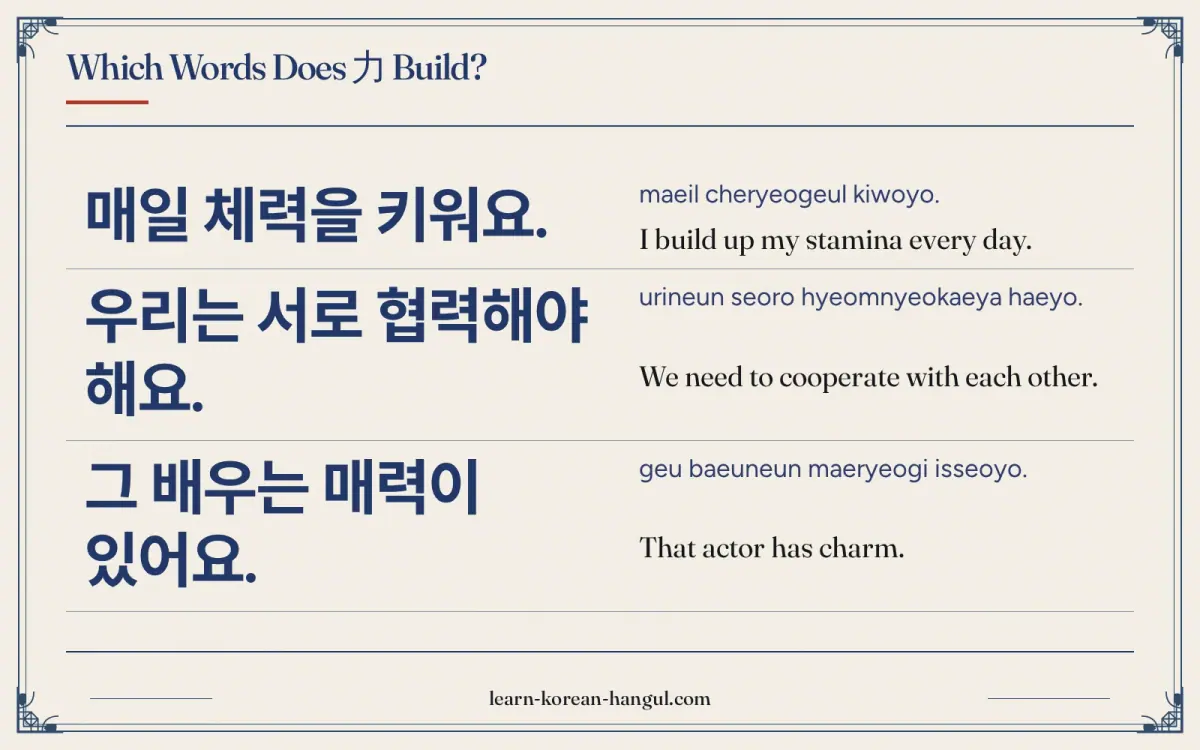
These 12 words are the best ones to learn first. They cover ability, effort, body, work, charm and violence. Revised Romanization (RR) appears only as a learning aid, and square brackets show the spoken form where it differs from the spelling.
| Word | Characters | RR | Meaning | How the characters add up |
|---|---|---|---|---|
| 능력 [능녁] | 能力 | neungnyeok | ability, capability | 能 can + 力 power |
| 전력 [절력] | 電力 | jeollyeok | electric power | 電 electricity + 力 power |
| 체력 | 體力 | cheryeok | physical strength, stamina | 體 body + 力 power |
| 노력 | 努力 | noryeok | effort | 努 strive + 力 power |
| 실력 | 實力 | sillyeok | real ability, skill | 實 real + 力 power |
| 협력 [혐녁] | 協力 | hyeomnyeok | cooperation | 協 together + 力 power |
| 역량 [영냥] | 力量 | yeongnyang | capability, competence | 力 power + 量 amount |
| 역사 [역싸] | 力士 | yeoksa | strongman, wrestler | 力 power + 士 man |
| 학력 [항녁] | 學力 | hangnyeok | academic ability; educational background | 學 study + 力 power |
| 세력 | 勢力 | seryeok | influence, force, power | 勢 momentum + 力 power |
| 매력 | 魅力 | maeryeok | charm, appeal | 魅 charm + 力 power |
| 폭력 [퐁녁] | 暴力 | pongnyeok | violence | 暴 violent + 力 force |
Two patterns are worth knowing. At the end of a word, 力 is read 력 and makes an abstract noun of power or ability: 능력, 체력, 실력, 학력, 매력. As a suffix, -력 is very productive: 집중력 (集中力, concentration), 상상력 (想像力, imagination), 영향력 (影響力, influence), 경쟁력 (競爭力, competitiveness), 지구력 (持久力, endurance) and 면역력 (免疫力, immunity) are all built from it. At the start of a word, 力 is read 역: 역량, 역사 (力士), 역도 (力道, weightlifting). So "start = 역, otherwise = 력" is a good rule of thumb.
The 12 Words One by One
능력 [능녁] (能力, neungnyeok): ability, capability. The power to do something: 능력이 있다 (to be capable), 언어 능력 (language ability), 능력 시험 (a proficiency test). The ㄹ of 력 follows ㅇ and becomes ㄴ, so it is said [능녁]. RR writes neungnyeok. 能 (능) means can and also appears in 가능 (possible).
전력 [절력] (電力, jeollyeok): electric power. Electric power as a supply: 전력 사용량 (power consumption), 전력 부족 (shortage of power). The ㄴ of 전 and the ㄹ of 력 meet and are both said as ㄹ, so the word is [절력]. RR writes jeollyeok. Do not confuse it with 전력 (全力, all one's strength) as in 전력을 다하다.
체력 (體力, cheryeok): physical strength, stamina. Strength of the body: 체력이 좋다 (to have good stamina), 체력 훈련 (physical training), 체력 시험 (a fitness test). It is about stamina and endurance more than about muscle. 體 (체) means body and also appears in 신체 (the body) and 체육 (physical education).
노력 (努力, noryeok): effort. Effort, hard work: 노력하다 (to make an effort), 노력 끝에 (after much effort), 노력의 결과 (the result of effort). It is a very common word in school, work and sport. The 노 is 努, a character that means to strive.
실력 (實力, sillyeok): real ability, skill. Skill that you really have and can show: 실력이 늘다 (one's skill improves), 한국어 실력 (Korean level), 실력 있는 사람 (a skilled person). The ㄹ of 실 and the ㄹ of 력 meet and make a long ㄹ, so RR writes sillyeok. 實 (실) means real and also appears in 사실 (fact).
협력 [혐녁] (協力, hyeomnyeok): cooperation. Working together: 협력하다 (to cooperate), 국제 협력 (international cooperation), 협력 업체 (a partner company). The final ㅂ of 협 and the ㄹ of 력 change into [ㅁ] and [ㄴ], so it is said [혐녁]. RR writes hyeomnyeok.
역량 [영냥] (力量, yeongnyang): capability, competence. The total capability of a person or an organisation, a favourite word in job ads and reviews: 역량을 키우다 (to build competence), 핵심 역량 (core competence). Here 力 is the first character, so it is read 역. The final ㄱ and the ㄹ change into [ㅇ] and [ㄴ]: [영냥]. RR writes yeongnyang.
역사 [역싸] (力士, yeoksa): strongman, wrestler. A man of great strength, a strongman. It is a rare word, mostly seen in writing about wrestling and weightlifting. Here 力 comes first, so it is read 역. It is said [역싸]. Do not confuse it with 역사 (歷史, history), which has the same sound.
학력 [항녁] (學力, hangnyeok): academic ability; educational background. Two meanings: how well someone does in school (학력 저하, a drop in academic ability) and the level of education someone has (최종 학력, highest level of education). The final ㄱ and the ㄹ change into [ㅇ] and [ㄴ], so it is said [항녁]. RR writes hangnyeok.
세력 (勢力, seryeok): influence, force, power. Power in the sense of a group's reach or a force: 세력을 넓히다 (to extend influence), 정치 세력 (a political force), 태풍의 세력 (the strength of a typhoon). 勢 (세) means momentum or force and also appears in 형세 (situation).
매력 (魅力, maeryeok): charm, appeal. The power that attracts people: 매력이 있다 (to be charming), 매력적이다 (to be attractive), 한국의 매력 (the charm of Korea). 魅 (매) means to charm or bewitch and is almost always seen in this word. The related 매력적 is the adjective form.
폭력 [퐁녁] (暴力, pongnyeok): violence. Violence, force used to hurt: 폭력 영화 (a violent film), 가정 폭력 (domestic violence), 폭력을 쓰다 (to use violence). The final ㄱ and the ㄹ change into [ㅇ] and [ㄴ], so it is said [퐁녁]. RR writes pongnyeok. It is a serious word, used in news and law.
Sentences to Hear the Words in Use
Six of the words appear in short sentences. Listen to each one first, then read it aloud with the audio. The brackets in the word table show how the words are said in connected speech.
그는 능력이 있는 사람이에요.
geuneun neungnyeogi inneun saramieyo.
He is a capable person.
매일 체력을 키워요.
maeil cheryeogeul kiwoyo.
I build up my stamina every day.
노력하면 꼭 잘할 수 있어요.
noryeokamyeon kkok jalhal su isseoyo.
If you make an effort, you can surely do well.
한국어 실력이 많이 늘었어요.
hangugeo sillyeogi mani neureosseoyo.
My Korean skills have improved a lot.
우리는 서로 협력해야 해요.
urineun seoro hyeomnyeokaeya haeyo.
We need to cooperate with each other.
그 배우는 매력이 있어요.
geu baeuneun maeryeogi isseoyo.
That actor has charm.
How Is 力 Read in Different Words?
The reading of 力 depends on where it sits in the word. It is 력 inside a word and 역 at the start. This is the initial-sound rule (두음법칙) in action: a Sino-Korean word does not begin with ㄹ in standard spelling, so a Sino-Korean syllable that is written 력 elsewhere becomes 역 when it begins a word.
Rule box: 력 or 역. Look at the position of 力.
- At the start of the word: 역. Examples: 力量 역량, 力士 역사, 力道 역도.
- Inside or at the end of the word: 력. Examples: 能力 능력, 體力 체력, 努力 노력, 魅力 매력.
For the 12 words in this list, "start = 역, otherwise = 력" is all you need.
Sound changes. When 력 follows a final consonant, the ㄹ often becomes ㄴ, and the final consonant can change too:
- After ㅇ, ㄱ, ㅂ: 능력 [능녁], 학력 [항녁], 폭력 [퐁녁], 협력 [혐녁] and 역량 [영냥]. The ㄹ becomes ㄴ, and a final ㄱ or ㅂ turns into a nasal (ㅇ or ㅁ). RR writes the change: neungnyeok, hangnyeok, pongnyeok, hyeomnyeok, yeongnyang.
- After ㄴ: 전력 [절력]. The ㄴ becomes ㄹ to match the ㄹ that follows. RR writes jeollyeok.
- After ㄹ: 실력 [실력]. The two ㄹ sounds are said as one long ㄹ. RR writes sillyeok.
- After a vowel: 체력, 노력, 세력, 매력 keep the plain ㄹ: [체력], [노력], [세력], [매력].
In 역사 (力士), the ㅅ after ㄱ is tense, [역싸]. The same tensing happens in 歷史 (history). The 노력 verb form 노력하다 is said [노려카다] because ㄱ and ㅎ merge into ㅋ, which is why RR writes noryeokada. For English speakers: the ㄹ in 력 between vowels is a quick tap of the tongue, like the middle sound of "butter" in American English, and the final ㄱ is not released.
What Is Easy to Confuse with 力?
능력, 실력 and 역량. Three words for ability with different shades. 능력 (能力) is capacity, what someone can do, even if it is not yet shown. 실력 (實力) is the skill someone really has, which they can show in a test or a match. 역량 (力量) is the total capability for a job, used in work and school documents. A person can have 능력 without yet having 실력.
力 and 刀. The characters 力 (power) and 刀 (knife, 도) look alike and differ mainly in how the strokes cross. The two shapes are close, so check the meaning: if the word is about strength or ability, the character is 力.
힘 and 力. 힘 is the native Korean word for strength, and 力 is the Sino-Korean character. 힘 can stand alone in a sentence: 힘이 세요 (you are strong), 힘들어요 (it is hard). 力 is only used inside words. The native word is the one you use in daily speech, and the hanja words are more formal.
전력 (電力) and 전력 (全力). Two words, one sound. 電力 is electric power, and 全力 is all one's strength, as in 전력을 다하다 (to do one's utmost). Both are said [절력].
역사 (力士) and 역사 (歷史). The sound 역사 is mostly history (歷史). 力士 is a rare word. If you see 역사 in a news story, assume it is history unless the context is about wrestling or lifting.
노력 and 열심히. 노력 (努力) is the noun "effort", and 열심히 (熱心히) is the adverb "hard". Say 노력하고 있어요 (I am making an effort) or 열심히 하고 있어요 (I am doing it hard). They are not interchangeable in grammar.
Practice This Family
The 12 Words as Flashcards
The deck below has one card for each of the 12 words, with audio. The table shows the same cards, so you can study from either one.
| # | Korean | RR | Meaning | Character and note |
|---|---|---|---|---|
| 1 | 능력 [능녁] | neungnyeok | ability, capability (能力) | 能 (능할 능) + 力. Said [능녁]. 언어 능력 = language ability. |
| 2 | 전력 [절력] | jeollyeok | electric power (電力) | 電 (번개 전) + 力. Said [절력]. Also 全力 = all one's strength. |
| 3 | 체력 | cheryeok | physical strength, stamina (體力) | 體 (몸 체) + 力. Stamina. 체력이 좋다 = have good stamina. |
| 4 | 노력 | noryeok | effort (努力) | 努 (힘쓸 노) + 力. Effort. 노력하다 = make an effort. |
| 5 | 실력 | sillyeok | real ability, skill (實力) | 實 (열매 실) + 力. Real skill. 한국어 실력 = Korean level. |
| 6 | 협력 [혐녁] | hyeomnyeok | cooperation (協力) | 協 (화할 협) + 力. Said [혐녁]. 협력 업체 = partner firm. |
| 7 | 역량 [영냥] | yeongnyang | capability, competence (力量) | 力 + 量 (헤아릴 량). 역 at the start. Said [영냥]. 핵심 역량 = core skill. |
| 8 | 역사 [역싸] | yeoksa | strongman, wrestler (力士) | 力 + 士 (선비 사). 역 at the start. Said [역싸]. 歷史 = history. |
| 9 | 학력 [항녁] | hangnyeok | academic ability; educational background (學力) | 學 (배울 학) + 力. Said [항녁]. 최종 학력 = highest education. |
| 10 | 세력 | seryeok | influence, force, power (勢力) | 勢 (형세 세) + 力. Influence. 정치 세력 = political force. |
| 11 | 매력 | maeryeok | charm, appeal (魅力) | 魅 (매혹할 매) + 力. Charm. 매력적이다 = be attractive. |
| 12 | 폭력 [퐁녁] | pongnyeok | violence (暴力) | 暴 (사나울 폭) + 力. Said [퐁녁]. 가정 폭력 = domestic violence. |
Practice · 12
- 01능력 [능녁]
Show answer
neungnyeok
ability, capability (能力)
- 02전력 [절력]
Show answer
jeollyeok
electric power (電力)
- 03체력
Show answer
cheryeok
physical strength, stamina (體力)
- 04노력
Show answer
noryeok
effort (努力)
- 05실력
Show answer
sillyeok
real ability, skill (實力)
- 06협력 [혐녁]
Show answer
hyeomnyeok
cooperation (協力)
- 07역량 [영냥]
Show answer
yeongnyang
capability, competence (力量)
- 08역사 [역싸]
Show answer
yeoksa
strongman, wrestler (力士)
- 09학력 [항녁]
Show answer
hangnyeok
academic ability; educational background (學力)
- 10세력
Show answer
seryeok
influence, force, power (勢力)
- 11매력
Show answer
maeryeok
charm, appeal (魅力)
- 12폭력 [퐁녁]
Show answer
pongnyeok
violence (暴力)
Decode Three Unseen Words
集中力 집중력 (jipjungnyeok). 集中 "concentrate" + 力 "power". It means the ability to concentrate: 집중력이 떨어지다 (concentration drops). The ㅇ before ㄹ turns ㄹ into ㄴ, so it is said [집중녁].
視力 시력 (siryeok). 視 "see" + 力 "power". It means eyesight: 시력이 나쁘다 (to have poor eyesight). The vowel before 력 keeps ㄹ plain, so it is said [시력].
想像力 상상력 (sangsangnyeok). 想像 "imagine" + 力 "power". It means imagination: 상상력이 풍부하다 (to have a rich imagination). The ㅇ before ㄹ turns ㄹ into ㄴ, so it is said [상상녁].
Check Yourself
Each question asks you to decode a word or answer a question about 力. The answers are checked as you go.
Practice · 6
Why is 力量 read 역량, but 能力 read 능력?
Show answer
Because 力 is read 역 at the start of a word
A Sino-Korean word does not begin with ㄹ in standard spelling, so 력 becomes 역 at the start (역량) and stays 력 inside a word (능력).
How is 능력 (ability) said in normal speech?
Show answer
[능녁]
After the ㅇ of 능, the ㄹ of 력 becomes ㄴ, so the word is [능녁]. RR writes neungnyeok.
Which word means "real skill that you can show"?
Show answer
실력
실력 (實力) is skill that is real and visible. 능력 is capacity, 체력 is stamina and 역량 is overall competence.
Which word is a physical strength or stamina word?
Show answer
체력
체력 (體力) is stamina. 매력 is charm, 노력 is effort and 협력 is cooperation.
How is 협력 (cooperation) said in normal speech?
Show answer
[혐녁]
The ㅂ of 협 becomes ㅁ and the ㄹ of 력 becomes ㄴ, so it is said [혐녁]. RR writes hyeomnyeok.
The suffix -력, as in 집중력 and 상상력, means…
Show answer
an ability or power
-력 comes from 力 and names an ability or power: 집중력 is the power to concentrate and 상상력 is the power to imagine.
What to Learn Next
You now have 12 words and the rule for 력 and 역. A good next step is the family for 不 (불/부), the other character in this set with two readings, where the choice depends on the next sound. The family for 氣 (기) covers energy and spirit, two ideas close to 力. The sound changes in 능력, 협력 and 폭력 are explained on the page about nasalization rules. The method behind these pages is set out in how to learn hanja, and a longer list of common hanja characters is on the page of the 100 most useful hanja. To choose another character, return to the hanja word families page. For the big picture, see Does Korean use hanja? and the hanja hub.
Frequently Asked Questions
Why is it 역량 but 능력?
Both words contain the same character, 力. The reading depends on its position. A Sino-Korean word does not start with ㄹ in standard spelling, so 력 becomes 역 when 力 begins a word, as in 역량 (力量). Inside a word the ㄹ is allowed, so 力 stays 력, as in 능력 (能力). This is the initial-sound rule (두음법칙), and the same rule makes 來日 read 내일.
Is 힘 the same as 力?
No, but they have the same meaning. 힘 is the native Korean word for strength, and it can stand alone: 힘이 세요 (you are strong), 힘내세요 (cheer up). 力 is a Sino-Korean character that appears only inside compound words such as 능력 and 체력. The native word 힘 is the dictionary meaning word for 力, which is why the 음훈 is 힘 력.
What does -력 mean as a suffix?
As a suffix, -력 (力) turns a word into an ability or a power. 집중력 is the power to concentrate, 상상력 is imagination, 영향력 is influence, 경쟁력 is competitiveness and 면역력 is immunity. You can often guess the meaning of a new -력 word from the part before it. Remember that the sound changes after some letters, so 집중력 is [집중녁].
How is 노력 pronounced?
노력 is said [노력]. The first syllable 노 ends in a vowel, so the ㄹ of 력 stays a light tap, with no change. Say 노, then a quick ㄹ and 력, with the final ㄱ closed and not released. As a verb, 노력하다 is said [노려카다], because the final ㄱ and the ㅎ merge into an aspirated ㅋ; RR writes noryeokada.