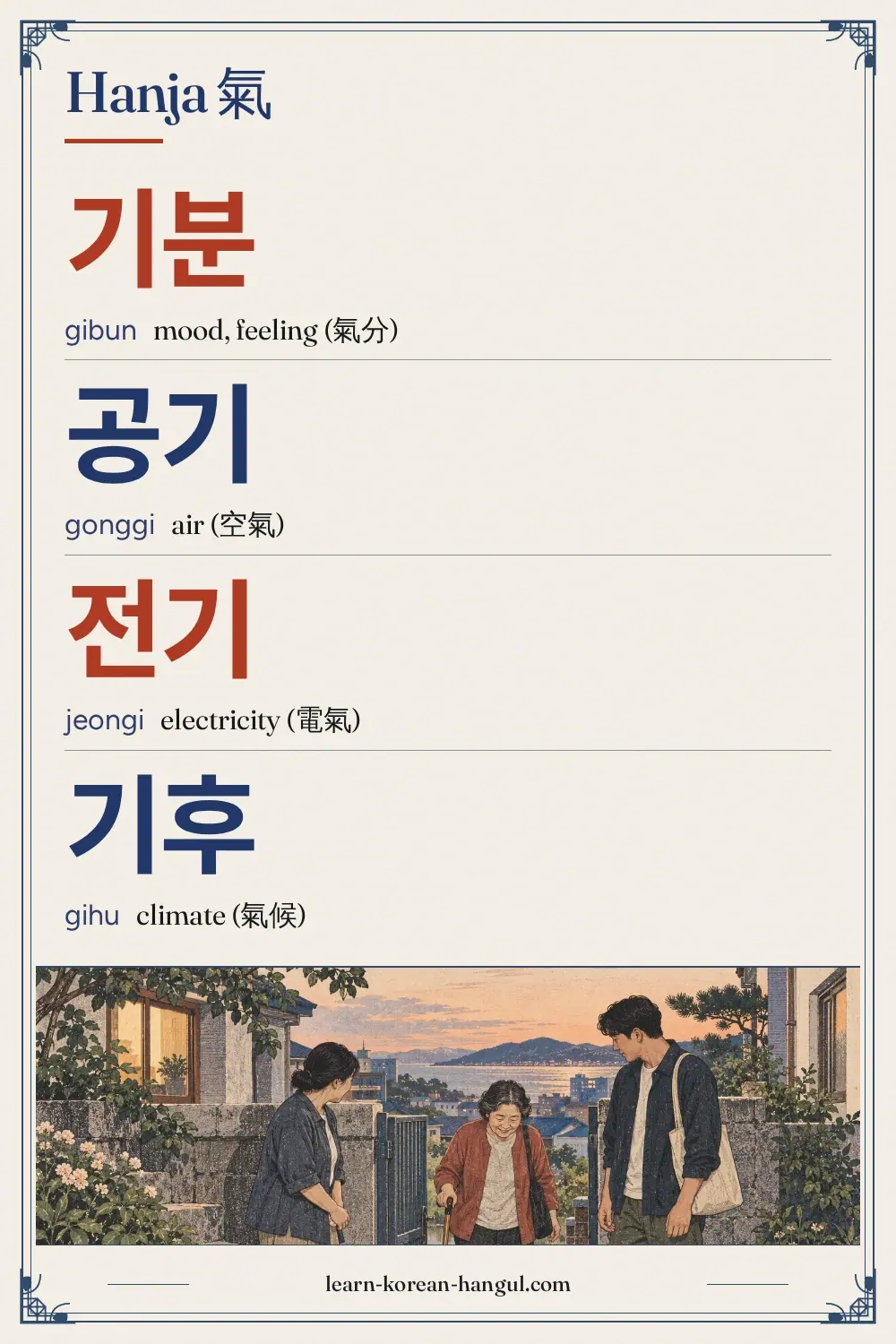
Hanja 氣: the Essentials
Hanja 氣 is one of the most flexible characters in Korean. Its 음훈 (the pair of the native meaning word and the Korean reading, as dictionaries list it) is 기운 기. The meaning word 기운 is itself a word built from this character (氣運, energy), so the dictionary explains 氣 by pointing at a word it helps to make. The reading you hear inside Sino-Korean words is 기.
The character has two parts. On top is 气, the radical for steam or vapour, which dictionaries use to file it. Below is 米 (rice), and the picture usually given is steam rising from cooking rice: a visible kind of energy. In Chinese and Japanese the same idea is read qi and ki, and in Korea it connects to traditional ideas of vital energy as well as to ordinary words for air and mood.
In practice 氣 does three jobs. It is air or weather (공기, 기온, 기후, 기상), it is energy or spirit (기운, 용기, 활기, 원기) and it is the mood or feel of a thing (기분, 분위기, 인기). The card below sums up the character.
| Item | Detail |
|---|---|
| Character | 氣 |
| 음훈 | 기운 기 |
| Reading | 기 (gi) |
| Core meanings | air; energy; spirit; mood |
| Radical | 气 (steam, air) |
| Strokes | 10 |
| Words on this page | 12 |
The same character is read 기 in every word, so it is a good first example of a hanja with a very wide range of meaning and a very stable sound. Weather has a native word, 날씨, and 氣 gives the formal science words that sit beside it.
Which Words Does 氣 Build?
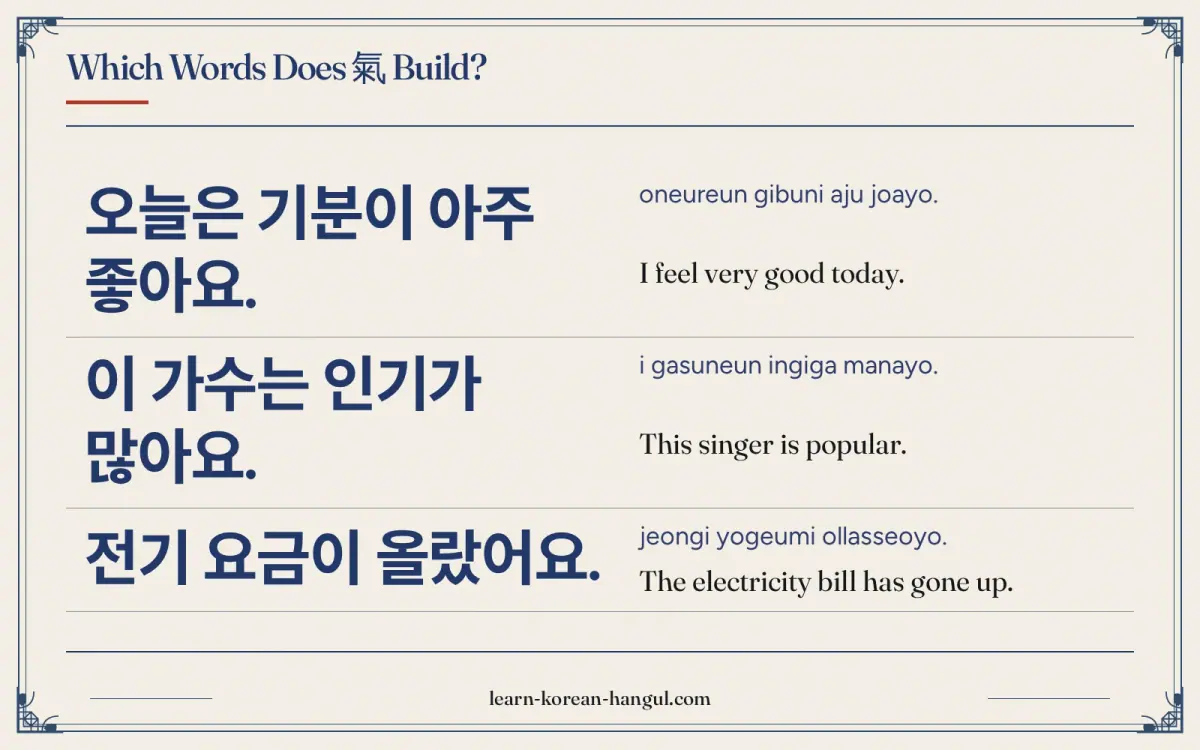
These 12 words are the best ones to learn first. They cover mood, air, weather, energy and popularity. Revised Romanization (RR) appears only as a learning aid, and square brackets show the spoken form where it differs from the spelling.
| Word | Characters | RR | Meaning | How the characters add up |
|---|---|---|---|---|
| 기분 | 氣分 | gibun | mood, feeling | 氣 spirit + 分 part |
| 공기 | 空氣 | gonggi | air | 空 empty + 氣 air |
| 인기 [인끼] | 人氣 | ingi | popularity | 人 people + 氣 spirit |
| 전기 | 電氣 | jeongi | electricity | 電 lightning + 氣 energy |
| 기후 | 氣候 | gihu | climate | 氣 air + 候 season, sign |
| 용기 | 勇氣 | yonggi | courage | 勇 brave + 氣 spirit |
| 활기 | 活氣 | hwalgi | vitality, liveliness | 活 alive + 氣 energy |
| 기온 | 氣溫 | gion | air temperature | 氣 air + 溫 warm |
| 기운 | 氣運 | giun | energy, strength | 氣 spirit + 運 move |
| 분위기 [부뉘기] | 雰圍氣 | bunwigi | atmosphere, mood of a place | 雰 mist + 圍 surround + 氣 air |
| 기상 | 氣象 | gisang | weather (as a science) | 氣 air + 象 appearance |
| 원기 | 元氣 | wongi | vigour, vitality | 元 origin + 氣 energy |
Two patterns are worth knowing. At the front of a word, 氣 is about the air or the state of things: 기분, 기온, 기후, 기상, 기운. At the end, it adds the idea of energy or feeling to the first part: 공기, 인기, 용기, 활기, 원기, 분위기, 전기. As a suffix, -기 (氣) is also in 감기 (感氣, a cold), 열기 (熱氣, heat or enthusiasm) and 경기 (景氣, the state of the economy). The word 기침 (cough) is not from 氣; it is a separate word.
The 12 Words One by One
기분 (氣分, gibun): mood, feeling. The mood you are in right now: 기분이 좋아요 (I feel good), 기분이 안 좋아요 (I am in a bad mood), 기분 나쁘다 (to feel offended). 分 (분) means a share or part, so the word is the "part of spirit" that you feel at the moment. It is a short-term feeling, not a lasting character trait.
공기 (空氣, gonggi): air. The air around you: 공기가 좋아요 (the air is fresh), 공기 청정기 (air purifier), 실내 공기 (indoor air). 空 (공) means empty or sky and also appears in 공항 (airport) and 공중 (in the air). Do not mix it up with 공기 (空器, a small rice bowl), which shares 空 but ends in 器 (vessel), or with 공기놀이 (a game played with small stones).
인기 [인끼] (人氣, ingi): popularity. Popularity, the energy that people give to someone or something: 인기가 많다 (to be popular), 인기 가수 (a popular singer), 인기 메뉴 (a popular menu item). The ㄱ is tense, [인끼], although RR does not mark this and writes ingi. The opposite idea is 인기가 없다 (to be unpopular).
전기 (電氣, jeongi): electricity. Electricity as power: 전기 요금 (electricity bill), 전기차 (electric car), 전기가 나가다 (the power goes out). 電 (전) is the character for lightning and is the subject of another family page. Note that 전기 (傳記, biography) sounds the same.
기후 (氣候, gihu): climate. The long-term pattern of weather in a place: 기후 변화 (climate change), 한국의 기후 (Korea's climate), 온난한 기후 (a mild climate). 候 (후) means a season or a sign and also appears in 증후군 (syndrome). It is not the same as the weather today, which is 날씨.
용기 (勇氣, yonggi): courage. The spirit to do something hard: 용기를 내다 (to find the courage), 용기가 있다 (to have courage). 勇 (용) means brave and also appears in 용감하다 (to be brave). Use 용기를 내다 as a set phrase when you want to say "I plucked up courage".
활기 (活氣, hwalgi): vitality, liveliness. Lively energy in a person, a place or a market: 활기가 넘치다 (to be full of life), 활기찬 시장 (a lively market). The adjective is 활기차다. 活 (활) means alive and also appears in 생활 (daily life), which is in the family for 生.
기온 (氣溫, gion): air temperature. The temperature of the air, as in a forecast: 기온이 떨어지다 (the temperature falls), 최고 기온 (the highest temperature), 평균 기온 (the average temperature). 溫 (온) means warm and also appears in 온도 (temperature) and 온천 (hot spring). It is a measured number, not a feeling.
기운 (氣運, giun): energy, strength. Physical or mental strength: 기운이 없다 (I have no energy), 기운 내세요 (cheer up, find your strength), 기운이 나다 (to feel strong again). 運 (운) means to move and also appears in 운동 (exercise) and 운명 (fate). Compare it with 기분, which is mood.
분위기 [부뉘기] (雰圍氣, bunwigi): atmosphere, mood of a place. The feel of a place or a moment: 분위기가 좋다 (the atmosphere is nice), 분위기 있는 카페 (a café with a nice feel), 분위기를 읽다 (to read the room). The ㄴ of 분 moves onto the empty ㅇ of 위, so it is said [부뉘기]. RR writes bunwigi.
기상 (氣象, gisang): weather (as a science). Weather as a field of science and news: 기상청 (the Korea Meteorological Administration), 기상 예보 (weather forecast) and 기상 특보 (a weather warning). It is a formal word. The everyday word is 날씨. Note the homophone 기상 (起床, getting up), as in 기상 시간.
원기 (元氣, wongi): vigour, vitality. The basic energy of the body and mind: 원기를 되찾다 (to regain one's vigour) and 원기 회복 (recovering strength). The word is a little old-fashioned and mostly seen in writing, in health talk and in the names of tonics. 元 (원) means origin or first.
Sentences to Hear the Words in Use
Six of the words appear in short sentences. Listen to each one first, then read it aloud with the audio. The brackets in the word table show how the words are said in connected speech.
오늘은 기분이 아주 좋아요.
oneureun gibuni aju joayo.
I feel very good today.
창문을 열어서 공기를 바꿔요.
changmuneul yeoreoseo gonggireul bakkwoyo.
I open the window to change the air.
이 가수는 인기가 많아요.
i gasuneun ingiga manayo.
This singer is popular.
전기 요금이 올랐어요.
jeongi yogeumi ollasseoyo.
The electricity bill has gone up.
겨울에는 기온이 많이 내려가요.
gyeoureneun gioni mani naeryeogayo.
In winter the temperature drops a lot.
이 카페는 분위기가 좋아요.
i kapeneun bunwigiga joayo.
This café has a nice atmosphere.
How Is 氣 Read in Different Words?
The reading of 氣 never changes. It is 기 in every word, whether it comes first or last. It also does not fall under the initial-sound rule (두음법칙), which changes some words that begin with ㄹ or ㄴ, because 기 begins with ㄱ. So you can read every word in the family with one syllable. What changes is the sound around it.
Rule box: two changes. Two words in the family are said differently from how they are spelled.
- 인기 → [인끼]: the ㄱ after the ㄴ of 인 is tense. This tensing is lexical, which means it comes with the word and does not follow a general rule. RR does not mark tensing caused by a sound change, so it gives ingi.
- 분위기 → [부뉘기]: the final ㄴ of 분 moves onto the empty ㅇ of 위. RR writes bunwigi.
In the other ten words nothing happens. In 기분, 기온, 기운, 기상 and 기후, 기 begins the word. In 공기 and 용기, the ㅇ before 기 does not change the ㄱ, so say them as spelled: [공기] and [용기]. In 활기, the ㄹ before ㄱ is plain: [활기]. In 전기 the ㄴ of 전 does not tense the ㄱ, so it is [전기]. In 원기 the final ㄴ of 원 does not tense the ㄱ, so it is [원기]. Why 활기 stays plain is explained on the page about Sino-Korean tensification: in Sino-Korean words a final ㄹ tenses only a following ㄷ, ㅅ or ㅈ, never ㄱ.
English speakers often say 기 with a hard "g", as in "go". Between voiced sounds, as in 공기 or 용기, a plain ㄱ is slightly voiced and sounds like a soft "g". At the start of a word, as in 기분, it is closer to a "k" without a puff of air. Do not add the puff you would use in "key"; that would sound like ㅋ.
What Is Easy to Confuse with 氣?
기분 and 기운. 기분 (氣分) is your mood, the feeling of the moment: 기분이 좋아요. 기운 (氣運) is your energy or strength: 기운이 없어요. You can be in a good mood and have no energy at the same time. Do not say 기분이 없어요 for "I have no energy". Say 기운이 없어요.
날씨, 기온, 기후 and 기상. 날씨 is the everyday word for weather. 기온 is the number on the thermometer. 기후 is the long-term pattern of a place, 기상 is the formal science and news word and 일기 예보 is the weather forecast. If you want to say "it is nice weather", say 날씨가 좋아요, not 기후가 좋아요.
전기 and 전기. 電氣 (전기) is electricity and 傳記 (전기) is a biography. They sound exactly the same and differ only in their characters. The words around them tell you which one: 전기 요금 (electricity bill) and 위인 전기 (a biography of a great person).
기상: weather or getting up. 氣象 (기상) is weather, and 起床 (기상) means getting out of bed, as in 기상 시간 (wake-up time). A military or camp setting uses the second.
공기: air or a rice bowl. 空氣 (공기) is air. 空器 (공기) is a small bowl, as in 밥 한 공기 (a bowl of rice): the same 空, but 器 (vessel) instead of 氣. For a bowl of rice say 밥 한 공기. For air, say 공기가 맑아요 (the air is clear).
기 as a prefix of other words. Do not assume that every word with 기 contains 氣. 기회 (機會, opportunity), 기억 (記憶, memory) and 기술 (技術, technology) have different characters. Look at the word in a dictionary before you guess.
Practice This Family
The 12 Words as Flashcards
The deck below has one card for each of the 12 words, with audio. The table shows the same cards, so you can study from either one.
| # | Korean | RR | Meaning | Character and note |
|---|---|---|---|---|
| 1 | 기분 | gibun | mood, feeling (氣分) | 氣 (기운 기) + 分 (나눌 분). Mood. 기분이 좋다 = feel good. |
| 2 | 공기 | gonggi | air (空氣) | 空 (빌 공) + 氣. Air. 공기 청정기 = air purifier. |
| 3 | 인기 [인끼] | ingi | popularity (人氣) | 人 (사람 인) + 氣. Said [인끼]. 인기가 많다 = popular. |
| 4 | 전기 | jeongi | electricity (電氣) | 電 (번개 전) + 氣. Electricity. 전기 요금 = electricity bill. |
| 5 | 기후 | gihu | climate (氣候) | 氣 + 候 (기후 후). Climate. 기후 변화 = climate change. |
| 6 | 용기 | yonggi | courage (勇氣) | 勇 (날랠 용) + 氣. Courage. 용기를 내다 = find courage. |
| 7 | 활기 | hwalgi | vitality, liveliness (活氣) | 活 (살 활) + 氣. Liveliness. 활기차다 = be full of life. |
| 8 | 기온 | gion | air temperature (氣溫) | 氣 + 溫 (따뜻할 온). Air temperature. 최고 기온 = daily high. |
| 9 | 기운 | giun | energy, strength (氣運) | 氣 + 運 (옮길 운). Energy. 기운 내세요 = cheer up. |
| 10 | 분위기 [부뉘기] | bunwigi | atmosphere, mood of a place (雰圍氣) | 雰 (눈 날릴 분) + 圍 (에워쌀 위) + 氣. Said [부뉘기]. Atmosphere. |
| 11 | 기상 | gisang | weather (as a science) (氣象) | 氣 + 象 (모양 상). Weather science. 기상청 = weather agency. |
| 12 | 원기 | wongi | vigour, vitality (元氣) | 元 (으뜸 원) + 氣. Basic vigour. 원기 회복 = regaining strength. |
Practice · 12
- 01기분
Show answer
gibun
mood, feeling (氣分)
- 02공기
Show answer
gonggi
air (空氣)
- 03인기 [인끼]
Show answer
ingi
popularity (人氣)
- 04전기
Show answer
jeongi
electricity (電氣)
- 05기후
Show answer
gihu
climate (氣候)
- 06용기
Show answer
yonggi
courage (勇氣)
- 07활기
Show answer
hwalgi
vitality, liveliness (活氣)
- 08기온
Show answer
gion
air temperature (氣溫)
- 09기운
Show answer
giun
energy, strength (氣運)
- 10분위기 [부뉘기]
Show answer
bunwigi
atmosphere, mood of a place (雰圍氣)
- 11기상
Show answer
gisang
weather (as a science) (氣象)
- 12원기
Show answer
wongi
vigour, vitality (元氣)
Decode Three Unseen Words
景氣 경기 (gyeonggi). 景 "scene" + 氣 "spirit". It means the state of the economy, "business conditions": 경기가 좋다 (business is good). The word 경기 also means a sports match (競技), so look for the context. The sound is [경기].
熱氣 열기 (yeolgi). 熱 "heat" + 氣 "air". It means heat, warmth, or enthusiasm: 응원 열기 (the heat of the cheering). The sound is [열기]; the noun form of the verb 열다 (to open) is spelled the same.
氣體 기체 (giche). 氣 "air" + 體 "body". It is a gas, as opposed to a liquid (액체) or a solid (고체). The sound is [기체].
Check Yourself
Each question asks you to decode a word or answer a question about 氣. The answers are checked as you go.
Practice · 6
기분 is 氣 + 分 "part". What does 기분 mean?
Show answer
mood
氣分 is the "part of spirit" you feel now, so your mood. Energy is 기운, air is 공기 and weather in science is 기상.
How is 인기 (popularity) said in normal speech?
Show answer
[인끼]
The ㄱ in 인기 is tense, so it is said [인끼]. RR does not mark this tensing and writes ingi.
Which word means "air temperature"?
Show answer
기온
기온 (氣溫) is the temperature of the air. 기후 is climate, 기분 is mood and 기운 is energy.
If you want to say "I have no energy", which is correct?
Show answer
기운이 없어요
기운 (氣運) is energy or strength, so 기운이 없어요 means "I have no energy". 기분 is mood, and 기분이 없어요 is not the way to say you are tired.
전기 can mean electricity or biography. What does this tell you about the two words?
Show answer
They sound the same but use different characters
電氣 (electricity) and 傳記 (biography) are homophones written with different characters. The context decides.
Which word names the long-term pattern of weather in a place?
Show answer
기후
기후 (氣候) is climate, as in 기후 변화 (climate change). 기상 is weather as a science, 기온 is temperature and 공기 is air.
What to Learn Next
You now have 12 words and the three main jobs of 氣. A good next step is the family for 力 (력/역), which also has to do with energy and ability. The family for 不 (불/부) covers negative feeling words such as 불안 (anxiety). The method behind these pages is set out in how to learn hanja, and a longer list of common hanja characters is on the page of the 100 most useful hanja. To choose another character, return to the hanja word families page. For the big picture, see Does Korean use hanja? and the hanja hub.
Frequently Asked Questions
Why is mood called 기분?
기분 (氣分) joins 氣, the energy or spirit that moves through a person, with 分, a share or part. The word means the "part of spirit" you feel at the moment, which is your mood. This is why 기분 changes from hour to hour: 기분이 좋아요 (I feel good) and 기분이 나빠요 (I feel bad or offended). A lasting trait of character is 성격, not 기분.
How is 기운 different from 기분?
기분 (氣分) is your mood and 기운 (氣運) is your energy or strength. 기분이 좋아요 means "I feel good", and 기운이 없어요 means "I have no energy". The two can differ: you can be in a good mood but tired. Use 기운 내세요 to cheer someone up ("find your strength") and 기분 좋아요 to say that you are pleased.
What is 분위기 made of?
분위기 (雰圍氣) has three characters: 雰 (분), mist or haze, 圍 (위), to surround, and 氣 (기), air or spirit. Together they say that something is "surrounded by a mist of air", the feel that wraps around a place or a moment. Koreans use it for restaurants, rooms and moods, as in 분위기가 좋다 (the atmosphere is nice) and 분위기를 읽다 (to read the room).
Is 氣 ever read differently?
No. 氣 is read 기 in every Korean word. It does not change like 不 (불/부) or 力 (력/역). The only variation is in speech, where the ㄱ can be tense after some sounds, as in 인기 [인끼]. Japanese reads the same character as ki and Chinese reads it as qi, so the syllable is close across the three languages.