Hanja 物: the Essentials
Hanja 物 is one of the most useful characters for building nouns. Its 음훈 (the pair of the native meaning word and the Korean reading, as dictionaries list it) is 물건 물. The meaning word 물건 is itself a word built from this character (物件, "thing"), so a Korean dictionary explains 物 with the word it helps to make. The reading you hear inside Sino-Korean words is 물.
The character has two parts. On the left is 牜, the ox radical (牛), which dictionaries use to file the character. On the right is 勿, which gives the sound: 勿 is also read 물, and this is why the unrelated word 물론 (of course) is written 勿論. You do not need to study the parts to read the family. They are only a way to see why the shape and the sound belong together.
In practice 物 does two jobs. At the front of a word it means "things" in a general sense (물건, 물가, 물질). At the end it works like a suffix that turns a first part into a thing or a kind of thing: 動物 is a "moving thing" and 建物 is a "built thing". The card below sums up the character.
| Item | Detail |
|---|---|
| Character | 物 |
| 음훈 | 물건 물 |
| Reading | 물 (mul) |
| Core meanings | thing; object; matter |
| Radical | 牛 (ox), written 牜 on the left |
| Strokes | 8 |
| Words on this page | 12 |
Do not mix this up with the everyday word 물 (water). That word is native Korean and has no hanja at all. The two share only a sound, and the later sections show how to tell them apart in a sentence.
Which Words Does 物 Build?
These 12 words are the best ones to learn first. They cover animals and plants, places, shopping, science and daily objects. Revised Romanization (RR) appears only as a learning aid, and square brackets show the spoken form where it differs from the spelling.
| Word | Characters | RR | Meaning | How the characters add up |
|---|---|---|---|---|
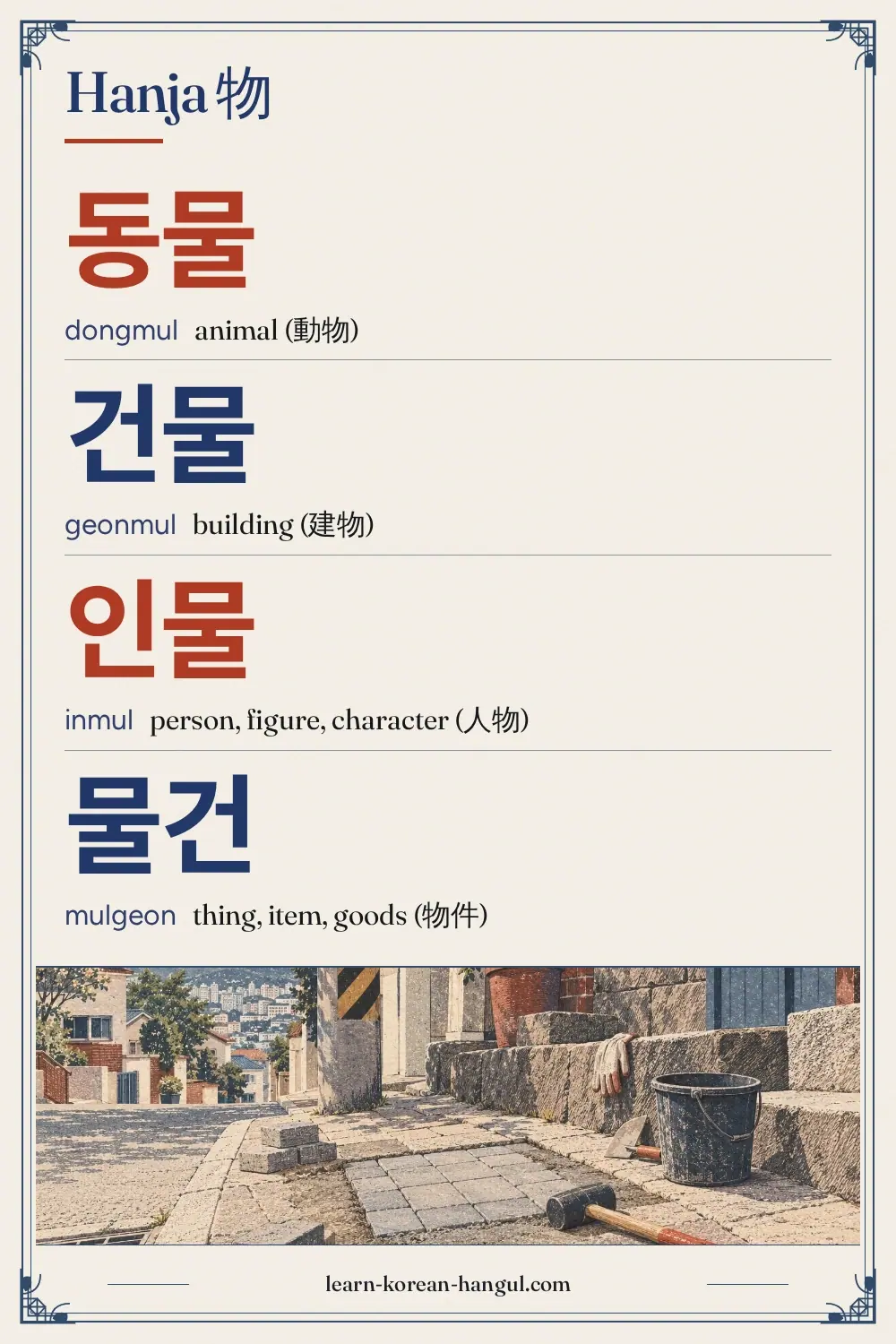
| 동물 | 動物 | dongmul | animal | 動 move + 物 thing |
| 식물 [싱물] | 植物 | singmul | plant | 植 plant + 物 thing |
| 건물 | 建物 | geonmul | building | 建 build + 物 thing |
| 인물 | 人物 | inmul | person, figure, character | 人 person + 物 thing |
| 물가 [물까] | 物價 | mulga | prices, cost of living | 物 goods + 價 price |
| 물건 | 物件 | mulgeon | thing, item, goods | 物 thing + 件 item |
| 물리 | 物理 | mulli | physics; the principles of things | 物 thing + 理 principle |
| 생물 | 生物 | saengmul | living thing, organism | 生 life + 物 thing |
| 박물관 [방물관] | 博物館 | bangmulgwan | museum | 博 wide + 物 thing + 館 hall |
| 화물 | 貨物 | hwamul | cargo, freight | 貨 goods + 物 thing |
| 사물 | 事物 | samul | things, objects (in general) | 事 matter + 物 thing |
| 물질 [물찔] | 物質 | muljil | matter, substance, material | 物 thing + 質 substance |
Two patterns are worth knowing. At the front of a word, 物 means "things": 물건, 물가, 물질. At the end, it makes a thing-noun from the first part: 선물 (膳物, a gift), 농산물 (農産物, farm products), 수산물 (水産物, marine products) and 음식물 (飮食物, food). The ending -물 is therefore one of the easiest Sino-Korean endings to spot. You will also meet the compound 동식물 (動植物, animals and plants), which joins two words from this family.
The 12 Words One by One
동물 (動物, dongmul): animal. The "moving thing" is the ordinary word for an animal. It is also the base of 동물원 (zoo) and 애완동물 (pet). The opposite word in schoolbooks is 식물 (plant), and the pair is often written together as 동식물 (animals and plants).
식물 [싱물] (植物, singmul): plant. A "planted thing", so a plant in the botanical sense. The final ㄱ of 식 turns into ㅇ before the ㅁ of 물, so the word is said [싱물]. RR writes the change: singmul. A garden of plants for study and visits is a 식물원 (botanical garden).
건물 (建物, geonmul): building. A "built thing". It covers any structure with walls and a roof, from a house to a tower. It is a general word; for a tall office block people also say 빌딩. The longer 건축물 (建築物) is the formal term used in law and city planning.
인물 (人物, inmul): person, figure, character. Here 物 gives the sense of a person as an object of description. 인물 is used for a notable person (역사적 인물, a historical figure), for a character in a story (등장인물) and for a person's quality, as in 인물이 좋다 (a person is good-looking). It is not the everyday word for "person"; that is 사람.
물가 [물까] (物價, mulga): prices, cost of living. The general level of prices: 물가가 오르다 (prices rise). The ㄱ is tense, [물까], as dictionaries list it; RR does not mark this tensing, so it gives mulga. Beware of a native word with the same spelling and sound: 물가 (물 + 가) also means the water's edge, as in 바닷가 (seaside).
물건 (物件, mulgeon): thing, item, goods. The most common everyday word in the family: any item you can own, carry or sell. 물건을 사다 means "to buy things", and 잃어버린 물건 means "lost property". 件 (건) is the same character as in 사건 (incident). There is no tensing here: the word is said as spelled.
물리 (物理, mulli): physics; the principles of things. The "principle of things", which is the school subject physics (물리학 in full, usually shortened to 물리). The two ㄹ sounds join as a long ㄹ, so RR writes mulli. In daily life 물리적 means "physical" in the sense of force and space, as in 물리적 거리 (physical distance).
생물 (生物, saengmul): living thing, organism. A "living thing" as science and school use it. The school subject biology is 생물학, shortened to 생물. The pair 생물 and 무생물 (無生物, non-living thing) is a standard contrast. This word is also in the 生 family page.
박물관 [방물관] (博物館, bangmulgwan): museum. A "hall of wide things", where many objects are kept and shown. The final ㄱ of 박 becomes ㅇ before ㅁ, so the word is said [방물관], and RR writes bangmulgwan. 관 (館) is the ending of many public buildings: 도서관 (library), 미술관 (art museum), 영화관 (cinema).
화물 (貨物, hwamul): cargo, freight. Goods that are being shipped by truck, train, ship or plane. You will see it in 화물차 (freight truck), 화물선 (cargo ship) and 화물 열차 (freight train). 貨 (화) means goods or money and also appears in 통화 (currency).
사물 (事物, samul): things, objects (in general). A broad word for "things" in the abstract: 사물을 보는 눈 means "the way of looking at things". It is common in essays and in the compound 사물 인터넷 (Internet of Things). It is not the word for a single item; that is 물건.
물질 [물찔] (物質, muljil): matter, substance, material. Matter in science (유해 물질, harmful substance) and "material" in the sense of money and goods as opposed to the spirit (물질적 풍요, material wealth). After ㄹ, a Sino-Korean ㅈ is tense, so the word is said [물찔]. RR keeps the plain letter: muljil.
Sentences to Hear the Words in Use
Six of the words appear in short sentences. Listen to each one first, then read it aloud with the audio. The brackets in the word table show how the words are said in connected speech.
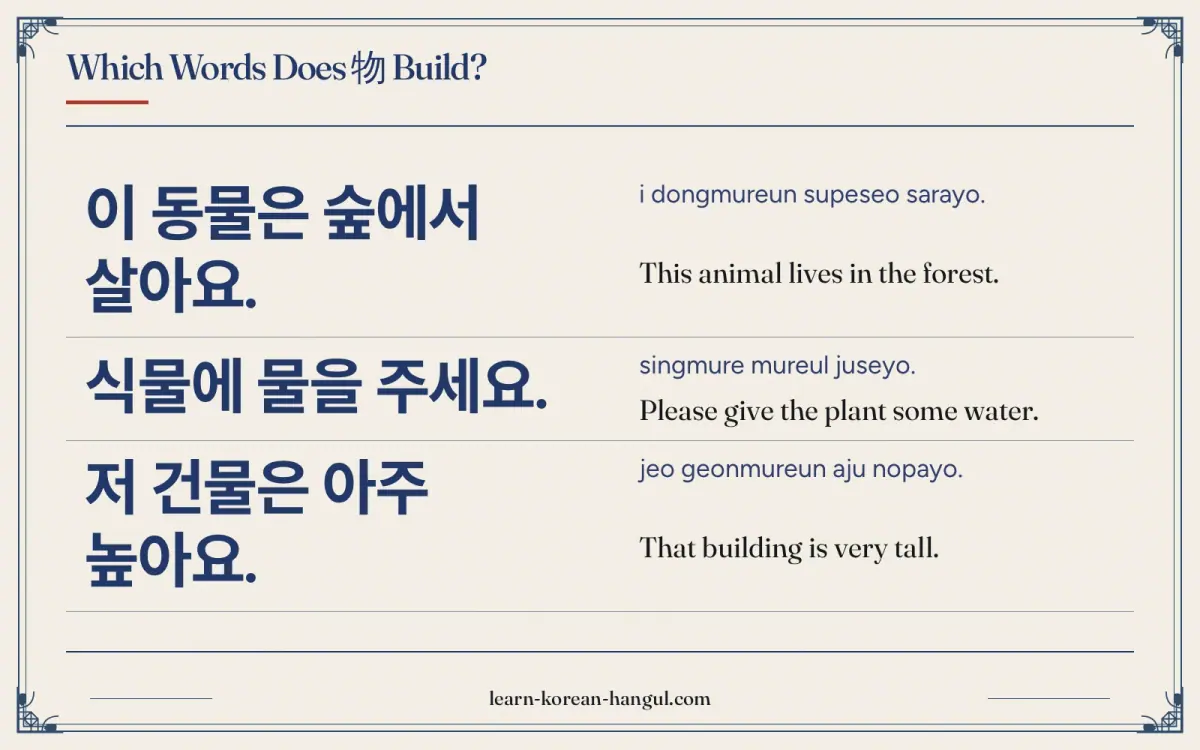
이 동물은 숲에서 살아요.
i dongmureun supeseo sarayo.
This animal lives in the forest.
식물에 물을 주세요.
singmure mureul juseyo.
Please give the plant some water.
저 건물은 아주 높아요.
jeo geonmureun aju nopayo.
That building is very tall.
요즘 물가가 너무 올랐어요.
yojeum mulgaga neomu ollasseoyo.
Prices have gone up too much lately.
이 물건은 얼마예요?
i mulgeoneun eolmayeyo?
How much is this item?
이 박물관은 월요일에 문을 닫아요.
i bangmulgwaneun woryoire muneul dadayo.
This museum is closed on Mondays.
How Is 物 Read in Different Words?
The reading of 物 never changes. It is 물 in every word, whether it comes first or last. It also does not fall under the initial-sound rule (두음법칙), which changes some words that begin with ㄹ or ㄴ, because 물 begins with ㅁ. So you can read every word in the family with one syllable. What changes is the sound around it.
Rule box: sounds next to 물. Four words in the family are said differently from how they are spelled.
- 식물 → [싱물] and 박물관 → [방물관]: a final ㄱ becomes ㅇ before ㅁ (nasalisation). RR writes the change: singmul, bangmulgwan.
- 물가 → [물까]: dictionaries list this word with a tense ㄱ. It is a word-by-word fact rather than a general rule (물건 after the same ㄹ stays plain), so learn it with the word. RR does not mark this tensing, so it gives mulga.
- 물질 → [물찔]: in Sino-Korean words, a final ㄹ makes a following ㄷ, ㅅ or ㅈ tense. RR gives muljil.
In the other eight words nothing happens. In 동물 and 인물 the final ㅇ or ㄴ of the first syllable just joins 물 with no change, so say [동물] and [인물] with a clear ㅁ. In 건물 the ㄴ also stays. In 물건 the ㄱ at the start of 건 is plain, not tense, so it is [물건]. In 물리, two ㄹ sounds meet and the word has a long ㄹ: [물리]. The ㄹ rule behind 물질 is explained on the page about Sino-Korean tensification.
One last point for English speakers: the vowel in 물 is ㅜ, a rounded back vowel like "oo" in "moon", and the final ㄹ is a clear "l" at the end of the word, but a quick tap when a vowel follows, as in 물이 [무리].
What Is Easy to Confuse with 物?
물 (water) and 物. The native word 물 (water) is not related to 物 or to 水. It is a short everyday word and has no hanja. If you meet 물 in a sentence, the particle after it tells you which word it is: 물을 마셔요 is "I drink water". A word such as 물건 can only be the 物 word. For the hanja that does mean water, see the family for 水 (수).
勿論 and 物. 물론 (of course) is written 勿論, with a different character, 勿 (do not). Because 勿 is also read 물, this word looks like it belongs to the family, but it does not mean "thing". Learn it as a separate word.
물가: prices or water's edge. The Sino-Korean 物價 means prices and the native 물가 means the edge of the water. Both are said [물까]. The sentence decides: 물가가 올랐어요 is "prices rose", and 물가에서 놀아요 is "we play at the water's edge".
사물: things or four instruments. 事物 (사물) means things in general, but 사물놀이 is a traditional percussion performance whose name uses 四物 (four instruments). Same sound, different characters.
물건 and 물품. 물건 is the everyday word for an item. 물품 (物品) is a formal word used in offices and on shipping forms. Use 물건 in speech.
인물 and 사람. Do not call a person you meet an 인물. Use 사람. 인물 is for notable people, story characters and descriptions of someone's looks or character.
Practice This Family
The 12 Words as Flashcards
The deck below has one card for each of the 12 words, with audio. The table shows the same cards, so you can study from either one.
| # | Korean | RR | Meaning | Character and note |
|---|---|---|---|---|
| 1 | 동물 | dongmul | animal (動物) | 動 (움직일 동) + 物. 動物園 = zoo. Pair: 식물. |
| 2 | 식물 [싱물] | singmul | plant (植物) | 植 (심을 식) + 物. Said [싱물]. 植物園 = botanical garden. |
| 3 | 건물 | geonmul | building (建物) | 建 (세울 건) + 物. A built thing. 건축물 is the formal term. |
| 4 | 인물 | inmul | person, figure, character (人物) | 人 (사람 인) + 物. A notable person or story character. 등장인물 = cast. |
| 5 | 물가 [물까] | mulga | prices, cost of living (物價) | 物 + 價 (값 가). Said [물까]. Do not confuse with native 물가 (water's edge). |
| 6 | 물건 | mulgeon | thing, item, goods (物件) | 物 + 件 (물건 건). The everyday word for an item. Also 사건 (incident). |
| 7 | 물리 | mulli | physics; the principles of things (物理) | 物 + 理 (다스릴 리). Physics is 물리학; 물리적 = physical. |
| 8 | 생물 | saengmul | living thing, organism (生物) | 生 (날 생) + 物. Biology = 생물학. Opposite: 무생물. |
| 9 | 박물관 [방물관] | bangmulgwan | museum (博物館) | 博 (넓을 박) + 物 + 館 (집 관). Said [방물관]. Also 미술관, 도서관. |
| 10 | 화물 | hwamul | cargo, freight (貨物) | 貨 (재물 화) + 物. Freight: 화물차 = freight truck. |
| 11 | 사물 | samul | things, objects (in general) (事物) | 事 (일 사) + 物. Things in general. 사물 인터넷 = Internet of Things. |
| 12 | 물질 [물찔] | muljil | matter, substance, material (物質) | 物 + 質 (바탕 질). Said [물찔]. 물질적 = material. |
Practice · 12
- 01동물
Show answer
dongmul
animal (動物)
- 02식물 [싱물]
Show answer
singmul
plant (植物)
- 03건물
Show answer
geonmul
building (建物)
- 04인물
Show answer
inmul
person, figure, character (人物)
- 05물가 [물까]
Show answer
mulga
prices, cost of living (物價)
- 06물건
Show answer
mulgeon
thing, item, goods (物件)
- 07물리
Show answer
mulli
physics; the principles of things (物理)
- 08생물
Show answer
saengmul
living thing, organism (生物)
- 09박물관 [방물관]
Show answer
bangmulgwan
museum (博物館)
- 10화물
Show answer
hwamul
cargo, freight (貨物)
- 11사물
Show answer
samul
things, objects (in general) (事物)
- 12물질 [물찔]
Show answer
muljil
matter, substance, material (物質)
Decode Three Unseen Words
動植物 동식물 (dongsingmul). 動 "move" + 植 "plant" + 物 "thing". It means animals and plants, and it is used in nature words such as 동식물원 and in school texts. The ㄱ of 식 becomes ㅇ before ㅁ, so it is said [동싱물].
農産物 농산물 (nongsanmul). 農 "farm" + 産 "produce" + 物 "thing". These are agricultural products, the goods you see sold at a market. The sound is [농산물] with no change.
建築物 건축물 (geonchungmul). 建 "build" + 築 "construct" + 物 "thing". It is the formal word for a building or structure. The ㄱ at the end of 축 becomes ㅇ before ㅁ, so it is said [건충물].
Check Yourself
Each question asks you to decode a word or answer a question about 物. The answers are checked as you go.
Practice · 6
동물 is 動 "move" + 物 "thing". What does 동물 mean?
Show answer
animal
動物 is a "moving thing", an animal. A plant is 식물, a building is 건물 and a museum is 박물관.
How is 식물 (plant) said in normal speech?
Show answer
[싱물]
A final ㄱ becomes ㅇ before ㅁ, so 식물 is [싱물]. RR writes the change as singmul.
Which word means "prices, cost of living"?
Show answer
물가
물가 (物價) is the general level of prices, said [물까]. 물건 is an item, 물리 is physics and 물질 is matter.
What is the 물 in 물 (water)?
Show answer
a native Korean word with no hanja
The everyday word 물 (water) is native Korean. It is not 物, and it is not 水 either. The hanja for water is 水, read 수, as in 수영.
農産物 농산물 is 農 "farm" + 産 "produce" + 物. What is it?
Show answer
agricultural products
The ending -물 makes a thing-noun, so 농산물 is "farm products". Compare 수산물 (marine products).
Which pair of words both contain the character 物 as their second part?
Show answer
동물 and 건물
動物 and 建物 end in 物. In 물건, 물가, 물리 and 물질 it comes first, and 물론 is written 勿論, with a different character.
What to Learn Next
You now have 12 words and the two jobs of 物. A good next step is 生, which shares the word 생물 with this page: see the family for 生 (생). The family for 水 (수) shows how another character joins with 物 in 수산물. The method behind these pages is set out in how to learn hanja, and a longer list of common hanja characters is on the page of the 100 most useful hanja. To choose another character, return to the hanja word families page. For the big picture, see Does Korean use hanja? and the hanja hub.
Frequently Asked Questions
Is 물건 the same as 物?
No. 물건 (物件) is a word made from two characters, 物 and 件, and it means an item or a thing. 物 is a single character that gives the sound 물 and the idea of "thing". In modern Korean 物 does not stand alone as a word, but it is the base of dozens of words. The dictionary meaning word for 物 is 물건, which is why its 음훈 is 물건 물.
What does 物 mean in 動物?
It means "thing". 動物 is a "moving thing", so an animal, and 植物 is a "planted thing", so a plant. In both words 物 works like the English ending -thing: it turns a quality or action into a kind of thing. That is why 건물 (built thing, building) and 화물 (goods thing, cargo) also end in 物.
Is 물 'water' related to 物?
No. The everyday word 물 (water) is native Korean and has no hanja. 物 is read 물 only in Sino-Korean words, and the hanja for water is 水 (수), as in 수영 (swimming). The two 물 sounds look the same in Hangul, so the context and the particle after the word show which one is meant.
Which words use 物 as a suffix?
Many common nouns end in -물: 동물 (animal), 식물 (plant), 건물 (building), 생물 (living thing), 화물 (cargo), 선물 (gift), 농산물 (farm products), 수산물 (marine products) and 음식물 (food). When a new Korean noun ends in -물, there is a good chance that it means a thing or a kind of thing.