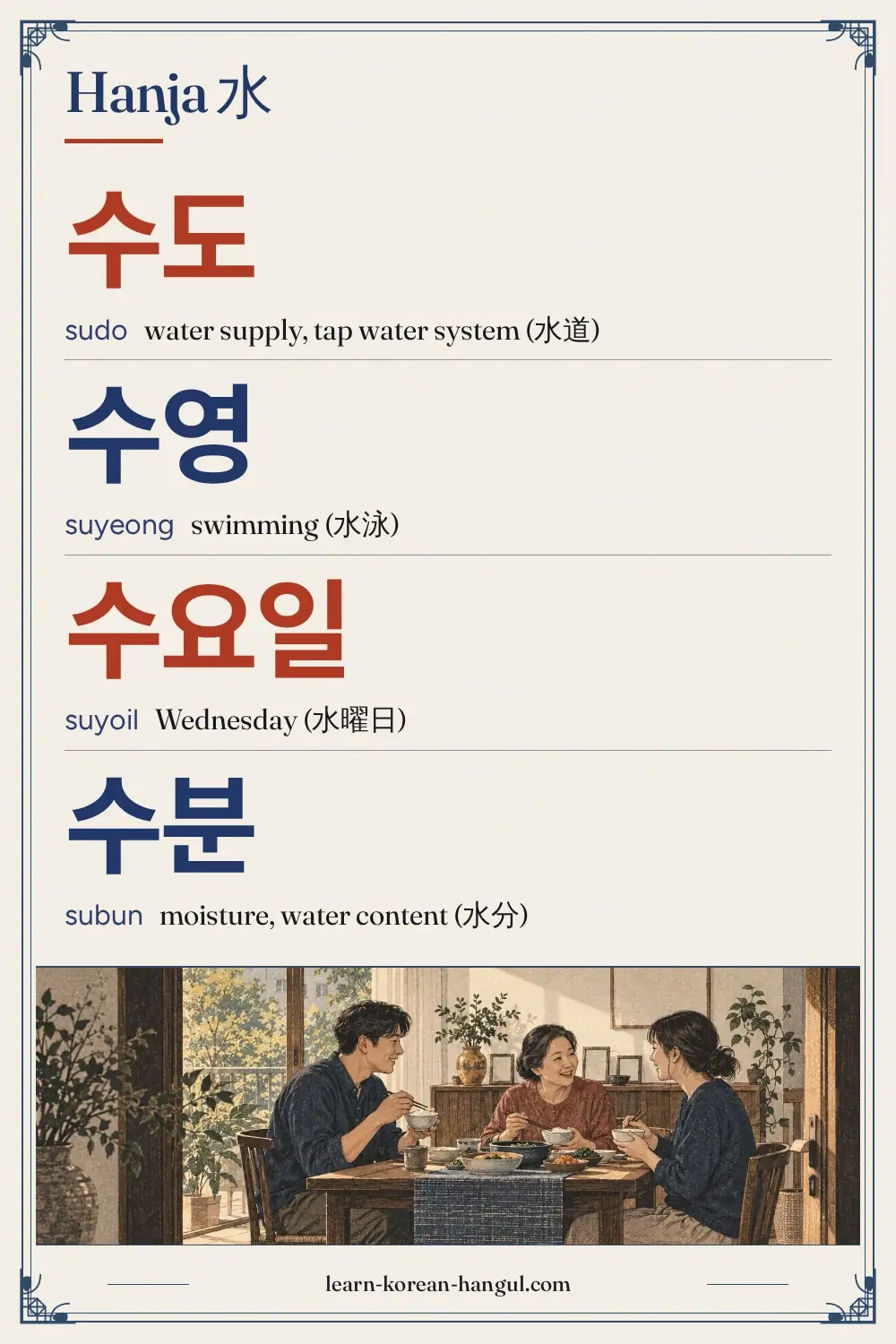
Hanja 水: the Essentials
Hanja 水 is a character you can read at a glance, and one of the first to learn. Its 음훈 (the pair of the native meaning word and the Korean reading, as dictionaries list it) is 물 수. The meaning word 물 is the everyday native Korean word for water, and 수 is the reading you hear inside Sino-Korean words. So the pair says: the character for water, read su.
The character is a picture of flowing water: a vertical stroke with a hook in the middle and drops or streams on either side. It is also its own radical, which means dictionaries file other characters under it. On the left side of a character, it shrinks to three short strokes, 氵, called 삼수변 (samsubyeon) in Korean, the "three-water side". This form appears in many water-related characters, including 洪 (홍, flood) and 淡 (담, fresh), which are both in this family.
In practice, Koreans use the native word 물 for water in daily life, so 水 appears almost only in compound words: you do not say 수 for water on its own, but you do say 수영, 수도 and 홍수. The card below sums up the character.
| Item | Detail |
|---|---|
| Character | 水 |
| 음훈 | 물 수 |
| Reading | 수 (su) |
| Core meanings | water; liquid; Wednesday |
| Radical | 水 (water), its own radical; left-side form 氵 |
| Strokes | 4 |
| Words on this page | 12 |
The same character is read 수 in every word, so it is an easy one to read. The reading is not the whole story, however: Koreans use two different words for water, and the next sections show where each one belongs.
Which Words Does 水 Build?
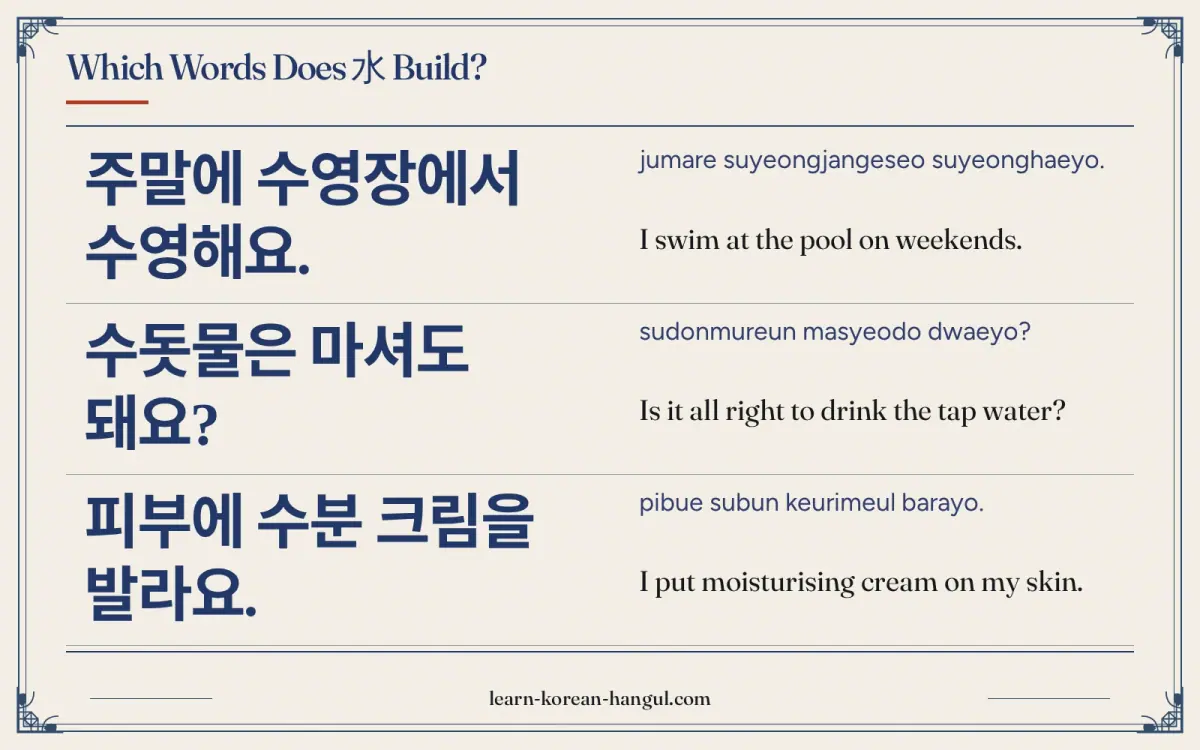
These 12 words are the best ones to learn first. They cover swimming, utilities, the week, science, daily goods and nature. Revised Romanization (RR) appears only as a learning aid, and square brackets show the spoken form where it differs from the spelling.
| Word | Characters | RR | Meaning | How the characters add up |
|---|---|---|---|---|
| 수도 | 水道 | sudo | water supply, tap water system | 水 water + 道 road |
| 수영 | 水泳 | suyeong | swimming | 水 water + 泳 swim |
| 수요일 | 水曜日 | suyoil | Wednesday | 水 water + 曜 day of the week + 日 day |
| 수분 | 水分 | subun | moisture, water content | 水 water + 分 part |
| 수준 | 水準 | sujun | level, standard | 水 water + 準 level |
| 향수 | 香水 | hyangsu | perfume | 香 scent + 水 water |
| 홍수 | 洪水 | hongsu | flood | 洪 large + 水 water |
| 수산물 | 水産物 | susanmul | marine products, seafood | 水 water + 産 produce + 物 thing |
| 수평 | 水平 | supyeong | horizontal, level | 水 water + 平 flat |
| 담수 | 淡水 | damsu | fresh water | 淡 fresh, weak + 水 water |
| 수소 | 水素 | suso | hydrogen | 水 water + 素 element |
| 식수 [식쑤] | 食水 | siksu | drinking water | 食 eat + 水 water |
Two patterns are worth knowing. At the front of a word, 水 is about water as a thing or a system: 수도, 수영, 수분, 수산물, 수평, 수소. At the end, it names a particular kind of water: 향수 (perfume), 홍수 (flood), 담수 (fresh water), 식수 (drinking water). Other words of the same shape are 해수 (海水, sea water), 폐수 (廢水, waste water), 강수 (降水, rainfall) and 배수 (排水, drainage). In 수요일, 水 does not mean water at all but names the day, after the old planet Mercury.
The 12 Words One by One
수도 (水道, sudo): water supply, tap water system. The pipes and system that bring water to homes: 수도 요금 (water bill), 수도꼭지 (tap, faucet), 수도가 끊기다 (the water is cut off). The tap water that comes out is 수돗물, said [수돈물]. Note the homophone 수도 (首都), meaning a capital city, as in 수도권 (the capital region).
수영 (水泳, suyeong): swimming. Swimming as a sport or an activity: 수영하다 (to swim), 수영장 (swimming pool), 수영복 (swimsuit), 수영 대회 (a swimming meet). The character 泳 (영) also has the three-dot water form on the left. The native word 헤엄치다 (to swim) is also used, mainly for animals and for general paddling.
수요일 (水曜日, suyoil): Wednesday. Wednesday, the "water day". Korean names the days of the week after the sun, the moon and the five visible planets of old astronomy: 日月火水木金土. Wednesday is the water day, 수요일, after the planet Mercury, 수성 (水星). The 曜 (요) is the ending that marks a weekday.
수분 (水分, subun): moisture, water content. The water that something contains: 수분 크림 (moisturising cream), 수분 보충 (replenishing fluids), 수분이 부족하다 (to lack moisture). 分 (분) means a part. It is a word you see on skincare and on food labels, and also in advice to drink more water.
수준 (水準, sujun): level, standard. A level or a standard: 수준이 높다 (the level is high), 한국어 수준 (Korean level), 생활 수준 (standard of living). The water in the word is the surface of still water, which is flat and can be used to check that something is level. So a 水準 is a "water level", and it came to mean any level. It is not related to swimming.
향수 (香水, hyangsu): perfume. Scented water, so perfume: 향수를 뿌리다 (to spray perfume), 향수 냄새 (the smell of perfume). Beware of the homophone 향수 (鄕愁), which means homesickness or nostalgia: 고향에 대한 향수. The words around the sound tell you which is meant.
홍수 (洪水, hongsu): flood. A flood: 홍수가 나다 (a flood happens), 홍수 피해 (flood damage), 홍수 경보 (flood warning). 洪 (홍) means large or flooding and carries the three-dot water form on the left. The phrase 정보의 홍수 (a flood of information) uses it figuratively.
수산물 (水産物, susanmul): marine products, seafood. Things produced from the sea and rivers: fish, shellfish and seaweed. It appears in 수산물 시장 (seafood market) and 수산물 가격 (seafood prices). The last syllable is the character 物, which is the subject of its own family page. The agricultural twin is 농산물.
수평 (水平, supyeong): horizontal, level. Flat like the surface of still water: 수평선 (the horizon, on the sea), 수평을 맞추다 (to make level). The opposite is 수직 (垂直, vertical). 平 (평) means flat and also appears in 평일 (weekday) and 평화 (peace).
담수 (淡水, damsu): fresh water. Water that is not salty, in lakes and rivers: 담수호 (a freshwater lake), 담수어 (freshwater fish). The opposite is 해수 (海水, sea water). 淡 (담) means light or weak and has the three-dot water form on the left. It is a science and geography word.
수소 (水素, suso): hydrogen. The element hydrogen, "the water element", because hydrogen burns to make water: 수소차 (hydrogen car), 수소 에너지 (hydrogen energy). 素 (소) means a plain or basic element and also appears in 산소 (oxygen) and 요소 (factor).
식수 [식쑤] (食水, siksu): drinking water. Water for drinking and cooking: 식수가 부족하다 (drinking water is short), 식수 공급 (a drinking-water supply). After the final ㄱ, the ㅅ is tense, so it is said [식쑤]. RR does not mark tensing caused by a sound change and writes siksu. For bottled water the everyday word is 생수 (生水) or 물.
Sentences to Hear the Words in Use
Six of the words appear in short sentences. Listen to each one first, then read it aloud with the audio. The brackets in the word table show how the words are said in connected speech.
주말에 수영장에서 수영해요.
jumare suyeongjangeseo suyeonghaeyo.
I swim at the pool on weekends.
수요일에 한국어 수업이 있어요.
suyoire hangugeo sueobi isseoyo.
I have a Korean class on Wednesday.
수돗물은 마셔도 돼요?
sudonmureun masyeodo dwaeyo?
Is it all right to drink the tap water?
피부에 수분 크림을 발라요.
pibue subun keurimeul barayo.
I put moisturising cream on my skin.
이 향수 냄새가 좋아요.
i hyangsu naemsaega joayo.
This perfume smells nice.
작년에 큰 홍수가 났어요.
jangnyeone keun hongsuga nasseoyo.
There was a big flood last year.
How Is 水 Read in Different Words?
The reading of 水 never changes. It is 수 in every word, whether it comes first or last. It also does not fall under the initial-sound rule (두음법칙), which changes some words that begin with ㄹ or ㄴ, because 수 begins with ㅅ. So you can read every word in the family with one syllable.
Rule box: one tense ㅆ. Only one word in the list is said differently from its spelling.
- 식수 → [식쑤]: after the final ㄱ of 식, the ㅅ of 수 is tense. RR does not mark tensing caused by a sound change, so it gives siksu.
In the other eleven words nothing happens. In 향수, 홍수 and 담수, the 수 follows a nasal (ㅇ or ㅁ), which does not tense the next sound, so say them with a plain ㅅ: [향수], [홍수], [담수]. In 수도, 수영, 수요일, 수분, 수준, 수산물, 수평 and 수소, 수 begins the word, so nothing before it can change it. The word 수돗물 (tap water) has a special spelling with a ㅅ in the middle, called the 사이시옷, and is said [수돈물]. RR writes it as sudonmul. The rule behind 식수 [식쑤] is explained on the page about tensification after stop consonants.
Two details help English speakers. First, 수 has the vowel ㅜ, a rounded back vowel like the "oo" in "moon", not the "u" of "sun". Round your lips. Second, ㅅ before ㅜ is said as a plain "s", unlike ㅅ before ㅣ, which sounds like "sh". So 수 sounds like "soo" and not "shoo".
What Is Easy to Confuse with 水?
물 and 水. The native word 물 is the everyday word for water, and 水 is the Sino-Korean character used inside compounds. Both mean water, but they work in different places. A glass of water is 물 한 잔, never 수 한 잔. A swimming pool is 수영장, never 물영장. As a rule of thumb, if the word stands alone, use 물; if it is part of a Sino-Korean compound, 水 is usually in it. The family for 物 (물) covers a different 물, the one that means "thing".
水 and 氵. The three-dot form 氵 is the same character shrunk to fit on the left side of another. You see it in 洪, 淡, 海 (바다 해), 江 (강 강) and 河 (강 하). When a character has 氵 on the left, the meaning usually has to do with water. The right-hand part often gives the sound.
水 and 氷. The character 氷 (얼음 빙, ice) is 水 with one extra dot. They look alike. 氷 is read 빙, as in 빙수 (shaved ice, 氷水), which has both characters.
수 as a sound. The syllable 수 is also the reading of 手 (hand), 數 (number), 樹 (tree), 首 (head) and 受 (receive). They sound alike, so the word around them matters. 수도 can be water supply (水道) or a capital (首都), and 수영 is swimming.
수준 and the sea. 수준 (水準) has nothing to do with the sea or swimming. The water in it is the flat surface of water, used to check levels. It is used for any standard: a school level, a quality level or a skill level.
수요일 and Mercury. In the weekday names, 水 refers to the planet Mercury, 수성 (水星). The other days follow the same system: 월요일 (moon), 화요일 (fire, Mars), 목요일 (wood, Jupiter), 금요일 (metal, Venus), 토요일 (earth, Saturn) and 일요일 (sun). The page about nature and days of the week teaches these characters together.
Practice This Family
The 12 Words as Flashcards
The deck below has one card for each of the 12 words, with audio. The table shows the same cards, so you can study from either one.
| # | Korean | RR | Meaning | Character and note |
|---|---|---|---|---|
| 1 | 수도 | sudo | water supply, tap water system (水道) | 水 (물 수) + 道 (길 도). The water system. 수돗물 = tap water. 수도 (首都) = capital. |
| 2 | 수영 | suyeong | swimming (水泳) | 水 + 泳 (헤엄칠 영). Swimming. 수영장 = pool; 수영복 = swimsuit. |
| 3 | 수요일 | suyoil | Wednesday (水曜日) | 水 + 曜 (빛날 요) + 日 (날 일). Wednesday. 수성 (水星) = Mercury. |
| 4 | 수분 | subun | moisture, water content (水分) | 水 + 分 (나눌 분). Water content. 수분 크림 = moisturiser. |
| 5 | 수준 | sujun | level, standard (水準) | 水 + 準 (준할 준). Level. 생활 수준 = standard of living. |
| 6 | 향수 | hyangsu | perfume (香水) | 香 (향기 향) + 水. Perfume. 향수 (鄕愁) = nostalgia. |
| 7 | 홍수 | hongsu | flood (洪水) | 洪 (넓을 홍) + 水. Flood. 홍수 경보 = flood warning. |
| 8 | 수산물 | susanmul | marine products, seafood (水産物) | 水 + 産 (낳을 산) + 物 (물건 물). Seafood. Twin: 농산물 (farm products). |
| 9 | 수평 | supyeong | horizontal, level (水平) | 水 + 平 (평평할 평). Horizontal. 수평선 = horizon. |
| 10 | 담수 | damsu | fresh water (淡水) | 淡 (맑을 담) + 水. Fresh water. Opposite: 해수 (sea water). |
| 11 | 수소 | suso | hydrogen (水素) | 水 + 素 (본디 소). Hydrogen. 수소차 = hydrogen car. |
| 12 | 식수 [식쑤] | siksu | drinking water (食水) | 食 (먹을 식) + 水. Said [식쑤]. 생수 = bottled water. |
Practice · 12
- 01수도
Show answer
sudo
water supply, tap water system (水道)
- 02수영
Show answer
suyeong
swimming (水泳)
- 03수요일
Show answer
suyoil
Wednesday (水曜日)
- 04수분
Show answer
subun
moisture, water content (水分)
- 05수준
Show answer
sujun
level, standard (水準)
- 06향수
Show answer
hyangsu
perfume (香水)
- 07홍수
Show answer
hongsu
flood (洪水)
- 08수산물
Show answer
susanmul
marine products, seafood (水産物)
- 09수평
Show answer
supyeong
horizontal, level (水平)
- 10담수
Show answer
damsu
fresh water (淡水)
- 11수소
Show answer
suso
hydrogen (水素)
- 12식수 [식쑤]
Show answer
siksu
drinking water (食水)
Decode Three Unseen Words
水中 수중 (sujung). 水 "water" + 中 "inside". It means underwater or in the water: 수중 촬영 (underwater filming), 수중 카메라 (an underwater camera). The sound is [수중] with no change.
水力 수력 (suryeok). 水 "water" + 力 "power". It means water power, as in 수력 발전 (hydroelectric power generation). It uses 力 (력) after a vowel: [수력]. See the family for 力 (력/역).
海水 해수 (haesu). 海 "sea" + 水 "water". It means sea water, the opposite of 담수. You see it in 해수욕장 (a beach for swimming). The sound is [해수].
Check Yourself
Each question asks you to decode a word or answer a question about 水. The answers are checked as you go.
Practice · 6
Which hanja is the 수 in 수영 (swimming)?
Show answer
水
水泳 is built from 水 (water) and 泳 (swim). The others are also read 수, but they mean hand, head and number.
Why is Wednesday called 수요일?
Show answer
Because 水 (water) names the day, after Mercury
The weekday names come from the sun, the moon and the five old planets. 水 is the water day, after Mercury (水星).
How is 식수 (drinking water) said in normal speech?
Show answer
[식쑤]
After the final ㄱ, the ㅅ of 수 is tense, so 식수 is said [식쑤]. RR does not mark this and writes siksu.
Which word means "flood"?
Show answer
홍수
洪水 is a flood. 향수 is perfume, 수분 is moisture and 수소 is hydrogen.
What does 수준 (水準) mean?
Show answer
level, standard
The water in 水準 is the flat surface of still water used to check that something is level. So 수준 means a level or a standard.
What does the left-side form 氵 usually tell you?
Show answer
the meaning is related to water
氵 is 水 in its short form on the left side of a character. Characters such as 洪, 淡, 海 and 江 have to do with water.
What to Learn Next
You now have 12 words and the main jobs of 水. A good next step is the page about nature and days of the week, where 水 appears next to 火, 木, 金 and 土 in the weekday names. The family for 物 (물) shows the character in 수산물 and in the many other words that end in -물. The family for 力 (력/역) adds 수력 (water power). The method behind these pages is set out in how to learn hanja, and a longer list of common hanja characters is on the page of the 100 most useful hanja. To choose another character, return to the hanja word families page. For the big picture, see Does Korean use hanja? and the hanja hub.
Frequently Asked Questions
Why is Wednesday 수요일?
Korean names the days of the week after the sun, the moon and the five planets known in old astronomy, written with the characters 日月火水木金土. Wednesday is 水曜日, the "water day", named after Mercury, which is called 수성 (水星) in Korean. The ending 요일 (曜日) means a day of the week. The same system gives 화요일 (fire), 목요일 (wood), 금요일 (metal), 토요일 (earth), 일요일 (sun) and 월요일 (moon).
Is 수준 related to water?
Yes, in its history. 수준 (水準) joins 水 (water) and 準 (level). The surface of still water is flat, so it was used as a way of checking that something is level, and the word came to mean any level or standard. In modern use 수준 has no link to water in the mind of speakers: 수준이 높다 means "the level is high" and is used for skill, quality and living standards.
What does 氵 mean?
氵 is the form that 水 takes when it sits on the left side of another character. It is called 삼수변 (samsubyeon, "three-water side") and has three short strokes. It usually shows that the character has to do with water or liquid. You can see it in 洪 (flood), 淡 (fresh), 海 (sea), 江 (river), 河 (river) and 泳 (swim). The right-hand part of such a character often gives its sound.
What is the difference between 水 and 물?
물 is the native Korean word for water and is what people say in daily life: 물 좀 주세요 (please give me some water). 水 is a Sino-Korean character that is read 수 and is found inside compound words such as 수영 (swimming), 수도 (water supply) and 홍수 (flood). The two mean the same thing but belong to different parts of the language, so 물 is for speech and 수 is for word-building.