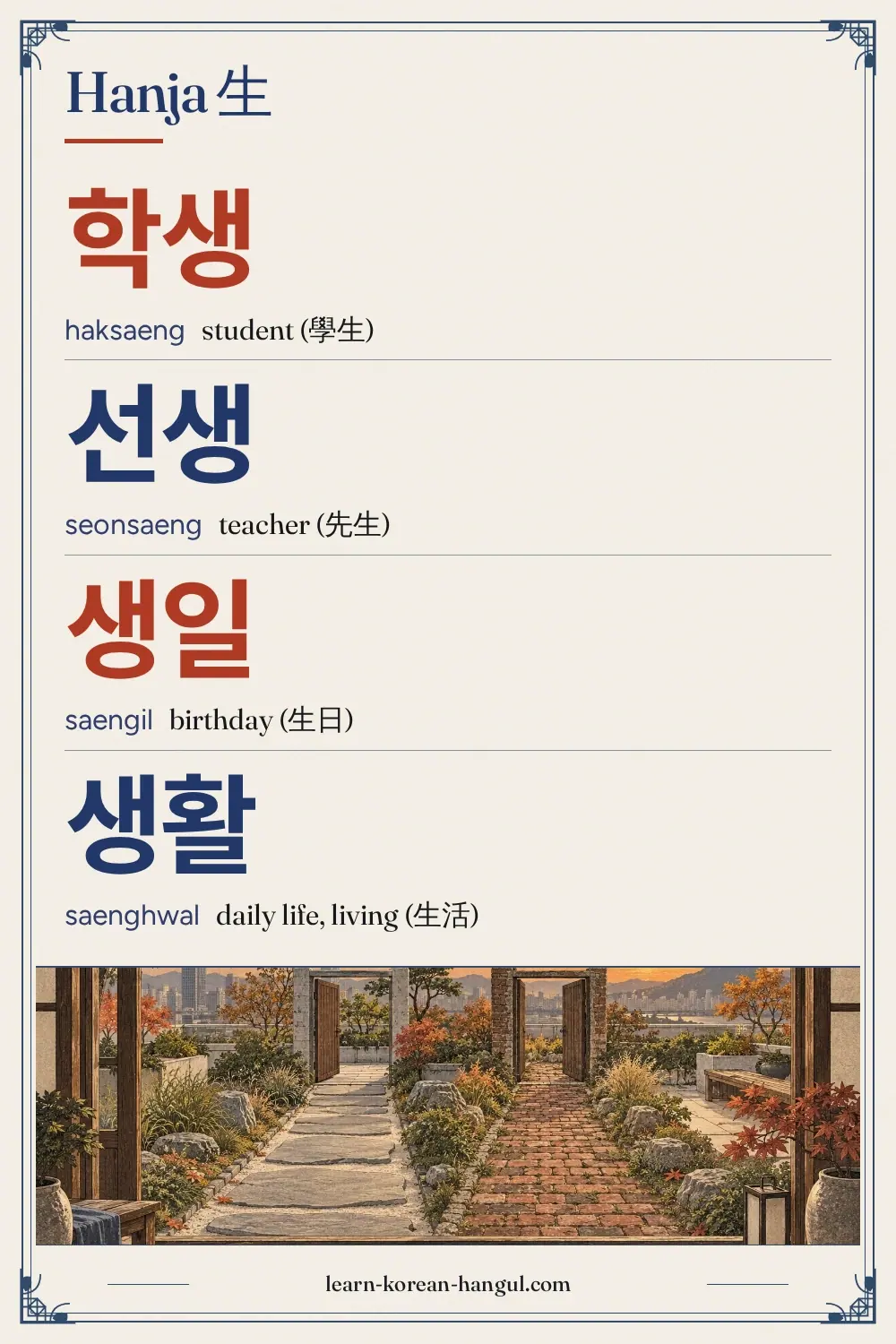
Hanja 生: the Essentials
Hanja 生 is one of the most productive characters in Korean vocabulary. Its 음훈 (the pair of the native meaning word and the Korean reading, as dictionaries list it) is 날 생. The word 날 here comes from the verb 나다, "to be born, to come out", and 생 is the reading you hear inside Sino-Korean words. Together they tell you the meaning (born, alive) and the sound (saeng).
The character is commonly explained as a picture of a plant pushing up out of the ground, which is why it carries both "birth" and "life". Two later meanings grew from that: "fresh, raw, not yet processed" (as in 생수, bottled drinking water, and 생방송, a live broadcast) and "a person defined by a way of life" (as in 학생, a person who studies). You do not need to memorise a theory. It is enough to hold three ideas: birth, life, and person.
The table below is the character card. Korean dictionaries list Chinese characters by their 음훈, so it is worth learning to read "날 생" as "the character that means born and is read saeng".
| Item | Detail |
|---|---|
| Character | 生 |
| 음훈 | 날 생 |
| Reading | 생 (saeng) |
| Core meanings | be born; live; life; raw or fresh; person |
| Radical | 生 itself (Kangxi radical 100) |
| Strokes | 5 |
| Words on this page | 12 |
Because 生 is its own radical, it also works as a building block in other characters, such as 性 (nature) and 星 (star), where it hints at the sound. You will meet more of these in the hanja radicals section. The next section lists the family itself.
Which Words Does 生 Build?
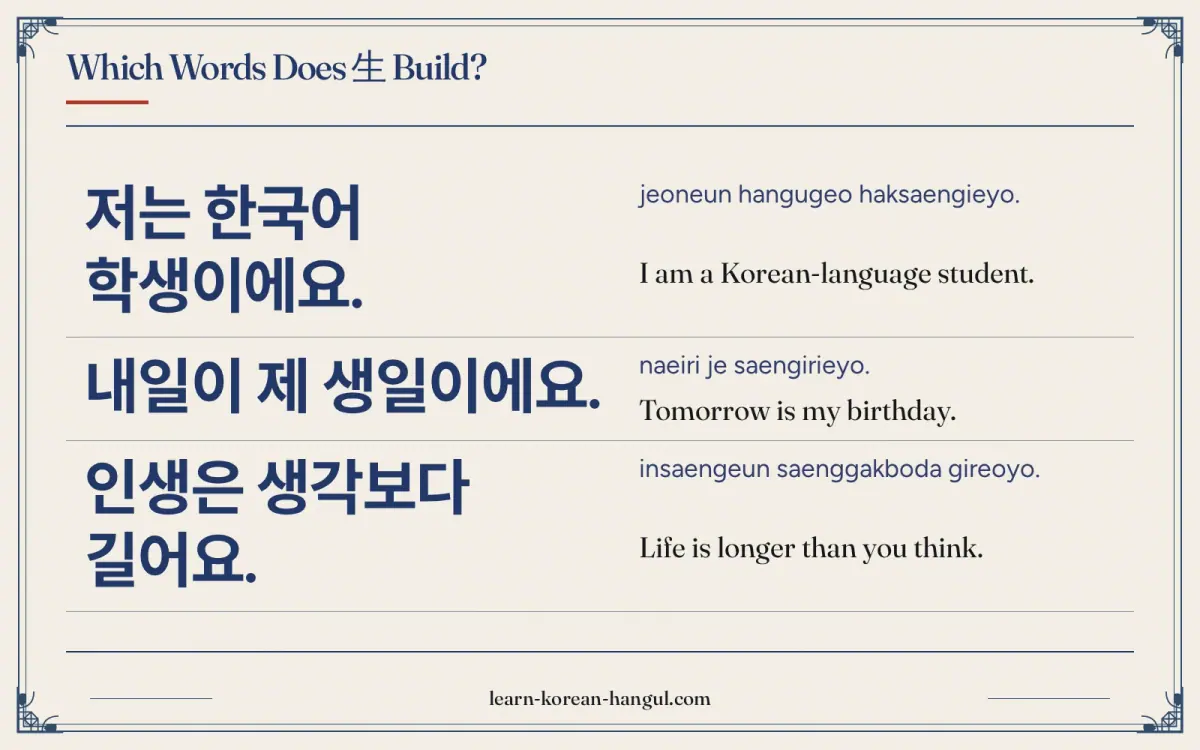
These 12 words are the best ones to learn first. They cover school, family, daily life, science and news. Revised Romanization (RR) appears only as a learning aid, and square brackets show the spoken form where it differs from the spelling.
| Word | Characters | RR | Meaning | How the characters add up |
|---|---|---|---|---|
| 학생 [학쌩] | 學生 | haksaeng | student | 學 study + 生 person |
| 선생 | 先生 | seonsaeng | teacher | 先 earlier + 生 born |
| 생일 | 生日 | saengil | birthday | 生 birth + 日 day |
| 생활 | 生活 | saenghwal | daily life, living | 生 live + 活 be active |
| 인생 | 人生 | insaeng | life, one's whole life | 人 person + 生 life |
| 생물 | 生物 | saengmul | living thing, organism | 生 live + 物 thing |
| 발생 [발쌩] | 發生 | balsaeng | occurrence, outbreak | 發 send out + 生 be born |
| 탄생 | 誕生 | tansaeng | birth (of a person, nation or idea) | 誕 be born + 生 be born |
| 생산 | 生産 | saengsan | production | 生 bring forth + 産 produce |
| 생명 | 生命 | saengmyeong | life (the living force) | 生 live + 命 life, fate |
| 위생 | 衛生 | wisaeng | hygiene, sanitation | 衛 protect + 生 life |
| 생도 | 生徒 | saengdo | cadet (also, in older use, pupil) | 生 person + 徒 follower |
Notice that 生 sits in two positions. In 생일, 생활, 생물, 생산, 생명 and 생도 it comes first and carries the "birth, live" idea. In 학생, 선생, 인생, 발생, 탄생 and 위생 it comes last. When 生 ends a word for people, as in 학생 and 선생, it means "person". When it ends an abstract word, as in 인생 and 위생, it means "life".
Two more patterns are worth knowing. As a prefix, 생- (生) means "raw, fresh, live": 생방송 (live broadcast), 생수 (bottled drinking water), 생선 (fresh fish) and 생맥주 [생맥쭈] (draft beer). And as a suffix, -생 (生) after a year or a group means a person born in that year or belonging to that group: 신입생 (new student), 졸업생 (graduate) and 94년생 (born in 1994).
The 12 Words One by One
학생 [학쌩] (學生, haksaeng): student. The most common 生 word. 學 (학) means "study", and 生 here means "a person living that life", so a 학생 is a person who studies. It covers pupils at every level, from 초등학생 (primary-school pupil) to 대학생 (university student). The ㅅ after the final ㄱ is tense, so say [학쌩], not "haksaeng" with a soft s.
선생 (先生, seonsaeng): teacher. Literally "born earlier": someone who came before you and so knows more. In speech Koreans nearly always add the respectful suffix 님 and say 선생님 (seonsaengnim) to a teacher, a doctor or another respected professional. Plain 선생 is used in compounds and in written style, for example 선생과 학생 (teacher and student).
생일 (生日, saengil): birthday. A "birth day". 日 (일) means day or sun, the same character as in 일요일 (Sunday). For an elder, the polite word is 생신 (生辰, saengsin), with 辰 meaning a special day, so you say 할머니 생신 (Grandmother's birthday), never 할머니 생일 in careful speech.
생활 (生活, saenghwal): daily life, living. 生 "live" plus 活 "be lively" gives the everyday business of living: your routine, your living conditions. It appears in 학교 생활 (school life), 직장 생활 (working life) and 생활비 (living costs). It is not the word for the span of a whole life; that is 인생.
인생 (人生, insaeng): life, one's whole life. A person's life as a story, from beginning to end: 인생이 힘들다 (life is hard), 인생 경험 (life experience). Here 生 stands for "life" rather than "birth". The pure Korean word 삶 means nearly the same, but 인생 is more common in speech, advice and song lyrics.
생물 (生物, saengmul): living thing, organism. Any living thing, from bacteria to whales. The opposite is 무생물 (無生物, non-living thing), and the school subject biology is 생물학 or, in schools, simply 생물. Do not confuse 生物 with the everyday word 물 (water): the 물 here is the character 物, "thing".
발생 [발쌩] (發生, balsaeng): occurrence, outbreak. Something "comes into being": an accident, a fire, a disease or a problem. It is often used as 발생하다 (to occur) in news and notices. The ㅅ is tense, [발쌩], because in Sino-Korean words a final ㄹ makes a following ㅅ tense. The related 발생률 means "rate of occurrence".
탄생 (誕生, tansaeng): birth (of a person, nation or idea). Both characters mean "be born", so the word feels grand and a little formal: 아기의 탄생 (the birth of a baby), 새 정부의 탄생 (the birth of a new government), 한글의 탄생 (the creation of Hangul). For an ordinary "I was born in 1995" Korean uses the verb 태어나다 instead.
생산 (生産, saengsan): production. Making goods, crops or energy. The pair is a "doubled" word, since 生 and 産 both lean toward "bring forth". You will see 생산하다 (to produce), 생산자 (producer) and 대량 생산 (mass production). The opposite is 소비 (消費, consumption). No tensing happens: the ㅇ before ㅅ is a nasal, so the word is [생산].
생명 (生命, saengmyeong): life (the living force). Life as something precious or biological: 생명이 위험하다 (life is in danger), 생명 보험 (life insurance), 생명 과학 (life science). 命 (명) also appears in 운명 (fate) and 명령 (order). Compare 인생, the story of a life, and 생활, daily living.
위생 (衛生, wisaeng): hygiene, sanitation. "Protecting life": keeping clean so that people stay healthy. You will see 위생 상태 (hygiene condition), 개인 위생 (personal hygiene) and 위생적 (hygienic). The first character 衛 is the same one as in 방위 (defence).
생도 (生徒, saengdo): cadet (also, in older use, pupil). A rare word you mostly meet in 사관생도 (military-academy cadet) and 생도 대표 (cadet representative). Everyday school speech uses 학생 instead. It is included because it shows the "person" sense of 生 clearly: a 徒 is a follower or disciple, and a 生徒 is one who is learning under a master.
Sentences to Hear the Words in Use
Ten of the words appear in short sentences. Listen to each one first, then read it aloud with the audio. The brackets in the word table above show how the words are said in connected speech.
저는 한국어 학생이에요.
jeoneun hangugeo haksaengieyo.
I am a Korean-language student.
우리 선생님은 아주 친절해요.
uri seonsaengnimeun aju chinjeolhaeyo.
Our teacher is very kind.
내일이 제 생일이에요.
naeiri je saengirieyo.
Tomorrow is my birthday.
한국 생활이 정말 재미있어요.
hanguk saenghwari jeongmal jaemiisseoyo.
Life in Korea is really fun.
인생은 생각보다 길어요.
insaengeun saenggakboda gireoyo.
Life is longer than you think.
바다에는 다양한 생물이 살아요.
badaeneun dayanghan saengmuri sarayo.
Many kinds of living things live in the sea.
이 근처에서 화재가 발생했어요.
i geuncheoeseo hwajaega balsaenghaesseoyo.
A fire broke out near here.
이 공장은 자동차를 생산해요.
i gongjangeun jadongchareul saengsanhaeyo.
This factory produces cars.
생명은 아주 소중해요.
saengmyeongeun aju sojunghaeyo.
Life is very precious.
손을 자주 씻으면 위생에 좋아요.
soneul jaju ssiseumyeon wisaenge joayo.
Washing your hands often is good for hygiene.
How Is 生 Read in Different Words?
The good news about 生 is that its reading never changes. It is 생 in every word, whether it comes first or last. Unlike 不 (불 or 부) and 力 (력 or 역), it has no second reading, and it does not fall under the initial-sound rule (두음법칙) that turns 력 into 역, because 생 does not begin with ㄹ or ㄴ.
Rule box: tensing after ㄱ and ㄹ. Two words in the family are said with a tense ㅆ even though the spelling shows a plain ㅅ.
- 학생 → [학쌩]: the final ㄱ of 학 is followed by ㅅ, which becomes tense (ㅆ).
- 발생 → [발쌩]: in Sino-Korean words a final ㄹ makes a following ㄷ, ㅅ or ㅈ tense.
Revised Romanization does not write tensing caused by a sound change, so it gives haksaeng and balsaeng. The brackets on this page show the spoken forms. The general rule is explained on the page about Sino-Korean tensification.
Compare the words where nothing happens. In 선생, 인생 and 탄생 the 생 follows a syllable ending in the nasal ㄴ, and in 위생 it follows a vowel. In 생산 the ㅅ of 산 follows the nasal ㅇ. Tensing happens after the stops ㄱ, ㄷ and ㅂ (and after ㄹ in Sino-Korean words), not after a nasal or a vowel. So 인생 is [인생], never "insseng", and 생산 is [생산].
One more detail catches learners: 생일 ends in 일, which begins with a silent ㅇ. The final ㅇ of 생 never moves to the next syllable the way ㄱ or ㄴ can, so 생일 stays [생일] (saeng-il), not "sae-ngil". Practise it slowly: 생, then 일.
The vowel ㅐ in 생 is the same as in 새 (bird, new) and 내일 (tomorrow). The standard pronunciation rules still list ㅐ and ㅔ as two vowels, but most Seoul speakers today pronounce them the same, so 생 and "seng" are close. Say it with the mouth only slightly open, and let the final ㅇ end the syllable with the back of the tongue raised, like the "ng" in "sing".
What Is Easy to Confuse with 生?
生 and 性. 생 (生, life) is often mixed up with 성 (性, nature or sex), which gives 성격 (personality) and 가능성 (possibility). The Hangul differs in just one letter: 생 versus 성. Remember that 성 has no ㅐ and no relation to birth. The character 姓 (surname, as in 성씨) is also read 성.
先生 and 선배. Both start with 先 "earlier", but 선생 (先生, born earlier) is a teacher, while 선배 (先輩, earlier group) is a senior at school or work. The opposite of 선배 is 후배 (後輩).
교사 and 선생님. 교사 (敎師) is the formal job title for a school teacher and is used in official writing; 선생님 is what you call a teacher to their face. Both can also be used about someone who teaches you something in any field, such as a piano teacher.
Four words for life. 인생 (人生) is a whole life seen as a story; 생활 (生活) is daily living; 생명 (生命) is life as a biological force; and 삶 is the native Korean word, often more literary. If you want to say "my life is busy", choose 생활이 바빠요, not 인생이 바빠요.
生日 and 生辰. For a friend or a child, 생일 is correct. For a parent, grandparent or boss, switch to 생신 and keep the rest of the sentence honorific: 할아버지 생신이 언제세요? (When is Grandfather's birthday?) That is the most common mistake with this family, and it is also why 생신 is worth learning at the same time as 생일.
Not every 생 is 生. Do not assume that every word with the syllable 생 contains this character: 생각 (thought), for example, is a native Korean word with no character behind it. When you see a word you do not know, check a dictionary for the characters instead of guessing from the sound.
Practice This Family
The 12 Words as Flashcards
The deck below has one card for each of the 12 words, with audio. The table shows the same cards, so you can study from either one.
| # | Korean | RR | Meaning | Character and note |
|---|---|---|---|---|
| 1 | 학생 [학쌩] | haksaeng | student (學生) | 學 (배울 학) + 生. Said [학쌩]. Also in 대학생 and 중학생. |
| 2 | 선생 | seonsaeng | teacher (先生) | 先 (먼저 선) + 生: "born earlier". Spoken form is 선생님. |
| 3 | 생일 | saengil | birthday (生日) | 生 + 日 (날 일): "birth day". Elders: 생신. |
| 4 | 생활 | saenghwal | daily life, living (生活) | 生 + 活 (살 활). Daily life: 학교 생활, 생활비. |
| 5 | 인생 | insaeng | life, one's whole life (人生) | 人 (사람 인) + 生. Life as a whole, from start to end. |
| 6 | 생물 | saengmul | living thing, organism (生物) | 生 + 物 (물건 물). Opposite: 무생물. Biology: 생물학. |
| 7 | 발생 [발쌩] | balsaeng | occurrence, outbreak (發生) | 發 (필 발) + 生. Said [발쌩]. News word: 발생하다. |
| 8 | 탄생 | tansaeng | birth (of a person, nation or idea) (誕生) | 誕 (낳을 탄) + 生. Formal "birth"; speech uses 태어나다. |
| 9 | 생산 | saengsan | production (生産) | 生 + 産 (낳을 산). Opposite of 소비 (consumption). |
| 10 | 생명 | saengmyeong | life (the living force) (生命) | 生 + 命 (목숨 명). Life as a living force; also 생명 보험. |
| 11 | 위생 | wisaeng | hygiene, sanitation (衛生) | 衛 (지킬 위) + 生. Hygiene: "protecting life". |
| 12 | 생도 | saengdo | cadet (also, in older use, pupil) (生徒) | 生 + 徒 (무리 도). Rare: 사관생도 (military cadet). |
Practice · 12
- 01학생
Show answer
haksaeng
student (學生)
- 02선생
Show answer
seonsaeng
teacher (先生)
- 03생일
Show answer
saengil
birthday (生日)
- 04생활
Show answer
saenghwal
daily life, living (生活)
- 05인생
Show answer
insaeng
life, one's whole life (人生)
- 06생물
Show answer
saengmul
living thing, organism (生物)
- 07발생
Show answer
balsaeng
occurrence, outbreak (發生)
- 08탄생
Show answer
tansaeng
birth (of a person, nation or idea) (誕生)
- 09생산
Show answer
saengsan
production (生産)
- 10생명
Show answer
saengmyeong
life (the living force) (生命)
- 11위생
Show answer
wisaeng
hygiene, sanitation (衛生)
- 12생도
Show answer
saengdo
cadet (also, in older use, pupil) (生徒)
Decode Three Unseen Words
生存 생존 (saengjon). 生 "live" + 存 "exist". The word means survival, as in 생존 게임 (survival game) and 생존자 (survivor). The sound is [생존] with no change.
學生證 학생증 (haksaengjeung). 學生 "student" + 證 "proof". It is the student ID card. Said [학쌩쯩]: the same tense ㅆ as in 학생, and the 증 is tense too.
新生兒 신생아 (sinsaenga). 新 "new" + 生 "born" + 兒 "child". This is the word for a newborn baby. The last syllable 아 is the character 兒, which also appears in 소아과 (pediatrics).
Check Yourself
Each question asks you to decode a word or answer a question about 生. The answers are checked as you go.
Practice · 6
선생 is 先 "earlier" + 生. What does 선생 literally mean?
Show answer
born earlier
先 means "earlier" and 生 means "born", so 선생 is "one born earlier": a teacher. A student is 학생, which is 學 "study" + 生.
How is 학생 said in normal speech?
Show answer
[학쌩] with a tense ㅆ
After the final ㄱ, the ㅅ becomes tense, so 학생 is [학쌩]. The final ㄱ is not nasalised here because the next sound is ㅅ, not ㄴ or ㅁ.
Which word is the polite word for an elder's birthday?
Show answer
생신
생신 (生辰) is the honorific for an elder's birthday. 생일 is for friends and children, 탄생 is "birth" in a general sense, and 생활 is daily life.
위생 is 衛 "protect" + 生. What does 위생 mean?
Show answer
hygiene
위생 (衛生) is hygiene: protecting life by staying clean. Production is 생산, a birthday is 생일, and an occurrence or accident is 발생 or 사고.
Which word means "a person's life as a whole story"?
Show answer
인생
인생 (人生) is life as a whole. 생물 is a living thing, 생도 is a cadet and 생산 is production.
신생아 is 新 "new" + 生 "born" + 兒 "child". Who is a 신생아?
Show answer
a newborn baby
신생아 (新生兒) is a newborn baby. A new student is 신입생, built from the same 生 "person" ending.
What to Learn Next
You now have a base of 12 words and the three meanings of 生. The best next step is to meet the word 人, which pairs with 生 in 인생 and 인간. Return to the hanja word families page to choose another character, or go straight to 人 (인) for the people family.
If you want to see 生 in the wider vocabulary of Chinese-origin words, the Sino-Korean vocabulary page lists such words by topic, and the Sino Korean Words Flashcards deck lets you review them with audio. For the big picture, see Does Korean use hanja? and the hanja hub. To widen your base, the 100 most useful hanja list puts 生 among the core characters, the 學 family shares the word 학생 with this one, and how to learn hanja explains the word-family method.
Frequently Asked Questions
Why do both 學生 and 先生 end in 生?
In both words 生 means "person who lives a certain way". A 學生 is a person who studies (學), and a 先生 is a person who was born earlier (先). The ending works like -er in English: it names the person. That is why the pair can sit together in the phrase 선생과 학생, "teacher and student".
What is 生 in 生日?
In 생일 (生日), 生 means "birth" and 日 means "day", so the word is "birth day". The honorific form for elders is 생신, which uses 辰 (a special day) in place of 日. Use 생신 with grandparents, parents and teachers, and 생일 with friends and children.
What does 生 mean as a prefix?
As a prefix, 생- means "raw, fresh or live". Examples are 생방송 (live broadcast), 생수 (bottled drinking water), 생선 (fish) and 생맥주 [생맥쭈] (draft beer). Context shows which sense is meant.
Is 生 pronounced 날 or 생?
It is pronounced 생. The syllable 날 in "날 생" is the 훈, the native Korean word that explains the character's meaning ("to be born"). The 음 is the reading you actually use inside Sino-Korean words, which is 생. So a dictionary lists the character as 날 생, and you say 학생, not "학날".