
Korean Time Counters: the Essentials
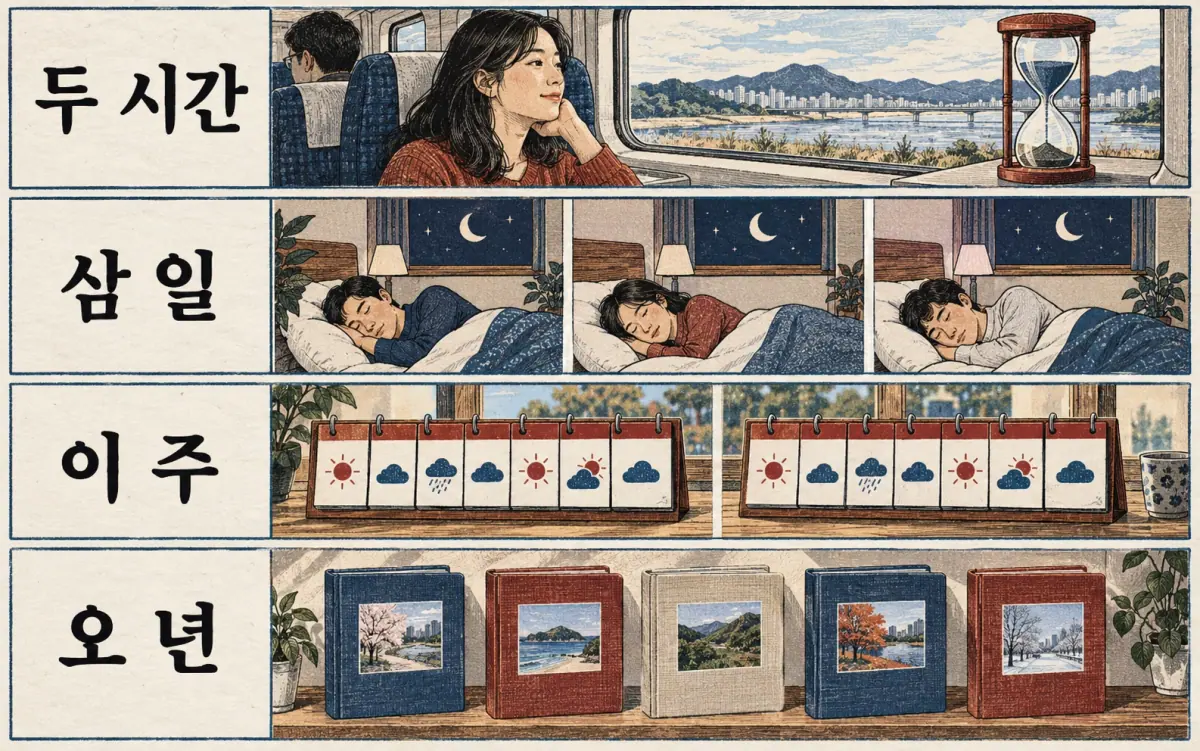
A Korean time counter is a word that follows a number to say how long something lasts. A duration is a length of time, such as two hours or three years, and it differs from a point in time such as 3 o'clock. Korean has one counter for each unit of time, and each counter is paired with either the native or the Sino-Korean number series.
| Span | Counter | Number system | Example | Question |
|---|---|---|---|---|
| hours | 시간 | native | 두 시간 | 몇 시간 |
| days | 일 | Sino-Korean | 삼 일 | 며칠 |
| weeks | 주 | Sino-Korean | 이 주 | 몇 주 |
| months | 달 | native | 두 달 | 몇 달 |
| months | 개월 | Sino-Korean | 이 개월 | 몇 개월 |
| years | 년 | Sino-Korean | 오 년 | 몇 년 |
Native numbers are the series 하나, 둘, 셋 that shorten to 한, 두, 세 before a counter. Sino-Korean numbers are the series 일, 이, 삼 borrowed from Chinese. The rule for time is easy to state, but not easy to guess: only hours and the native month counter 달 use the native series. Everything else takes Sino-Korean numbers, with two spoken exceptions: 주 also appears with native numbers (한 주, 두 주), and the native noun 해 counts years (두 해).
For the general rules that every counter shares, see how Korean counters work.
Pages in This Group
The group has five lessons, one for each time unit. Each lesson gives the counter's number forms, its question word, example sentences with audio and a practice set.
Hours and Days
Korean counter sigan (시간): how to say how many hours teaches 한 시간, 두 시간 and 한 시간 반 (an hour and a half). It separates 시 (3 o'clock) from 시간 (three hours) and shows how to add Sino-Korean minutes, as in 두 시간 삼십 분. It also covers 몇 시간 걸려요? and 동안, the word for "for".
Korean counter il (일): how to count days in Korean explains why days take Sino-Korean numbers (삼 일) while speech also uses the native day words 하루, 이틀, 사흘 and 나흘. It teaches 며칠 for "how many days" and separates a counted span from a calendar date.
Weeks and Months
Korean counter ju (주): how to count weeks in Korean covers 이 주, 삼 주 and the noun 일주일 for one week. It compares 주 with 주일 and teaches 몇 주 for plans such as a two-week holiday.
Korean counter dal (달) and gaewol (개월): counting months gives the rule that 달 takes native numbers (두 달) and 개월 takes Sino-Korean numbers (이 개월). It separates month names such as 삼월 from month counts and explains baby ages in months.
Years
Korean counter nyeon (년): how to count years in Korean teaches 일 년, 이 년 and 십 년, the question 몇 년 and the native noun 해. It contrasts counted years (3년) with calendar years (2026년).
How Do Duration and Clock Time Differ?

Duration and clock time use similar words but answer different questions. A duration says how long, a clock time says when. The table shows how a single number changes meaning with its counter.
| Number | Clock or calendar use | Duration use |
|---|---|---|
| 세 | 세 시 (3 o'clock) | 세 시간 (three hours) |
| 삼 | 삼월 (March) | 삼 개월 (three months) |
| 삼 | 삼 일 (the 3rd) | 삼 일 (three days) |
| 이천이십육 | 이천이십육 년 (the year 2026) | 이 년 (two years) |
Note the third row. A date and a three-day span look identical on paper (삼 일) and only context separates them. To see clock time in depth, read telling time in Korean, and for the date side see dates in Korean.
How Do You Ask How Long Something Takes?

To ask how long, use 몇 (how many) plus the counter, then a verb such as 걸려요 (it takes). Every counter in the group has its own question word, and the answer repeats the counter.
| Counter | Question | Answer |
|---|---|---|
| 시간 | 몇 시간 걸려요? | 두 시간 걸려요. |
| 일 | 며칠 걸려요? | 사흘 걸려요. |
| 주 | 몇 주 걸려요? | 이 주 걸려요. |
| 달 / 개월 | 몇 달 걸려요? | 세 달 걸려요. |
| 년 | 몇 년 걸려요? | 삼 년 걸려요. |
Note that 며칠 is a fixed word and does not take the form 몇 일. The shared verb 걸리다 works for every unit because it means "to take (time)". To state a plan instead of a question, swap 몇 for the number and keep the rest: 삼 일 걸려요 (it takes three days), 이 주 걸려요 (it takes two weeks). Each lesson in the group drills this frame with the counter's own numbers.
Why Does 달 Take Native Numbers but 개월 Sino-Korean?

달 is a native Korean word for "month", so it pairs with native numbers (한 달, 두 달). 개월 is built from the Chinese-origin pieces 개 (counter) and 월 (month), so it pairs with Sino-Korean numbers (일 개월, 이 개월). Both mean a length of months. The choice rarely changes the meaning, but it changes the register: 달 is common in speech and 개월 is common in contracts, medical notes and baby ages.
Which Time Counter Should You Learn First?

Start with 시간 and 일, because daily plans use them most: "It takes two hours" and "for three days". Add 주 and 개월 next for schedules and trips, and finish with 년. This order follows how often each counter appears in beginner conversation, and it works as a study plan for the whole set of Korean time counters.
| If you want to... | Start with |
|---|---|
| say how long a trip takes | 시간 |
| plan a holiday or a stay | 일, then 주 |
| talk about a course or a baby's age | 개월 and 달 |
| talk about years of study or work | 년 |
If you also need the clock, read telling time in Korean afterward, because 시 and 시간 are easy to mix up when both are fresh. Time words such as 오늘 and 내일 belong to the vocabulary section.
Expert tip: in a single sentence you can mix counters from this group, and the number systems mix with them. 이 년 삼 개월 (two years and three months) uses Sino-Korean numbers for both parts, while 두 시간 삼십 분 (two hours and thirty minutes) uses a native number for hours and a Sino-Korean number for minutes. When you build a long duration, choose the number system for each counter separately, never for the whole phrase.
Frequently Asked Questions
What is the difference between 시 and 시간?
시 names a point on the clock, as in 세 시 (3 o'clock), and 시간 names a length of time, as in 세 시간 (three hours). Both take native numbers, so the extra syllable 간 is the only difference in form. Ask 몇 시예요? for the time and 몇 시간 걸려요? for how long.
How do I say three months?
Say 세 달 with the native number or 삼 개월 with the Sino-Korean number. Both mean three months. 달 pairs with native numbers, and 개월 pairs with Sino-Korean numbers. Do not confuse either one with 삼월, which is the month name March. Baby ages and contracts usually use 개월.
How do I say two weeks?
Say 이 주, which uses the Sino-Korean number 이 and the counter 주. You can also say 이 주일 or the digits 2주. One week is the fixed noun 일주일. To ask how many weeks, say 몇 주 걸려요? In speech you will also hear the native 두 주 (two weeks) and 한 주 (one week).
Do I say 일 or 날?
Use 일 as the counter after Sino-Korean numbers, as in 삼 일. 날 is the native noun for day, as in 좋은 날 (a good day), and it is not a counter. For short spans, Koreans prefer the native words 하루, 이틀 and 사흘 instead of a number plus 일.
Which time counter is used for a school term?
There is no time counter for a term. Count terms with the noun 학기 (semester) and native numbers, as in 한 학기, and give the length with 개월, as in 사 개월. A term is a unit of school, not a unit of time, so it follows its own counter.
Return to Korean Counters for the full set of counter groups, or go back to Korean Numbers for the number systems behind them.