Before you start
- Time: about 15 minutes to learn the method.
- Prerequisites: native Korean numbers 1 to 12 and a few Sino-Korean numbers (5, 10, 15, 30, 45).
- Materials: none. Say each example aloud and play the audio.
- Result: you can say any clock time and answer 지금 몇 시예요? (What time is it now?)
How to Tell Time in Korean: the Formula
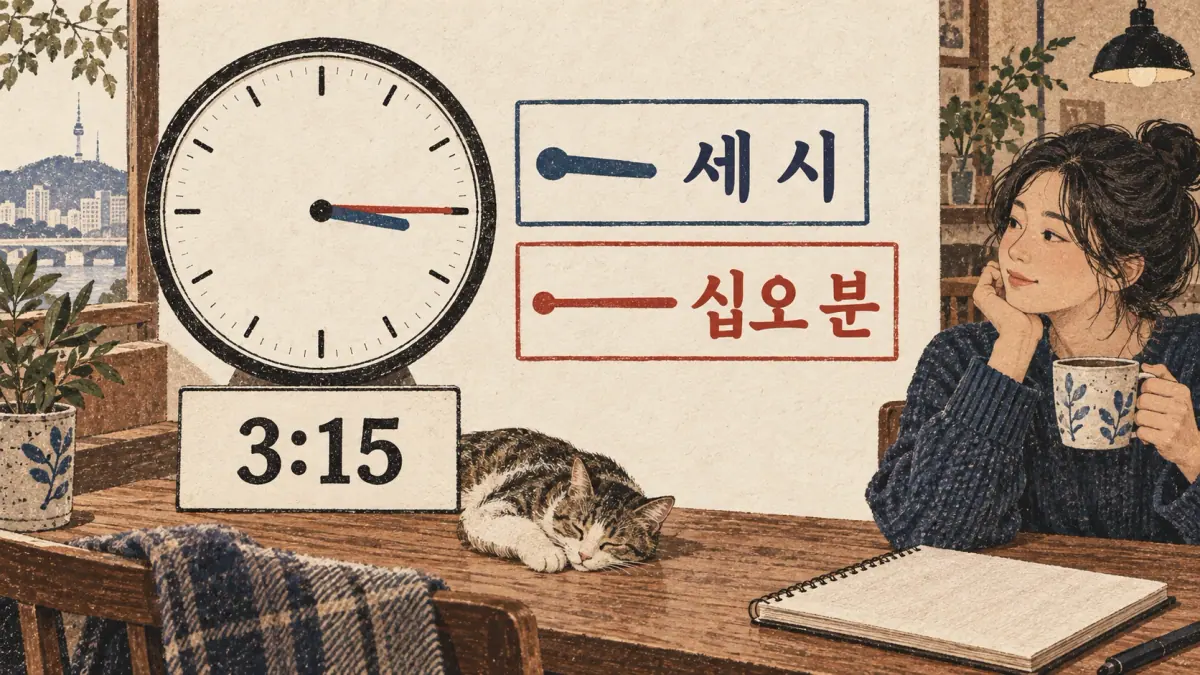
Telling time in Korean uses one formula with two number systems: native number + 시 (si) + Sino-Korean number + 분 (bun). The word 시 means "o'clock" and names the hour. The word 분 means "minute" and names the minutes. Both are counters, which are short words that attach to a number and say what it measures.
For example, 3:15 breaks into three parts:
| Part | Korean | Meaning |
|---|---|---|
| Hour | 세 시 | 3 o'clock (native 세 + 시) |
| Minutes | 십오 분 | 15 minutes (Sino 십오 + 분) |
| Whole time | 세 시 십오 분 | 3:15 |
Why two systems? Korean counts the hour as a position on the clock with native numbers and labels the minutes as a unit with Sino-Korean numbers. The lesson on Sino vs native Korean numbers explains the wider rule. If you want the formula on its own page, the hub for telling time in Korean has a summary.
Now take the four steps one at a time, starting with the hour.
Step 1: Say the Hour with a Native Number and 시
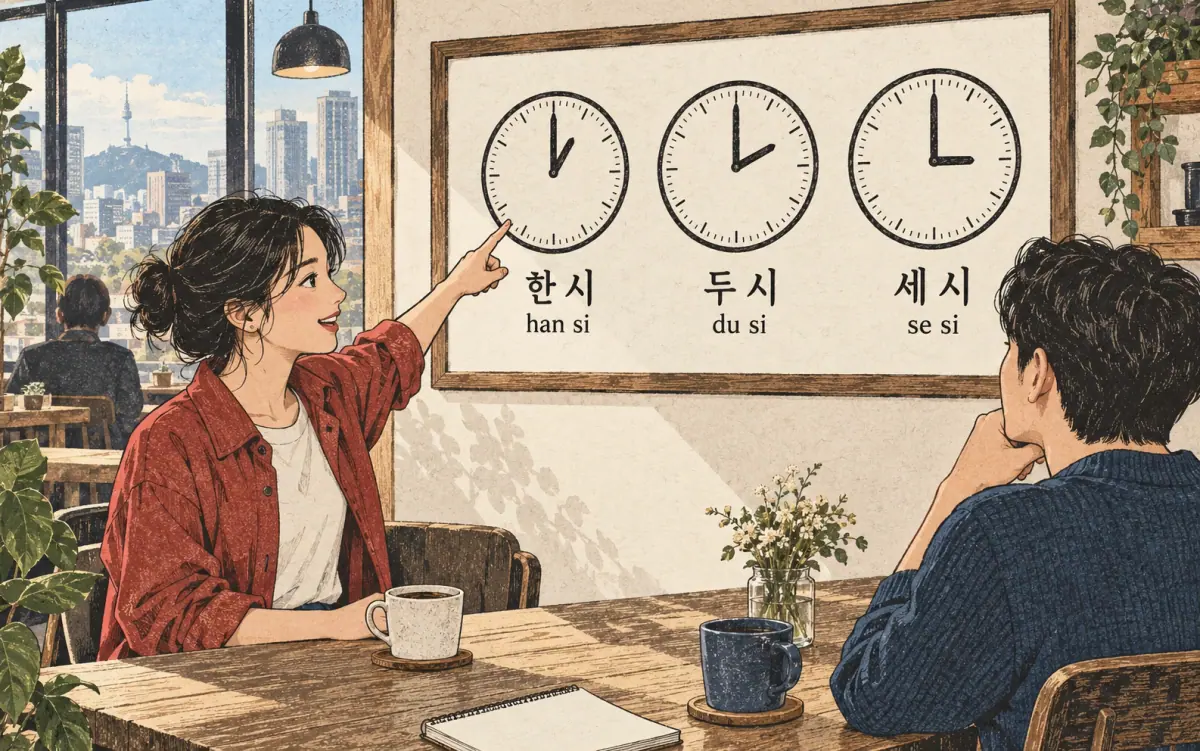
Say the hour by putting a native Korean number before 시. Use the short forms 한, 두, 세, 네 for 1 to 4, and the usual forms for 5 to 10. For 11 and 12, use 열한 and 열두. The native Korean numbers 1-10 page teaches the base list.
| Hour | Korean | Reading aid | Sound |
|---|---|---|---|
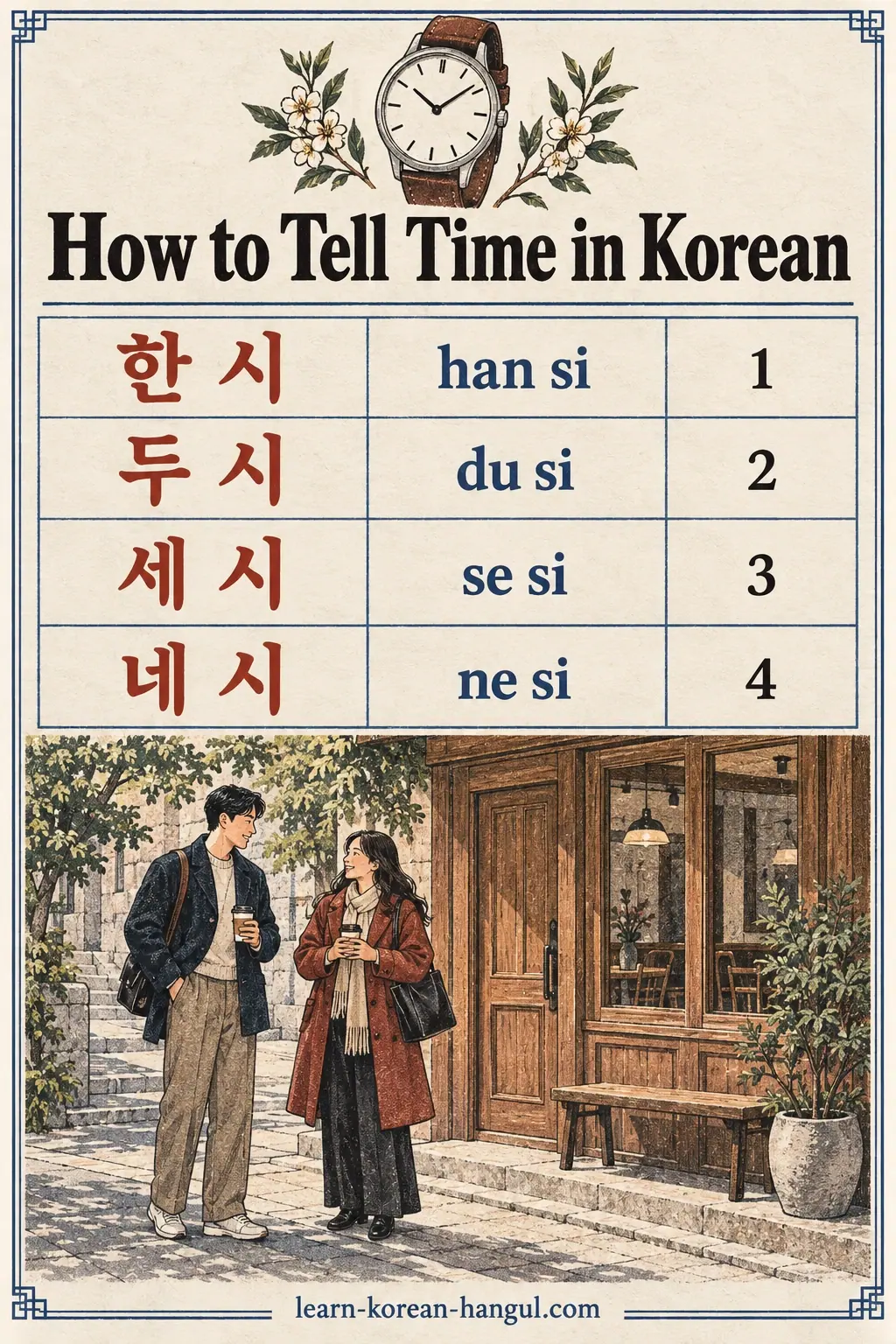
| 1 | 한 시 | han si | [한시] |
| 2 | 두 시 | du si | [두시] |
| 3 | 세 시 | se si | [세시] |
| 4 | 네 시 | ne si | [네시] |
| 5 | 다섯 시 | daseot si | [다섣씨] |
| 6 | 여섯 시 | yeoseot si | [여섣씨] |
| 7 | 일곱 시 | ilgop si | [일곱씨] |
| 8 | 여덟 시 | yeodeol si | [여덜시], often [여덜씨] |
| 9 | 아홉 시 | ahop si | [아홉씨] |
| 10 | 열 시 | yeol si | [열시], often [열씨] |
| 11 | 열한 시 | yeolhan si | [열한시] |
| 12 | 열두 시 | yeoldu si | [열두시] |
The two hours that change shape are 11 and 12. Native 11 is 열하나 and 12 is 열둘, but before 시 they shorten to 열한 and 열두, just as 하나 shortens to 한 and 둘 to 두. So 11 o'clock is 열한 시, not 열하나 시.
You'll know it worked when you can say 4, 7 and 11 o'clock (네 시, 일곱 시, 열한 시) without counting from one.
Common mistake: using Sino-Korean numbers for the hour. 삼 시 and 오 시 are wrong. The correct forms are 세 시 and 다섯 시. The full hour lesson on the Korean counter si drills all 12 hours.
The hour is only half of most times, so the next step adds the minutes.
Step 2: Add the Minutes with a Sino-Korean Number and 분
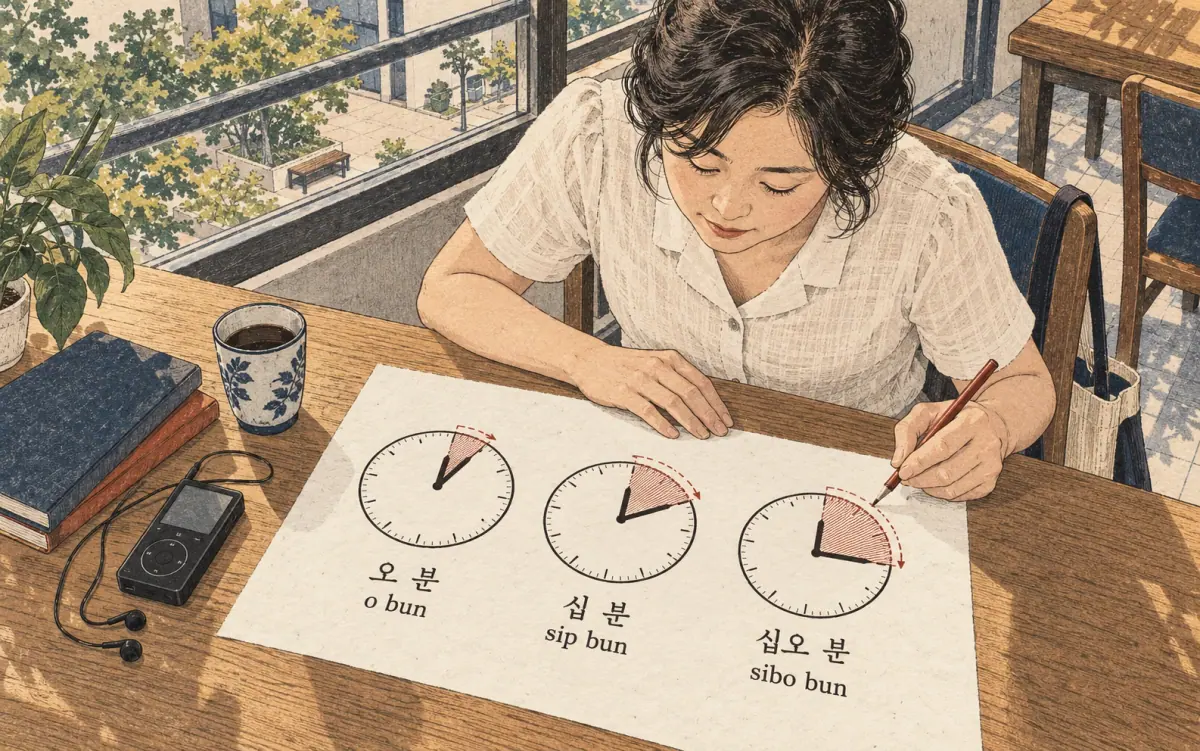
Add the minutes by putting a Sino-Korean number before 분 and saying it right after the hour. Sino-Korean numbers are 일, 이, 삼, 사, 오, 육, 칠, 팔, 구, 십, and tens are built with 십: 이십 is 20 and 삼십 is 30. The page on Sino-Korean numbers 1-100 has the full list.
| Minutes | Korean | Reading aid |
|---|---|---|
| 5 | 오 분 | o bun |
| 10 | 십 분 | sip bun |
| 15 | 십오 분 | sibo bun |
| 20 | 이십 분 | isip bun |
| 25 | 이십오 분 | isibo bun |
| 30 | 삼십 분 | samsip bun |
| 40 | 사십 분 | sasip bun |
| 45 | 사십오 분 | sasibo bun |
| 55 | 오십오 분 | osibo bun |
Put the hour and the minutes together with a space between the two parts:
- 3:05 is 세 시 오 분.
- 7:30 is 일곱 시 삼십 분.
- 11:45 is 열한 시 사십오 분.
You'll know it worked when you can say 7:30 and 11:45 in one breath, with the hour first and the minutes second.
Common mistake: using native numbers for the minutes. 세 분 and 열 분 are wrong for minutes. 세 분 actually means "three people" in polite speech. Use 삼 분 and 십 분 instead. The page on the minutes counter explains this and the seconds word 초.
With hours and minutes in place, you can say the time, but you cannot yet say whether it is morning or evening.
Step 3: Mark AM or PM
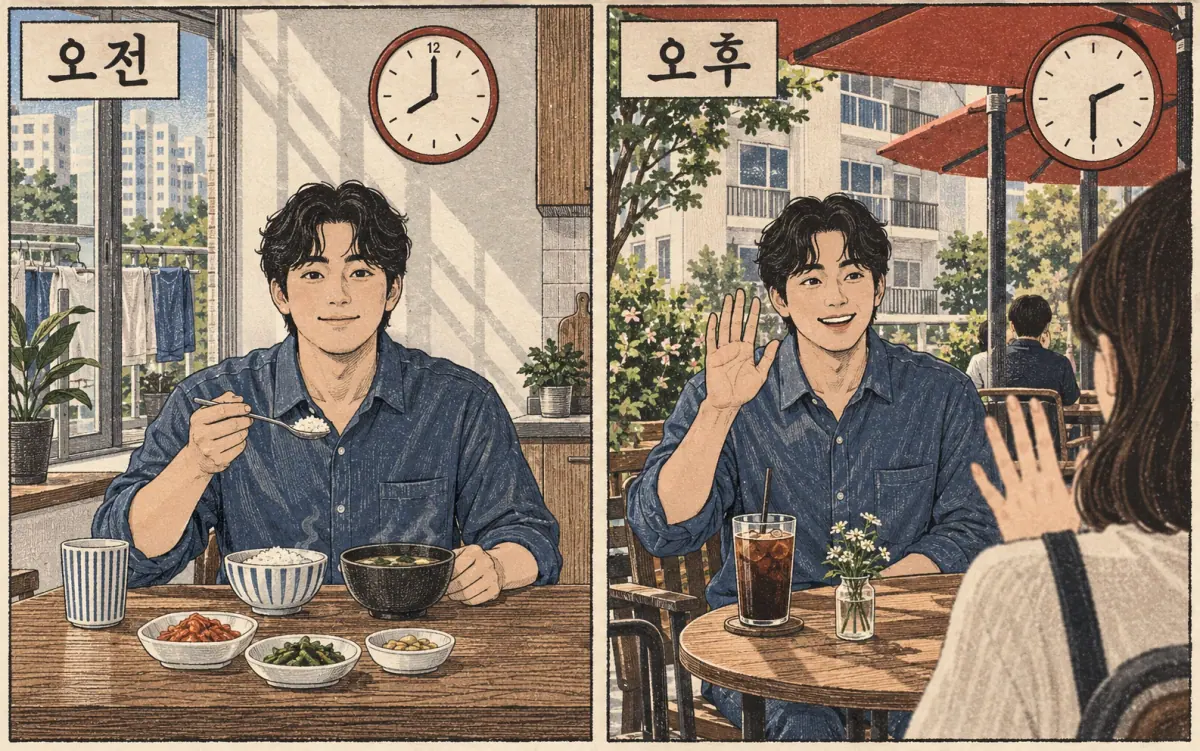
Mark AM or PM by putting 오전 (AM) or 오후 (PM) before the hour. Korean puts the day part first, which is the reverse of English. So 3:15 PM is 오후 세 시 십오 분, not 세 시 십오 분 오후.
| English | Korean | Reading aid |
|---|---|---|
| 7:30 AM | 오전 일곱 시 삼십 분 | ojeon ilgop si samsip bun |
| 3:15 PM | 오후 세 시 십오 분 | ohu se si sibo bun |
| 11:45 PM | 오후 열한 시 사십오 분 | ohu yeolhan si sasibo bun |
Koreans also use day-part words instead of 오전 and 오후: 아침 (morning) and 저녁 (evening) are the most common, as in 아침 일곱 시 (7 in the morning) and 저녁 여섯 시 (6 in the evening). The lesson on AM, PM and half past lists them all.
You'll know it worked when you can turn 8:00 PM into 오후 여덟 시 without placing 오후 after the hour.
Common mistake: copying the English word order. 세 시 오후 is wrong. Also skip 오전 and 오후 when the context is obvious, such as a class schedule: 아홉 시에 시작해요 is fine without 오전.
The time is complete, so the last step shows how to use it in a sentence.
Step 4: Say 'at' with 에 and Ask 몇 시
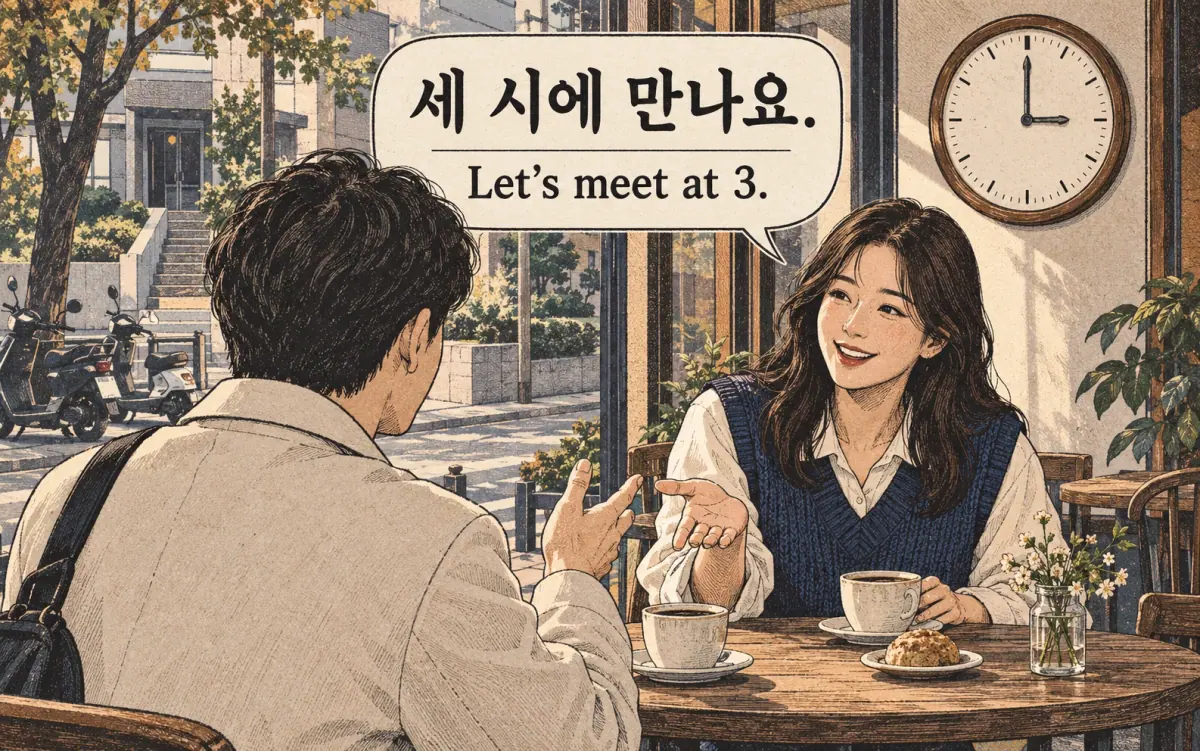
Say "at" a time by adding the particle 에 (e) right after the time, and ask the time with the question word 몇 시 (myeot si, "what time"). A particle is a short word that follows a noun and shows its role. The particle 에 marks a point in time.
| Sentence | Meaning |
|---|---|
| 세 시에 만나요. | Let's meet at 3. |
| 일곱 시 삼십 분에 일어나요. | I get up at 7:30. |
| 몇 시에 자요? | What time do you go to bed? |
| 열한 시에 자요. | I go to bed at 11. |
When you ask what time it is now, you do not use 에, because 몇 시 is the main answer, not a time of an event: 지금 몇 시예요? A short dialogue shows both patterns:
- 지금 몇 시예요? (What time is it now?)
- 세 시 십오 분이에요. (It's 3:15.)
- 몇 시에 만나요? (At what time shall we meet?)
- 네 시에 만나요. (Let's meet at 4.)
Notice the ending. After a word that ends in a vowel, such as 시, the polite ending is 예요 (세 시예요). After a word that ends in a consonant, such as 분 or 반, it is 이에요 (십오 분이에요, 세 시 반이에요). The phrase page on what time is it in Korean adds casual and formal versions.
You'll know it worked when you can answer 몇 시에 일어나요? with your own wake-up time.
Common mistake: adding 에 to 지금 몇 시예요? or leaving it out of 몇 시에 만나요? The first never takes 에, and the second needs it.
Four steps cover the method. The next section puts all four together in full examples.
What Do Full Examples Sound Like?
Full examples combine all four steps in one phrase. The table below runs from 3:00 to 11:45, with the hour first, the minutes second and the day part in front when you need it.
| Time | Korean | Reading aid |
|---|---|---|
| 3:00 | 세 시 | se si |
| 4:05 | 네 시 오 분 | ne si o bun |
| 5:10 PM | 오후 다섯 시 십 분 | ohu daseot si sip bun |
| 6:20 | 여섯 시 이십 분 | yeoseot si isip bun |
| 7:30 AM | 오전 일곱 시 반 | ojeon ilgop si ban |
| 8:40 | 여덟 시 사십 분 | yeodeol si sasip bun |
| 10:50 | 열 시 오십 분 | yeol si osip bun |
| 11:45 PM | 오후 열한 시 사십오 분 | ohu yeolhan si sasibo bun |
Here is a short day plan that uses the same pattern in real sentences:
- 오전 일곱 시에 일어나요. (I get up at 7 AM.)
- 여덟 시 삼십 분에 학교에 가요. (I go to school at 8:30.)
- 오후 열두 시 반에 점심을 먹어요. (I eat lunch at 12:30 PM.)
- 오후 여섯 시에 집에 와요. (I come home at 6 PM.)
Each sentence has the same skeleton: time + 에 + verb. Swap the time and the verb, and you can describe your own day. The next section lists the errors that appear most often when learners try this.
What Mistakes Do Learners Make When Telling Time in Korean?
Learners make five main mistakes when telling time. Each row shows the error, the fix and the reason.
| Mistake | Wrong | Right | Reason |
|---|---|---|---|
| Sino number for the hour | 삼 시 | 세 시 | Hours take native numbers |
| Native number for the minute | 세 분 (for 3 minutes) | 삼 분 | Minutes take Sino-Korean numbers |
| Full form before 시 | 하나 시, 둘 시 | 한 시, 두 시 | 하나 and 둘 shorten before a counter |
| Wrong 11 or 12 | 열하나 시 | 열한 시 | 열한 and 열두 are the forms before 시 |
| AM or PM last | 세 시 오후 | 오후 세 시 | Day part goes first |
Expert insight: the fastest self-test is the 10:10 time. Say 열 시 십 분. The two tens are different words, the native 열 and the Sino 십, and if you say them correctly you have understood the whole method.
A few set phrases make the clock easier, and they appear in the next section.
What Variations Should You Know?
Four variations cover almost every other way of saying a time: 반 for half past, 정각 for exactly on the hour, 전 for minutes before, and 쯤 for about. The table lists each with an example.
| Variation | Meaning | Example | English |
|---|---|---|---|
| 반 | half past | 세 시 반 | 3:30 |
| 정각 | exactly on the hour | 세 시 정각 | exactly 3:00 |
| 전 | before | 세 시 오 분 전 | five minutes to 3 |
| 쯤 | about | 세 시쯤 | about 3 |
| 십오 분 | quarter past | 세 시 십오 분 | 3:15 |
| 사십오 분 | quarter to the next hour | 세 시 사십오 분 | 3:45 |
Korean has no common word for "quarter", so say 십오 분 or 사십오 분. For the full explanation of each modifier, see the lesson on AM, PM and half past.
Can I Drop 분 When Saying the Time?
Keep 분 when you are learning. The standard way to say 3:15 is 세 시 십오 분, and the shorter 세 시 십오 may be heard in quick casual talk, but it is not the form to copy. Only 반 and 정각 replace the minute part completely, as in 세 시 반 and 세 시 정각.
The variations are useful, but they do not change the formula. One more question is how much practice you need.
How Long Does It Take to Learn to Tell Time in Korean?
Plan about 15 minutes to learn the method and a few short sessions to make it automatic. The method itself has only one formula. The slow part is the minute list, because Sino-Korean numbers above 20 need repeating. The durations that follow clock time, such as "two hours", are a separate topic taught on the page for the 시간 counter.
A useful routine is to say the real time aloud in Korean three times a day for a week: when you wake up, at lunch and in the evening. You will practise the hour list often and the minute list in smaller doses.
Practice Set
Answer each item aloud before you read the answers.
- Say 9:00 in Korean.
- Say 6:20 in Korean.
- Say 2:30 PM in two ways.
- Say "Let's meet at 5."
- Ask "What time is it now?"
- Correct the mistake: 삼 시 십 분.
Answers:
- 아홉 시 (ahop si)
- 여섯 시 이십 분 (yeoseot si isip bun)
- 오후 두 시 삼십 분 or 오후 두 시 반
- 다섯 시에 만나요. (daseot sie mannayo)
- 지금 몇 시예요? (jigeum myeot siyeyo)
- 세 시 십 분. The hour needs the native 세, not the Sino 삼.
Practice · 8
How do you say 3:15?
Show answer
세 시 십오 분
The hour takes a native number with 시 and the minutes take a Sino-Korean number with 분.
How do you say 9:00?
Show answer
아홉 시
Hours take native numbers with 시, so 9 o'clock is 아홉 시.
How do you say 11 o'clock?
Show answer
열한 시
Native 11 shortens to 열한 before 시.
How do you say 3:15 PM?
Show answer
오후 세 시 십오 분
Korean puts the day part first: 오후 goes before the hour.
How do you say "Let's meet at 5"?
Show answer
다섯 시에 만나요.
Use the native hour 다섯 with 시, then 에 for "at".
How do you ask "What time is it now?"
Show answer
지금 몇 시예요?
The question about the current time never takes 에. 몇 분이세요? asks how many people.
How do you say 10:10?
Show answer
열 시 십 분
The hour is native 열 and the minutes are Sino 십.
Which phrase also means 3:30?
Show answer
세 시 반
반 means half past. 정각 means exactly on the hour, and 오 분 전 means five minutes to.
What Should You Learn Next?
You now know how to tell time in Korean: native number and 시 for the hour, Sino-Korean number and 분 for the minute, 오전 or 오후 first, and 에 for "at". Continue in this order:
- The hour with 시 for a deeper drill on all 12 hours and the 시 versus 시간 difference.
- AM, PM and half past for noon, midnight and the parts of the day.
- What time is it in Korean for the question in more speech styles.
- The 시간 counter for durations such as "two hours".
If you can complete the practice set without help, you have mastered how to tell time in Korean at beginner level.
Frequently Asked Questions
Why is 3 o'clock 세 시 and not 삼 시?
The hour counts a position on the clock face, and Korean counts that with native numbers: 한, 두, 세, 네. The Sino-Korean 삼 is kept for the minute. So 3:00 is 세 시, 3:03 is 세 시 삼 분, and saying 삼 시 sounds wrong to Korean ears.
How do I say 12:30 in Korean?
Say 열두 시 삼십 분 (yeoldu si samsip bun) or the shorter, very common 열두 시 반 (yeoldu si ban). Both mean 12:30. The hour 12 is 열두, a special native form, and 반 means half. To mark noon or midnight, add 낮 or 밤 in front of the hour.
How do I say 'at 3' in Korean?
Add the particle 에 after 시 to say that something happens at a time: 세 시에 만나요 means 'Let's meet at 3'. With a minute, put 에 after 분: 세 시 십오 분에 만나요. Do not add 에 to the question 지금 몇 시예요?, because there 몇 시 is the answer itself.
Is 정각 required when saying an exact hour?
No. 세 시 alone already means 3:00. 정각 means 'exactly on the hour' and is added only for emphasis or when you want to avoid doubt, as in 세 시 정각에 시작해요 (it starts at exactly 3). It is never needed in a plain answer such as 세 시예요.
How do I say five minutes to three?
Use 전, which means before: 세 시 오 분 전 (se si o bun jeon) is five minutes before three, or 2:55. You can also say the clock reading directly, 두 시 오십오 분, which is the safer pattern for beginners because it needs no extra word.