몇 시예요?
몇 시예요?
What you'll learn
- Say 몇 시예요? aloud as [멷씨예요].
- Choose between 몇 시예요?, 몇 시야? and 몇 시입니까? for a stranger, a friend and a formal setting.
- Answer with hours (native numbers) and minutes (Sino-Korean numbers).
- Tell 몇 시 (what time) from 몇 시간 (how many hours).
Before you start: you need to read Hangul and know the numbers one to ten; romanization is shown as an aid and can be hidden. Time: about 10 minutes. Audio plays only when you press a button.
How Do You Say What Time Is It in Korean?
The most natural way to ask the time is 몇 시예요? (myeot siyeyo). It joins 몇 (how many) with 시 (o'clock) and the polite ending 예요. Four forms cover the question, from friends to formal announcements.
| Form | Romanization | Meaning | Register | Say it to |
|---|---|---|---|---|
| 몇 시예요? | myeot siyeyo | what time is it? | Polite (해요체) | Shop staff, coworkers, strangers |
| 지금 몇 시예요? | jigeum myeot siyeyo | what time is it now? | Polite (해요체) | Strangers, elders |
| 몇 시야? | myeot siya | what time is it? | Casual (반말) | Close friends, younger people |
| 몇 시입니까? | myeot siimnikka | what time is it? | Formal (합쇼체) | Announcements, business, speeches |
The table lists the forms. The next section shows each one in a sentence.
What Are the Formal, Polite and Casual Ways to Say What Time Is It?
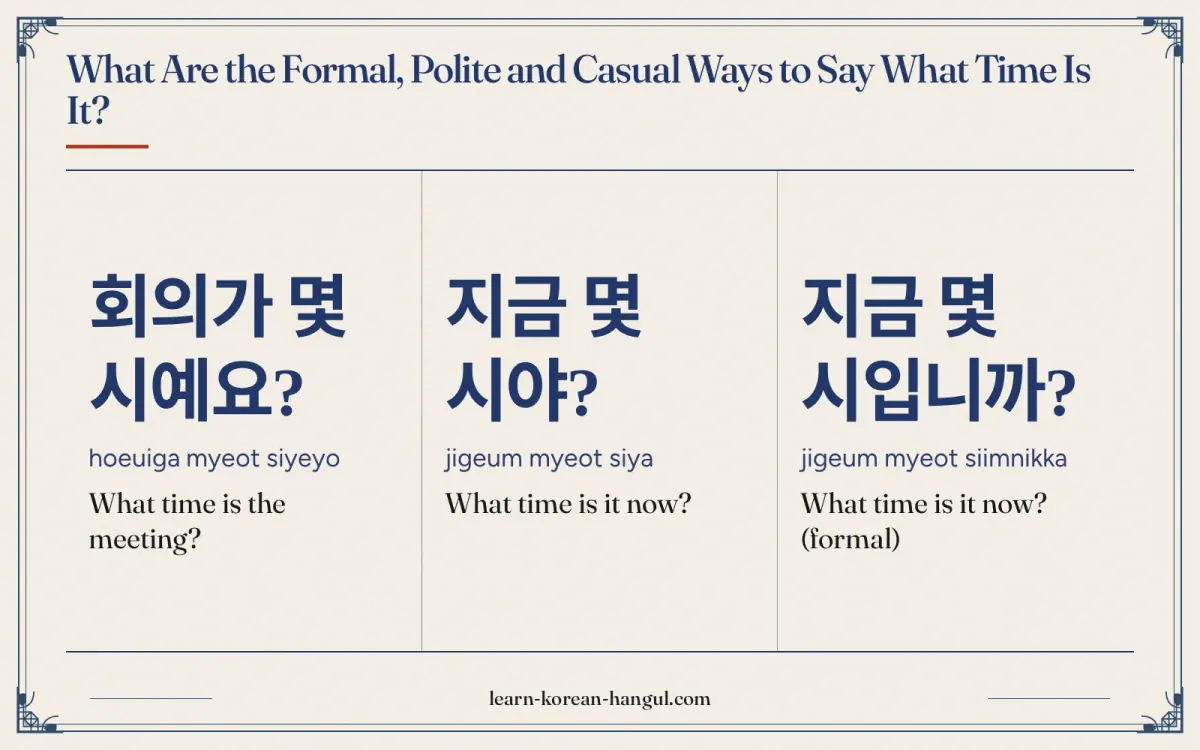
Korean changes the ending of a sentence to match the listener's age, status and closeness. These endings are called speech levels, and the guide to Korean speech levels explains them in full. For this question, only the ending changes, and the words 몇 시 stay the same.
Polite: 몇 시예요? (myeot siyeyo)
Polite · 해요체몇 시예요? is the standard polite question. It works when the context is clear, such as when you glance at a clock together. It is also the form that asks about an event time, as in 회의가 몇 시예요? (what time is the meeting?).
회의가 몇 시예요?
hoeuiga myeot siyeyo
What time is the meeting?
Polite: 지금 몇 시예요? (jigeum myeot siyeyo)
Polite · 해요체지금 몇 시예요? adds 지금 (now), which makes it plain that you want the current time. It is the best choice with a stranger. Start with 실례합니다 (sillyehamnida, "excuse me"), then ask.
실례합니다. 지금 몇 시예요?
sillyehamnida. jigeum myeot siyeyo
Excuse me. What time is it now?
Casual: 몇 시야? (myeot siya)
Casual · 반말몇 시야? replaces 예요 with 야, the casual ending. It is 반말 (casual speech) for close friends, siblings and younger people. It is short and fast, and friends often follow it with a reaction, such as 벌써? (already?).
지금 몇 시야?
jigeum myeot siya
What time is it now?
Formal: 몇 시입니까? (myeot siimnikka)
Formal · 합쇼체몇 시입니까? uses the formal ending -ㅂ니까, the 합쇼체 style of announcements, military settings and business meetings. It is rare in everyday talk, but you may read or hear it in service contexts and formal scripts.
지금 몇 시입니까?
jigeum myeot siimnikka
What time is it now? (formal)
How Do You Answer What Time Is It in Korean?
Answer with an hour in native Korean numbers and a minute in Sino-Korean numbers. This pattern is the part learners most often get wrong, so it deserves a table.
| Time | Korean | Romanization |
|---|---|---|
| 1:00 | 한 시예요 | han siyeyo |
| 2:00 | 두 시예요 | du siyeyo |
| 3:00 | 세 시예요 | se siyeyo |
| 4:00 | 네 시예요 | ne siyeyo |
| 3:15 | 세 시 십오 분이에요 | se si sibo bunieyo |
| 3:30 | 세 시 반이에요 | se si banieyo |
| 3:00 sharp | 세 시 정각이에요 | se si jeonggagieyo |
Hours 1 to 4 change shape before 시: 하나 becomes 한, 둘 becomes 두, 셋 becomes 세, and 넷 becomes 네. Hours 5 to 10 keep their plain forms: 다섯 시, 여섯 시, 일곱 시, 여덟 시, 아홉 시, 열 시. Hours 11 and 12 shorten the same way as 1 and 2: 열한 시, 열두 시. Add 오전 (ojeon, a.m.) or 오후 (ohu, p.m.) in front for clarity, as in 오후 세 시. The page on telling time in Korean covers the system in depth.
How Do You Pronounce 몇 시예요?
몇 시예요? is pronounced [멷씨예요] (myeot-ssi-ye-yo). Two sound changes make it differ from the spelling.
- 몇 (myeot): the final ㅊ is pronounced as ㄷ, so the syllable sounds like [멷].
- 시 (si): after the ㄷ sound, ㅅ becomes the tense ㅆ, so it sounds like [씨].
- 예요 (ye-yo): "yeh-yoh." Stress 몇, the question word, and let the end fall, or rise and then fall; a sharp final rise is for yes/no questions.
Sound Changes to Listen For
Three rules from the National Institute of Korean Language Standard Pronunciation (표준 발음법) shape this phrase and its answers.
- Final consonant neutralization. At the end of a syllable, ㅊ is pronounced [ㄷ]. So 몇 is [멷].
- Tensification. After the [ㄷ] sound, ㅅ becomes [ㅆ]. So 몇 시 is [멷씨]. See Korean tensification.
- Nasalization and liaison. In 몇 시입니까?, the ㅂ before ㄴ becomes [ㅁ], so 입니까 is [임니까]. In the answer 십오 분, the ㅂ of 십 moves onto 오, so 십오 is [시보], and 분이에요 is [부니에요].
With the sounds set, the next question is who you can ask.
When Should You Use 몇 시예요?, and When Should You Not?
Use 지금 몇 시예요? with strangers, 몇 시예요? with colleagues, and 몇 시야? with friends. Keep 몇 시입니까? for formal settings.
Situations Where It Fits
- A stranger at a station. 실례합니다, 지금 몇 시예요? is polite and short.
- A coworker before a meeting. 몇 시예요? checks the clock.
- Planning with a friend. 몇 시야? is quick, and 몇 시에 만나? (what time shall we meet?) sets the plan.
- An event time. 회의가 몇 시예요? asks about a scheduled time.
Situations to Avoid
- 몇 시야? to a stranger or elder. The casual ending is too familiar.
- 몇 시입니까? with friends. It sounds like a formal announcement.
- Asking when a clock is in view. Stations, buses and shops usually show the time, so check for a clock or screen before you stop someone.
These rules are easier to feel in real exchanges, so here are three.
What Does What Time Is It Sound Like in a Real Conversation?
A time exchange is short. The asker uses the polite or casual form, and the answer names the hour and, if needed, the minutes.
A Stranger at the Station
Traveller
실례합니다. 지금 몇 시예요?
sillyehamnida. jigeum myeot siyeyo
Excuse me. What time is it now?
Passer-By
네 시 십 분이에요.
ne si sip bunieyo
It's ten past four.
Traveller
감사합니다.
gamsahamnida
Thank you.
What to notice: 분이에요 is pronounced [부니에요], because the ㄴ of 분 links to the vowel 이.
Friends
Jun
지금 몇 시야?
jigeum myeot siya
What time is it now?
Mina
일곱 시 반.
ilgop si ban
Half past seven.
Jun
벌써?
beolsseo
Already?
What to notice: Mina drops 이야 and says only the time, which is normal in casual speech.
Colleagues
Hana
회의가 몇 시예요?
hoeuiga myeot siyeyo
What time is the meeting?
Taeho
오후 두 시예요.
ohu du siyeyo
It's two in the afternoon.
What to notice: 오후 (p.m.) goes before the hour, and 두 시 uses the short form 두 for "two." The next section covers how Koreans talk about time in everyday life.
What Should You Know about the Culture behind What Time Is It?
Koreans mix two clock styles. In speech, people say 오전 or 오후 plus the hour on a 12-hour clock. Written timetables for trains and buses often show 24-hour digits such as 14:00, while a speaker says 오후 두 시. Both styles appear in daily life.
- Half hours use 반. 세 시 반 means 3:30, not "three half."
- 정각 means "on the dot." 세 시 정각 is exactly 3:00.
- Exact minutes matter in transport. Subways and trains publish exact departures, so 몇 시에 출발해요? (what time does it leave?) is useful.
- Asking a stranger is normal. People answer helpfully, and many show their phone screen.
An expert tip: the question words stay the same, but one particle changes the question. 몇 시예요? asks what the time is. 몇 시에 만나요? asks at what time to meet; the particle 에 means "at." This page covers the spoken question and answer. The full number system and clock vocabulary live in the telling-time lessons.
What Mistakes Do Learners Make with What Time Is It in Korean?
Most mistakes with this question come from numbers, sound and word choice.
| Mistake | Why it is a problem | Fix |
|---|---|---|
| Saying 삼 시 | Hours need native numbers | Say 세 시 |
| Saying 하나 시 or 둘 시 | The short forms 한, 두 are required before 시 | Say 한 시, 두 시 |
| Saying 세 시 열다섯 분 | Minutes need Sino-Korean numbers | Say 세 시 십오 분 |
| Pronouncing 몇 시 as [며치시] | The ㅊ becomes [ㄷ], and ㅅ is tensed | Say [멷씨] |
| Asking 몇 시간이에요? for the time | 시간 means hours as a length | Say 몇 시예요? |
Learners often think 시 is the word for "time." It is the counter for the hour of the day. The word for "time" in general is 시간, as in 시간이 없어요 (I have no time), and the page on time in Korean covers it.
How Do You Say Time, What's the Time or Tell Time in Korean?
Time as an amount is 시간, the hour on the clock is 시, and "what's the time?" is the same question as 몇 시예요?. The short answers below cover each search.
- Time in Korean: the word is 시간 (sigan) for an amount of time, and 시 for the hour on the clock.
- What's the time in Korean / what is the time in Korean: these variants ask the same thing, so use 지금 몇 시예요?.
- Tell time in Korean: state the hour with a native number and the minute with a Sino-Korean number. The numbers hub explains both systems.
- What time is the meeting in Korean: 회의가 몇 시예요?.
Knowing the forms is one thing; saying them on cue is another, so practise now.
Practice: Say It Aloud
Play the slow clip of 몇 시예요?, repeat it three times, then answer it with the time on your clock. Then choose a form for each situation. Answers follow.
- A stranger at a bus stop.
- A close friend you are meeting.
- It is 4:30 p.m. Say it.
- Why does 몇 시 sound like [멷씨]?
Answers
- 실례합니다. 지금 몇 시예요?
- 몇 시야?
- 오후 네 시 반이에요.
- The final ㅊ is pronounced [ㄷ], and the following ㅅ becomes tense [ㅆ].
The phrase flashcards drill all four lines with audio.
Related Phrases to Learn Next
Asking the time sits with the rest of the daily small talk.
- Korean small talk: the collection that lists every phrase in this cluster.
- What's the date in Korean: the natural next question.
- See you later in Korean: the phrase you will often hear in the same conversation.
- Telling time in Korean: the number system behind every answer.
What this page does not cover: dates, durations and long clock vocabulary. Pick 지금 몇 시예요? when in doubt, and you can ask what time is it in Korean to almost anyone.
Frequently Asked Questions
How do you say what time is it in Korean?
Say 몇 시예요? (myeot siyeyo) or 지금 몇 시예요? (jigeum myeot siyeyo) in the polite style. 몇 means "how many" and 시 means "o'clock." With friends say 몇 시야?. In formal speech say 몇 시입니까?. Answer with a native number plus 시, such as 세 시예요.
How do you pronounce 몇 시예요?
Say [멷씨예요] (myeot-ssi-ye-yo). The final ㅊ of 몇 is pronounced like ㄷ, and the ㅅ after it becomes a tense ㅆ. Revised Romanization still writes myeot siyeyo, so do not follow the spelling alone. Stress 몇, and let the end fall or rise and then fall.
What is the difference between 몇 시예요? and 지금 몇 시예요?
Both ask the time. 몇 시예요? is shorter and assumes the context. 지금 몇 시예요? adds 지금 (now), which makes it clear that you mean the current time, not an event time. Use the longer form with a stranger. Use the shorter form with a friend, when the situation is obvious.
Is 몇 시예요? formal or casual?
It is polite but not formal. It uses the 해요체 ending, which suits shop staff, coworkers and acquaintances. The formal form is 몇 시입니까?, used in announcements and business settings. The casual form is 몇 시야?, used only with friends and younger people. Choose the polite form when you are unsure.
Can I use 몇 시예요? with friends, elders and strangers?
Yes with strangers and elders, where 지금 몇 시예요? is the best choice, ideally after 실례합니다 ("excuse me"). With friends, 몇 시야? is natural and quick. With a respected elder, you can keep 몇 시예요? and add 죄송하지만 (sorry, but) before it. The polite form is safe whenever you are unsure.
What is the most common mistake with what time is it in Korean?
The most common mistake is using Sino-Korean numbers for hours, as in 삼 시. Hours need native Korean numbers: 한, 두, 세, 네. Minutes use Sino-Korean numbers, as in 십오 분. A second mistake is mixing 몇 시 (what time) with 몇 시간 (how many hours).