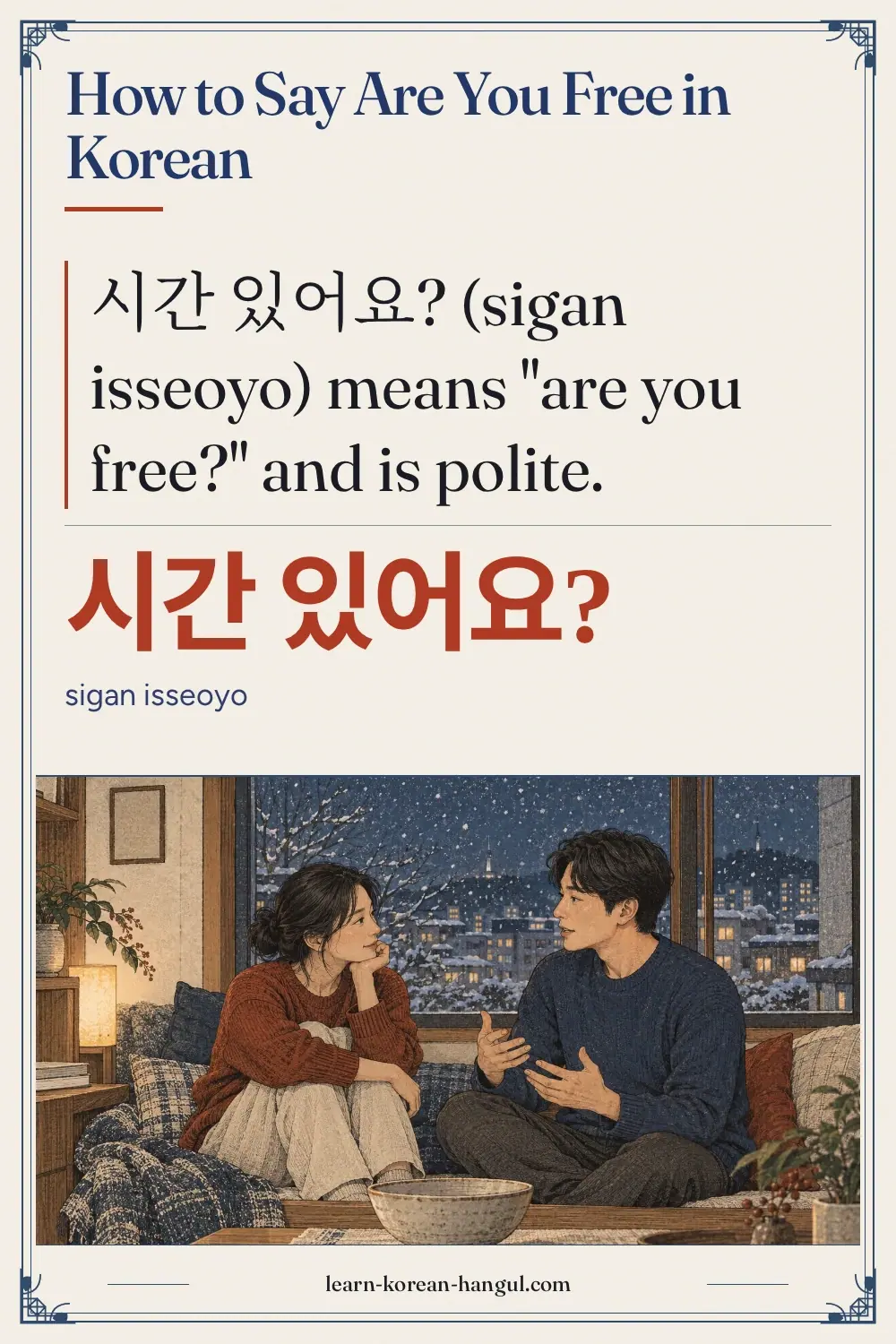
시간 있어요?
시간 있어요?
What you'll learn
- Say 시간 있어요? aloud with the right link in 있어요.
- Choose between 시간 있어요?, 시간 괜찮으세요?, 오늘 한가해요? and 시간 있어? for different listeners.
- Answer politely, with a yes or a soft no.
- Avoid the cold 시간 없어요 and the wrong use of 한가해요.
Before you start: you need to read Hangul; romanization is shown as an aid and can be hidden. Time: about 10 minutes. Audio plays only when you press a button.
Key facts
- 시간 있어요? asks about availability; it does not ask what time it is.
How Do You Say Are You Free in Korean?
To ask "are you free?" in Korean, say 시간 있어요?. 시간 means "time", and 있어요 means "there is" or "have". So the question is "do you have time?". A yes/no question like this usually ends with a rise.
| Situation | What it means | Korean |
|---|---|---|
| Coworker or classmate | Are you free? | 시간 있어요? |
| Senior or client | Would your schedule work? | 시간 괜찮으세요? |
| Asking about today | Are you free today? | 오늘 한가해요? |
| Close friend | Free? | 시간 있어? |
The question is a doorway, because it often comes before an invitation. You can then add a day, as in 오늘 저녁에 시간 있어요?. The next section shows each form in a sentence.
What Are the Polite and Casual Ways to Say Are You Free?
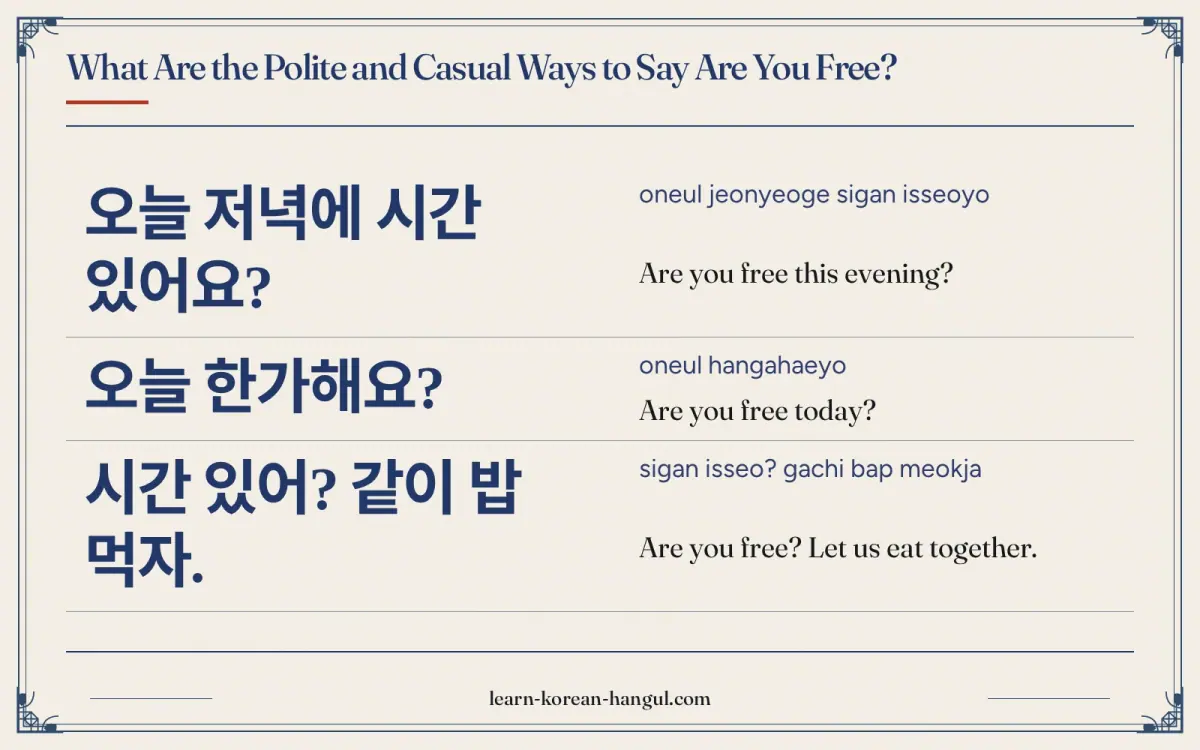
The question stays short, and the ending carries the respect. The sentence endings follow the Korean speech levels.
Polite: 시간 있어요? (sigan isseoyo)
Polite · 해요체시간 있어요? is the default. Name the day or time first, and the question becomes an invitation lead-in. The particle 에 marks the time.
오늘 저녁에 시간 있어요?
oneul jeonyeoge sigan isseoyo
Are you free this evening?
Respectful: 시간 괜찮으세요? (sigan gwaenchaneuseyo)
Formal · 합쇼체시간 괜찮으세요? asks "is the time all right for you?". The honorific -(으)세요 shows respect to the listener, so it suits a teacher, a boss or a client. It asks whether a plan fits, not only whether the person is free.
이번 주 토요일에 시간 괜찮으세요?
ibeon ju toyoire sigan gwaenchaneuseyo
Would Saturday this week work for you?
Polite: 오늘 한가해요? (oneul hangahaeyo)
Polite · 해요체한가하다 means to be free of work, with time to spare. 오늘 한가해요? suits a friend, a peer or someone younger. With a senior it can sound as if you are asking whether the person has nothing to do, so use 시간 괜찮으세요? instead.
오늘 한가해요?
oneul hangahaeyo
Are you free today?
Casual: 시간 있어? (sigan isseo)
Casual · 반말시간 있어? drops the 요 and is for close friends and family. The invitation often follows in the same breath.
시간 있어? 같이 밥 먹자.
sigan isseo? gachi bap meokja
Are you free? Let us eat together.
Answering: Yes or a Soft No
Polite · 해요체A yes is 네, 있어요. A no is better with a reason: 오늘은 좀 바빠요 ("I am a bit busy today"), often with 다음에요 ("next time"). A bare 시간 없어요 ("I have no time") sounds cold.
오늘은 좀 바빠요. 다음에요.
oneureun jom bappayo. daeumeyo
I am a bit busy today. Next time.
The forms are set. Saying 있어요 with the right link is the next step.
How Do You Pronounce 시간 있어요?
시간 있어요 is pronounced [시간 이써요], sigan isseoyo, in five syllables. The two words flow together, so the ㅆ of 있 jumps onto the next block and the pause between them disappears.
- 시 (si): a soft "see".
- 간 (gan): a short "gan".
- 이 (i): an open "ee".
- 써 (sseo): a tense "s" and an open, unrounded "uh".
- 요 (yo): a light "yo".
Sound Changes to Listen For
시간 있어요 and its relatives each have a sound change:
- ㅆ moves forward. The final ㅆ of 있 links to 어, so you hear [이써요], not "it-eo-yo".
- A silent ㅎ. In 괜찮으세요, the ㅎ of ㄶ is silent before a vowel, so 찮으 sounds like 차느 and the whole word is [괜차느세요].
- ㅓ is open. In 있어요, 써요 and 한가해요, ㅓ is an unrounded "uh", not "oh" or "oo".
Revised Romanization, the official system for writing Korean in Latin letters, writes these as isseoyo and gwaenchaneuseyo, following the sound. Knowing whom to ask matters more than the spelling, as the next section shows.
When Should You Use 시간 있어요?, and When Should You Not?
Use 시간 있어요? to a peer or a new acquaintance, 시간 괜찮으세요? to a senior, and 시간 있어? to a close friend. Do not use it when you only want to know what time it is.
Situations Where It Fits
- Planning with a coworker. 오늘 저녁에 시간 있어요? leads to dinner.
- Setting a meeting. 시간 괜찮으세요? works for a teacher, boss or client.
- Inviting a friend. 시간 있어? starts a quick plan.
Situations to Avoid
- Asking the clock time. 지금 몇 시예요? asks what time it is. 시간 있어요? asks if you have free time.
- A senior with 한가해요. It can sound as if you ask whether the person is idle.
- A refusal. Do not answer 시간 없어요 flat; give a reason.
These choices are easier to feel in real exchanges, so here are three.
What Does Are You Free Sound Like in a Real Conversation?
The question usually has a day in it, and the answer repeats part of the question. Listen for how speakers soften a no.
A Colleague Plans an Evening
Colleague A
지수 씨, 오늘 저녁에 시간 있어요?
Jisu ssi, oneul jeonyeoge sigan isseoyo
Jisu, are you free this evening?
Jisu
네, 있어요. 왜요?
ne, isseoyo. waeyo
Yes, I am. Why?
What to notice: the colleague answers 네, 있어요 and asks 왜요? ("why?"). The question word in 왜요? does not end with a sharp rise.
Asking a Professor for a Meeting
Student
교수님, 내일 시간 괜찮으세요?
gyosunim, naeil sigan gwaenchaneuseyo
Professor, would tomorrow work for you?
Professor
네, 오후에는 괜찮아요.
ne, ohueneun gwaenchanayo
Yes, the afternoon is fine.
What to notice: the student uses the respectful 시간 괜찮으세요? with a professor, and the professor answers in the polite style.
Two Friends and a Weekend
Friend A
이번 주말에 시간 있어?
ibeon jumare sigan isseo
Are you free this weekend?
Friend B
미안, 이번 주는 좀 바빠.
mian, ibeon juneun jom bappa
Sorry, I am a bit busy this week.
What to notice: the friends drop the 요, and the refusal 미안 comes first, then the reason 좀 바빠.
What Should You Know about the Culture behind Are You Free?
Asking about free time is the usual first step of an invitation, and the answer shows whether the person wants to go. The wording leaves room to say no without a clash.
- Day first. Naming the day (오늘 저녁에) before the question helps the listener plan. It also signals that you have a purpose.
- A question as an invitation. 시간 있어요? often means "I would like to meet you". People may answer 네, 있어요 and then ask 왜요? to learn the plan before they say yes.
- Soft refusals. A reason and 다음에요 ("next time") are the normal way to decline. A bare 안 돼요 or 시간 없어요 can sound abrupt.
- Respect for seniors. 괜찮으세요 asks whether the plan fits the person's schedule, which puts their time first.
An expert insight: learners often think 시간 있어요? is just a yes/no question about the calendar. Actually, it usually starts an invitation, and the listener often wants the plan before answering. The mistakes below come from using the question without a day or the wrong ending.
What Mistakes Do Learners Make with Are You Free in Korean?
Most mistakes come from the ending, from refusing too bluntly, or from mixing time words.
| Mistake | Why it is a problem | Fix |
|---|---|---|
| Answering 시간 없어요 | Sounds cold | Say 오늘은 좀 바빠요 |
| Asking a senior 한가해요? | May sound like "are you idle?" | Say 시간 괜찮으세요? |
| Using 시간 있어요? for the clock time | It asks about free time | Say 지금 몇 시예요? |
| Using 시간 있어? with a stranger | Too casual | Say 시간 있어요? |
| Saying 있어요 as "it-eo-yo" | The ㅆ should link | Say [이써요] |
Learners often assume 한가해요 is the natural word for "are you free?". Actually, 시간 있어요 is far more common, and 한가하다 describes a quiet period or an empty schedule.
Other Ways People Search for Are You Free in Korean
People search for are you free in Korean in several ways. The short answers below cover each one.
- Free time in Korean: 시간 (time) or 여유 (spare time, leeway); 자유 시간 means free time in a schedule.
- Are you busy in Korean: 바빠요? (bappayo), the opposite question; the answer is 네, 바빠요 or 아니요, 안 바빠요.
- Are you available in Korean: 시간 괜찮으세요? is the best match.
Reading the rules is one thing; producing the right question on cue is another, so practise now.
Practice: Say It Aloud
Play the slow clip of 시간 있어요?, repeat it three times, then try 시간 괜찮으세요? and 시간 있어?. Then choose a form for each situation. Answers follow.
- You ask a coworker if she is free tonight.
- You ask your professor if tomorrow works.
- You ask a close friend if he is free on Saturday.
- You want to decline politely today and suggest another time.
Answers
- 오늘 저녁에 시간 있어요?
- 교수님, 내일 시간 괜찮으세요?
- 토요일에 시간 있어?
- 오늘은 좀 바빠요. 다음에 해요.
Drill 시간 있어요? and the related phrases with the phrase flashcards, which include audio for each form.
Related Phrases to Learn Next
시간 있어요? is a gateway to many plans and replies.
- Let's eat together in Korean: the invitation that often follows.
- I'm busy in Korean: the polite way to decline.
- Let's go in Korean: the next step after you agree.
This guide belongs to the Korean small talk collection. What this page does not cover: formal scheduling in business letters and the full set of invitation endings. Ask 시간 있어요? with a day, soften a no with a reason, and you will use are you free in Korean naturally.
Frequently Asked Questions
How do you say are you free in Korean?
Say 시간 있어요? (sigan isseoyo), which means "do you have time?". It is polite and suits coworkers and new friends. With seniors say 시간 괜찮으세요?, and with close friends say 시간 있어?. Add a day or time first, such as 오늘 저녁에, to turn it into an invitation.
How do you pronounce 시간 있어요?
Say [시간 이써요]. The final ㅆ of 있 moves onto the next syllable, so 있어요 sounds like 이써요. The ㅓ in 써 is an open, unrounded "uh". The Revised Romanization is sigan isseoyo. Say it as one smooth phrase, without a pause after 시간.
What is the difference between 시간 있어요? and 시간 괜찮으세요?
시간 있어요? asks whether you have free time, and it is polite. 시간 괜찮으세요? asks whether a plan fits the listener's schedule, and it uses the honorific -(으)세요. Use the second for a boss, teacher or client, and the first for peers and acquaintances.
Is 시간 있어요? formal or casual?
It is polite, in the middle between formal and casual. The casual form is 시간 있어?, and the respectful form is 시간 괜찮으세요?. A formal written form is 시간이 있으십니까?, which you may meet in announcements but rarely hear in conversation.
Can I use 시간 있어요? with friends, elders and strangers?
With friends, the casual 시간 있어? sounds natural, and 시간 있어요? is also fine. With elders and seniors, use 시간 괜찮으세요?. With strangers, 시간 있어요? is polite but unusual, since you rarely invite a stranger; use it for people you already know a little.
What is the most common mistake with are you free in Korean?
The most common mistake is answering with a flat 시간 없어요, which sounds cold. Say 오늘은 좀 바빠요 and 다음에요 instead. The second mistake is using 한가해요 with a senior, which can sound as if you ask whether they are idle. A third is saying 있어요 as "it-eo-yo" instead of [이써요].