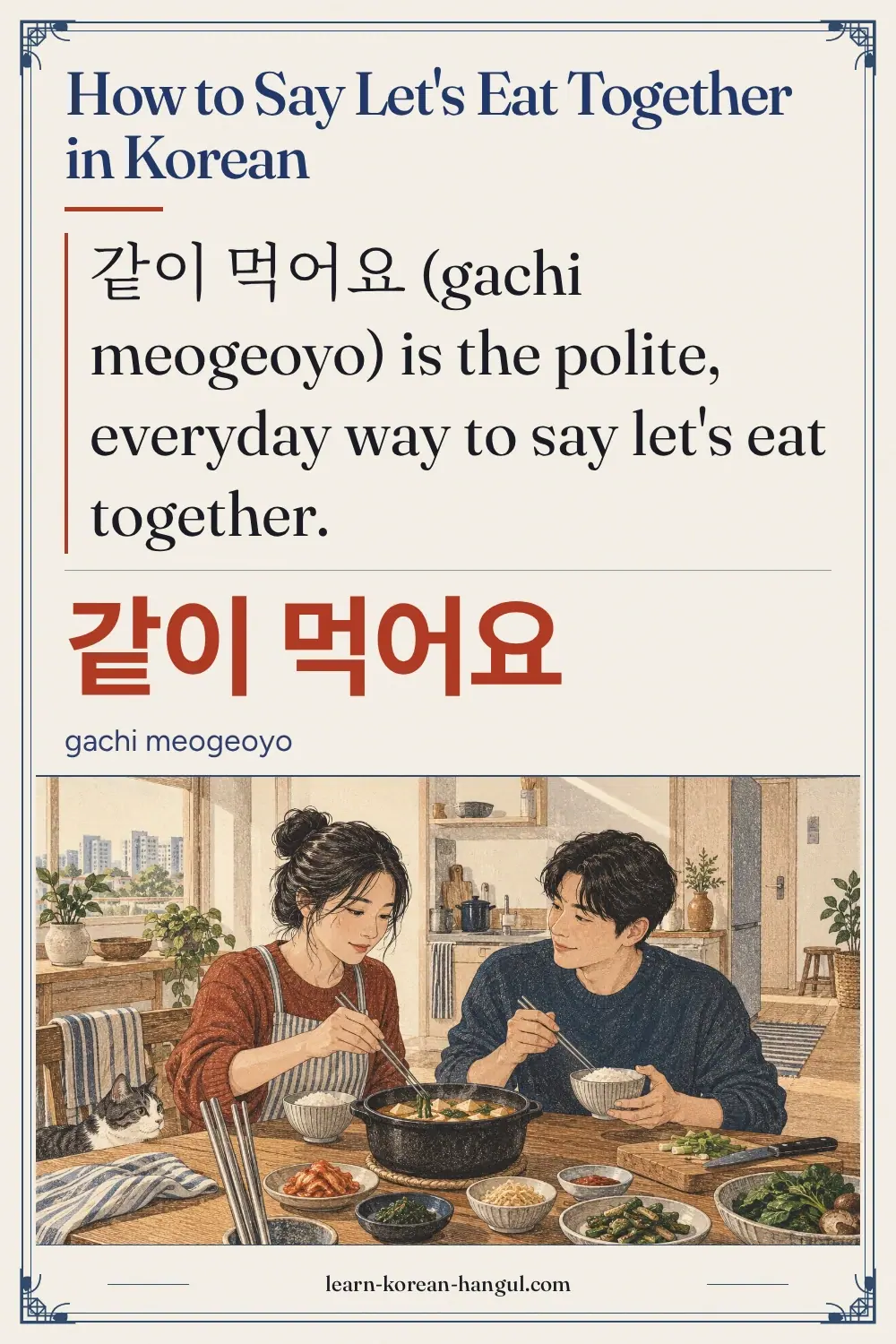
같이 먹어요
같이 먹어요
What you'll learn
- Say let's eat together with 같이 먹어요, 같이 먹자 or 같이 먹읍시다, depending on the listener.
- Invite an older person with 같이 드실래요?
- Use 밥 한번 먹자 and know when it is a real plan.
- Pronounce 같이 as [가치].
Before you start: you only need to read Hangul. When you want to greet someone with food, learn did you eat in Korean. Time: about 10 minutes. Audio plays only when you press a button.
How Do You Say Let's Eat Together in Korean?
The standard way to say let's eat together in Korean is 같이 먹어요. The adverb 같이 (gachi) means "together" or "with each other". The verb 먹어요 (meogeoyo) is the polite form of 먹다 (to eat). Korean uses the same ending, -아요/어요, for statements and for suggestions, so 같이 먹어요 can mean "we eat together" or "let's eat together". The tone and the moment decide which.
| Situation | Best form | Romanization | Why |
|---|---|---|---|
| Inviting a colleague or new friend | 같이 먹어요 | gachi meogeoyo | Polite, natural |
| Inviting a close friend | 같이 먹자 | gachi meokja | Casual |
| A group meal at a formal event | 같이 먹읍시다 | gachi meogeupsida | Formal |
| A gentle question | 같이 먹을까요? | gachi meogeulkkayo | Shall we |
| Inviting an elder | 같이 드실래요? | gachi deusillaeyo | Honorific |
The ending changes with the listener, while 같이 stays the same. The next section sorts the forms by level.
What Are the Formal, Polite and Casual Ways to Say Let's Eat Together?
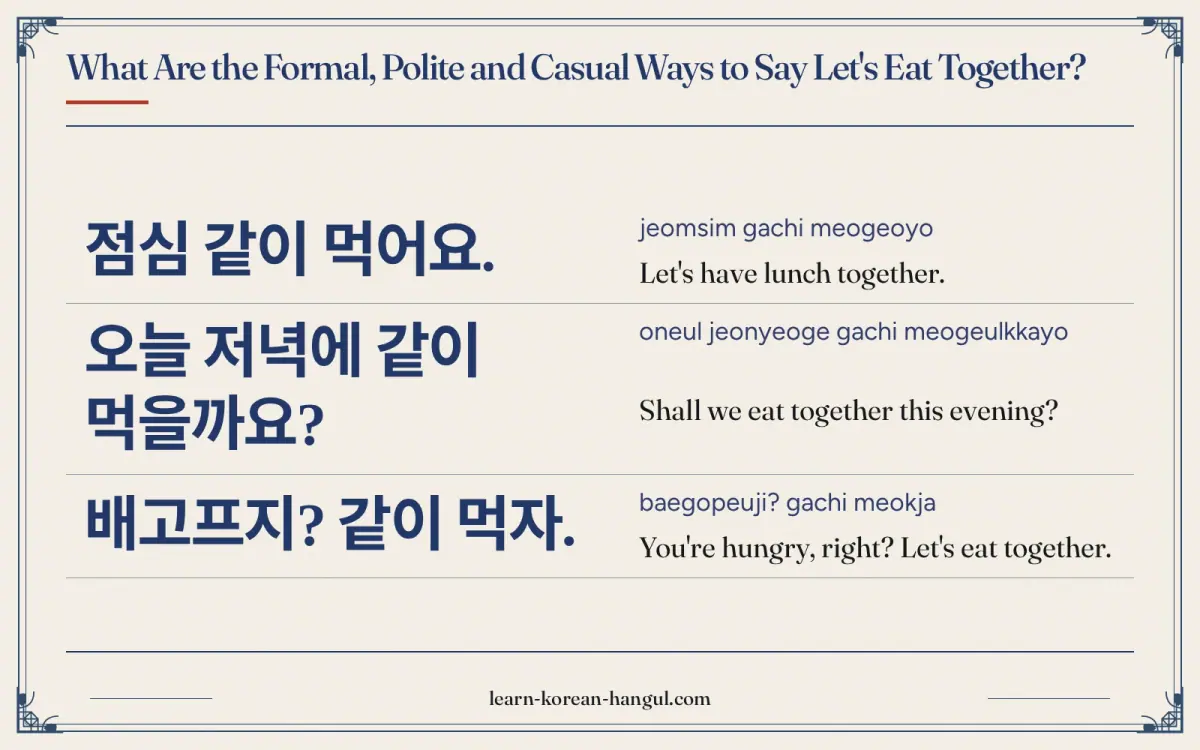
The forms follow the Korean speech levels, explained in the guide to Korean speech levels. Korean has a separate "let's" ending, called the propositive, at each level.
Polite: 같이 먹어요 (gachi meogeoyo)
Polite · 해요체같이 먹어요 is the form to learn first. It suits colleagues, classmates, neighbors and new friends. Add a meal word to be specific, such as 점심 (jeomsim, lunch) or 저녁 (jeonyeok, dinner).
점심 같이 먹어요.
jeomsim gachi meogeoyo
Let's have lunch together.
Gentle: 같이 먹을까요? (gachi meogeulkkayo)
Polite · 해요체같이 먹을까요? asks "shall we eat together?". The ending -(으)ㄹ까요 is the soft way to propose something, because the other person can say no easily. It is pronounced [가치 머글까요].
오늘 저녁에 같이 먹을까요?
oneul jeonyeoge gachi meogeulkkayo
Shall we eat together this evening?
Casual: 같이 먹자 (gachi meokja)
Casual · 반말같이 먹자 drops the polite ending. Use it with close friends, siblings and classmates. The ending -자 means "let's". It is pronounced [가치 먹짜], because the ㄱ makes the ㅈ tense.
배고프지? 같이 먹자.
baegopeuji? gachi meokja
You're hungry, right? Let's eat together.
Honorific: 같이 드실래요? (gachi deusillaeyo)
Polite · 해요체같이 드실래요? is for elders, teachers and bosses. The verb 드시다 is the honorific form of 먹다, and -ㄹ래요 asks what the person would like. A longer version is 식사 같이 하실래요? (siksa gachi hasillaeyo). Never use 드시다 for yourself.
Formal: 같이 먹읍시다 (gachi meogeupsida)
Formal · 합쇼체같이 먹읍시다 is the formal "let's". It fits a speaker who invites a group in a formal setting. It can sound like an order if you say it to a peer, so treat it with care. It is pronounced [가치 머급씨다].
Now the sounds.
How Do You Pronounce 같이 먹어요?
같이 먹어요 is pronounced [가치 머거요], ga-chi meo-geo-yo, in five syllables. The spelling and the sound are different in two places, and both follow standard rules.
- 같이 (gachi): the ㅌ before 이 changes to ㅊ, so you say "ga-chi".
- 먹 (meok): the ㄱ moves to the next syllable.
- 어 (eo): carries the ㄱ, so it sounds like 거.
- 요 (yo): "yo".
Sound Changes to Listen For
These changes follow the National Institute of Korean Language standard pronunciation rules (표준 발음법):
- Palatalization. ㅌ before 이 becomes ㅊ, so 같이 is [가치] (Article 17).
- Liaison. 먹어요 is [머거요] (Article 13).
- Tense after ㄱ. 먹자 is [먹짜] (Article 23). See Korean tensification.
- Liaison before a tense sound. 먹을까요 is [머글까요]: the ㄱ moves forward, and the ㄲ is already tense in the spelling (Article 13).
The vowel ㅓ in 먹 and 어 is unrounded, so keep your lips relaxed. Revised Romanization writes gachi, because it follows the sound, and meokja, because it does not show tensing caused by a neighbouring sound. With the sounds clear, here is when to use each form.
When Should You Use 같이 먹어요, and When Should You Not?
Use 같이 먹어요 when you want to share a meal with someone of similar age or rank. Choose another form when status is different.
Situations Where It Fits
- Lunch with colleagues. 점심 같이 먹어요. (Let's have lunch together.)
- A new classmate. 오늘 같이 먹을까요? (Shall we eat together today?)
- After a class. 수업 끝나고 같이 먹어요. (Let's eat together after class.)
Situations to Avoid
- A boss or an older relative. Use 같이 드실래요? instead.
- A stranger on a train. Korean does not usually invite strangers to eat.
- When you mean a vague goodbye. Say 밥 한번 먹자 only if you are happy to follow up.
Two short conversations show how it sounds.
What Does Let's Eat Together Sound Like in a Real Conversation?
In real life, the line is followed by a place or a menu suggestion.
Colleagues at Lunchtime
Sumin
지원 씨, 점심 같이 먹어요.
jiwon ssi, jeomsim gachi meogeoyo
Jiwon, let's have lunch together.
Jiwon
좋아요! 뭐 먹을까요?
joayo! mwo meogeulkkayo
Sure! What shall we eat?
Sumin
김치찌개 어때요?
gimchijjigae eottaeyo
How about kimchi stew?
What to notice: Jiwon answers with 좋아요 and asks 뭐 먹을까요?, a wh-question, so it does not end in a sharp rise. The title 씨 follows a first name, and it is polite.
With a Grandmother
Grandson
할머니, 식사하셨어요?
halmeoni, siksahasyeosseoyo
Grandma, have you eaten?
Grandmother
아직. 같이 먹자.
ajik. gachi meokja
Not yet. Let's eat together.
Grandson
네, 잘 먹겠습니다.
ne, jal meokgetseumnida
Yes, I will eat well.
What to notice: the grandson uses the honorific 식사하셨어요, and the grandmother uses the casual 먹자 to a younger relative. The reply 잘 먹겠습니다 is said before a meal to thank the cook.
What Should You Know about the Culture behind Let's Eat Together?
Meals are one of the main ways Koreans build relationships. Sharing food is a sign that you want to know someone. Eating alone (혼밥, honbap) is now common, but when colleagues or classmates are heading out together, inviting someone who would otherwise eat alone is a kind gesture. Many dishes are put in the middle of the table and eaten together, so inviting someone is also a way of sharing.
- Eating sometime. 밥 한번 먹자 (bap hanbeon meokja) means "let's eat sometime". It is often a warm goodbye with no date, so follow it with a day if you mean it.
- Who pays. A senior or the person who invited often pays, and a friend may say 내가 쏠게 (naega ssolge, I'll treat you). Splitting the bill is called 더치페이 (deochipei), and friends often do it too.
- Start together. At a table with elders, wait until the oldest person lifts their spoon. Then say 잘 먹겠습니다.
- Shared plates. Take food from the shared dish with clean chopsticks or a serving spoon.
An expert tip: the question 밥 먹었어요? (did you eat?) is often a greeting, and 같이 먹어요 is the natural next step. The page for did you eat in Korean explains it.
What Mistakes Do Learners Make with Let's Eat Together in Korean?
Most mistakes come from the sound of 같이 and from choosing the wrong level.
| Mistake | Why it is a problem | Fix |
|---|---|---|
| [갓이] or [가티] for 같이 | The ㅌ becomes ㅊ before 이 | Say [가치] |
| 가치 먹어요 | 가치 is not the word for together | Write 같이 |
| 같이 먹자 to a boss | Too casual | Say 같이 드실래요? |
| 같이 먹읍시다 to a peer | Sounds like an order | Say 같이 먹어요 |
| 드실래요 about yourself | The honorific is for others | Say 먹을래요 |
| 같이 먹어요 as only a statement | May be heard as an invitation | Use context |
Learners also think "let's eat" before a meal is 먹자. That is a suggestion to start. The thanks before eating is 잘 먹겠습니다, which means "I will eat well".
How Do You Invite Someone to Eat Together?
You can turn the same words into a question by raising your voice at the end. To a friend, say 같이 먹을래? (gachi meogeullae?), which means "do you want to eat with me?". To a colleague, say 같이 먹을래요? (gachi meogeullaeyo?). To an older person, use the honorific 같이 드실래요? (gachi deusillaeyo?). A softer idea is 시간 되면 같이 먹어요 (sigan doemyeon gachi meogeoyo), which means "if you have time, let's eat together". These are yes-or-no questions, so they rise at the end.
| Listener | Question | Romanization |
|---|---|---|
| Close friend | 같이 먹을래? | gachi meogeullae |
| Colleague | 같이 먹을래요? | gachi meogeullaeyo |
| Elder or boss | 같이 드실래요? | gachi deusillaeyo |
Is It the Same as Let's Eat, Eat Together or Eat with Me?
Close, but each folded query has its own wording. The short answers below cover the other searches folded into this page.
- Let's eat in Korean: 먹어요 (polite) or 먹자 (casual). Before a meal, say 잘 먹겠습니다.
- Eat together in Korean: 같이 먹다 (gachi meokda), the verb phrase.
- Eat with me in Korean: 저랑 같이 먹어요 (jeorang gachi meogeoyo).
- Let's go eat in Korean: 밥 먹으러 가요 (bap meogeureo gayo) or 밥 먹으러 가자.
Now practise aloud.
Practice: Say It Aloud
Play the slow clip of 같이 먹어요 three times and keep the ㅊ clear in 같이. Then choose a phrase. Answers follow.
- You invite a colleague politely to lunch.
- You invite a close friend to eat.
- You ask an older person if they will eat with you.
- You say "let's eat together next time."
Answers
- 점심 같이 먹어요.
- 같이 먹자.
- 같이 드실래요?
- 다음에 같이 먹어요.
The phrase flashcards drill these lines with audio.
Related Phrases to Learn Next
An invitation leads to a greeting, a thanks and a compliment.
- Did you eat in Korean: 밥 먹었어요? as a greeting.
- Enjoy your meal in Korean: 맛있게 드세요 when you serve food.
- Delicious in Korean: 맛있어요 once you start eating.
This guide belongs to the Korean small talk collection. What this page does not cover: ordering food, table manners in detail and paying the bill. Remember to use 같이 먹어요 with peers, 같이 드실래요? with elders, and say 같이 as [가치], and you can say let's eat together in Korean naturally.
Frequently Asked Questions
How do you say let's eat together in Korean?
Say 같이 먹어요 (gachi meogeoyo) in polite speech, 같이 먹자 (gachi meokja) to a close friend and 같이 먹읍시다 (gachi meogeupsida) in formal speech. The word 같이 means together. To make it a gentle question, say 같이 먹을까요? (gachi meogeulkkayo), which means shall we eat together.
How do I invite an older person to eat together in Korean?
Say 같이 드실래요? (gachi deusillaeyo) or 식사 같이 하실래요? (siksa gachi hasillaeyo). The verb 드시다 is the honorific form of 먹다 (to eat), and -ㄹ래요 asks what the person would like. Avoid 같이 먹자 and 같이 먹어요 with someone much older, because they sound too familiar.
Does 같이 먹어요 mean we eat or let's eat?
It can mean both, and context decides. The polite ending -아요/어요 is used for statements and for suggestions. With 같이 at the start and a friendly tone, as in 점심 같이 먹어요, it is a suggestion. To make it clearer, use -을까요 for shall we or -자 with friends.
What is the difference between 같이 and 함께?
Both mean together. 같이 (gachi) is the everyday spoken word, used with friends, family and colleagues. 함께 (hamkke) is a little more formal and appears in speeches, invitations and writing, as in 함께 식사하시겠습니까. In a chat invitation, 같이 먹어요 is the natural choice.
What does 밥 한번 먹자 mean in Korean?
밥 한번 먹자 (bap hanbeon meokja) literally means let's eat a meal sometime. Koreans often say it at the end of a chat, as a warm goodbye, without a fixed date. If you want a real plan, follow it with a day, as in 이번 주 금요일에 먹어요 (let's eat this Friday).
What mistakes do learners make with let's eat together in Korean?
Learners say [같이] as written, with a hard ㅌ, instead of [가치], or use 같이 먹자 to a boss. They may also say 먹읍시다 to a peer, which sounds like an order. Another slip is writing 가치 for together; the correct spelling is 같이. Use 같이 먹어요 or 같이 먹을까요? when unsure.