입어 봐도 돼요?
입어 봐도 돼요?
What you'll learn
- Say 입어 봐도 돼요?, 한번 입어 볼게요, 더 큰 사이즈 있어요? and 다른 색깔 있어요?
- Switch the verb for shoes, hats and rings: 신어, 써 and 껴.
- Pronounce 입어 as [이버] and 볼게요 as [볼께요].
- Avoid using 해 봐도 돼요 for clothes.
Before you start: knowing how to ask about prices helps, so see how much is it in Korean if you have not learned it. Time: about 12 minutes. Audio plays only when you press a button.
How Do You Say Can I Try It on in Korean?
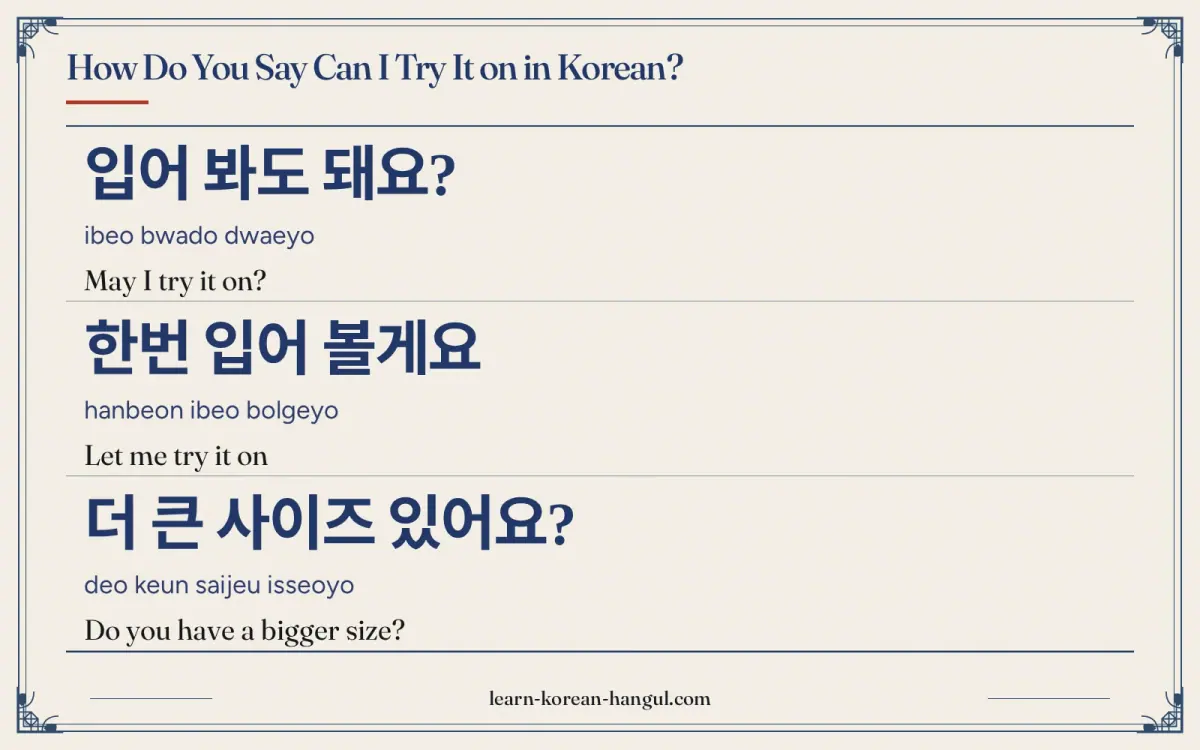
The standard way to ask to try something on in Korean is 입어 봐도 돼요?. It joins three pieces. The verb 입다 means "to wear". The pattern -아/어 보다 means "to try doing". The pattern -아/어도 되다 asks for permission. Together, they ask "Is it all right if I try wearing it?". The question ends with a rise, because it is a yes-or-no question.
| Korean | Romanization | Meaning | Where you hear it |
|---|---|---|---|
| 입어 봐도 돼요? | ibeo bwado dwaeyo | May I try it on? | Asking permission |
| 한번 입어 볼게요 | hanbeon ibeo bolgeyo | Let me try it on | Announcing your plan |
| 더 큰 사이즈 있어요? | deo keun saijeu isseoyo | Do you have a bigger size? | After trying it on |
| 다른 색깔 있어요? | dareun saekkal isseoyo | Do you have another colour? | Asking about colours |
Revised Romanization (the South Korean government standard of 2000) is only a reading aid here. Learn the Hangul first. The next section shows how each line fits a step in the shop.
What Are the Polite Ways to Say Can I Try It On?
Shop Korean is polite from start to finish. Customers and clerks both use the 요 or 습니다 style, as explained in Korean speech levels. The lines below follow the order of a normal try-on.
Polite: 입어 봐도 돼요? (ibeo bwado dwaeyo)
Polite · 해요체입어 봐도 돼요? is the main question. Say it while you hold the item. The word 이거 ("this") or the name of the item usually comes first. The clerk will answer 네, 입어 보세요, which means "Yes, please try it on".
이 셔츠 입어 봐도 돼요?
i syeocheu ibeo bwado dwaeyo
May I try on this shirt?
Polite: 한번 입어 볼게요 (hanbeon ibeo bolgeyo)
Polite · 해요체한번 입어 볼게요 states what you will do. Here 한번, written as one word, means "just" or "give it a go" (spaced 한 번 means "one time"), and -ㄹ게요 is a polite promise. Use it when the clerk has already offered or when you head to the fitting room.
이거 한번 입어 볼게요.
igeo hanbeon ibeo bolgeyo
Let me try this on.
Polite: 더 큰 사이즈 있어요? (deo keun saijeu isseoyo)
Polite · 해요체더 큰 사이즈 있어요? asks for a bigger size. 더 means "more", 큰 means "big", and 사이즈 is the loanword "size". For a smaller size, say 더 작은 사이즈 있어요? (deo jageun saijeu isseoyo), pronounced [더 자근 사이즈 이써요]. Both are yes-or-no questions, so they end with a rise.
이거 더 큰 사이즈 있어요?
igeo deo keun saijeu isseoyo
Do you have this in a bigger size?
Polite: 다른 색깔 있어요? (dareun saekkal isseoyo)
Polite · 해요체다른 색깔 있어요? asks for another colour. 다른 means "other" and 색깔 means "colour". You can also add 도 to the noun to say "in other colours too": 다른 색깔도 있어요?
다른 색깔도 있어요?
dareun saekkaldo isseoyo
Do you have other colours too?
The verb 입다 is only for clothes. When you try something else, the verb changes, and the table below shows the common pairs.
| Item | Verb | Question |
|---|---|---|
| Clothes (옷, ot) | 입다 | 입어 봐도 돼요? (ibeo bwado dwaeyo) |
| Shoes (신발, sinbal) | 신다 | 신어 봐도 돼요? (sineo bwado dwaeyo) |
| Hats (모자, moja) | 쓰다 | 써 봐도 돼요? (sseo bwado dwaeyo) |
| Rings or gloves (반지, banji / 장갑, janggap) | 끼다 | 껴 봐도 돼요? (kkyeo bwado dwaeyo) |
With the right verb in hand, the next step is the sound.
How Do You Pronounce 입어 봐도 돼요?
입어 봐도 돼요 is pronounced [이버 봐도 돼요], in six syllables. The only spelling change is in the first word, and the other lines have a few more.
- 입 (ip on its own): the final ㅂ moves to the next vowel, so the two syllables sound like 이-버.
- 어 (eo): the vowel ㅓ, with the lips relaxed and unrounded, not "o".
- 봐 (bwa): a plain b and the vowel ㅘ.
- 도 (do): a plain d and the vowel ㅗ.
- 돼 (dwae): a plain d, then w, then ㅐ.
- 요 (yo): a short, light ending.
Sound Changes to Listen For
- Linking ㅂ. The final ㅂ of 입 moves to the vowel of 어, so 입어 sounds like [이버].
- Tense ㄱ after -ㄹ. In 볼게요, the ㄱ of 게 is tense after the -ㄹ ending, so the word is spoken [볼께요]. Revised Romanization does not show this change. See Korean tensification for the full rule.
- Written tense ㄲ. 색깔 is spoken [색깔], and the ㄲ is already written as a tense sound. Close the throat and release with no puff of air.
- Linking ㄱ. In 작은, the final ㄱ links to the vowel of 은, so the word sounds like [자근].
A common slip is to say 입어 with a clear final b, as in "ib-eo". Link the ㅂ to the vowel instead. A rising pitch on 돼요 also shows that you are asking, not stating. Once the sound is smooth, the next question is when each line fits.
When Should You Use 입어 봐도 돼요, and When Should You Not?
Use 입어 봐도 돼요? whenever you want to try something on. Use 한번 입어 볼게요 when you have permission and head to the fitting room. Use the size and colour questions after you have tried the item. A fitting room is called 탈의실 (taruisil) or, in many shops, the loanword 피팅룸 (pitingnum, spoken [피팅눔]).
Situations Where It Fits
- A clothing shop or mall. Hold the item, say 입어 봐도 돼요?, and follow the clerk to the fitting room.
- A shoe shop. Change the verb to 신다: 신어 봐도 돼요?
- A size problem. After trying it on, ask 더 큰 사이즈 있어요? or 더 작은 사이즈 있어요?
Situations to Avoid
- A market stall or small street shop. Many have no fitting room. Ask first, and accept a no.
- 해 봐도 돼요 for clothes. 하다 does not mean "to wear" here. Use 입다 for clothes.
- Casual 입어 봐도 돼? with a clerk. Dropping 요 sounds like speech to a friend.
Three short scenes show the lines in context.
What Does Can I Try It on Sound Like in a Real Conversation?
Try-ons follow a clear order: ask, try, then ask about size or colour. Listen for the clerk's answer in each dialogue.
Asking a Clerk
Customer
저기요, 이거 입어 봐도 돼요?
jeogiyo, igeo ibeo bwado dwaeyo
Excuse me, may I try this on?
Clerk
네, 입어 보세요. 탈의실은 저쪽이에요.
ne, ibeo boseyo. taruisireun jeojjogieyo
Yes, please try it on. The fitting room is over there.
What to notice: The customer's question rises at the end because it is a yes-or-no question. The clerk's 입어 보세요 uses the honorific -세요 to invite you.
Asking for a Bigger Size
Customer
이거 더 큰 사이즈 있어요?
igeo deo keun saijeu isseoyo
Do you have this in a bigger size?
Clerk
네, 있어요. 가져다 드릴게요.
ne, isseoyo. gajyeoda deurilgeyo
Yes, we do. I'll bring it to you.
What to notice: 드릴게요 is spoken [드릴께요], with a tense 께 after -ㄹ. 드리다 is the humble verb for giving, so the clerk shows respect.
After Trying It On
Customer
한번 입어 볼게요.
hanbeon ibeo bolgeyo
Let me try it on.
Clerk
네, 천천히 입어 보세요.
ne, cheoncheonhi ibeo boseyo
Yes, take your time and try it on.
Customer
좀 작아요. 다른 색깔도 있어요?
jom jagayo. dareun saekkaldo isseoyo
It is a bit small. Do you have other colours too?
What to notice: 좀 작아요 is a soft way to say "it's a bit small". The final question rises because it is yes-or-no.
What Should You Know about the Culture behind Can I Try It On?
Shopping for clothes in Korea follows a few habits. These are general, and each shop sets its own rules.
- Fitting rooms. Most malls and larger shops have a fitting room, called 탈의실 or 피팅룸. Small street shops may not allow try-ons, so asking first is expected.
- Free size. Many Korean clothing items are sold as 프리 사이즈 (peuri saijeu, "free size"), one size meant to fit most people. Ask 프리 사이즈예요? to check.
- Shoe sizes in millimetres. Shoe sizes are usually given in millimetres. A size 250 is read 이백오십 (ibaegosip), pronounced [이배고십].
- Staff help. Clerks may offer to bring a size with 가져다 드릴까요? Accepting with 네, 부탁드려요 is polite.
An expert tip: 입어 봐도 돼요? is not only for clothes, because -아/어 봐도 돼요 asks permission to try any action. It also works as 먹어 봐도 돼요? ("May I taste it?") at a market stall. For the price after you decide, see discount please in Korean, and to choose an item, see this one please in Korean.
What Mistakes Do Learners Make with Can I Try It on in Korean?
Most mistakes with this phrase come from choosing the wrong verb or the wrong register.
| Mistake | Why it is a problem | Fix |
|---|---|---|
| Using 해 봐도 돼요 for clothes | 하다 does not mean "to wear" | Use 입어 봐도 돼요? |
| Using 입어 for shoes or hats | The verb changes with the item | Use 신어, 써 or 껴 |
| Saying 봐도 돼요 alone | It means "may I look?" | Say 입어 봐도 돼요? |
| Saying 입어 with a clear final b | The ㅂ links: [이버] | Say [이버] |
| Using casual 입어 봐도 돼? with a clerk | It sounds like speech to a friend | Add 요: 입어 봐도 돼요? |
Learners often translate "try on" word for word. Korean has no single verb for it. The sentence is built from the wearing verb plus 보다 for "try".
Is It the Same as Try on, Fitting Room or Bigger Size?
Mostly yes. The searches below point to the same set of lines, with small differences.
- Try on in Korean: -아/어 보다, as in 입어 보다 (ibeo boda, to try on clothes).
- Fitting room in Korean: 탈의실 (taruisil) or 피팅룸 (pitingnum). To ask where it is, say 탈의실이 어디예요? (taruisiri eodiyeyo). It is a wh-question, so the pitch does not rise sharply.
- Bigger size in Korean: 더 큰 사이즈 있어요?, as above.
- Smaller size in Korean: 더 작은 사이즈 있어요?, pronounced [더 자근 사이즈 이써요].
Practice: Say It Aloud
Play the slow clip and repeat 입어 봐도 돼요? three times. Then choose the best line for each scene. Answers follow.
- You hold a jacket and want to try it on.
- You are in a shoe shop.
- The jacket is too small.
- How is 입어 pronounced?
Answers
- 이거 입어 봐도 돼요?
- 신어 봐도 돼요?
- 더 큰 사이즈 있어요?
- [이버]: the final ㅂ links to the vowel of 어.
The phrase flashcards drill these lines with audio.
Related Phrases to Learn Next
Trying things on connects to other shopping phrases.
- how much is it in Korean: ask the price before you buy.
- discount please in Korean: ask for a lower price politely.
- this one please in Korean: choose the item you want.
This guide belongs to the korean shopping phrases collection. What this page does not cover: returns, exchanges and size conversion charts. Learn the permission question, the size request and the verb pairs, and you can say can I try it on in Korean in any shop.
Frequently Asked Questions
How do you say can i try it on in Korean?
Say 입어 봐도 돼요? (ibeo bwado dwaeyo) for "May I try it on?". The clerk usually answers 네, 입어 보세요. If the size is wrong, ask 더 큰 사이즈 있어요? or 더 작은 사이즈 있어요?. These lines are polite and fit every clothing shop.
How do you pronounce 입어 봐도 돼요?
Say i-beo bwa-do dwae-yo. The final ㅂ of 입 links to the vowel of 어, so the first word sounds like [이버]. The ㅓ is relaxed, with the lips unrounded. End the question with a rise. Revised Romanization writes ibeo bwado dwaeyo. Play the slow clip and repeat it.
What is the difference between 입어 봐도 돼요? and 한번 입어 볼게요?
입어 봐도 돼요? asks for permission, and the clerk can say yes or no. 한번 입어 볼게요 states your plan, and it fits after the clerk has agreed. Use the question first, and then the statement when you walk to the fitting room.
Can I use 입어 봐도 돼요? with friends, elders and strangers?
Yes with strangers and clerks. The line is polite and also fits elders. With close friends, drop the polite ending and say 입어 봐도 돼?. Shop staff expect the polite form, so use 요 in a shop even if the clerk is young.
How do I ask about a fitting room in Korean?
Ask 탈의실이 어디예요? (taruisiri eodiyeyo), which means "Where is the fitting room?". Some shops also use the loanword 피팅룸. The question is a wh-question, so it does not rise sharply at the end. The clerk will point to the room or say 저쪽이에요.
What is the most common mistake with can i try it on in Korean?
Using the wrong verb. Learners say 해 봐도 돼요, but clothes use 입다, shoes use 신다, hats use 쓰다 and rings or gloves use 끼다. Another slip is saying 봐도 돼요 alone, which only means "may I look?". Always put the wearing verb first.