얼마예요?
얼마예요?
What you'll learn
- Say 얼마예요? and 이거 얼마예요? aloud with the stress on the question word 얼마.
- Choose between 얼마예요?, 얼마입니까? and 이거 얼마야? for a seller, an official and a friend.
- Understand a spoken price by reading the units 천 (1,000) and 만 (10,000).
- Avoid the common mistakes with native numbers and with the word for "how many".
Before you start: knowing how Korean numbers work helps, but this page explains the price units you need. Read Korean speech levels if you want the full background. Time: about 13 minutes.
How Do You Say How Much Is It in Korean?
The standard way to say how much is it in Korean is 얼마예요? (eolmayeyo). It is a polite question made of 얼마 (eolma, how much) and 예요 (is), and the question word 얼마 carries the stress. Korean usually drops "it" and understands the item from context or a pointing gesture.
| Form | Romanization | Meaning | Register | Say it to |
|---|---|---|---|---|
| 얼마예요? | eolmayeyo | how much is it? | Polite (해요체) | Sellers, staff, strangers |
| 이거 얼마예요? | igeo eolmayeyo | how much is this? | Polite (해요체) | Sellers, while pointing |
| 얼마입니까? | eolmaimnikka | how much is it? | Formal (합쇼체) | Service desks, business |
| 이거 얼마야? | igeo eolmaya | how much is this? | Casual (반말) | Close friends, family |
The pointing word 이거 (igeo, this thing) has two partners: 그거 (geugeo, that thing near you) and 저거 (jeogeo, that thing over there). The sections below show each form in use, starting with the choice between polite, formal and casual.
What Are the Formal, Polite and Casual Ways to Say How Much Is It?
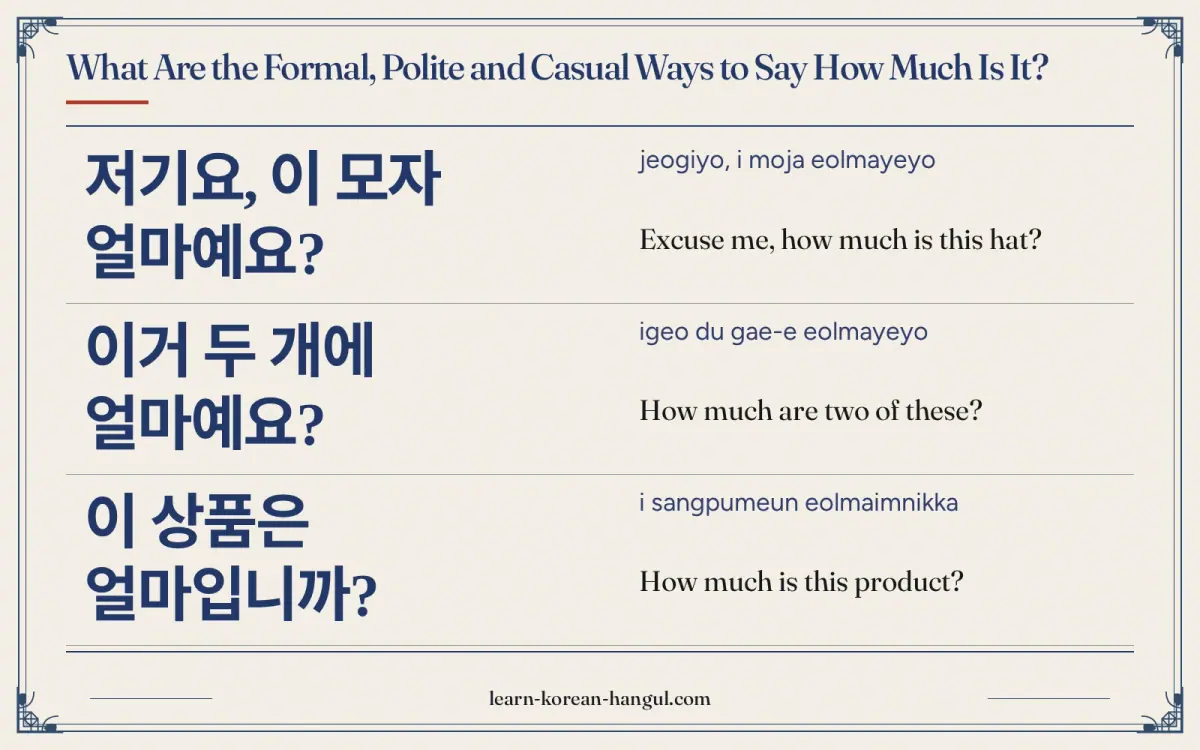
Korean price questions follow the speech levels, the endings that change with the listener. The guide to Korean speech levels explains the system. For shopping, the polite style is the default and the casual style is for people you know well.
Polite: 얼마예요? (eolmayeyo)
Polite · 해요체얼마예요? is the all-purpose price question. It is polite enough for a market seller, a shop clerk, a taxi driver or a stranger, and it is short enough to say while holding the item. Use it when the seller already knows which item you mean.
저기요, 이 모자 얼마예요?
jeogiyo, i moja eolmayeyo
Excuse me, how much is this hat?
Polite: 이거 얼마예요? (igeo eolmayeyo)
Polite · 해요체이거 얼마예요? is the version learners hear most. 이거 means "this thing", and the word does the pointing for you. Add a number and 에 to ask about a quantity: 두 개에 얼마예요? means "how much for two?"
이거 두 개에 얼마예요?
igeo du gae-e eolmayeyo
How much are two of these?
Formal: 얼마입니까? (eolmaimnikka)
Formal · 합쇼체얼마입니까? uses the formal ending -ㅂ니까. You hear it in announcements, on forms, in business talk and from people who want to sound very correct. Most shoppers do not need it: in a normal shop, 얼마예요? sounds more natural than 얼마입니까?
이 상품은 얼마입니까?
i sangpumeun eolmaimnikka
How much is this product?
Casual: 이거 얼마야? (igeo eolmaya)
Casual · 반말이거 얼마야? is the casual form, in 반말 (banmal, intimate speech). It suits a friend, a sibling or a partner, for example when you ask what they paid. To a seller, it would sound rude.
이 신발 얼마야?
i sinbal eolmaya
How much are these shoes?
Four forms come down to one decision: who is the listener. A question is only half the exchange, though, so the next section covers the answer.
How Do You Understand the Price You Hear?
The answer to 얼마예요? is a Sino-Korean number followed by 원 (won). Korean has two number systems, and money always uses the Sino-Korean one: 일, 이, 삼, 사, 오, 육, 칠, 팔, 구, 십. The guide to Sino-Korean numbers lists them all, and Korean money and prices covers reading price tags.
Korean groups large numbers by 10,000, not by 1,000 as English does. That is the main reason prices confuse beginners.
| Unit | Korean | Value | Example price |
|---|---|---|---|
| 천 | cheon | 1,000 | 삼천 원 = 3,000 won |
| 만 | man | 10,000 | 만 원 = 10,000 won |
| 십만 | simman | 100,000 | 십만 원 = 100,000 won |
| 백만 | baengman | 1,000,000 | 백만 원 = 1,000,000 won |
Build a price from left to right. 15,000 won is 만 오천 원: one 만 (10,000) plus 오천 (5,000). Say 10,000 as 만, not 일만. A typical answer sounds like this.
삼천오백 원이에요 means "it is 3,500 won". The ending 이에요 is the polite "it is" after a consonant, and 예요 is the same word after a vowel, which is why the question is 얼마예요 (after 마) and the answer is 원이에요 (after 원).
Counting items works differently: you use native Korean numbers and counters, such as 두 개 (two things), while the price stays Sino-Korean. Hearing the number is easier once you can say the question cleanly, which is the next job.
How Do You Pronounce 얼마예요?
얼마예요? is pronounced eol-ma-ye-yo, in four even syllables. The standard pronunciation is [얼마예요], and [얼마에요] is the common everyday variant.
- 얼 (eol): "uh" with a final l, the tongue touching the ridge behind the teeth.
- 마 (ma): "mah".
- 예 (ye): "yeh"; in everyday speech it often sounds like "eh".
- 요 (yo): "yo" as in "yoga".
Because 얼마 already makes it a question, put the prominence on 얼마 and let the end fall or rise-fall; a sharp final rise is not needed. The pointing word 이거 is said "ee-guh", with a soft g.
Sound Changes to Listen For
These details follow the National Institute of Korean Language (국립국어원) Standard Pronunciation rules (표준 발음법) and natural speech:
- 예요 and its everyday [에요]. The standard pronunciation is [얼마예요], with 예. In everyday speech it often sounds like [얼마에요], and both versions are understood.
- Nasalization in -ㅂ니까. In 얼마입니까, the ㅂ before ㄴ becomes ㅁ, so it is said [얼마임니까]. The rule is explained in ㅂ-to-ㅁ nasalization.
- Liaison in 가격이. In 가격이 얼마예요?, the ㄱ of 격 moves onto 이, giving [가겨기]. See Korean liaison for the full rule.
- Nasal ㄱ in 육만. In 육만 원, the ㄱ before ㅁ becomes ㅇ, so 60,000 won sounds like [융만 원].
Good pronunciation helps only when the form fits the place, so the next section covers where each version belongs.
When Should You Use 얼마예요?, and When Should You Not?
Use 얼마예요? whenever you ask a price in a normal shop, market or restaurant, and switch to 얼마야? only with friends. The formal 얼마입니까? belongs in business or service-desk settings.
Situations Where It Fits
- A market stall. Point and say 이거 얼마예요?
- A shop with no price tag. 저기요, 이 가방 얼마예요?
- A restaurant menu. 이거 얼마예요? works if a price is not shown.
- A service with no posted price. Ask 얼마예요? before you agree, for example for a haircut or a repair.
- A friend's new purchase. Use 얼마야? between friends.
Situations to Avoid
- Asking how long. 얼마예요? asks for money; use 얼마나 걸려요? (eolmana geollyeoyo, how long does it take?) for time.
- Asking how many. Use 몇 개예요? (myeot gaeyeyo, how many are there?).
- A stranger's income or rent. Direct money questions are rude in Korean, as in many languages.
- Casual 얼마야? to a seller. It sounds like talking down to the seller.
Two quick scenes put these choices into action.
What Does How Much Is It Sound Like in a Real Conversation?
A price exchange is short: question, number, decision. Notice how the buyer's form matches the setting.
At the Market
Customer
이 귤 얼마예요?
i gyul eolmayeyo
How much are these tangerines?
Seller
한 봉지에 오천 원이에요.
han bongjie ocheon wonieyo
It's 5,000 won a bag.
Customer
그럼 두 봉지 주세요.
geureom du bongji juseyo
Then two bags, please.
What to notice: the price uses Sino-Korean 오천, and the quantity uses native 한 and 두.
Friends Shopping
Mina
그 가방 얼마야?
geu gabang eolmaya
How much is that bag?
Jun
육만 원.
yungman won
60,000 won.
Mina
비싸다.
bissada
That's expensive.
What to notice: friends drop the polite ending, answer with only the number and add the casual comment 비싸다 (it's expensive). Behind the numbers sits the Korean way of handling money.
What Should You Know about Korean Prices and Money?
Korean prices are written in won (원), with no decimals, and the unit that matters is 만, ten thousand. These facts help in a shop.
- Banknotes. South Korea uses 1,000, 5,000, 10,000 and 50,000 won notes: 천 원, 오천 원, 만 원 and 오만 원. Coins are 10, 50, 100 and 500 won.
- Fixed prices. In department stores, supermarkets, convenience stores and chains, prices are fixed and not negotiated.
- Market bargaining. In traditional markets (시장), a polite request such as 조금 깎아 주세요 is possible, covered in discount please in Korean.
- Paying. Most shops accept cards, but small stalls may take cash only. Ask with do you take cards in Korean.
- Dropping 원. In speech, the word 원 is often left out: 삼천오백 alone is clear.
An expert insight: learners often wait to hear the whole number before understanding it. Listen for the last unit word instead: if you hear 만, the price is in the ten-thousands, and if you hear 천, it is in the thousands. The common mistakes below show where that habit helps.
What Mistakes Do Learners Make with How Much Is It in Korean?
Most mistakes come from number systems and from confusing "how much" with "how many".
| Mistake | Why it is a problem | Fix |
|---|---|---|
| Using native numbers for prices (하나, 둘) | Money uses Sino-Korean numbers | Say 삼천 원, not 세 천 원 |
| Saying "ten thousand" as 십천 | Korean has a single word, 만 | Say 만 원 |
| Reading 15,000 as "fifteen thousand" | Korean groups by 10,000 | Say 만 오천 원 |
| Using 얼마예요 for how many | It asks for money | Say 몇 개예요? |
| Using 얼마예요 for how long | It asks for money | Say 얼마나 걸려요? |
| Asking a seller 얼마야? | Casual speech is rude to sellers | Say 얼마예요? |
Learners often assume that numbers in prices are the same as numbers for counting things. Actually, Korean uses Sino-Korean numbers for money and native Korean numbers with counters for objects, so one sentence can contain both, as in 두 개에 칠천 원 (7,000 won for two). The next section collects the other ways people search for this phrase.
Is 얼마예요? the Same as "How Much Is This"?
Yes. 얼마예요? covers "how much is it", "how much is this" and "how much is that" depending on the pointing word. The short answers below cover the other searches.
- How much is this in Korean: 이거 얼마예요?
- How much is that in Korean: 그거 얼마예요? (near the listener) or 저거 얼마예요? (far from both).
- How much does it cost in Korean: 얼마예요? is the everyday way. 얼마 들어요? (eolma deureoyo) asks the total cost of something like a trip or a repair.
- What's the price in Korean: 가격이 얼마예요? The noun 가격 (gagyeok) means price. For the word itself, see price in Korean.
- How much in Korean: 얼마 (eolma) is the question word, and it appears in 얼마나 (how much, how long, how far).
Now practise the question aloud.
Practice: Say It Aloud
Play the slow clip of 얼마예요? and repeat it three times, then try 이거 얼마예요? and 이거 얼마야? Next solve these. Answers follow.
- You point at a scarf in a shop and want to ask the seller the price.
- A friend says 오천 원. How much is that?
- How do you say 12,000 won in Korean?
- You want the price of three oranges. What do you ask?
Answers
- 이거 얼마예요?
- 5,000 won.
- 만 이천 원.
- 오렌지 세 개에 얼마예요? (orenji se gae-e eolmayeyo, how much for three oranges?).
The phrase flashcards drill all four forms with audio.
Related Phrases to Learn Next
Asking the price leads straight into buying and paying.
- This one please in Korean: how to say which item you want.
- Discount please in Korean: asking politely for a lower price at a market.
- Do you take cards in Korean: how to check payment before you buy.
This guide belongs to the Korean shopping phrases collection. What this page does not cover: reading large numbers in full, exchange rates and tax refunds for tourists. Choose 얼마예요? for sellers, add 이거 when you point, and learn 천 and 만, and you can ask how much is it in Korean in any shop.
Frequently Asked Questions
How do you ask the price of something you point to in Korean?
Point at the item and say 이거 얼마예요? (igeo eolmayeyo, how much is this?). For something far from both of you, say 저거 얼마예요? (jeogeo eolmayeyo). Add 저기요 (jeogiyo, excuse me) first if you need to get a seller's attention, and listen for the number followed by 원 in the reply.
What is the difference between 얼마예요 and 몇 개예요?
얼마예요 asks for a price or an amount of money, while 몇 개예요 (myeot gaeyeyo) asks how many items there are. If you want the price of two items, say 두 개에 얼마예요? (du gae-e eolmayeyo, how much for two?). Mixing them up leads to an answer in the wrong kind of number.
How do Koreans say the price in Korean numbers?
Prices use Sino-Korean numbers followed by 원 (won). 3,500 won is 삼천오백 원 (samcheon-obaek won), and 10,000 won is 만 원 (man won). Native numbers such as 하나 and 둘 count items, not money. Learn the number units 천 (1,000) and 만 (10,000) first.
Can I bargain after asking 얼마예요?
In traditional markets (시장), a small friendly discount request is common, such as 조금 깎아 주세요 (jogeum kkakka juseyo, please lower it a little). In department stores, convenience stores and chain shops, prices are fixed and bargaining is rude. Ask the price first, then judge by the place.
How do you ask if the price includes tax or a service charge?
Ask 세금 포함이에요? (segeum pohamieyo, is tax included?) or 부가세 포함이에요? (bugase pohamieyo, is VAT included?). In Korea, shelf prices normally include value-added tax, so a different price at the till is unusual. Restaurants rarely add a separate service charge, except some hotels.