이거 주세요
이거 주세요
What you'll learn
- Say 이거 주세요 aloud and use it with a pointing gesture.
- Choose between 이거, 그거 and 저거 by where the item is.
- Explain why 이것 주세요 is pronounced [이걷 쭈세요].
- Ask for two or three of an item with 이거 두 개 주세요.
Before you start: knowing hello in Korean helps, because shop staff greet you first. Time: about 12 minutes. Audio plays only when you press a button.
How Do You Say This One Please in Korean?
The standard way to say this one please in Korean is 이거 주세요, made of 이거 (igeo, this thing) and 주세요 (juseyo, please give me). Korean needs no word for "please" or "one" here: 주세요 already carries the polite request, and 이거 names the thing you mean. Point as you speak, and the shop assistant will understand at once.
| Form | Romanization | Register | Say it to |
|---|---|---|---|
| 이거 주세요 | igeo juseyo | Polite (해요체) | Any shop assistant, waiter or stranger |
| 이것 주세요 | igeot juseyo | Polite, slightly formal | Careful speech; the fuller form you see in writing |
| 저거 주세요 | jeogeo juseyo | Polite (해요체) | Staff, for an item far from both of you |
| 그거 주세요 | geugeo juseyo | Polite (해요체) | Staff, for an item near them |
| 이거 줘 | igeo jwo | Casual (반말) | Close friends and family only |
All the polite forms share 주세요; only the pointing word changes, as the next section shows.
What Are the Polite Ways to Say This One Please?
This one please follows the Korean speech levels, explained in the guide to Korean speech levels. In a shop, 주세요 is the polite request form, so the choices below are mainly about which pointing word you use.
Polite: 이거 주세요 (igeo juseyo)
Polite · 해요체이거 주세요 is the default. 이거 is the spoken short form of 이것 (this thing), and 주세요 is the polite request form of 주다, "to give". Use it for an item near you, such as one on the counter in front of you or in your hand.
이거 주세요. 카드로 할게요.
igeo juseyo. kadeuro halgeyo
This one, please. I'll pay by card.
Polite: 이것 주세요 (igeot juseyo)
Polite · 해요체이것 is the full form of 이거. In speech it sounds a little stiff, so you see it more in writing and hear it mainly in careful speech. Both forms are correct. If you copy a native speaker in a shop, you will mostly hear 이거.
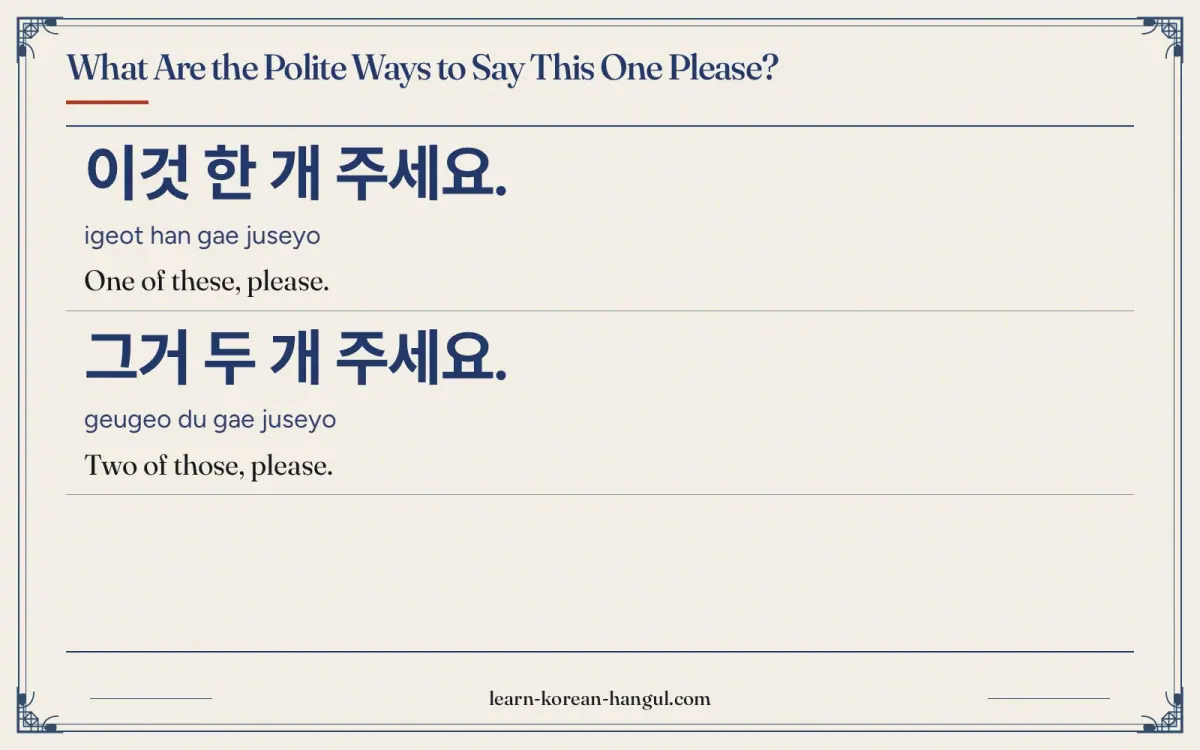
이것 한 개 주세요.
igeot han gae juseyo
One of these, please.
Polite: 저거 주세요 (jeogeo juseyo)
Polite · 해요체저거 points to something far from both you and the listener, such as an item on a high shelf or across the shop. Add 저기 있는 (jeogi inneun, "that is over there") and a colour or shape if several items look alike.
저기 있는 빨간색 저거 주세요.
jeogi inneun ppalgansaek jeogeo juseyo
That red one over there, please.
Polite: 그거 주세요 (geugeo juseyo)
Polite · 해요체그거 points to something near the listener, or something you have both just mentioned. In a shop, use it for an item the assistant is holding or standing next to. It is the middle point of the three-way system, and English has no matching word.
그거 두 개 주세요.
geugeo du gae juseyo
Two of those, please.
Four polite forms come down to two decisions: where the item is, and whether you want one or more. The next section shows how the sounds work.
How Do You Pronounce 이거 주세요?
이거 주세요 is pronounced [이거 주세요], igeo juseyo, in five even syllables. There are no special sound changes, so it is one of the easiest shop phrases to say.
- 이 (i): "ee".
- 거 (geo): a soft g and the open vowel ㅓ, like "uh".
- 주 (ju): a soft j and "oo".
- 세 (se): "seh".
- 요 (yo): "yoh".
Sound Changes to Listen For
Three details from the National Institute of Korean Language Standard Pronunciation Rules (표준 발음법) matter here.
- Final ㅅ becomes [ㄷ]. In 이것 주세요, the final ㅅ of 것 is said as [ㄷ], so 이것 is [이걷].
- ㅈ becomes tense. After that [ㄷ], the ㅈ of 주 becomes tense, so 이것 주세요 is [이걷 쭈세요]. The rule is explained in Korean tensification.
- Soft g and j between vowels. In 이거 and 주세요, ㄱ and ㅈ are soft and voiced between vowels, so they sound close to English "g" and "j", not to "k" and "ch".
With the sounds covered, the next question is when each form is safe to use.
When Should You Use 이거 주세요, and When Should You Not?
Use 이거 주세요 whenever you can point at an item. It suits shops, cafés, markets and kiosks. Point at an item near you with 이거, near the assistant with 그거, and far away with 저거.
Situations Where It Fits
- A bakery or café counter. Point at a pastry and say 이거 주세요.
- A market stall. Point at fruit and say 이거 한 봉지 주세요 (one bag of this, please).
- A clothing shop. Point at a shelf and say 저거 보여 주세요 (please show me that one).
- A menu. Point at a photo and say 이걸로 주세요 (I'll take this one).
Situations to Avoid
- A person. 이거 means "this thing". Never point at a person and say it. Use 이 사람 (i saram, this person) or 이분 (ibun, this person, respectful) when you need to refer to someone.
- A casual form with staff. 이거 줘 is rude to a shop assistant. Keep the 주세요.
- An item next to you with 그거. 그거 points to the listener's side, so staff will look at their own side.
- Very formal writing. In forms or announcements, 이것을 주십시오 is the formal version.
The short scenes below show the three pointing words at work.
How Do You Choose between 이거, 그거 and 저거?
Choose by the item's position relative to the two speakers, not by distance from you alone. The word 그 belongs to the listener's side, so the same object can take different words depending on who speaks.
| Word | Romanization | Points to | Example |
|---|---|---|---|
| 이거 | igeo | near me | 이거 주세요 |
| 그거 | geugeo | near you, or just mentioned | 그거 주세요 |
| 저거 | jeogeo | far from both of us | 저거 주세요 |
When the assistant holds an item and asks 이거요? (igeoyo?, "this one?"), the assistant is speaking from their own side. You then answer 네, 그거요 (ne, geugeoyo, "yes, that one"), because for you it is near the other person. The full grammar is in the guide to 이, 그, 저 demonstratives.
Next, the question of quantity.
How Do You Ask for More than One?
Add a native-number count between the item and 주세요. Items take native Korean numbers with the counter 개 (gae, items): 한 개 (one), 두 개 (two), 세 개 (three). The number 하나 (hana, one) also works on its own, as in 이거 하나 주세요.
| You want | Korean | Romanization |
|---|---|---|
| One of these | 이거 하나 주세요 | igeo hana juseyo |
| Two of these | 이거 두 개 주세요 | igeo du gae juseyo |
| Three of those | 그거 세 개 주세요 | geugeo se gae juseyo |
Use native numbers here, not 일, 이, 삼. The numbers are covered in native Korean numbers 1-10, and the counter in the 개 counter. When you have chosen among several options and want to confirm, you can also say 이걸로 주세요 (igeollo juseyo, "I'll take this one"), explained under the folded queries below.
What Does This One Please Sound Like in a Real Conversation?
A shop exchange is usually three short turns: a question, a price and a choice. Notice how the pointing word follows the position of the item in each scene.
At a Bakery
Customer
이거 얼마예요?
igeo eolmayeyo?
How much is this?
Assistant
삼천 원이에요.
samcheon wonieyo
It's 3,000 won.
Customer
이걸로 주세요.
igeollo juseyo
I'll take this one.
What to notice: 이걸로 comes after the price, and means "I'll take this one among the options". Prices are covered in how much is it in Korean.
An Item Far Away
Customer
저거 주세요.
jeogeo juseyo
That one over there, please.
Assistant
이거요?
igeoyo?
This one?
Customer
아니요, 저기 있는 거요.
aniyo, jeogi inneun geoyo
No, the one over there.
What to notice: the assistant says 이거요? because the assistant is pointing at an item near them; the customer says no and adds 저기 있는 거 (the one over there).
An Item near the Assistant
Customer
그거 한번 보여 주세요.
geugeo hanbeon boyeo juseyo
Please show me that one.
Assistant
이거요?
igeoyo?
This one?
Customer
네, 그거요. 하나 주세요.
ne, geugeoyo. hana juseyo
Yes, that one. One, please.
What to notice: the same item is 그거 for the customer and 이거 for the assistant. The shopping habits behind this are next.
What Should You Know about the Culture behind This One Please?
Pointing words in Korean follow the speaker and the listener, and shop manners add a few habits that English speakers may not expect.
- A three-way system. Korean uses 이 (near me), 그 (near you) and 저 (far from both). English has only two, "this" and "that".
- Pointing is fine. Pointing with an open hand or a finger at an item is normal in shops; pointing at people is not.
- Giving and receiving. Many Koreans hand over cash and cards with the right hand, supported by the left hand, or with both hands, especially to older people.
- Staff say 이거요?. Assistants often check with "this one?" before they act, so a short 네 (yes) is all you need.
An expert insight: learners often get stuck choosing between 이거, 그거 and 저거 in the moment. A simple rule is to point first and say 이거 for anything you touch or hold. If the assistant corrects you with 이거요?, answer 네 and move on. The common mistakes below come from the same pointing logic.
What Mistakes Do Learners Make with This One Please in Korean?
Most mistakes with this one please come from the pointing word and the counting words, not from 주세요.
| Mistake | Why it is a problem | Fix |
|---|---|---|
| Using 그거 for an item next to you | 그거 points to the listener's side, so the shopkeeper looks at their own side | Use 이거 |
| Pointing at a person and saying 이거 | 이거 means "this thing" | Use 이 사람 or 이분 |
| Saying 이거 줘 to staff | The casual ending is rude to a service worker | Say 이거 주세요 |
| Counting with 일 개 or 이 개 | Items take native numbers | Say 한 개, 두 개 |
| Pronouncing 이것 with a final s: "igeos" | Final ㅅ is said as [ㄷ] | Say [이걷] |
Learners often assume that 이거, 그거 and 저거 simply mean "this", "that" and "that over there" by distance from the speaker. Actually, 그거 depends on the listener, so the same item can be 그거 for one speaker and 이거 for the other. Always ask whose side the item is on.
Is It the Same as Give Me This?
The short answers below cover the other ways people search for this phrase.
- Give me this in Korean: 이거 주세요 (polite); 이거 줘 (casual, friends only).
- I'll take this in Korean: 이걸로 할게요 (igeollo halgeyo) or 이걸로 주세요 (igeollo juseyo), the natural choice among several options. For "I'll buy this", 이거 살게요 (igeo salgeyo) [이거 살께요].
- I want this in Korean: 이거 사고 싶어요 (igeo sago sipeoyo, I want to buy this). In a shop, 이거 주세요 is more natural than "I want".
- Related shop lines: do you take cards in Korean and receipt please in Korean.
The next section turns these forms into a short practice routine.
Practice: Say It Aloud
Play the slow clip of 이거 주세요 and repeat it three times while pointing, then try 그거 and 저거. Then choose the right words for each case. Answers follow.
- You hold a pastry and want to buy it.
- The assistant holds the item you want and you can see it.
- The item is on a high shelf across the shop.
- You want two of the item you are touching.
Answers
- 이거 주세요.
- 그거 주세요.
- 저거 주세요.
- 이거 두 개 주세요.
The phrase flashcards drill the pointing words and shop lines with audio.
Related Phrases to Learn Next
This one please sits beside the other lines you use at a shop counter.
- How much is it in Korean: 얼마예요? for asking the price.
- Do you take cards in Korean: 카드 돼요? for paying.
- Receipt please in Korean: 영수증 주세요 for the end of the sale.
This guide belongs to the Korean shopping phrases collection. What this page does not cover: bargaining, sizes and refunds. Point, choose 이거, 그거 or 저거, add 주세요, and you can say this one please in Korean at any counter.
Frequently Asked Questions
What is the difference between 이거 주세요 and 이것 주세요?
Both mean "this one, please" and both are polite. 이거 is the spoken short form, and 이것 is the fuller written form that sounds a little stiff. In shops you will mostly hear 이거. The pronunciation also differs: 이것 주세요 is said [이걷 쭈세요], with a tense ㅈ, while 이거 주세요 has no sound change.
How do I say I'll take this one when choosing between options?
Say 이걸로 주세요 (igeollo juseyo) or 이걸로 할게요 (igeollo halgeyo). 이걸로 combines 이것 with the particle 로, "by means of this", and signals a choice among several items. It is very natural at cafés and restaurants after you have looked at a menu or a display.
Can I use 이거 주세요 with friends, elders and strangers?
Yes with strangers and elders, because it is polite. With close friends, the casual 이거 줘 is more natural, for example when you ask a friend to pass you something. Never use the casual form with staff, and never point at a person with 이거, because the word refers to things.
How do I say two of these?
Put the number and counter between the item and 주세요: 이거 두 개 주세요 means "two of these, please". Use native numbers: 하나 or 한 개 for one, 두 개 for two, 세 개 for three. For food by serving, 인분 takes the other number system: 이 인분 주세요 means "two servings, please".
Is 이거 주세요 formal or casual?
이거 주세요 is polite, in the 해요체 style, so it is neither formal nor casual. It is correct for almost every shop and restaurant. A formal version, 이것을 주십시오, appears in announcements and written forms. The casual version, 이거 줘, is for friends and family only.