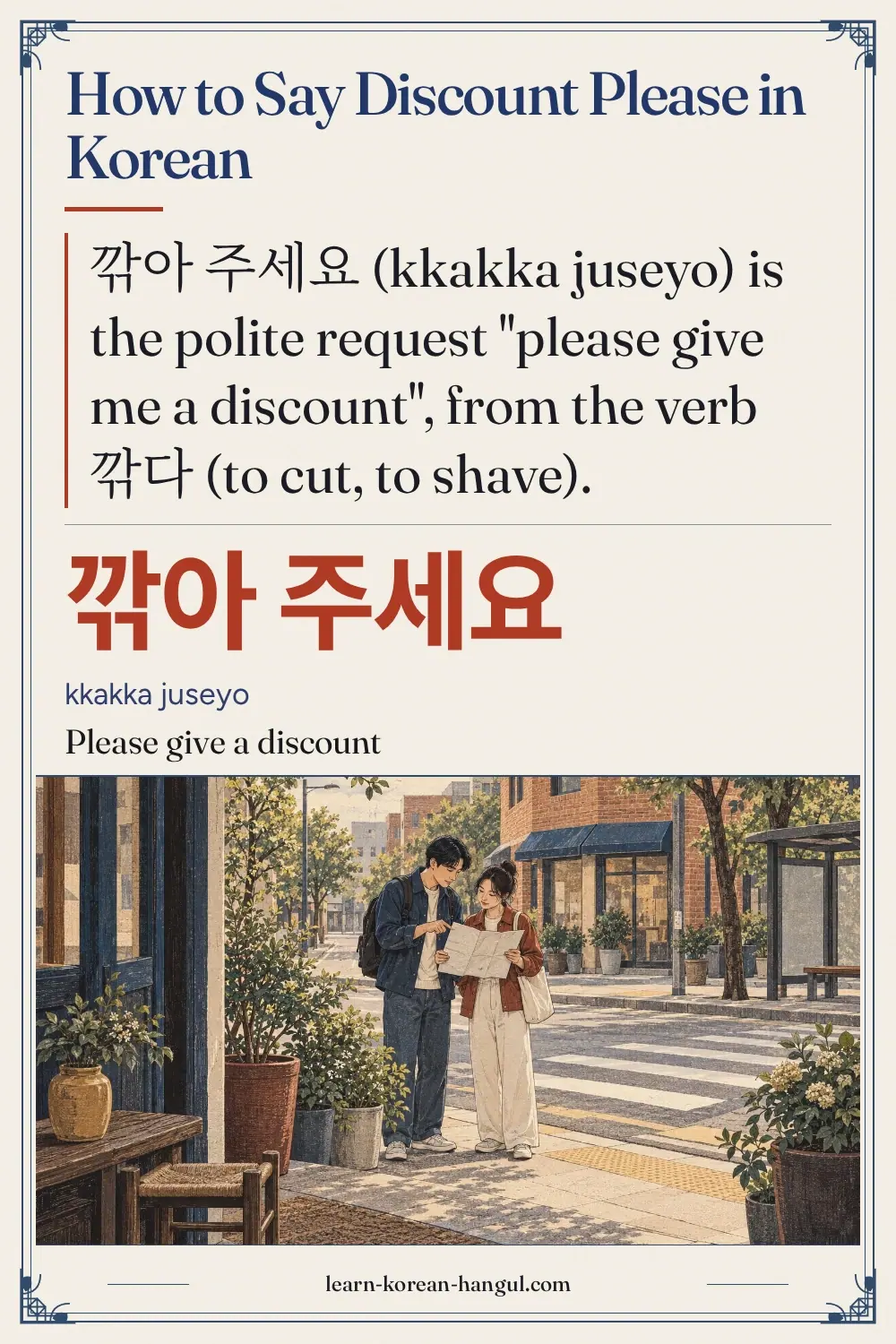
깎아 주세요
깎아 주세요
What you'll learn
- Ask for a discount with 깎아 주세요 and 좀 싸게 해 주세요.
- Open the negotiation with 너무 비싸요 and ask 얼마까지 돼요?
- Pronounce 깎아 as [까까] with its tense ㄲ.
- Know where bargaining is normal and where prices are fixed.
Before you start: the endings below follow the levels explained in Korean speech levels. To ask the price first, see how much is it in Korean. Time: about 12 minutes. Audio plays only when you press a button.
How Do You Say Discount Please in Korean?
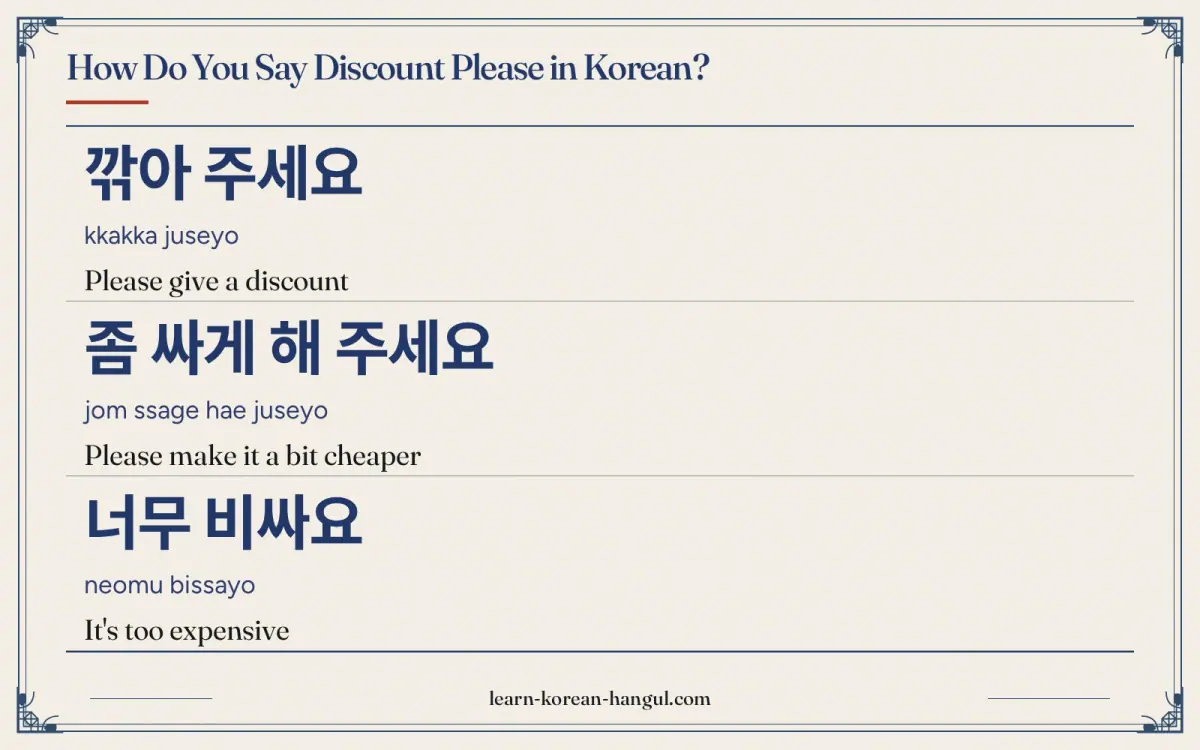
The standard way to say discount please in Korean is 깎아 주세요, built from the verb 깎다 (to cut, to shave off) and 주세요 (please give). It asks the seller to cut the price. The table shows the choices for different situations.
| Situation | Korean | Romanization | Meaning |
|---|---|---|---|
| Standard request | 깎아 주세요 | kkakka juseyo | Please give a discount |
| Softer request | 좀 싸게 해 주세요 | jom ssage hae juseyo | Please make it a bit cheaper |
| Opening move | 너무 비싸요 | neomu bissayo | It's too expensive |
| Asking the limit | 얼마까지 돼요? | eolmakkaji dwaeyo | How low can it go? |
| Close friend | 깎아 줘 | kkakka jwo | Cut it for me |
Revised Romanization (the South Korean government standard of 2000) is a reading aid here. Learn the Hangul first. For a plain price question, ask 이거 얼마예요? ("how much is this?") before you negotiate.
What Are the Polite Ways to Say Discount Please?
Discount please has four everyday phrases, and all of them are polite. They differ in how direct they are, so the order you use them in matters.
Polite: 깎아 주세요 (kkakka juseyo)
Polite · 해요체깎아 주세요 is the standard request. The ending -아/어 주세요 means "please do it for me", so the phrase asks for a favour. Address the owner as 사장님 (sajangnim, "boss"), a common friendly term for a shop owner.
사장님, 좀 깎아 주세요.
sajangnim, jom kkakka juseyo
Boss, please give me a little discount.
Polite and Soft: 좀 싸게 해 주세요 (jom ssage hae juseyo)
Polite · 해요체좀 싸게 해 주세요 means "please make it a bit cheaper". It describes the result (싸게, cheaply) and does not name the act of cutting, which makes it gentler. Give a reason, such as buying a lot, to make it persuasive.
많이 살게요. 좀 싸게 해 주세요.
mani salgeyo. jom ssage hae juseyo
I will buy a lot. Please make it a bit cheaper.
Polite: 너무 비싸요 (neomu bissayo)
Polite · 해요체너무 비싸요 states that the price is too high. It is not a request, so pair it with 깎아 주세요. Say it with a smile, because a flat tone can sound like a complaint.
이거 너무 비싸요.
igeo neomu bissayo
This is too expensive.
Polite: 얼마까지 돼요? (eolmakkaji dwaeyo)
Polite · 해요체얼마까지 돼요? asks how far the price can go down. 얼마 means "how much", 까지 means "up to" and 돼요 means "is possible". Offering to pay in cash often helps.
얼마까지 돼요? 현금으로 낼게요.
eolmakkaji dwaeyo? hyeongeumeuro naelgeyo
How low can it go? I will pay in cash.
With friends or family who run a stall, the casual 깎아 줘 is possible, but with vendors you meet for the first time, stay with the polite forms.
Four phrases cover most negotiations. Next, the sounds, because tense consonants appear in three of them.
How Do You Pronounce 깎아 주세요?
깎아 주세요 is pronounced [까까 주세요], kka-kka ju-se-yo, in five syllables. The request is a statement, so the pitch does not rise at the end.
- 깎 (kkak) → 까 (kka): the tense "kk" sound, with a tight throat and no puff of air.
- 아 (a) → 까 (kka): the final ㄲ moves onto the vowel.
- 주 (ju): a short "ju".
- 세 (se): "seh".
- 요 (yo): a short "yo".
Sound Changes to Listen For
Three features shape this phrase and its relatives:
- Liaison. The final ㄲ of 깎 moves onto the vowel of 아, so 깎아 is [까까], not [깍아]. The rule is covered in Korean liaison.
- Tense consonants. ㄲ and ㅆ are written letters for tense sounds, as in 깎, 싸게 and 비싸요. They are explained in Korean double consonants. Revised Romanization writes them kk and ss.
- Question tone. 얼마까지 돼요? has the question word 얼마, so the prominence falls on 얼마 and the pitch usually ends with a fall or a small rise-fall. A sharp final rise can turn 얼마 into "some amount", which changes the meaning.
Say 깎아 three times, holding the tight ㄲ. The sounds are easy to practise, but the situation matters more.
When Should You Use 깎아 주세요, and When Should You Not?
Use 깎아 주세요 where bargaining is normal, and skip it where prices are fixed. The difference decides whether the phrase sounds friendly or rude.
Situations Where It Fits
- A traditional market. Markets such as Namdaemun are typical places for 좀 깎아 주세요.
- Buying several items. Ask 두 개 사면 얼마예요? ("how much if I buy two?") for a multi-buy price.
- A small shop or street stall. 좀 싸게 해 주세요 is common.
- Paying in cash. 현금으로 낼게요 can help your request.
Situations to Avoid
- Chain stores, supermarkets and department stores. Prices are fixed (a system called 정찰제, jeongchalje), so the cashier cannot negotiate.
- Restaurants and cafés. Do not ask for a lower menu price.
- Very small amounts. Pressing hard over a few hundred won can sound petty.
Three short dialogues show how a negotiation sounds.
What Does Discount Please Sound Like in a Real Conversation?
A negotiation usually has three steps: ask the price, say it is too high, and ask for a reduction. Listen for the vendor's counter-offer at the end.
At a Market Stall
Customer
이거 얼마예요?
igeo eolmayeyo
How much is this?
Vendor
만 원이에요.
man wonieyo
It's 10,000 won.
Customer
너무 비싸요. 좀 깎아 주세요.
neomu bissayo. jom kkakka juseyo
It's too expensive. Please give a little discount.
Vendor
그럼 구천 원에 드릴게요.
geureom gucheon wone deurilgeyo
Then I'll give it to you for 9,000 won.
What to notice: the vendor answers with a number plus 드릴게요 ("I will give it"), which is pronounced [드릴께요].
Buying Two
Customer
두 개 사면 얼마예요?
du gae samyeon eolmayeyo
How much if I buy two?
Vendor
두 개에 만 오천 원이에요.
du gaee man ocheon wonieyo
Two for 15,000 won.
Customer
그럼 두 개 주세요.
geureom du gae juseyo
Then two, please.
What to notice: the customer never says 깎아 주세요. Asking for a multi-buy price is a polite way to get a reduction.
A Free Extra
Customer
얼마까지 돼요?
eolmakkaji dwaeyo
How low can it go?
Vendor
더는 어려워요. 대신 덤으로 하나 더 드릴게요.
deoneun eoryeowoyo. daesin deomeuro hana deo deurilgeyo
Lower is hard. Instead I'll give you one more as a bonus.
Customer
와, 감사합니다!
wa, gamsahamnida
Wow, thank you!
What to notice: the vendor refuses politely with 어려워요 ("it is difficult") and offers 덤 (a free extra) instead.
What Should You Know about the Culture behind Discount Please?
Bargaining in Korea is friendly and short, and it mostly belongs to markets.
- Markets bargain, stores do not. At traditional markets and street stalls, a small reduction is common. In department stores and chains, price tags are final.
- A free extra is a discount. Vendors often add a free item, called 덤 (deom), instead of lowering the price.
- Buying more helps. A multi-buy price is easier to get than a cut on a single item.
- Manners count. A smile, a polite ending and a quick yes to a fair offer keep the mood warm.
An expert insight: Koreans often answer a discount request with a number, not with a yes or no. The vendor's counter-offer is the answer, so you accept it, or thank them and walk away. The mistakes below are the ones that make that exchange awkward.
What Mistakes Do Learners Make with Discount Please in Korean?
Most mistakes come from vocabulary and from place.
| Mistake | Why it is a problem | Fix |
|---|---|---|
| 싸요 as a request | It means "it's cheap", a fact | Say 싸게 해 주세요 |
| Bargaining at a fixed-price shop | Sounds rude | Pay the price, or ask 할인돼요? |
| Spelling 깎아 as 깍아 | Leaves out the doubled ㄲ | Write 깎 with ㄲ |
| Saying [깍아] with a plain ㄱ | Misses the tense sound | Say [까까] |
| 깎아 줘 to a stranger | Casual | Say 깎아 주세요 |
Learners often assume 할인 and 깎다 are the same word, but 할인 (discount) is a noun for an official reduction, while 깎다 is the action of cutting a price in a negotiation.
Is It the Same as Discount, Bargain, Haggle, Cheaper and Sale in Korean?
Not exactly. These single-word searches lead to related words, and the short answers below separate them. The dedicated pages on discount in Korean and sale in Korean go further.
- Discount in Korean: 할인 (harin, pronounced [하린]), the official discount on a price tag. Ask 할인돼요? to check for one.
- Bargain / haggle in Korean: 깎다 (to cut a price) and 흥정하다 (heungjeonghada, to negotiate).
- Cheaper in Korean: 더 싸게 (deo ssage), as in 더 싸게 해 주세요.
- Too expensive in Korean: 너무 비싸요.
- Sale in Korean: 세일 (seil), the word on store signs.
Now practise the request with your own voice.
Practice: Say It Aloud
Play the slow clip and repeat 깎아 주세요 three times, keeping the ㄲ tight. Then choose the right phrase. Answers follow.
- You want to open a negotiation by saying the price is high.
- You buy five items and want a softer request.
- You want to ask how low the price can go.
- Which word means "it's cheap", and is therefore not a request?
Answers
- 너무 비싸요.
- 많이 살게요. 좀 싸게 해 주세요.
- 얼마까지 돼요?
- 싸요
The phrase flashcards drill these phrases with audio.
Related Phrases to Learn Next
Discount please connects to the phrases for paying and choosing.
- How much is it in Korean: the question that comes before any negotiation.
- This one please in Korean: how to pick the item you want.
- Do you take cards in Korean: what to ask once the price is agreed.
This guide belongs to the Korean shopping phrases collection. What this page does not cover: how to read prices aloud, which is explained on the page about money and prices. Ask kindly, smile, and keep the amount reasonable, and you can say discount please in Korean at the right stalls.
Frequently Asked Questions
How do you say discount please in Korean?
Say 깎아 주세요 (kkakka juseyo), and add 좀 ("a little") to soften it: 좀 깎아 주세요. A gentler version is 좀 싸게 해 주세요, which means "please make it a bit cheaper". Use both at markets and small shops, where price negotiation is expected.
How do you pronounce 깎아 주세요?
Say kka-kka ju-se-yo, written [까까 주세요]. The final ㄲ of 깎 moves onto the vowel of 아, so the sound is the same tense 까 twice. Tense means no puff of air and a tight throat. Keep 주세요 light and clear, and do not stress it.
What is the difference between 깎아 주세요 and 좀 싸게 해 주세요?
깎아 주세요 uses the verb 깎다, "to cut", and asks directly for a reduction. 좀 싸게 해 주세요 means "make it a bit cheaper" and sounds softer, because 좀 and 싸게 describe the result. Both are polite. Shoppers often use the second form first and the first form to follow up.
Can I use 깎아 주세요 with friends, elders and strangers?
You can use 깎아 주세요 with vendors and shop owners of any age, because it is polite. With a friend or relative who runs a stall, the casual 깎아 줘 is possible. In chain stores, supermarkets and department stores, do not bargain, because prices are fixed.
What is the most common mistake with discount please in Korean?
Saying 싸요 as a request. 싸요 means "it is cheap", so it states a fact. The request is 싸게 해 주세요. Another mistake is bargaining at a fixed-price shop, where it can sound rude. A third is spelling 깎아 with one ㄱ, as in 깍아.