체크인하고 싶어요
체크인하고 싶어요
What you'll learn
- Say 체크인하고 싶어요, 여권 여기 있어요, 창가 자리로 주세요 and 짐은 한 개예요 at a counter.
- Understand the staff questions about the destination, the seat and the bags.
- Pronounce 여권 as [여꿘] and 창가 as [창까].
- Avoid saying 창문 자리 or 티켓 where Koreans say 창가 자리 and 탑승권.
Before you start: if you need to find the right counter or gate first, see where is the gate in Korean. Time: about 12 minutes. Audio plays only when you press a button.
How Do You Say Check in at the Airport in Korean?
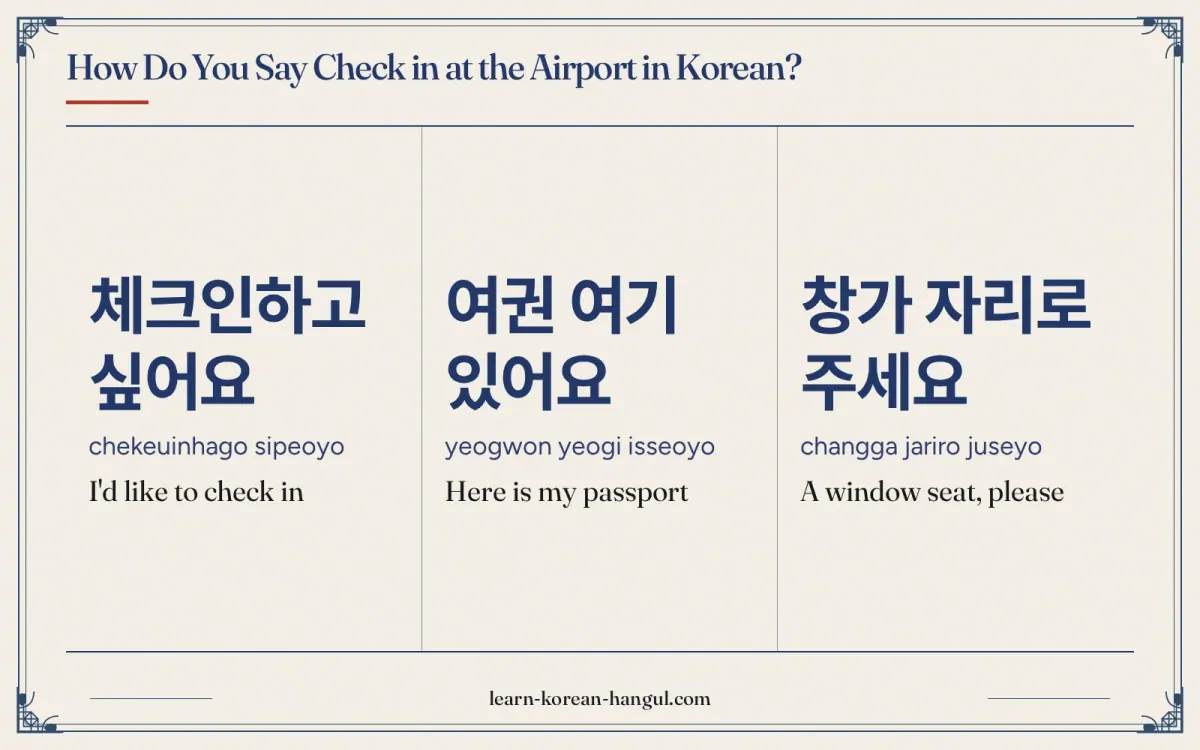
The standard way to check in at the airport in Korean is 체크인하고 싶어요. It is the same sentence you use at a hotel, but the setting changes what follows. At an airline counter, the staff will ask for your destination, your passport and your bags. The ending -고 싶어요 expresses a wish, so the sentence sounds gentle and polite.
| Korean | Romanization | Meaning | Where you hear it |
|---|---|---|---|
| 체크인하고 싶어요 | chekeuinhago sipeoyo | I'd like to check in | Starting at the counter |
| 여권 여기 있어요 | yeogwon yeogi isseoyo | Here is my passport | Handing over ID |
| 창가 자리로 주세요 | changga jariro juseyo | A window seat, please | Choosing a seat |
| 짐은 한 개예요 | jimeun han gaeyeyo | I have one bag | Answering the bag question |
Revised Romanization (the South Korean government standard of 2000) is only a reading aid here. Learn the Hangul first. The next section shows how each line fits a step at the counter.
What Are the Polite Ways to Say Check in at the Airport?
Airport Korean is polite from start to finish. Guests and staff both use the 요 or 습니다 style, as explained in Korean speech levels. The lines below follow the order of a normal check-in.
Polite: 체크인하고 싶어요 (chekeuinhago sipeoyo)
Polite · 해요체체크인하고 싶어요 opens the conversation at the counter. Add the destination or flight if the staff do not ask. The loanword 체크인 comes from English "check-in", and it is the same word as in a hotel. At an airport it also covers dropping off checked bags.
안녕하세요. 도쿄 가는 비행기 체크인하고 싶어요.
annyeonghaseyo. dokyo ganeun bihaenggi chekeuinhago sipeoyo
Hello. I'd like to check in for the flight to Tokyo.
Polite: 여권 여기 있어요 (yeogwon yeogi isseoyo)
Polite · 해요체여권 여기 있어요 is what you say as you hand over your passport. 있어요 means "it is here", so the sentence is a plain, polite handover. Staff ask for the passport first, so keep it ready in your hand.
네, 여기 제 여권이에요.
ne, yeogi je yeogwonieyo
Yes, here is my passport.
Polite: 창가 자리로 주세요 (changga jariro juseyo)
Polite · 해요체창가 자리로 주세요 asks for a window seat. 창가 means "the window side", 자리 means "seat" or "place", and -로 주세요 means "please give me ... ". For an aisle seat, say 통로 쪽 자리로 주세요 (tongno jjok jariro juseyo). Some airlines also say 복도 쪽, which means the hallway side.
가능하면 창가 자리로 주세요.
ganeunghamyeon changga jariro juseyo
If possible, a window seat, please.
Polite: 짐은 한 개예요 (jimeun han gaeyeyo)
Polite · 해요체짐은 한 개예요 answers the question about your bags. 짐 means "luggage", 한 개 means "one piece" and 예요 is the polite "it is" after a vowel. For two bags, say 두 개예요. The particle 은 shows that you are talking about the bags.
맡길 짐은 한 개예요.
matgil jimeun han gaeyeyo
I have one bag to check in.
Four lines cover most check-ins: the wish, the passport, the seat and the bags. The next section shows how to pronounce them.
How Do You Pronounce 체크인하고 싶어요?
체크인하고 싶어요 is pronounced [체크인하고 시퍼요], in eight syllables. The long phrase has one change near the end, but the other lines at the counter have their own sound changes.
- 체 (che): an aspirated ch and the vowel ㅔ.
- 크 (keu): an aspirated k and the flat ㅡ vowel, with the lips spread.
- 인 (in): a clear i and n.
- 하 (ha) and 고 (go): plain and light.
- 싶 (si): a soft s followed by i. The final ㅍ moves on to the next syllable.
- 어 (peo): the ㅍ links to 어 and is spoken as an aspirated p, so you hear [퍼].
- 요 (yo): a short, light ending.
Sound Changes to Listen For
- Linking ㅍ. The final ㅍ of 싶 moves to the vowel of 어, so 싶어요 sounds like [시퍼요].
- Tense ㄱ in 여권. The word 여권 is spoken [여꿘], with a tense ㄱ. Revised Romanization does not show this change and writes yeogwon.
- Tense ㄱ in 창가. 창가 is spoken [창까]. The word is a compound, and the ㄱ of 가 becomes tense.
- Linking ㅁ. In 짐은, the ㅁ links to the vowel of 은, so it sounds like [지믄].
- Boarding pass. 탑승권 is spoken [탑씅꿘]. The ㅅ becomes tense after ㅂ, and the ㄱ of 권 is tense. See Korean tensification for the full rule.
Learners often say 여권 with a plain g, as in "yeo-gwon". Use the tense sound, and the word is easy to recognise. Once the sounds are right, the next question is when each line fits.
When Should You Use 체크인하고 싶어요, and When Should You Not?
Use 체크인하고 싶어요 when you reach the airline counter. Use 여권 여기 있어요 when the staff ask for ID. Use 창가 자리로 주세요 when they ask about the seat. Use 짐은 한 개예요 when they ask about bags. Many airports also have self check-in kiosks, but you still need the counter to drop checked bags.
Situations Where It Fits
- An airline counter. Greet the staff, say 체크인하고 싶어요, and give your destination.
- A kiosk problem. If the screen fails, take your passport to the counter and say 체크인하고 싶어요.
- A bag drop. After the kiosk, say 짐은 한 개예요 and put the bag on the belt.
Situations to Avoid
- 창문 자리 for a window seat. 창문 is the window itself. The seat is 창가 자리.
- 티켓 for the boarding pass. 티켓 is the ticket. The boarding pass is 탑승권.
- Casual forms with staff. 체크인할래 is for a friend, not an airline counter.
Three short scenes show the lines in context.
What Does Check in at the Airport Sound Like in a Real Conversation?
Airport check-in is a short question-and-answer. Listen for the staff question and the guest's short answer.
At the Airline Counter
Staff
어디 가세요?
eodi gaseyo
Where are you going?
Traveller
도쿄 가요. 체크인하고 싶어요.
dokyo gayo. chekeuinhago sipeoyo
I'm going to Tokyo. I'd like to check in.
What to notice: 어디 가세요 is a wh-question, so the pitch falls or rises and then falls, with no sharp final rise. The traveller answers with the destination first.
Choosing a Seat
Staff
자리는 어떻게 해 드릴까요?
jarineun eotteoke hae deurilkkayo
What kind of seat would you like?
Traveller
창가 자리로 주세요.
changga jariro juseyo
A window seat, please.
Staff
네, 창가 자리로 드릴게요.
ne, changga jariro deurilgeyo
Yes, I'll give you a window seat.
What to notice: 드릴게요 is spoken [드릴께요], with a tense 께 after -ㄹ. 드리다 is the humble verb for giving, so the staff show respect.
Dropping a Bag
Staff
부칠 짐 있으세요?
buchil jim isseuseyo
Do you have luggage to check in?
Traveller
네, 짐은 한 개예요.
ne, jimeun han gaeyeyo
Yes, I have one bag.
Staff
여기에 올려 주세요.
yeogie ollyeo juseyo
Please put it here.
What to notice: 부칠 짐 is spoken [부칠찜], with a tense ㅈ after -ㄹ. The question is yes-or-no, so it ends with a rise.
What Should You Know about the Culture behind Check in at the Airport?
Airport check-in follows a few habits. These are general, and each airline sets its own rules.
- Passport first. Staff ask for your passport before anything else. Keep it out of your bag.
- Kiosks. Incheon and Gimpo airports both have self check-in kiosks, but a counter is still needed for checked baggage. Check your airline's current options.
- Window and aisle. 창가 means the side by the window, and 통로 means the aisle. Seats are often chosen online before you arrive.
- Boarding pass. The staff give you a 탑승권 (tapseunggwon). It shows the gate and the boarding time, so check it again at the gate.
An expert tip: keep each answer to one short sentence. Staff ask a fixed order of questions, so a clear 짐은 한 개예요 is better than a long sentence. For the next step after check-in, see korean airport phrases. For a lost document, see i lost my passport in Korean.
What Mistakes Do Learners Make with Check in at the Airport in Korean?
Most errors at the counter come from a borrowed English word or an everyday word where staff use a set term.
| Mistake | Why it is a problem | Fix |
|---|---|---|
| Saying 창문 자리 for a window seat | 창문 is the window itself | Say 창가 자리 |
| Using 티켓 for the boarding pass | 티켓 is the ticket, not the pass | Say 탑승권 |
| Saying 여권 with a plain g | The sound is tense: [여꿘] | Say [여꿘] |
| Saying 싶어요 as "sip-eo-yo" | The ㅍ moves to the next vowel | Say [시퍼요] |
| Using casual 체크인할래 with staff | It sounds like speech to a friend | Say 체크인하고 싶어요 |
Learners often use English words for everything at an airport. Koreans understand them, but the Korean words are faster for staff, especially 창가 자리 and 탑승권.
Is It the Same as Airline Check in or Window Seat?
Mostly yes. The searches below point to the same set of lines, with small differences.
- Airline check in in Korean: 항공사 카운터 (hanggongsa kaunteo) is the airline counter. Say 체크인하고 싶어요 there.
- Checking in in Korean: 체크인하다, as in 체크인하고 싶어요.
- Passport in Korean: 여권, pronounced [여꿘]. See passport in korean for the single word.
- Window seat in Korean: 창가 자리 (changga jari), pronounced [창까 자리].
Practice: Say It Aloud
Play the slow clip and repeat 체크인하고 싶어요 three times. Then choose the best line for each scene. Answers follow.
- You reach the counter and want to start.
- The staff ask for your passport.
- You prefer to look out of the window.
- How is 여권 pronounced?
Answers
- 체크인하고 싶어요.
- 네, 여권 여기 있어요.
- 창가 자리로 주세요.
- [여꿘]: the ㄱ is tense.
The phrase flashcards drill these lines with audio.
Related Phrases to Learn Next
Airport check-in connects to other travel phrases.
- where is the gate in Korean: what to ask after check-in.
- i lost my passport in Korean: when the passport is missing.
- take me to the airport in Korean: how to reach the airport first.
This guide belongs to the korean airport phrases collection. What this page does not cover: customs, security checks and airline rules. Learn the wish, the passport line, the seat request and the bag answer, and you can check in at the airport in Korean.
Frequently Asked Questions
How do you say check in at the airport in Korean?
Say 체크인하고 싶어요 (chekeuinhago sipeoyo) for "I'd like to check in" at the airline counter. Then say 여권 여기 있어요 when you hand over your passport. These lines are polite and fit every airline. Add your destination or flight if the staff do not ask first.
How do you pronounce 체크인하고 싶어요?
Say che-keu-in-ha-go si-peo-yo. The ㅡ in 크 is flat, with the lips unrounded. The final ㅍ of 싶 links to the next vowel, so 싶어요 sounds like [시퍼요]. Revised Romanization writes chekeuinhago sipeoyo. Play the slow clip and repeat it a few times.
What is the difference between 체크인하고 싶어요 and 여권 여기 있어요?
체크인하고 싶어요 states the wish to check in. 여권 여기 있어요 hands over your passport and answers the staff request. Use the first line to start and the second line when the staff ask for ID. Both are polite, and both belong at the airline counter.
Can I use 체크인하고 싶어요 with friends, elders and strangers?
Yes with strangers and staff. The line is polite and also fits elders. With close friends you would not use it, because friends do not check each other in. For the casual wish, drop the 요 and say 체크인하고 싶어. Airline staff expect the polite form.
How do I ask for a window seat in Korean?
Say 창가 자리로 주세요 (changga jariro juseyo), pronounced [창까 자리로 주세요]. For an aisle seat, say 통로 쪽 자리로 주세요. Koreans use 창가, the window side, and not 창문, which is the window itself, so choose 창가 for the seat.
What is the most common mistake with check in at the airport in Korean?
Picking a word that is understood but is not the usual one at the counter. Learners say 창문 자리 for a window seat, but the natural phrase is 창가 자리. They also say 티켓 for the boarding pass, but staff say 탑승권. A second slip is saying 여권 with a plain g, not [여꿘].