게이트가 어디예요?
게이트가 어디예요?
What you'll learn
- Ask where the gate is, which gate number to use, and what time boarding starts.
- Choose between the loanword 게이트 and the Sino-Korean word 탑승구.
- Say 탑승구 as [탑씅구], with the tense sound that follows a ㅂ.
- Understand the short directions airport staff give you.
Before you start: you will usually ask this after check-in, so see check in in Korean first. Time: about 15 minutes. Audio plays only when you press a button.
How Do You Say Where Is the Gate in Korean?
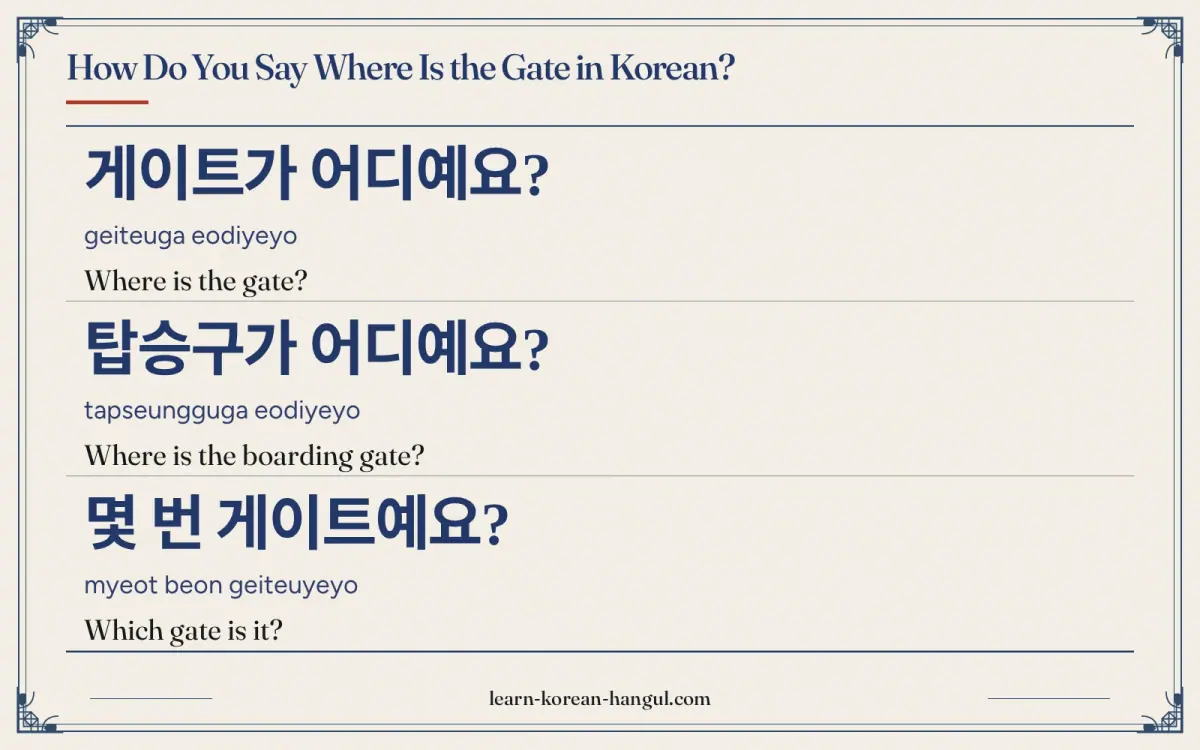
The standard question is 게이트가 어디예요?, and three partners cover the rest of a boarding routine. Learn all four, because a traveller needs a place, a number and a time.
| Situation | Korean | Revised Romanization | Meaning |
|---|---|---|---|
| Ask where the gate is | 게이트가 어디예요? | geiteuga eodiyeyo | Where is the gate? |
| Ask for the boarding gate | 탑승구가 어디예요? | tapseungguga eodiyeyo | Where is the boarding gate? |
| Ask the gate number | 몇 번 게이트예요? | myeot beon geiteuyeyo | Which gate is it? |
| Ask the boarding time | 탑승은 몇 시예요? | tapseungeun myeot siyeyo | What time is boarding? |
The word 어디 means "where", the particle 가 marks the gate as the subject, and 예요 is the polite "is". The word 탑승 combines 탑, "to ride", and 승, "to get on", so it means "boarding". The next section shows each form in a sentence.
What Are the Polite Ways to Say Where Is the Gate?
Every form below is polite or formal, because you almost always ask staff. Korean marks the listener with speech levels, the sentence endings explained in the guide to Korean speech levels. The ending -요 makes a sentence polite, and -ㅂ니까 makes a question formal.
Polite: 게이트가 어디예요? (geiteuga eodiyeyo)
Polite · 해요체This is the default. Use it with airline staff, security officers and information desks. Show your boarding pass, and the answer is usually a number and a direction.
저기요, 게이트가 어디예요?
jeogiyo, geiteuga eodiyeyo?
Excuse me, where is the gate?
Polite: 탑승구가 어디예요? (tapseungguga eodiyeyo)
Polite · 해요체탑승구 is the standard word on signs and announcements. It sounds a little more official than 게이트, and both are understood. Use it when the staff member speaks mostly Korean.
실례합니다, 탑승구가 어디예요?
sillyehamnida, tapseungguga eodiyeyo?
Excuse me, where is the boarding gate?
Polite: 몇 번 게이트예요? (myeot beon geiteuyeyo)
Polite · 해요체몇 번 asks for a number, and the answer is a Sino-Korean number plus 번. Use it when your ticket shows no gate yet, or when you want to confirm the number you heard.
제 비행기는 몇 번 게이트예요?
je bihaenggineun myeot beon geiteuyeyo?
Which gate is my flight?
Polite: 탑승은 몇 시예요? (tapseungeun myeot siyeyo)
Polite · 해요체The particle 은 marks 탑승 as the topic: "as for boarding, what time is it?". 몇 시 means "what time". Ask this when your pass shows a flight time but not the boarding time.
탑승은 몇 시예요?
tapseungeun myeot siyeyo?
What time is boarding?
Formal: 탑승구가 어디입니까? (tapseungguga eodiimnikka)
Formal · 합쇼체The formal question ending -ㅂ니까 suits an official counter or a group trip with a guide. It is correct, but stiff for a quick question at a gate.
실례합니다. 탑승구가 어디입니까?
sillyehamnida. tapseungguga eodiimnikka?
Excuse me. Where is the boarding gate? (formal)
Casual: 게이트 어디야? (geiteu eodiya)
Casual · 반말When you travel with a friend, drop -요 and say 어디야. Never use it with staff, strangers or elders.
야, 게이트 어디야?
ya, geiteu eodiya?
Hey, where's the gate?
Asking is only half of the exchange, so the next section covers what you will hear back.
What Will People Answer When You Ask?
Most replies give a number and a direction, so learn six. Staff often point as they speak.
| Korean | Revised Romanization | Meaning |
|---|---|---|
| 12번 게이트예요 | sibi beon geiteuyeyo | It's gate 12 |
| 저쪽으로 쭉 가세요 | jeojjogeuro jjuk gaseyo | Go straight over there |
| 에스컬레이터로 올라가세요 | eseukeolleiteoro ollagaseyo | Go up by the escalator |
| 보안 검색대를 지나세요 | boan geomsaekdaereul jinaseyo | Pass through security |
| 출국 심사 후에 있어요 | chulguk simsa hue isseoyo | It's after immigration |
| 30분 후에 탑승해요 | samsip bun hue tapseunghaeyo | Boarding is in 30 minutes |
Numbers are said with Sino-Korean words: 십이 for 12, and 번 follows. Knowing the answers prepares you for the sounds in the question itself.
How Do You Pronounce 게이트가 어디예요?
게이트가 어디예요? is pronounced [게이트가 어디예요], ge-i-teu-ga eo-di-ye-yo, in eight syllables. There is no hidden link, so you read it as it is written.
- 게 (ge): like "geh", with a soft g.
- 이 (i): "ee", said quickly so 게이 sounds almost like one syllable.
- 트 (teu): the vowel ㅡ is unrounded, with the lips flat, not "too".
- 가 (ga): "gah", with a soft g.
- 어디 (eodi): start with the open vowel ㅓ, like the "u" in "bus", then "dee".
- 예요 (yeyo): "yeh-yo", said lightly; many speakers say [에요] in everyday speech.
Sound Changes to Listen For
Four points matter in this family of questions:
- Tensing in 탑승구. A ㅅ after the batchim ㅂ is said tense, so 탑승구 sounds like [탑씅구]. The National Institute of Korean Language (국립국어원) Standard Pronunciation rules (표준 발음법) set this in Article 23. Revised Romanization writes tapseunggu, because it does not show tensing caused by a neighbouring sound. See Korean tensification.
- 탑승은 is [탑씅은]. The same tense ㅆ appears, and the ㅇ batchim of 승 stays in place, so there is no link to 은.
- 몇 시 is [멷씨]. The ㅊ of 몇 is said as ㄷ, and the ㅅ after it is tense.
- 몇 번 is [멷뻔]. The final ㄷ sound makes the ㅂ of 번 tense.
With the sounds in place, the next step is knowing when each form fits.
When Should You Use 게이트가 어디예요?, and When Should You Not?
Use 게이트가 어디예요? after check-in, when you need to find your way. Use 탑승은 몇 시예요? when you are unsure how long you have, and 몇 번 게이트예요? when the screen shows no gate yet.
Situations Where It Fits
- After check-in. Ask the desk staff while you hold your boarding pass.
- At security or immigration. An officer can tell you which direction to walk.
- In the departure hall. Information desks and airline counters give the quickest answer.
Situations to Avoid
- Asking a cleaner or a shop worker. They may not know current gate numbers; look for an information desk instead.
- Using the casual form. 게이트 어디야? is for friends only.
- Calling a gate 문. 문 means a door, and staff may point to the nearest door.
Real exchanges show how the questions chain together.
What Does Asking Where the Gate Is Sound Like in a Real Conversation?
Three exchanges cover the usual cases: finding the gate, checking the time and handling a gate change. Listen for the numbers.
Finding the Gate
Traveller
저기요, 게이트가 어디예요?
jeogiyo, geiteuga eodiyeyo?
Excuse me, where is the gate?
Staff
탑승권 좀 보여 주세요.
tapseunggwon jom boyeo juseyo
Please show me your boarding pass.
Staff
12번 게이트예요. 저쪽으로 쭉 가세요.
sibi beon geiteuyeyo. jeojjogeuro jjuk gaseyo
It's gate 12. Go straight over there.
Traveller
감사합니다.
gamsahamnida
Thank you.
What to notice: 보여 주세요 means "please show me", and the staff member asks for your pass before answering. The answer gives a number first and a direction second.
Checking the Boarding Time
Traveller
탑승은 몇 시예요?
tapseungeun myeot siyeyo?
What time is boarding?
Staff
두 시 반이에요. 30분 후에 탑승해요.
du si banieyo. samsip bun hue tapseunghaeyo
It's half past two. Boarding is in 30 minutes.
Traveller
알겠어요. 감사합니다.
algesseoyo. gamsahamnida
Got it. Thank you.
What to notice: clock hours use native Korean numbers, so two o'clock is 두 시, and 반 means "half". Minutes use Sino-Korean numbers, as in 30분.
Asking about a Gate Change
Traveller
게이트가 바뀌었어요?
geiteuga bakkwieosseoyo?
Did the gate change?
Staff
네, 20번 게이트로 바뀌었어요.
ne, isip beon geiteuro bakkwieosseoyo
Yes, it changed to gate 20.
Traveller
20번이요? 감사합니다.
isip beoniyo? gamsahamnida
Gate 20? Thank you.
What to notice: 바뀌었어요 is the past polite form of 바뀌다, "to change". Gate changes are common, so this question is useful. Airports also have habits worth knowing.
What Should You Know about the Culture behind Airport Gates?
Airports in Korea are large and well signed, and a few habits make a visit easier.
- Signs show English. Gate signs show Gate or 탑승구 together with the number, and screens list flights in Korean and English.
- Check the screen again. Gate numbers can change, so look at the screen before you walk a long way.
- Walking time. At some large airports, certain gates are in a separate building reached by a short shuttle train. Leave extra time and follow the signs.
- Announcements. Boarding calls give the flight, the gate and the rows. Listen for the gate number, which is said in Sino-Korean numbers.
An expert insight: airport staff are used to travellers, and a short polite question with a boarding pass in hand almost always gets a clear answer. The next section lists the mistakes that cause the most confusion.
What Mistakes Do Learners Make with Where Is the Gate in Korean?
Most mistakes come from picking the wrong noun or the wrong number system.
| Mistake | Why it is a problem | Fix |
|---|---|---|
| Saying 문 for the gate | 문 means a door | Say 게이트 or 탑승구 |
| Saying 입구 for the gate | 입구 means an entrance | Say 탑승구 |
| Reading 탑승구 as [탑승구] | The ㅅ should be tense | Say [탑씅구] |
| Using native numbers for gates | Gate numbers are Sino-Korean | Say 12번 as 십이 번 |
| Using 어디야 with staff | It is casual and abrupt | Say 어디예요 |
Learners often assume 어디 있어요? is wrong for a gate. In fact 게이트 어디 있어요? is also acceptable, though 어디예요 is the shorter and more direct choice. Several other English queries fold into this page.
Is It the Same as Gate, Boarding or Boarding Gate?
Mostly yes. Each English word maps onto a Korean word you can use in a question.
- Gate in Korean: 게이트 for the loanword, or 탑승구 for the official word. Both mean the same place.
- Boarding in Korean: 탑승 is the noun, and 탑승하다 is the verb: 탑승해요. A boarding pass is 탑승권.
- Boarding gate in Korean: 탑승구. Ask 탑승구가 어디예요?
- Where is the gate in Korean: 게이트가 어디예요? is the exact question.
Now practise the question until it feels automatic.
Practice: Say It Aloud
Play the slow clip of 게이트가 어디예요? three times and repeat it. Then choose a form for each situation. Answers follow.
- You are holding your boarding pass and ask where to go.
- Your pass shows no gate yet, and you ask the number.
- You want to know the boarding time.
- You are at an official counter and want the formal form.
Answers: 1. 게이트가 어디예요? 2. 몇 번 게이트예요? 3. 탑승은 몇 시예요? 4. 탑승구가 어디입니까?
Use the phrase flashcards to drill the question with audio.
Related Phrases to Learn Next
- Check in in Korean: 체크인 before you look for the gate.
- What time is it in Korean: 몇 시예요? for the clock.
- Take me to the airport in Korean: the phrase for the ride there.
This guide belongs to the Korean airport phrases collection. What this page does not cover: security and immigration vocabulary and the full set of flight announcements, which deserve their own lessons. Master the four questions above, and you can say where is the gate in Korean in any airport.
Frequently Asked Questions
How do you say where is the gate in Korean?
Say 게이트가 어디예요? (geiteuga eodiyeyo). 게이트 is the English word written in Hangul, and 어디예요 means "where is it". The ending -요 makes the sentence polite, so it suits airline staff. For the official word, ask 탑승구가 어디예요?, which means "where is the boarding gate".
How do you pronounce 게이트가 어디예요?
It sounds like ge-i-teu-ga eo-di-ye-yo, with eight syllables and no sound change, so you read it as written. The vowel in 트 is ㅡ, said with flat lips, not "too". The first two syllables, 게이, blend into a quick "geh-ee". Say the last two syllables lightly.
What is the difference between 게이트가 어디예요? and 탑승구가 어디예요?
Both ask where the gate is, and both are polite. 게이트 is the borrowed English word and is heard every day, while 탑승구 is the Korean word used on signs and announcements. Staff understand both. Use 탑승구 if you want to sound slightly more formal, and note that it is pronounced [탑씅구].
Can I use 게이트가 어디예요? with friends, elders and strangers?
Yes for strangers and elders, because the ending -요 is polite. With a close friend you can drop it and say 게이트 어디야?. At an official counter, the formal 탑승구가 어디입니까? is also fine. Avoid the casual form with staff and with anyone you do not know well.
What is the most common mistake with where is the gate in Korean?
Saying 문 for the gate. 문 means a door, so a staff member may point at the nearest door instead of your gate. Use 게이트 or 탑승구. The second most common mistake is using native Korean numbers for gate numbers, which take Sino-Korean numbers plus 번.