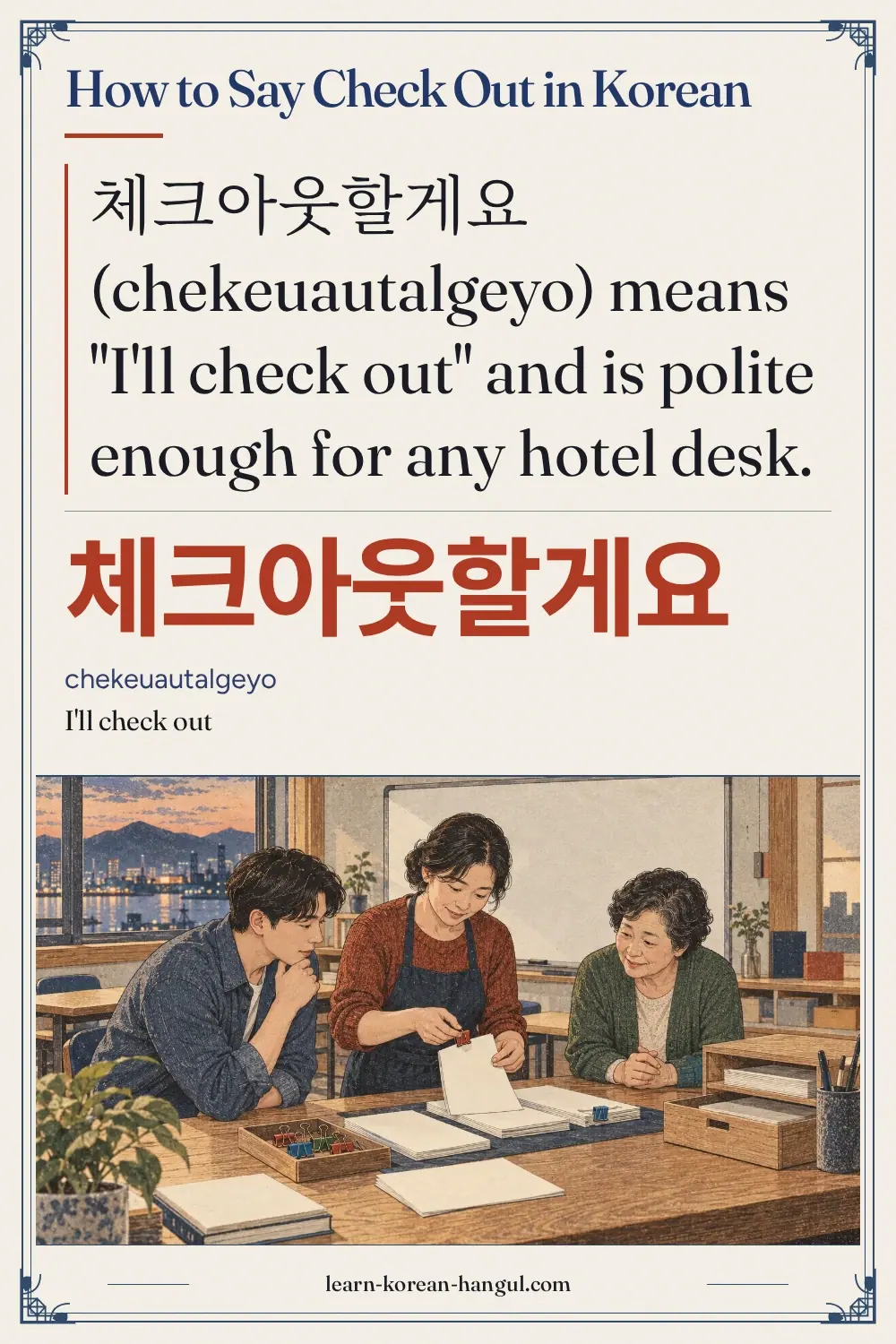
체크아웃할게요
체크아웃할게요
What you'll learn
- Say 체크아웃할게요, 몇 시까지 체크아웃이에요? and 짐을 맡길 수 있어요? at a front desk.
- Ask for late check-out with 늦게 체크아웃할 수 있어요?
- Pronounce 체크아웃할게요 as [체크아우탈께요], with an aspirated ㅌ and a tense 께.
- Avoid using 나가요 (I'm going out) when you mean check out.
Before you start: the arrival comes first, so see check in in Korean if you have not learned the opening lines. Time: about 12 minutes. Audio plays only when you press a button.
How Do You Say Check out in Korean?
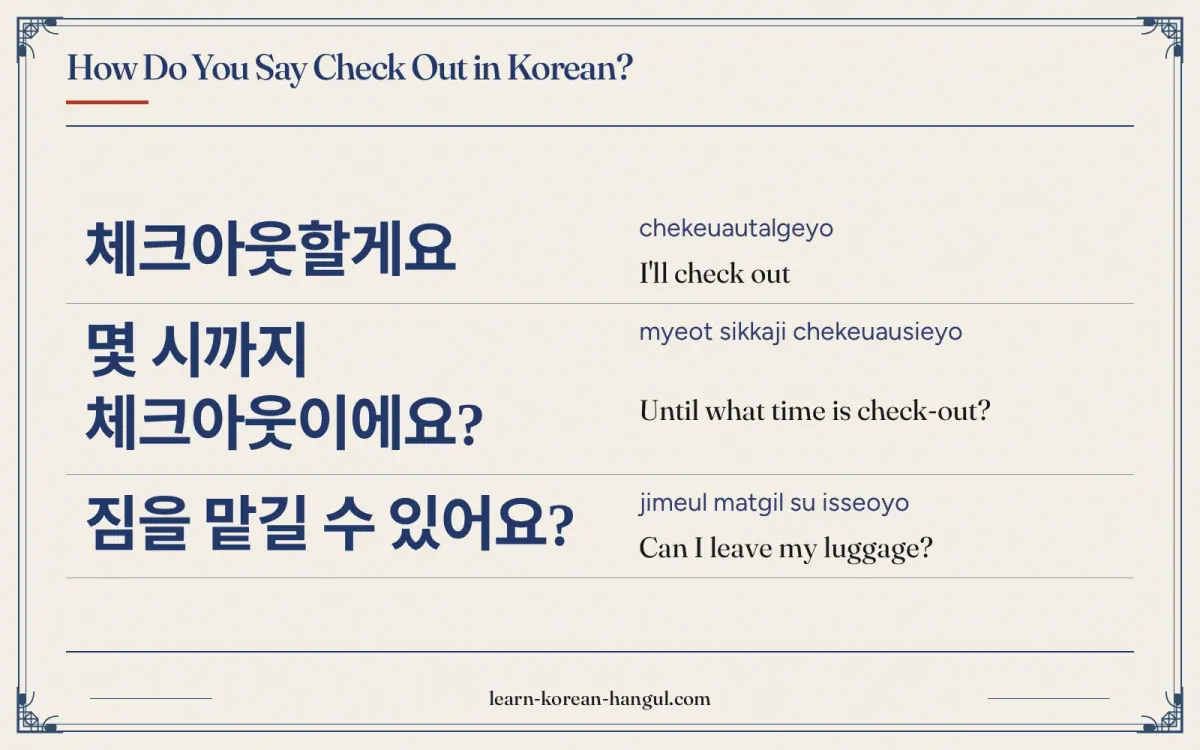
The standard way to check out in Korean is 체크아웃할게요. The loanword 체크아웃 (chekeuaut) comes from English "check-out". The verb 체크아웃하다 means "to check out", and the ending -ㄹ게요 means "I will". So the sentence is a polite announcement: "I'll check out now".
| Korean | Romanization | Meaning | Where you hear it |
|---|---|---|---|
| 체크아웃할게요 | chekeuautalgeyo | I'll check out | Handing in the key |
| 몇 시까지 체크아웃이에요? | myeot sikkaji chekeuausieyo | Until what time is check-out? | Asking the deadline |
| 짐을 맡길 수 있어요? | jimeul matgil su isseoyo | Can I leave my luggage? | After check-out |
| 늦게 체크아웃할 수 있어요? | neutge chekeuautal su isseoyo | Can I check out late? | Asking for extra time |
Revised Romanization (the South Korean government standard of 2000) is only a reading aid here. Learn the Hangul first. The next section shows how each line fits the end of a stay.
What Are the Polite Ways to Say Check Out?
Hotel Korean is polite from start to finish. Guests and staff both use the 요 or 습니다 style, as explained in Korean speech levels. The lines below follow the order of a normal departure.
Polite: 체크아웃할게요 (chekeuautalgeyo)
Polite · 해요체체크아웃할게요 is the main line. Say it when you reach the desk with your key or key card. The ending -ㄹ게요 makes a promise or an announcement, so it fits a plan that you control. Staff will usually answer with a thank-you.
안녕하세요. 체크아웃할게요. 키 여기 있어요.
annyeonghaseyo. chekeuautalgeyo. ki yeogi isseoyo
Hello. I'll check out. Here is the key.
Polite: 몇 시까지 체크아웃이에요? (myeot sikkaji chekeuausieyo)
Polite · 해요체몇 시까지 체크아웃이에요? asks about the deadline. 몇 시 means "what time", 까지 means "until", and 이에요 means "it is". It is a wh-question, so the pitch does not rise sharply at the end.
저기요, 몇 시까지 체크아웃이에요?
jeogiyo, myeot sikkaji chekeuausieyo
Excuse me, until what time is check-out?
Polite: 짐을 맡길 수 있어요? (jimeul matgil su isseoyo)
Polite · 해요체짐을 맡길 수 있어요? asks the hotel to keep your bags. 맡기다 means to entrust something to someone for safekeeping, and -ㄹ 수 있어요 means "can". It is a yes-or-no question, so it ends with a rise.
체크아웃하고 짐을 맡길 수 있어요?
chekeuautago jimeul matgil su isseoyo
Can I leave my luggage after I check out?
Polite: 늦게 체크아웃할 수 있어요? (neutge chekeuautal su isseoyo)
Polite · 해요체늦게 체크아웃할 수 있어요? is the late check-out request. 늦게 means "late" as an adverb. Ask the desk before the check-out time, because late check-out may cost extra at some hotels.
늦게 체크아웃할 수 있어요?
neutge chekeuautal su isseoyo
Can I check out late?
Four lines cover most departures: announce, ask the time, store the bags, or ask for more time. The next section shows how to say them.
How Do You Pronounce 체크아웃할게요?
체크아웃할게요 is pronounced [체크아우탈께요], in seven syllables. The sound changes happen in the middle and the end, so go slowly.
- 체 (che): an aspirated ch and the vowel ㅔ.
- 크 (keu): an aspirated k and the flat ㅡ vowel, with the lips spread.
- 아 (a) and 우 (u): two short vowels, spoken one after the other.
- 탈 (tal): the ㅅ at the end of 웃 and the ㅎ of 할 merge into an aspirated ㅌ, so you hear [우탈].
- 께 (kke): the ㄱ of 게 is tense after the ending -ㄹ.
- 요 (yo): a short, light ending.
Sound Changes to Listen For
- ㅅ + ㅎ = ㅌ. The ㅅ at the end of 웃 is spoken as ㄷ, and ㄷ meets ㅎ in 할, so they merge into ㅌ: [체크아우탈]. Revised Romanization shows this in verbs and writes chekeuautalgeyo.
- Tense ㄱ after -ㄹ. After an ending that finishes in -ㄹ, a plain ㄱ becomes tense (Standard Pronunciation Rules, Article 27). That makes 게요 sound like 께요. Revised Romanization does not show this change. See Korean tensification for the full rule.
- Time words. 몇 시까지 is pronounced [멷씨까지]. The ㅊ at the end of 몇 is spoken as ㄷ, and the ㅅ of 시 becomes tense.
- Luggage. 맡길 is pronounced [맏낄], and 짐을 맡길 수 is spoken [지믈 맏낄쑤]. The final ㅌ becomes ㄷ, the ㄱ is tense, and the ㅅ of 수 is tense after -ㄹ.
A common slip is to say the ending as "-hal-geyo" with a plain g. Use the tense 께 and the aspirated 탈, and the word sounds natural. Once the sound is smooth, the next question is when each line fits.
When Should You Use 체크아웃할게요, and When Should You Not?
Use 체크아웃할게요 when you hand in the key. Use 몇 시까지 체크아웃이에요? before the morning of departure, so you know the deadline. Use 짐을 맡길 수 있어요? when your flight is later than check-out time. The lines work in a hotel, a guesthouse or a resort.
Situations Where It Fits
- The morning of departure. Go to the desk, say 체크아웃할게요 and return the key.
- A late flight. After check-out, ask 짐을 맡길 수 있어요? so you can explore with free hands.
- An early question. The night before, ask 몇 시까지 체크아웃이에요? to plan the morning.
Situations to Avoid
- 나가요 for check out. 나가요 means "I'm going out", which is not the same as checking out.
- Casual forms with staff. 체크아웃할게 is for a friend, not a front desk.
- Leaving bags without asking. 짐을 두고 가요 means you leave things behind. Use 맡기다 to ask for safekeeping.
Three short scenes show the lines in context.
What Does Check out Sound Like in a Real Conversation?
Check-out is short. Listen for the key, the time and the thank-you.
At the Front Desk
Guest
안녕하세요. 체크아웃할게요. 키 여기 있어요.
annyeonghaseyo. chekeuautalgeyo. ki yeogi isseoyo
Hello. I'll check out. Here is the key.
Staff
네, 이용해 주셔서 감사합니다.
ne, iyonghae jusyeoseo gamsahamnida
Yes, thank you for staying with us.
What to notice: The staff use 주셔서, the honorific of 주다, to thank the guest. The guest does not need to answer in the same style.
Asking the Deadline
Guest
저기요, 몇 시까지 체크아웃이에요?
jeogiyo, myeot sikkaji chekeuausieyo
Excuse me, until what time is check-out?
Staff
열한 시까지예요.
yeolhan sikkajiyeyo
It's until eleven o'clock.
What to notice: The time here is only an example, and each hotel sets its own. In the staff answer 열한 시까지예요, the standard pronunciation keeps the ㅎ, [열한 시까지예요], but in everyday speech it is often weakened to [여란 시까지예요]. Revised Romanization follows the standard and writes yeolhan sikkajiyeyo.
Asking for Late Check-Out
Guest
늦게 체크아웃할 수 있어요?
neutge chekeuautal su isseoyo
Can I check out late?
Staff
네, 확인해 볼게요. 잠깐 기다려 주세요.
ne, hwaginhae bolgeyo. jamkkan gidaryeo juseyo
Yes, I'll check. Please wait a moment.
What to notice: The guest's question rises at the end because it is a yes-or-no question. 볼게요 is spoken [볼께요] with a tense 께.
What Should You Know about the Culture behind Check Out?
Check-out follows a few habits. These are general, and each hotel sets its own rules.
- Morning deadline. Many hotels set check-out in the morning, often around 11 a.m. or noon. Guesthouses also have fixed times, so check your booking.
- Late check-out. Some hotels allow it for a fee or at no cost, depending on the room and the day. Ask the day before.
- Luggage storage. Many hotels keep guests' bags after check-out. The sign for this service is often 짐 보관 (jim bogwan).
- Signs. Notices in the room often use the formal word 퇴실 (toesil), which means leaving the room. 퇴실 시간 is "check-out time".
An expert tip: the verb for leaving bags is 맡기다, not 놓다 or 두다. Those verbs mean to put down or to leave something behind, so on their own they do not ask anyone to look after the bag. For the ride that follows, see take me to the airport in Korean, and for the internet question that often comes first, see wifi password in Korean.
What Mistakes Do Learners Make with Check out in Korean?
Most errors at the desk come from a wrong verb or from the sound changes in the long verb.
| Mistake | Why it is a problem | Fix |
|---|---|---|
| Using 나가요 for check out | It only means going out | Say 체크아웃할게요 |
| Saying 체크아웃 in one beat | Korean spreads it over four syllables | Say 체-크-아-웃 |
| Using only 두고 가요 for leaving luggage | It says you are leaving it, not asking the hotel to keep it | Use 맡기다: 짐을 맡길 수 있어요? |
| Saying the ㅅ and ㅎ separately | The sound is a merged ㅌ | Say [체크아우탈께요] |
| Using casual 체크아웃할게 with staff | It sounds like speech to a friend | Add 요: 체크아웃할게요 |
Learners often think the English word "check out" works for everything. In Korean, 체크아웃 only means leaving a hotel. To "check something out" in the sense of looking, use 한번 보세요 or 확인해 보세요.
Is It the Same as Checkout, Late Checkout or Leave Luggage?
Mostly yes. The searches below point to the same lines, with small differences.
- Checkout in Korean: 체크아웃, written as one word in Korean.
- Late checkout in Korean: 늦게 체크아웃할 수 있어요?, as above.
- Leave luggage in Korean: 짐을 맡길 수 있어요? The service name on signs is 짐 보관 (jim bogwan, luggage storage).
Practice: Say It Aloud
Play the slow clip and repeat 체크아웃할게요 three times. Then choose the best line for each scene. Answers follow.
- You reach the desk and hand in the key.
- You need to know the deadline.
- Your flight is in the evening.
- How is 체크아웃할게요 pronounced?
Answers
- 체크아웃할게요. 키 여기 있어요.
- 몇 시까지 체크아웃이에요?
- 짐을 맡길 수 있어요?
- [체크아우탈께요]: ㅅ and ㅎ merge into ㅌ, and 게 becomes tense after -ㄹ.
The phrase flashcards drill these lines with audio.
Related Phrases to Learn Next
Checking out connects to other hotel and travel phrases.
- check in in Korean: what to say when you arrive.
- wifi password in Korean: a common request during the stay.
- take me to the airport in Korean: the next step after check-out.
This guide belongs to the korean hotel phrases collection. What this page does not cover: paying the bill, resolving charges and hotel complaints. Learn the announcement, the deadline question and the luggage line, and you can check out in Korean at any hotel.
Frequently Asked Questions
How do you say check out in Korean?
Say 체크아웃할게요 (chekeuautalgeyo) for "I'll check out" and hand over your key. To ask the deadline, say 몇 시까지 체크아웃이에요?. To store bags, say 짐을 맡길 수 있어요?. These lines are polite and fit every hotel, guesthouse and resort.
How do you pronounce 체크아웃할게요?
Say che-keu-a-u-tal-ge-yo. The ㅅ at the end of 웃 merges with the ㅎ of 할 and becomes an aspirated ㅌ, giving [체크아우탈께요]. The ㄱ of 게 is tense after -ㄹ. Revised Romanization writes chekeuautalgeyo. Play the slow clip and repeat it a few times.
What is the difference between 체크아웃할게요 and 몇 시까지 체크아웃이에요?
체크아웃할게요 announces that you are leaving now. 몇 시까지 체크아웃이에요? asks for the deadline. Use the question the night before, and use the announcement at the desk on the morning of departure. Both are polite and both fit any hotel.
Can I use 체크아웃할게요 with friends, elders and strangers?
Yes with strangers and staff. The line is polite and also fits elders. With close friends you would not use it, because you check out at a desk, not with a friend. For a casual version, drop the 요 and say 체크아웃할게. Hotel staff expect the polite form.
Can I ask for late check-out in Korean?
Yes. Say 늦게 체크아웃할 수 있어요?, which means "Can I check out late?". Ask before the normal check-out time and be ready for the answer to depend on the hotel. Some hotels allow it at no cost, and others charge a fee, so listen for 요금 (yogeum, fee).
What is the most common mistake with check out in Korean?
Using 나가요, which means "I'm going out", instead of 체크아웃할게요. The staff may not realise you are leaving the hotel. A second slip is saying only 두고 가요 about your luggage, which states that you are leaving it but does not ask anyone to keep it. Use 맡기다 to ask the hotel to keep your bags.