카드 돼요?
카드 돼요?
What you'll learn
- Ask 카드 돼요? and 카드로 결제할 수 있어요? at a counter.
- Check for cash only with 현금만 되나요? and ask for a receipt with 영수증 주세요.
- Spell 돼요 correctly and avoid 되요.
- Pronounce 결제할 수 as [결제할쑤].
Before you start: the endings below follow the levels explained in Korean speech levels. The price comes first, as in how much is it in Korean. Time: about 12 minutes. Audio plays only when you press a button.
How Do You Say Do You Take Cards in Korean?
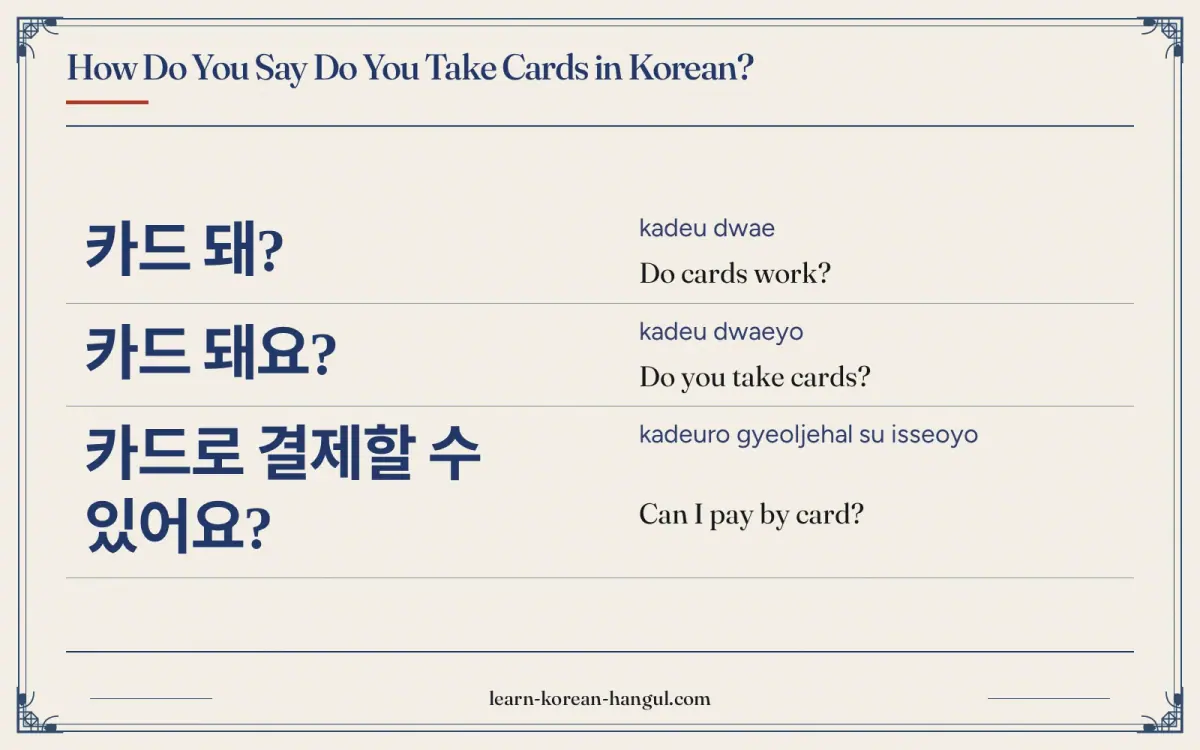
The standard way to say do you take cards in Korean is 카드 돼요?, from 카드 (card) and 돼요 (it works, it is okay). The sentence has no verb for "pay" or "take", which is normal in spoken Korean. The table shows the choices.
| Listener | Korean | Romanization | Meaning |
|---|---|---|---|
| Friend, family shop | 카드 돼? | kadeu dwae | Do cards work? |
| Cashier, shop owner | 카드 돼요? | kadeu dwaeyo | Do you take cards? |
| Fuller question | 카드로 결제할 수 있어요? | kadeuro gyeoljehal su isseoyo | Can I pay by card? |
| Formal setting | 카드 됩니까? | kadeu doemnikka | Do you accept cards? |
| Checking for cash only | 현금만 되나요? | hyeongeumman doenayo | Is it cash only? |
Revised Romanization (the South Korean government standard of 2000) is a reading aid here. Learn the Hangul first. The next section explains each phrase.
What Are the Polite Ways to Say Do You Take Cards?
Do you take cards has four useful phrases, and all of them are polite. They cover the question, the fuller version, the check for cash and the receipt.
Polite: 카드 돼요? (kadeu dwaeyo)
Polite · 해요체카드 돼요? is the quick question. It is a yes or no question, so the pitch rises on the last syllable. Ask it before you order or at the counter, when you see no card sign.
저기요, 카드 돼요?
jeogiyo, kadeu dwaeyo
Excuse me, do you take cards?
For a formal place, the question becomes 카드 됩니까?, and with friends it becomes 카드 돼?
Polite: 카드로 결제할 수 있어요? (kadeuro gyeoljehal su isseoyo)
Polite · 해요체카드로 결제할 수 있어요? means "is it possible to pay by card?". 카드로 marks the tool ("with a card"), 결제하다 means to make a payment, and -(으)ㄹ 수 있다 means "can". Add 일시불로 할게요 ("I will pay in one payment") when the cashier asks how.
카드로 결제할 수 있어요? 일시불로 할게요.
kadeuro gyeoljehal su isseoyo? ilsibullo halgeyo
Can I pay by card? I will pay in one payment.
Polite: 현금만 되나요? (hyeongeumman doenayo)
Polite · 해요체현금만 되나요? checks whether a shop takes cash only. 현금 means cash, 만 means "only", and the ending -나요 is a soft, polite question ending. It sounds a little more careful than -어요.
현금만 되나요? 카드를 안 가져왔어요.
hyeongeumman doenayo? kadeureul an gajyeowasseoyo
Is it cash only? I did not bring my card.
Polite: 영수증 주세요 (yeongsujeung juseyo)
Polite · 해요체영수증 주세요 asks for a receipt. It is a request, so the pitch does not rise. Ask for it right after you pay, because many cashiers print a receipt only on request.
영수증 주세요. 카드로 했어요.
yeongsujeung juseyo. kadeuro haesseoyo
Receipt, please. I paid by card.
Four phrases cover most payments. The next section explains a spelling trap and the sounds.
Is It 돼요 or 되요?
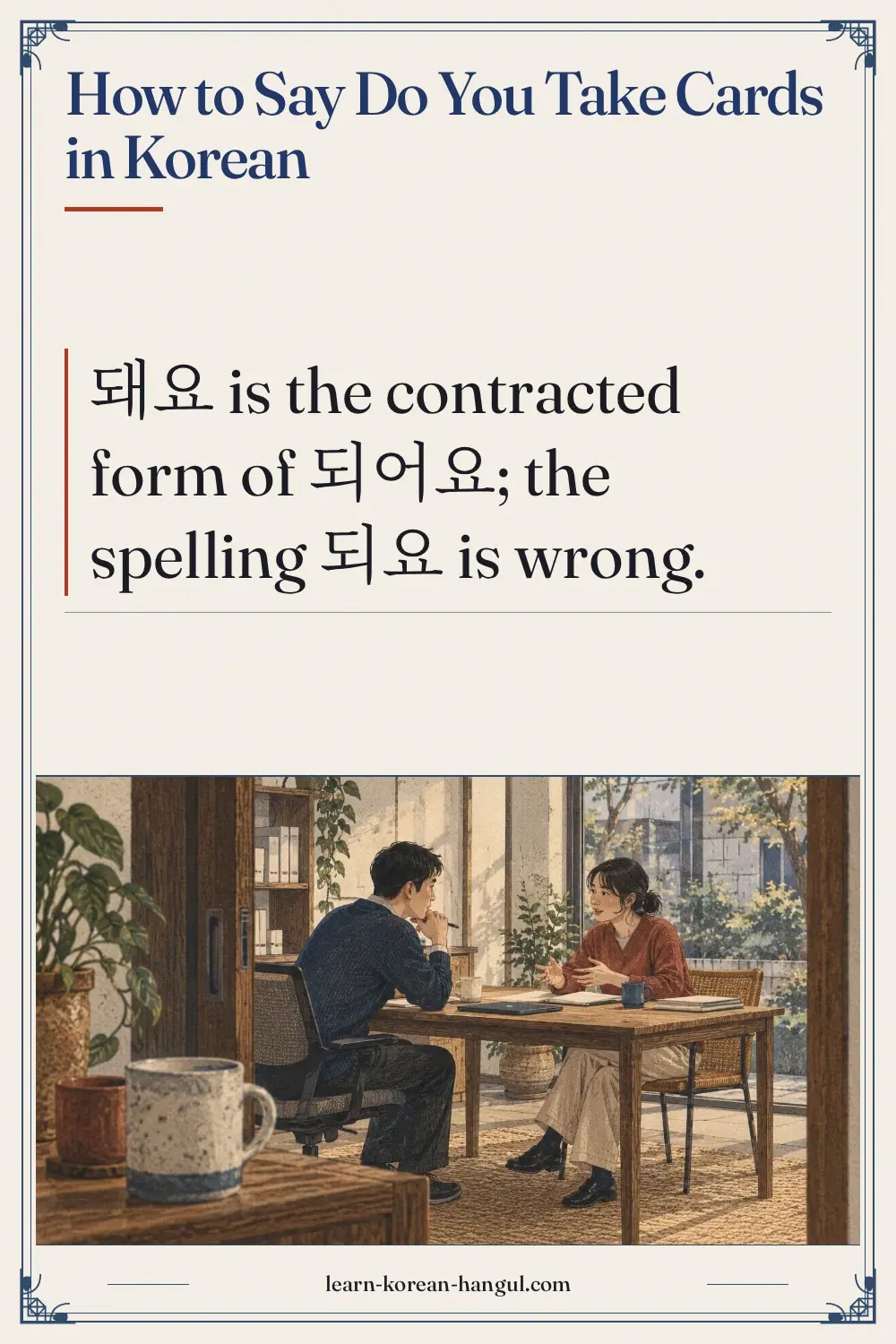
The correct spelling is 돼요. It is the contracted form of 되어요, where 되 and 어 merge into 돼. The spelling 되요 is a very common error, because 되 and 돼 sound almost the same in speech.
A quick test is to try 하 and 해 in the same spot. Where 해요 would fit, write 돼요, because 해 and 돼 both come from a contraction with 어. Where 하세요 would fit, write 되세요. The same test works for 안 돼요 ("it doesn't work") and 돼요? ("is it okay?").
| Spelling | Status | Example |
|---|---|---|
| 돼요 | correct | 카드 돼요? |
| 되요 | incorrect | 카드 되요? |
| 됩니다 | correct (formal) | 카드 됩니다 |
How Do You Pronounce 카드 돼요?
카드 돼요? is pronounced [카드 돼요], ka-deu dwae-yo, in four syllables. The question mark in writing matches a rising pitch in speech.
- 카 (ka): a breathy, aspirated "ka".
- 드 (deu): a short "deu", with the lips unrounded.
- 돼 (dwae): "dweh", gliding from "d" through "w" to "eh".
- 요 (yo): a short "yo", with the pitch rising for a question.
Sound Changes to Listen For
Three features shape this phrase and its relatives:
- ㅙ and ㅚ sound alike. Most Seoul speakers say 돼 and 되 the same way, close to "dweh", so only the spelling separates them. Spelling follows grammar, not sound.
- Tense ㅅ after -(으)ㄹ. In 결제할 수, the ㅅ of 수 turns tense after the ㄹ ending, so it is [결제할쑤]. The rule is covered in Korean tensification. Revised Romanization does not show tensing caused by a neighbouring sound, so it writes gyeoljehal su.
- Liaison in 있어요. The ㅆ of 있 moves onto the next vowel, so 있어요 is [이써요].
Say [카드 돼요] with the rising tone, and then the longer question slowly. The right words also depend on what the shop expects.
When Should You Use 카드 돼요?, and When Should You Not?
Use 카드 돼요? when you are unsure about payment, and skip it when you see a card sign or a terminal. Cards are common, but they are not universal.
Situations Where It Fits
- A small shop or café. 카드 돼요? before you order.
- A market stall. 현금만 되나요? to check for cash only.
- A taxi or a small restaurant. 카드 돼요? before you start the ride or the meal.
- At the counter. 카드로 결제할 수 있어요? before you pay.
Situations to Avoid
- Chain stores with a card sign. The sign answers the question, so no question is needed.
- A shop owner you do not know, with 카드 돼? The casual form is too familiar.
- After you have paid. Ask for 영수증 주세요 instead.
The replies are short. The table shows the most common ones.
| Reply | Korean | Meaning |
|---|---|---|
| Yes | 네, 돼요 | Yes, it works |
| No | 카드는 안 돼요 | No cards |
| Cash only | 현금만 돼요 | Cash only |
| One payment? | 일시불로 해 드릴까요? | Shall I do it as one payment? |
Three short dialogues show how a payment sounds.
What Does Do You Take Cards Sound Like in a Real Conversation?
A card payment usually takes three lines: the question, the answer and a short confirmation. Listen for the rising tone on the question and the falling tone on the answer.
At a Small Shop
Customer
카드 돼요?
kadeu dwaeyo
Do you take cards?
Clerk
네, 돼요. 일시불로 해 드릴까요?
ne, dwaeyo. ilsibullo hae deurilkkayo
Yes. Shall I do it as one payment?
Customer
네, 일시불이요.
ne, ilsiburiyo
Yes, one payment.
What to notice: 일시불 (one payment) is the opposite of 할부 (installments), and the clerk offers the choice.
A Cash-Friendly Stall
Customer
현금만 되나요?
hyeongeumman doenayo
Is it cash only?
Vendor
네, 현금만 돼요. 계좌이체도 돼요.
ne, hyeongeumman dwaeyo. gyejwaichedo dwaeyo
Yes, cash only. Bank transfer works too.
Customer
계좌이체로 할게요.
gyejwaichero halgeyo
I'll pay by bank transfer.
What to notice: the vendor says 돼요 for what works, and 할게요 ([할께요]) is the customer's decision.
Paying and Asking for the Receipt
Customer
카드로 결제할 수 있어요?
kadeuro gyeoljehal su isseoyo
Can I pay by card?
Clerk
네, 여기에 카드를 대 주세요.
ne, yeogie kadeureul dae juseyo
Yes, please tap your card here.
Customer
영수증도 주세요.
yeongsujeungdo juseyo
A receipt too, please.
Clerk
네, 여기 있어요.
ne, yeogi isseoyo
Sure, here you are.
What to notice: 도 ("too") adds the receipt to the payment, and 여기 있어요 means "here you are".
What Should You Know about the Culture behind Do You Take Cards?
Cards are common in Korea, and the habits around payment are specific. The points below are typical, not universal.
- Cards almost everywhere. Most shops, cafés and restaurants accept cards, even for small amounts.
- Cash still appears. Some street food stalls and traditional market vendors prefer cash or a bank transfer (계좌이체, gyejwaiche).
- One payment or installments. When you pay by card, the cashier may ask 일시불 (one payment) or 할부 (installments). 일시불로 해 주세요 is the usual answer.
- Receipts on request. Many cashiers ask 영수증 드릴까요? ("shall I give you a receipt?"), or wait for you to ask.
An expert insight: Korean says 돼요 for anything that works or is allowed, so 카드 돼요? and 사진 돼요? ("may I take photos?") share the same pattern. The mistakes below come from missing that pattern.
What Mistakes Do Learners Make with Do You Take Cards in Korean?
Most mistakes come from spelling and from word choice.
| Mistake | Why it is a problem | Fix |
|---|---|---|
| Writing 되요 | Wrong contraction | Write 돼요 |
| 카드 있어요? | Asks "do you have a card?" | Say 카드 돼요? |
| Flat tone on 돼요 | Sounds like "cards work" | Raise the last syllable |
| 카드 주세요 | Means "give me a card" | Say 카드로 할게요 for "I'll pay by card" |
| Saying [결제할수] with a plain ㅅ | Misses the tense sound | Say [결제할쑤] |
Learners often assume 되다 and 하다 are interchangeable, but 되다 means "to become, to work" and 하다 means "to do", so 카드 돼요? is a question about the card, not about an action.
Is It the Same as Pay by Card, Credit Card, Cash and Accept Cards in Korean?
Not exactly. Each search points to a nearby phrase, and the short answers below separate them. The page on cash in Korean covers the word 현금 in depth.
- Pay by card in Korean: 카드로 결제할 수 있어요? or 카드로 할게요.
- Credit card in Korean: 신용카드 (sinyongkadeu), and 체크카드 (chekeukadeu) for a debit card.
- Cash in Korean: 현금 (hyeongeum), as in 현금만 되나요?
- Accept cards in Korean: 카드 받아요? (kadeu badayo), a very close alternative to 카드 돼요?
- Can I pay by card in Korean: 카드로 해도 돼요? (kadeuro haedo dwaeyo).
Now practise the question with your own voice.
Practice: Say It Aloud
Play the slow clip and repeat 카드 돼요? three times, raising the last syllable. Then choose the right phrase. Answers follow.
- You are at a café and want to know if you can pay by card.
- You are at a market stall and suspect it is cash only.
- You just paid and want a receipt.
- Which spelling is correct, 돼요 or 되요?
Answers
- 카드 돼요?
- 현금만 되나요?
- 영수증 주세요.
- 돼요
The phrase flashcards drill these phrases with audio.
Related Phrases to Learn Next
Do you take cards connects to the phrases for paying and bargaining.
- How much is it in Korean: the question that comes first.
- Receipt please in Korean: the full lesson on asking for a receipt.
- Discount please in Korean: the request that comes before you pay at a market.
This guide belongs to the Korean shopping phrases collection. What this page does not cover: mobile payments and refunds. Ask 카드 돼요? with a rising tone, and spell it with 돼, and you can say do you take cards in Korean at any counter.
Frequently Asked Questions
How do you say do you take cards in Korean?
Say 카드 돼요? (kadeu dwaeyo) with a rising tone. For a fuller question, say 카드로 결제할 수 있어요?, which means "can I pay by card?". To check for cash only, say 현금만 되나요? A cashier may answer 네, 돼요 for yes or 카드는 안 돼요 for no.
How do you pronounce 카드 돼요?
Say ka-deu dwae-yo, written [카드 돼요]. The vowel in 돼 sounds like "weh". Most Seoul speakers pronounce ㅚ, ㅙ and ㅞ alike, so only the spelling separates 돼요 from 되요. Raise your pitch on the last syllable to make it a question, and keep 카드 short.
What is the difference between 카드 돼요? and 카드로 결제할 수 있어요?
카드 돼요? is short and everyday, and it is what people say at a counter. 카드로 결제할 수 있어요? says "can I make a payment with a card?" and sounds a little more complete and formal. Both are polite, and a cashier will understand either one.
Can I use 카드 돼요? with friends, elders and strangers?
Yes, with cashiers and shop owners of any age, because it is polite. With friends, you could say the casual 카드 돼? For a formal setting, such as a hotel desk, use 카드 됩니까? or 카드로 결제할 수 있습니까? The polite form is the safe choice nearly everywhere.
Is it 돼요 or 되요?
The correct spelling is 돼요. It comes from 되어요, which contracts to 돼요. The spelling 되요 is a common mistake, because 되 and 돼 sound alike. A quick check is to try 하 and 해 in the same spot: where 해요 would fit, write 돼요, and where 하세요 would fit, write 되세요.
What is the most common mistake with do you take cards in Korean?
Writing 되요 instead of 돼요. Another is saying 카드 있어요?, which asks whether you or they have a card, not whether cards are accepted. A third is a flat tone, which makes the question sound like a statement.