영수증 주세요
영수증 주세요
What you'll learn
- Say 영수증 주세요 aloud and ask a cashier for a receipt.
- Answer the cashier's question 영수증 드릴까요? with a yes or a polite no.
- Explain what a 현금영수증 (cash receipt) is and when shops offer it.
- Hear why 필요 없어요 is pronounced [피료 업써요].
Before you start: knowing how much is it in Korean helps, because you ask the price before you pay. Time: about 10 minutes. Audio plays only when you press a button.
How Do You Say Receipt Please in Korean?
The standard way to say receipt please in Korean is 영수증 주세요. 영수증 (yeongsujeung) is the paper or digital proof of payment, and 주세요 is the polite way to ask for something. Add 같이 (gachi, together) as in 영수증도 같이 주세요 if you want the receipt with your goods. The same word is used for restaurants, shops and taxis. For the receipt itself as a vocabulary word, see receipt in korean.
| Form | Romanization | Register | Say it to |
|---|---|---|---|
| 영수증 주세요 | yeongsujeung juseyo | Polite (해요체) | Cashiers, restaurant staff and drivers |
| 영수증 필요 없어요 | yeongsujeung piryo eopseoyo | Polite (해요체) | Anyone, to refuse a receipt |
| 현금영수증 해 주세요 | hyeongeumnyeongsujeung hae juseyo | Polite (해요체) | Cashiers, when you pay in cash |
| 영수증 부탁드립니다 | yeongsujeung butakdeurimnida | Formal (합쇼체) | Hotels, offices and written requests |
| 영수증 줘 | yeongsujeung jwo | Casual (해체) | Close friends and family only |
Everything you say to staff is polite, so you can use the same ending in every shop. The next section takes the three most useful forms one by one.
What Are the Polite Ways to Say Receipt Please?
Receipt please follows the Korean speech levels, explained in the guide to Korean speech levels. At a shop the politeness stays the same, so the choice depends on what you want to happen to the receipt: take it, refuse it or register it as a cash receipt.
Polite: 영수증 주세요 (yeongsujeung juseyo)
Polite · 해요체영수증 주세요 is the basic request. It has no verb besides 주세요, because 주다 (to give) is enough: "please give me the receipt". Use it after you pay, or while you pay at the register. The staff may answer 여기 있습니다 (here you are).
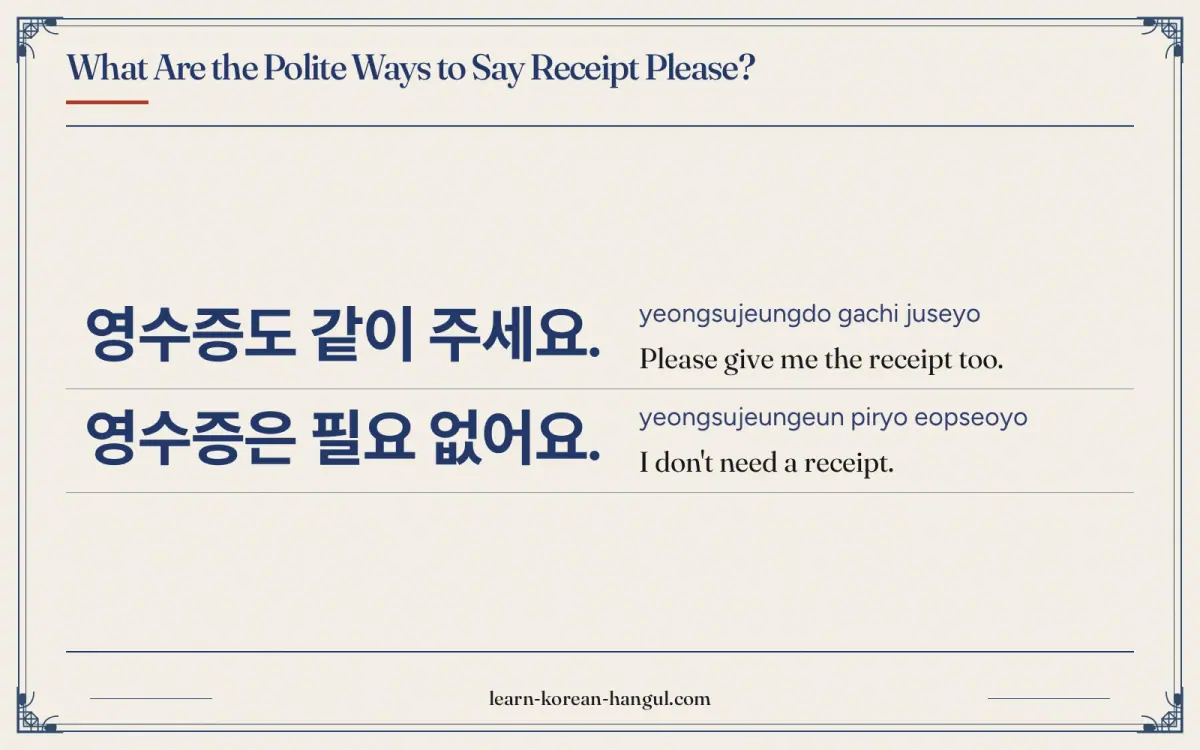
영수증도 같이 주세요.
yeongsujeungdo gachi juseyo
Please give me the receipt too.
Polite: 영수증 필요 없어요 (yeongsujeung piryo eopseoyo)
Polite · 해요체필요 (piryo) means need and 없어요 (eopseoyo) means there is none, so the phrase says "a receipt is not needed". It is the neutral refusal. The softer 괜찮아요 (gwaenchanayo, it's fine) also works when the cashier asks if you want one.
영수증은 필요 없어요.
yeongsujeungeun piryo eopseoyo
I don't need a receipt.
Polite: 현금영수증 해 주세요 (hyeongeumnyeongsujeung hae juseyo)
Polite · 해요체현금 (hyeongeum) means cash, and 현금영수증 is a cash receipt that is registered for tax purposes. 해 주세요 means "please do it for me". Say it when you pay in cash. The cashier will ask for a phone number or a card number to register it, so have one ready.
현금으로 낼게요. 현금영수증 해 주세요.
hyeongeumeuro naelgeyo. hyeongeumnyeongsujeung hae juseyo
I'll pay in cash. A cash receipt, please.
Receipt phrases are short and quick, so the sounds matter, and they come next.
How Do You Pronounce 영수증 주세요?
영수증 주세요 is written with six syllables and pronounced [영수증 주세요], yeongsujeung juseyo. Say it as two beats: 영수증, then 주세요. The six syllables sound like this.
- 영 (yeong): an open "yuhng", ending with the ng sound.
- 수 (su): "soo".
- 증 (jeung): a soft j, the vowel ㅡ with spread lips, and ng at the end.
- 주 (ju): a soft j and "oo".
- 세 (se): "seh".
- 요 (yo): "yoh".
Sound Changes to Listen For
Four details from the National Institute of Korean Language Standard Pronunciation Rules (표준 발음법) matter in these phrases.
- No change in 영수증. There is no linking or tensing, so each syllable keeps its spelling: [영수증]. The final ㅇ stays an "ng" sound.
- Linking in 필요. The final ㄹ of 필 moves to the vowel 요, so 필요 is pronounced [피료]. That is why the romanization is piryo.
- Tensing in 없어요. Before a vowel, the cluster ㅄ splits: ㅂ stays at the end of 없, and ㅅ moves to the next syllable, where it is tense after ㅂ. So 없어요 is pronounced [업써요]. Revised Romanization writes eopseoyo and does not show the tensing caused by the neighbouring sound. See Korean tensification for the rule.
- ㄴ-insertion in 현금영수증. In this compound word, an ㄴ sound appears before 영, so it is pronounced [현금녕수증] and romanized hyeongeumnyeongsujeung. In slow, careful speech you may also hear the plain [현금영수증].
With the sounds clear, the next question is when each phrase fits.
When Should You Use 영수증 주세요, and When Should You Not?
Use 영수증 주세요 when you want a receipt, 영수증 필요 없어요 when you do not, and 현금영수증 해 주세요 when you pay in cash and want it registered. All three work in shops, restaurants and taxis.
Situations Where It Fits
- A convenience store. 영수증 주세요. (Receipt, please.)
- A cafe or restaurant after paying. 영수증 주세요 or 영수증은 필요 없어요.
- Paying in cash. 현금영수증 해 주세요. (A cash receipt, please.)
- A taxi ride. 영수증 주세요, to keep a record of the fare.
Situations to Avoid
- With 영수증 없어요. It means "I have no receipt", which is what you say at a returns desk, not when refusing one.
- With the bill. At a restaurant table, you ask for 계산서 (gyesanseo, the bill) before you pay. See the bill please in Korean.
- With 영수증 줘 to staff. The casual 줘 sounds rude to a service worker.
- For a tourist tax refund. That needs separate paperwork. Ask the shop 세금 환급 돼요? (can I get a tax refund?).
Short scenes show how the phrases sound at a counter.
What Does Receipt Please Sound Like in a Real Conversation?
A checkout has a question, an answer and a hand-over. Each scene below keeps the polite ending 요 or the formal 습니다.
At a Convenience Store
Cashier
영수증 드릴까요?
yeongsujeung deurilkkayo
Shall I give you the receipt?
You
네, 주세요.
ne, juseyo
Yes, please.
Cashier
여기 있습니다.
yeogi itseumnida
Here you are.
What to notice: the cashier uses 드릴까요? (shall I give), the humble form of giving, and you answer with 주세요.
Paying in Cash
Cashier
현금영수증 필요하세요?
hyeongeumnyeongsujeung piryohaseyo
Do you need a cash receipt?
You
네, 해 주세요.
ne, hae juseyo
Yes, please do one.
Cashier
전화번호 말씀해 주세요.
jeonhwabeonho malsseumhae juseyo
Please tell me your phone number.
What to notice: the cashier asks for a phone number to register the cash receipt.
Refusing a Receipt
Cashier
영수증 드릴까요?
yeongsujeung deurilkkayo
Shall I give you the receipt?
You
아니요, 필요 없어요.
aniyo, piryo eopseoyo
No, I don't need it.
Cashier
네, 감사합니다.
ne, gamsahamnida
Okay, thank you.
What to notice: 아니요 gives the answer first, and 필요 없어요 adds the reason.
What Should You Know about the Culture behind Receipt Please?
Receipts matter in Korea because they connect to tax benefits and to returns.
- Cash receipts help with taxes. A 현금영수증 is registered with the National Tax Service (국세청), which runs the system, and individuals can use it for tax benefits. Giving a phone number is the usual way to register.
- Shops ask first. At many counters, the cashier asks 영수증 드릴까요? so you do not need to ask for one.
- Returns need the receipt. Shops usually want the receipt for a refund or exchange. See refund in Korean.
- Tourist refunds are separate. A tax refund for visitors is a different process. Rules and limits change, so check them with the shop and the Korea Customs Service (customs.go.kr).
An expert insight: learners often confuse the bill with the receipt. At a restaurant, you ask for the bill (계산서) before you pay, and the receipt (영수증) is the proof after you pay. Using the right word keeps the staff from handing you the wrong paper. The mistakes below show other common slips.
What Mistakes Do Learners Make with Receipt Please in Korean?
Most mistakes with receipt please come from the verb 없다 and from the bill-versus-receipt confusion.
| Mistake | Why it is a problem | Fix |
|---|---|---|
| Saying 영수증 없어요 to refuse | It means you have no receipt | Say 필요 없어요 or 괜찮아요 |
| Asking for 영수증 before the meal | The receipt exists only after payment | Ask for 계산서 first |
| Saying 영수증 줘 to staff | Casual 줘 sounds rude | Say 영수증 주세요 |
| Saying 현금영수증 only | It names the item but makes no request | Add 해 주세요 |
| Pronouncing 없어요 as eop-eo-yo | The ㅅ becomes tense after ㅂ | Say [업써요] |
Learners often assume that 없어요 always means "no". Actually, 없어요 means "there is none" or "I don't have it", so only a context that talks about need makes 필요 없어요 a refusal.
Is It the Same as Receipt?
The short answers below cover the other ways people search for this phrase.
- Receipt in Korean: 영수증, as a vocabulary word. See receipt in korean.
- Cash receipt in Korean: 현금영수증, the registered cash receipt.
- Tax refund in Korean: 세금 환급 (segeum hwangeup), a separate tourist process.
- Paying by card: see do you take cards in Korean.
The related pages below continue the shopping vocabulary.
Related Phrases to Learn Next
Receipt please sits beside the other lines you use at the register.
- Do you take cards in Korean: 카드 돼요? before you pay.
- How much is it in Korean: 얼마예요? for the price.
- The bill please in Korean: 계산해 주세요 at a restaurant.
This guide belongs to the Korean shopping phrases collection. What this page does not cover: the full tourist tax-refund steps and returning goods. Say 영수증 주세요 to take one, 필요 없어요 to decline, and you can say receipt please in Korean at any counter.
Practice: Say It Aloud
Play the slow clip of 영수증 주세요 and repeat it three times, then try 영수증 필요 없어요 and 현금영수증 해 주세요. Then choose the phrase for each case. Answers follow.
- You buy a snack and want the receipt.
- The cashier asks 영수증 드릴까요? and you do not want it.
- You pay in cash and want it registered.
- You want to ask for the bill at a restaurant.
Answers
- 영수증 주세요.
- 아니요, 필요 없어요.
- 현금영수증 해 주세요.
- 계산해 주세요.
The phrase flashcards drill the shopping requests with audio.
Frequently Asked Questions
How do you say receipt please in Korean?
Say 영수증 주세요 (yeongsujeung juseyo). It is polite and works with cashiers, restaurant staff and taxi drivers. If you pay in cash and want a registered receipt, say 현금영수증 해 주세요 instead.
How do you pronounce 영수증 주세요?
Pronounce it [영수증 주세요]. It has six syllables, and nothing is linked or tensed. The vowel in 증 is ㅡ, with spread lips, and the final ㅇ is an "ng" sound. The Revised Romanization is yeongsujeung juseyo.
What is the difference between 영수증 주세요 and 영수증 필요 없어요?
영수증 주세요 asks for a receipt. 영수증 필요 없어요 says you do not need one. Both are polite, and a cashier who asks 영수증 드릴까요? expects one of them, or the shorter 네 and 아니요.
Can I use 영수증 주세요 with friends, elders and strangers?
Yes with strangers, staff and elders, because it is polite. With close friends, you can say 영수증 줘. Avoid 줘 with a cashier, since it sounds rude to a service worker.
What is the most common mistake with receipt please in Korean?
The most common mistake is saying 영수증 없어요 to refuse a receipt. That sentence means "I have no receipt", not "I don't want one". To refuse, say 필요 없어요 or 괜찮아요. A second mistake is asking for the receipt when you want the bill (계산서).