How Do You Say Don't Cry in Korean?
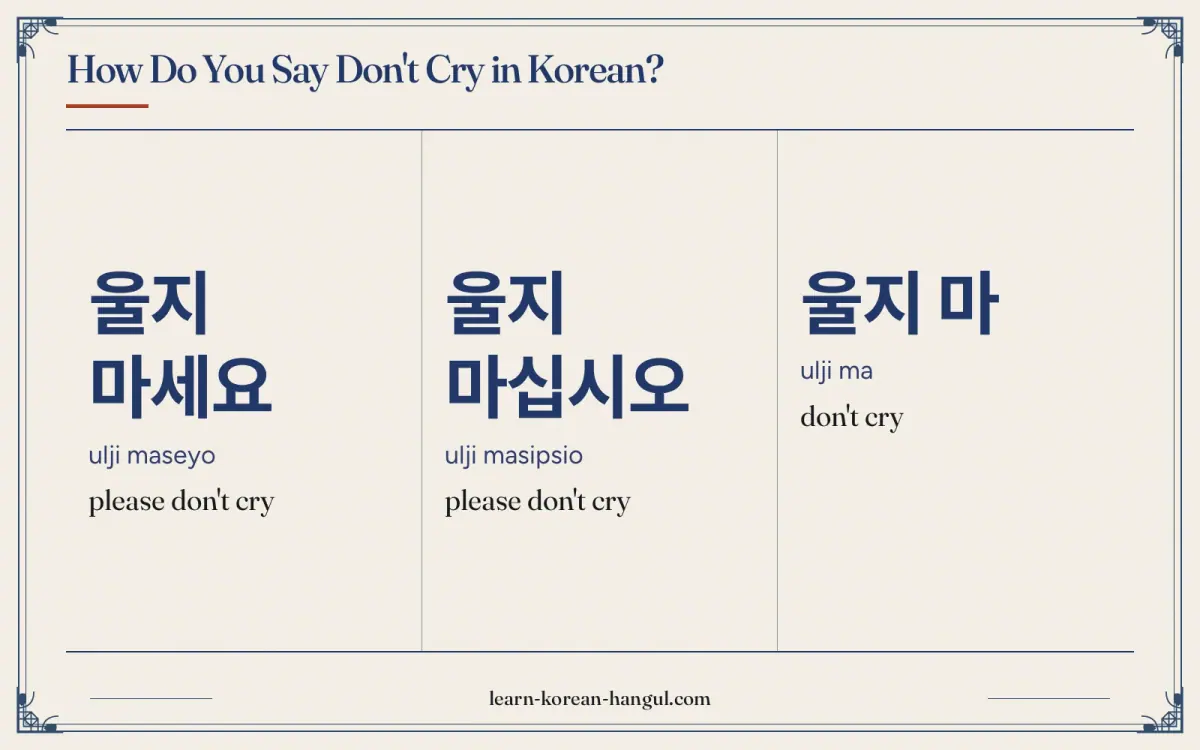
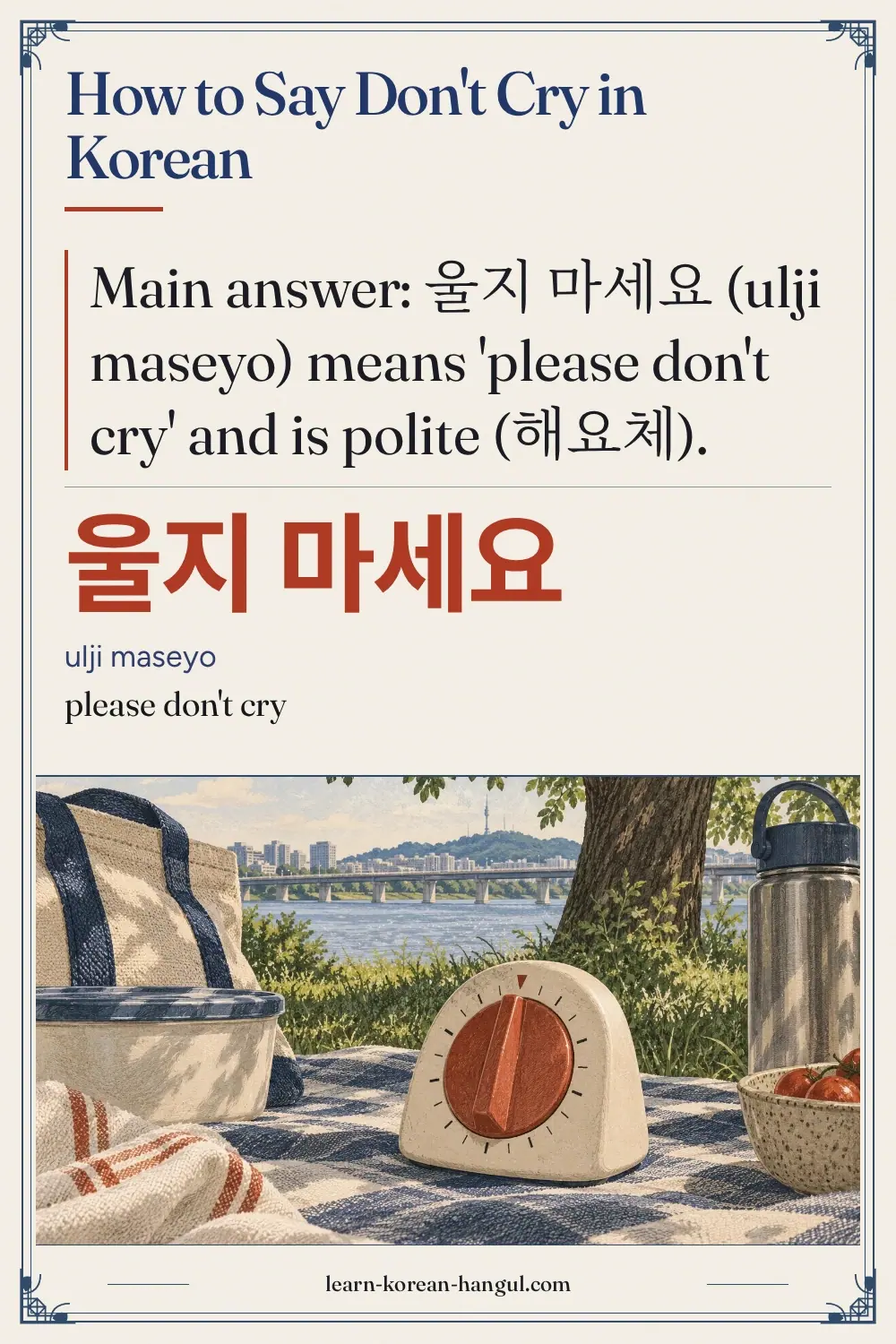
The standard polite way to say don't cry in Korean is 울지 마세요 (ulji maseyo). The phrase has three parts: 울 (ul, the stem of 울다, "to cry"), 지 (ji, a link that attaches the command ending to the verb) and 마세요 (maseyo, from 말다, "to stop, to refrain," plus the polite request ending). Together they ask the listener to refrain from crying.
The pattern is the most useful part. Put 지 마세요 after any action verb stem and you get a polite "please don't." Examples are 가지 마세요 (gaji maseyo, "please don't go") and 먹지 마세요 (meokji maseyo, "please don't eat"). Learn the pattern once and it works for hundreds of verbs.
Four forms cover most situations.
| Korean | Revised Romanization | Meaning | Register |
|---|---|---|---|
| 울지 마세요 | ulji maseyo | please don't cry | polite (해요체) |
| 울지 마십시오 | ulji masipsio | please don't cry | formal (합쇼체) |
| 울지 마 | ulji ma | don't cry | casual (해체) |
| 그만 우세요 | geuman useyo | please stop crying | polite, to someone already crying |
Revised Romanization (the South Korean government standard of 2000) is a reading aid only. The Hangul is the real spelling. The next section shows who each form fits.
What Are the Formal, Polite and Casual Ways to Say Don't Cry?
Korean changes the sentence ending to match the listener, and the Korean speech levels explain the whole system. For "don't cry," the level depends on who is crying and how close you are. The polite form is safe in most cases, and the casual form belongs to people you know well.
Polite: 울지 마세요 (ulji maseyo)
울지 마세요 is the form to learn first. It suits a coworker, a neighbour, a teacher or an older relative, and the tone is gentle. A short pause after it, then a reassurance, makes it sound caring instead of bossy.
Example: 울지 마세요. 다 잘될 거예요. (ulji maseyo. da jaldoel geoyeyo.) "Please don't cry. Everything will work out."
Formal: 울지 마십시오 (ulji masipsio)
울지 마십시오 uses the formal ending -십시오 (합쇼체). It appears in staff speech, in announcements and in written scripts, for example a nurse or hotel clerk speaking to a guest. Among friends it sounds stiff, almost like a TV drama, so keep it for service and ceremony settings.
Example: 울지 마십시오. 저희가 도와드리겠습니다. (ulji masipsio. jeohuiga dowadeurigetseumnida.) "Please don't cry. We will help you."
Casual: 울지 마 (ulji ma)
울지 마 drops the 요 and is casual (해체). Close friends, partners, siblings and parents speaking to children use it. The tone can be soft or firm depending on the voice, and a lower, slower delivery sounds like comfort.
Example: 울지 마. 내가 옆에 있잖아. (ulji ma. naega yeope itjana.) "Don't cry. I'm right here beside you."
Polite: 그만 우세요 (geuman useyo)
그만 우세요 means "please stop crying." The word 그만 (geuman) means "enough, that's all," and 우세요 is the polite request form of 울다 with its ㄹ dropped before 세요. Use it when the person is already crying and the crying is the problem, for example a child in a shop. The casual version is 그만 울어 (geuman ureo).
Choosing a Form by Listener
The table gives one clear choice per situation.
| Situation | Best choice | Why |
|---|---|---|
| Coworker or neighbour upset | 울지 마세요 | polite and gentle |
| Guest or customer, staff speaking | 울지 마십시오 | formal service tone |
| Close friend or partner | 울지 마 | warm and casual |
| Child who is already crying | 그만 울어 | firm, parent-to-child |
| Someone in deep grief | 울어도 돼요 | gives permission, not a ban |
With the choice clear, the next step is to hear how the phrase sounds.
How Do You Pronounce 울지 마세요?
울지 마세요 is pronounced [울지 마세요], roughly "ul-ji ma-se-yo," with five syllables in two word groups. Play the slow clip first, then the normal clip, and repeat each one aloud.
| Word | Spelled | Spoken | Revised Romanization |
|---|---|---|---|
| 울지 | 울-지 | [울지] | ulji |
| 마세요 | 마-세-요 | [마세요] | maseyo |
| 마십시오 | 마-십-시-오 | [마십씨오] | masipsio |
What Sound Changes Happen in the Don't-Cry Phrases?
The polite phrase has no spelling change, but two details matter.
First, the final ㄹ of 울 is a light "l" made with the tongue tip touching the ridge behind the upper teeth. The 지 that follows stays a plain ㅈ. Many learners tense it and say [울찌], but the Standard Pronunciation Rules (표준 발음법) of the National Institute of Korean Language (국립국어원) tense a verb ending only after certain stems, such as those ending in ㄴ or ㅁ, or after a stop sound. A plain ㄹ stem like 울 does not trigger it.
The contrast is easy to hear with another verb. After the stop sound ㄱ, the 지 does tense: 먹지 마세요 is [먹찌 마세요].
Second, the formal 마십시오 has a tense ㅅ in the middle, so it is read [마십씨오]. Learners sometimes expect the ㅂ to turn into ㅁ, as in 합니다 [함니다], but nasalization needs a nasal sound after the ㅂ, and ㅅ is not one. The page on tensification lists the other cases.
One more change appears in the example sentence: 잘될 거예요 is spoken [잘될꺼예요], because the ㄱ of 거 turns tense after the -(으)ㄹ ending. Revised Romanization does not show tensing that comes from a sound change, so the romanization stays geoyeyo.
For intonation, 울지 마세요 is a request, so the voice falls gently at the end and does not rise like a question. With the sounds clear, the next question is when to say it.
When Should You Use 울지 마세요, and When Should You Not?
Use 울지 마세요 for small, passing sadness: a friend who failed a quiz, a coworker with a hard day, a child who dropped an ice cream. The phrase works as a quick comfort. For serious sorrow it can sound as if you want the crying to end, so pair it with presence and warmth.
Situations Where 울지 마세요 Fits
- A friend or coworker is tearful over a setback. Say 울지 마세요 and offer a tissue or a drink.
- A child is upset. Say 울지 마 or 그만 울어 in a calm voice.
- A partner is touched or overwhelmed. Say 울지 마 with a smile.
Situations to Avoid
- Deep grief. Telling a grieving person not to cry can feel dismissive. Say 울어도 돼요 (ureodo dwaeyo, "it's okay to cry") instead.
- A senior who is upset. Even the polite form can sound like you are instructing them. Ask 괜찮으세요? (gwaenchaneuseyo?, "Are you all right?") first.
- A stranger. Most Koreans would not speak to a crying stranger at all, and a polite 괜찮으세요? is the safe choice.
If unsure, ask how the person is before you ask them to stop. The dialogues below show both tones.
What Does Don't Cry Sound Like in a Real Conversation?
Read each dialogue, play the clip, and say one role aloud.
Dialogue 1: Comforting a coworker
- A: 울지 마세요. 휴지 여기 있어요. (ulji maseyo. hyuji yeogi isseoyo.) "Please don't cry. Here is a tissue."
- B: 고마워요. 이제 괜찮아요. (gomawoyo. ije gwaenchanayo.) "Thank you. I'm all right now."
울지 마세요. 휴지 여기 있어요. 고마워요. 이제 괜찮아요.
Dialogue 2: Two friends
- A: 울지 마. 다 지나갈 거야. (ulji ma. da jinagal geoya.) "Don't cry. It will all pass."
- B: 응, 고마워. (eung, gomawo.) "Yeah, thanks."
울지 마. 다 지나갈 거야. 응, 고마워.
In Dialogue 1, the speaker offers a tissue right after the phrase, which turns the command into care. The reply 이제 괜찮아요 closes the moment, and the guide to it's okay in Korean shows more ways to answer. In Dialogue 2, both friends use the casual endings 지나갈 거야 and 고마워. The phrase also carries a cultural weight.
What Should You Know about the Culture behind Don't Cry?
In Korean dramas, 울지 마 is a classic comfort line, often said by someone who has just arrived beside the person who is crying. The words carry little weight alone; the moment of arriving, the tone and the added reassurance do the work. Real conversations follow the same pattern. A friend rarely says 울지 마 and stops, and usually adds something like 내가 있잖아 (naega itjana, "I'm here").
Parents comforting a small child often use the even shorter 뚝! (ttuk, "stop!"), a soft, familiar word for stopping tears that is only for children.
Korean speakers also distinguish "stop the tears" from "make room for them." 울지 마세요 asks the tears to stop. 울어도 돼요 allows them. Many speakers pick the second when the sorrow is large, because it respects the feeling. Learners who copy a drama line word for word can miss this difference, which leads to some common slips.
What Mistakes Do Learners Make with Don't Cry in Korean?
The most common mistake is putting the command ending on a feeling adjective. Five mistakes appear again and again:
- Saying 슬프지 마세요 for "don't be sad." The command normally works with action verbs. Fix: use the verb 슬퍼하다 and say 슬퍼하지 마세요 (seulpeohaji maseyo).
- Tensing the ㅈ and saying [울찌]. Fix: keep the 지 plain after ㄹ, [울지].
- Using 울지 마 with a senior. Fix: add 세요, and ask 괜찮으세요? first.
- Saying 말세요. The ㄹ of 말다 drops before ㅅ. Fix: 마세요.
- Confusing the command with a statement. 울지 않아요 means "I (or he, she) do not cry." It does not ask anyone to stop. Fix: use 울지 마세요 when you speak to the person.
All five come from translating "don't cry" without its grammar. A few related searches ask the same thing in other words, so they are answered next.
Short Answers on Stop Crying and Please Don't Cry
Two searches lead to this page, so each gets a short answer.
- Stop crying in Korean: Say 그만 우세요 (geuman useyo) in the polite style and 그만 울어 (geuman ureo) in the casual style. The word 그만 adds "enough," so the phrase is firmer than 울지 마세요.
- Please don't cry in Korean: The word "please" is already inside the 세요 ending, so 울지 마세요 covers it.
In fast speech, many people also say 울지 마요 (ulji mayo), which is a colloquial polite form. It is common in conversation, but 울지 마세요 is the safer choice in writing and with seniors. The related page don't worry in Korean uses the same pattern.
Related Phrases to Learn Next
Three pages follow the same layout and pair well with this one:
- It's okay in Korean: the everyday reassurance.
- Cheer up in Korean: encouragement after the tears.
- I'm sad in Korean: how the other person can say what they feel.
The complete list sits in the Korean feelings phrases cluster.
Practice: Say It Aloud
Spend five minutes on this routine.
- Play the slow clip of 울지 마세요 and repeat it three times, keeping the 지 plain.
- Say 울지 마세요, then 울지 마, and name the listener for each.
- Replace 울 with 가 and 먹 to build 가지 마세요 and 먹지 마세요, and listen for the tense 먹지 [먹찌].
- Hide the Romanization with the toggle and read the four forms from Hangul only.
- Drill the cluster with the phrase flashcards.
When the phrase comes out soft and steady, you can say don't cry in Korean in a way that comforts.
Frequently Asked Questions
The answers below add details about how to say don't cry in Korean beyond the sections above.
What is the difference between 울지 마세요 and 울지 마?
Both mean "don't cry." 울지 마세요 is polite (해요체) and fits a coworker, a neighbour, an older relative or someone you have just met. 울지 마 has no 요 and is casual (해체), so it fits a close friend, a partner, a younger sibling or a child. Using 울지 마 with a senior sounds too familiar.
Why is it 마세요 and not 말세요?
마세요 comes from the verb 말다 (malda, "to stop, to refrain") plus the polite request ending -(으)세요. The ㄹ at the end of the stem 말 drops before ㅅ, so 말 + 세요 becomes 마세요. The same drop gives 마십시오 in the formal style. You never write or say 말세요.
Can I use 지 마세요 with adjectives like sad or happy?
Usually not. The -지 마세요 command normally works with action verbs. For feelings, switch to a verb such as 슬퍼하다 (seulpeohada, "to feel sad"): say 슬퍼하지 마세요, "please don't be sad." A few set wishes, such as 아프지 마세요 ("please don't be sick"), are common, but 슬프지 마세요 sounds wrong.
How do I answer when someone says 울지 마세요 to me?
A kind reply is 고마워요 (gomawoyo, "thank you") or 괜찮아요 (gwaenchanayo, "I'm fine"). If you really are not fine, 조금만 울게요 (jogeumman ulgeyo, "I'll cry just a little") is honest and warm. With a friend, 응, 고마워 (eung, gomawo) is enough.
Is it kind to tell someone not to cry in Korean?
It can be, but it depends on the moment. 울지 마세요 works as a quick comfort for small troubles. For deep grief, many speakers prefer 울어도 돼요 (ureodo dwaeyo, "it's okay to cry") because it gives the person permission instead of asking them to hold the tears back.
What is the most common mistake with don't cry in Korean?
Learners often tense the ㅈ and say [울찌] because they remember tense sounds in other 지 마세요 phrases. After the ㄹ of 울, the ㅈ stays plain, so 울지 is [울지]. Tensing happens after a stop sound, as in 먹지 마세요 [먹찌 마세요].