How Do You Say Don't Give up in Korean?
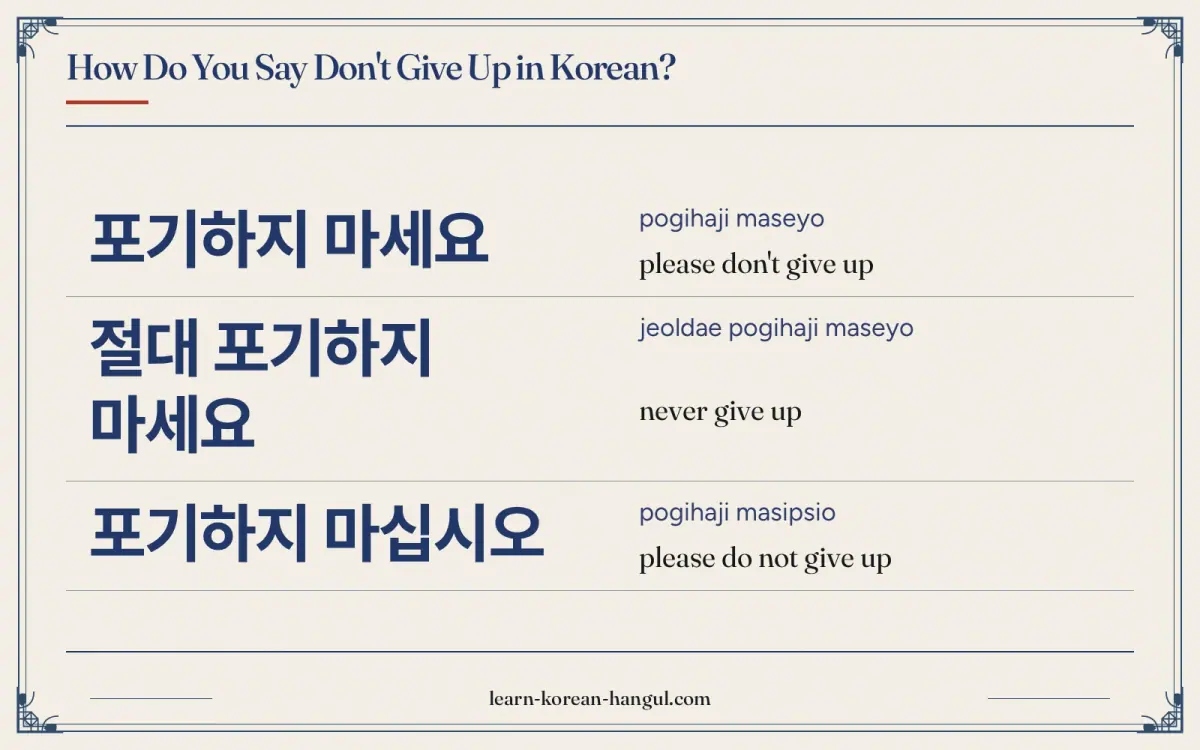
The standard polite way to say don't give up in Korean is 포기하지 마세요 (pogihaji maseyo). The phrase has three parts: 포기하 (pogiha, the stem of 포기하다, from the noun 포기, "giving up," plus 하다, "to do"), 지 (ji, the link before the command) and 마세요 (maseyo, from 말다, "to refrain," plus the polite request ending).
Add 절대 (jeoldae, "never, absolutely") to get "never give up." In a negative sentence, 절대 works like an underline, so 절대 포기하지 마세요 is the line coaches and teachers choose for a final push.
Four forms cover most situations.
| Korean | Revised Romanization | Meaning | Register |
|---|---|---|---|
| 포기하지 마세요 | pogihaji maseyo | please don't give up | polite (해요체) |
| 절대 포기하지 마세요 | jeoldae pogihaji maseyo | never give up | polite, emphatic |
| 포기하지 마십시오 | pogihaji masipsio | please do not give up | formal (합쇼체) |
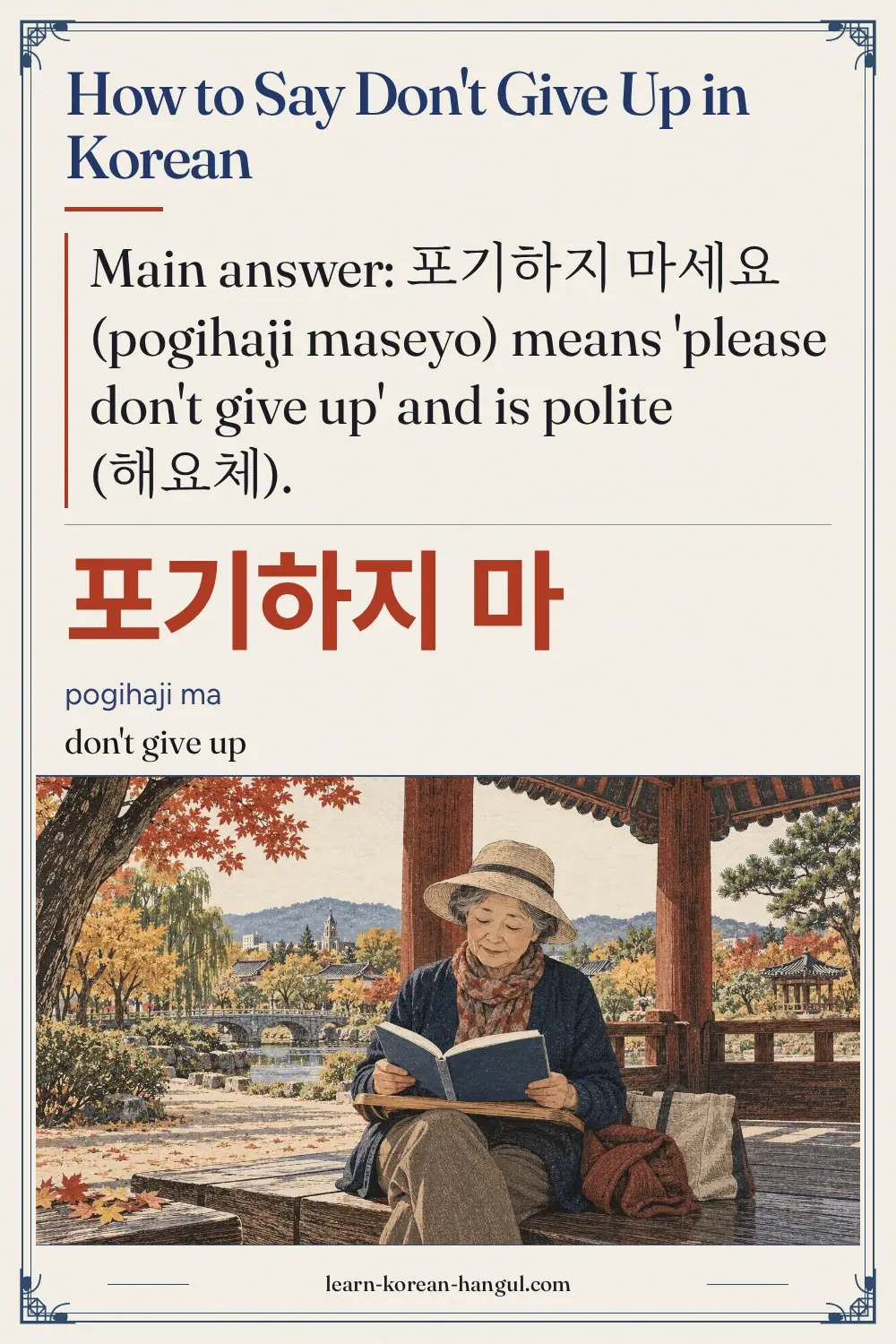
| 포기하지 마 | pogihaji ma | don't give up | casual (해체) |
Revised Romanization (the South Korean government standard of 2000) is a reading aid only. The Hangul is the real spelling. The next section shows who each form fits.
What Are the Formal, Polite and Casual Ways to Say Don't Give Up?
Korean changes the sentence ending to match the listener, and the Korean speech levels explain how. For encouragement, the choice also signals your relationship. A teacher can speak politely to a student and still sound warm, and a friend can speak casually and sound close.
Polite: 포기하지 마세요 (pogihaji maseyo)
포기하지 마세요 suits a student, a younger coworker, a customer or an older relative. The tone is steady. Pair it with a reason, such as the distance already covered, and it sounds like belief instead of pressure.
Example: 절대 포기하지 마세요. 꿈은 이룰 수 있어요. (jeoldae pogihaji maseyo. kkumeun irul su isseoyo.) "Never give up. You can achieve your dream."
Formal: 포기하지 마십시오 (pogihaji masipsio)
포기하지 마십시오 uses the formal ending -십시오 (합쇼체). It appears in speeches, in broadcasts and in written messages to a group. The tone is solemn, almost ceremonial.
Example: 포기하지 마십시오. 끝까지 함께하겠습니다. (pogihaji masipsio. kkeutkkaji hamkkehagetseumnida.) "Please do not give up. We will be with you to the end."
Casual: 포기하지 마 (pogihaji ma)
포기하지 마 drops the 요 and is casual (해체). Friends, partners and siblings use it, usually with a short push such as 거의 다 왔어 ("you're almost there"). A parent can use it with a child as well.
Example: 포기하지 마. 거의 다 왔어. (pogihaji ma. geoui da wasseo.) "Don't give up. You're almost there."
Choosing a Form by Listener
The table gives one clear choice per situation.
| Situation | Best choice | Why |
|---|---|---|
| Group speech or written message | 포기하지 마십시오 | formal and solemn |
| Student, coworker, older relative | 포기하지 마세요 | polite and sincere |
| Last push before a deadline | 절대 포기하지 마세요 | emphatic |
| Close friend or partner | 포기하지 마 | warm and casual |
Once the choice is clear, the next step is to hear the words.
How Do You Pronounce 포기하지 마세요?
포기하지 마세요 is pronounced [포기하지 마세요], roughly "po-gi-ha-ji ma-se-yo," with seven syllables in two word groups. Play the slow clip, then the normal clip, and repeat each one aloud.
| Word | Spelled | Spoken | Revised Romanization |
|---|---|---|---|
| 포기하지 | 포-기-하-지 | [포기하지] | pogihaji |
| 마세요 | 마-세-요 | [마세요] | maseyo |
| 절대 | 절-대 | [절때] | jeoldae |
| 마십시오 | 마-십-시-오 | [마십씨오] | masipsio |
What Sound Changes Happen in the Don't-Give-up Phrases?
The polite phrase has no spelling change, but the sounds need care. The first letter ㅍ is aspirated, which means a puff of air leaves the mouth, as in "p" at the start of "pie." The ㄱ in the middle sits between two vowels, so it is voiced and sounds like "g" in "pogi." The ㅎ of 하 sits between vowels too, so it is soft. The whole phrase flows without a pause between the first three syllables.
Two other forms change. In 절대, the Standard Pronunciation Rules (표준 발음법) of the National Institute of Korean Language (국립국어원) make a ㄷ tense after the ㄹ in Sino-Korean words (Article 26), so 절대 is spoken [절때]. In the formal 마십시오, the ㅅ of 시 is tense, so the word is [마십씨오], and the ㅂ does not change to ㅁ. The page on tensification lists the other cases.
The example 이룰 수 has a tense ㅅ, [이룰쑤], because the -(으)ㄹ ending tenses the next consonant. Revised Romanization does not show tensing that comes from a sound change, so the romanization stays su. The sentence falls at the end, because it is a request. With the sounds clear, the next question is when to say it.
When Should You Use 포기하지 마세요, and When Should You Not?
Use 포기하지 마세요 when someone has a goal and is close to quitting: an exam, a diet, a long project, a language course. The phrase works because it names the action to avoid. Follow it with a concrete next step or a sign of progress.
Situations Where 포기하지 마세요 Fits
- A student before a big exam. Say 포기하지 마세요, then 거의 다 왔어요.
- A friend who failed once. Say 포기하지 마, then 다음엔 잘될 거야.
- A colleague at the end of a long project. Say 절대 포기하지 마세요 with a smile.
Situations to Avoid
- A person who has decided to leave a harmful situation. Telling them not to give up can push them the wrong way. Ask what they need first.
- A senior who is struggling. Even the polite form can sound like you are coaching them. Try 응원하겠습니다 (eungwonhagetseumnida, "I'll support you") instead.
- A sick person. Use 힘내세요 (himnaeseyo) and keep the tone soft.
If unsure, add a reason for hope. The dialogues below show how that sounds.
What Does Don't Give up Sound Like in a Real Conversation?
Read each dialogue, play the clip, and say one role aloud.
Dialogue 1: A teacher and a student
- A: 힘들어도 포기하지 마세요. 거의 다 왔어요. (himdeureodo pogihaji maseyo. geoui da wasseoyo.) "Even if it is hard, don't give up. You're almost there."
- B: 네, 포기하지 않을게요. 감사합니다. (ne, pogihaji aneulgeyo. gamsahamnida.) "Yes, I won't give up. Thank you."
힘들어도 포기하지 마세요. 거의 다 왔어요. 네, 포기하지 않을게요. 감사합니다.
Dialogue 2: Two friends after an exam
- A: 이번 시험 또 떨어졌어. (ibeon siheom tto tteoreojyeosseo.) "I failed this exam again."
- B: 포기하지 마. 다음엔 잘될 거야. (pogihaji ma. daeumen jaldoel geoya.) "Don't give up. Next time will go well."
이번 시험 또 떨어졌어. 포기하지 마. 다음엔 잘될 거야.
In Dialogue 1, the student answers with a promise, 포기하지 않을게요, built on the -(으)ㄹ게요 ending that commits the speaker to an action.
In Dialogue 2, the friend adds a future hope with 잘될 거야, spoken [잘될꺼야]. To cheer someone on in a group, see fighting in Korean and you can do it in Korean. The phrase also has a cultural twist.
What Should You Know about the Culture behind Don't Give Up?
Korean encouragement often stresses effort and finishing, which is why 끝까지 (kkeutkkaji, "to the end") appears in so many cheers. The word 포기 also has a second life as a counter for heads of napa cabbage: 배추 한 포기 (baechu han pogi) means "one head of cabbage."
That coincidence created a famous pun: 포기는 배추 셀 때나 하는 말이야 (pogineun baechu sel ttaena haneun mariya), "'pogi' is only a word for counting cabbages." The joke tells the listener that quitting is not in the vocabulary. Teachers, coaches and friends use it to lift a mood, and it works because the sound is the same and the meaning is a surprise.
Use the pun with people you know, because it is playful. These cultural shades explain several typical mistakes.
What Mistakes Do Learners Make with Don't Give up in Korean?
The most common mistake is writing a space inside the verb. Five mistakes appear again and again:
- Writing 포기 하지 마세요. 포기하다 is one verb. Fix: write 포기하지.
- Saying 절대 as [절대]. Fix: tense the ㄷ, [절때].
- Using 포기하지 마 with a senior. Fix: add 세요.
- Mixing up 포기하다 and 그만두다. 포기하다 gives up on a goal. 그만두다 quits a job, a school or a habit. Fix: choose by the object.
- Answering with 포기하지 마세요 when you mean "I won't." Fix: say 포기하지 않을게요.
All five come from translating "give up" without its context. A few related searches ask the same thing in other words, so they are answered next.
Short Answers on Never Give up and Keep Going
Three searches lead to this page, so each gets a short answer.
- Never give up in Korean: Say 절대 포기하지 마세요. In casual speech, say 절대 포기하지 마.
- Keep going in Korean: Say 계속해 보세요 (gyesokae boseyo, "keep trying") or 끝까지 해 보세요 (kkeutkkaji hae boseyo, "do it to the end"). For a quick cheer, say 힘내세요.
- Please don't give up in Korean: The word "please" is already inside 세요, so 포기하지 마세요 covers it.
The related pages cheer up in Korean and don't worry in Korean cover the neighbouring encouragements.
Related Phrases to Learn Next
Three pages follow the same layout and pair well with this one:
- Fighting in Korean: the all-purpose cheer.
- You can do it in Korean: confidence in a person's ability.
- Cheer up in Korean: a lift for a low mood.
The complete list sits in the Korean feelings phrases cluster.
Practice: Say It Aloud
Spend five minutes on this routine.
- Play the slow clip of 포기하지 마세요 and repeat it three times, with a clear puff on the first ㅍ.
- Say 포기하지 마세요, then 절대 포기하지 마세요, and tense the ㄷ in 절대.
- Answer with 포기하지 않을게요 after each one.
- Hide the Romanization with the toggle and read the four forms from Hangul only.
- Drill the cluster with the phrase flashcards.
When the phrase comes out with a steady, hopeful tone, you can say don't give up in Korean and mean it.
Frequently Asked Questions
The answers below add details about how to say don't give up in Korean beyond the sections above.
What is the difference between 포기하지 마세요 and 힘내세요?
포기하지 마세요 means "please don't give up" and speaks to someone who might quit. 힘내세요 means "cheer up" or "hang in there" and gives energy to someone who is low. Many speakers use them together: 힘내세요, 포기하지 마세요. The first lifts the mood, and the second names the goal.
What is the difference between 포기하지 마세요 and 절대 포기하지 마세요?
절대 (jeoldae) means "absolutely, never" in a negative sentence, so 절대 포기하지 마세요 means "never give up." It is stronger than the plain phrase and fits speeches, notes to a student or a final push. The first word is read [절때], with a tense ㄷ.
Is 포기하지 마 casual or rude?
It is casual (해체), not rude. Friends, partners, siblings and younger people use it. With a boss, a teacher or an older stranger, add 세요 and say 포기하지 마세요. The casual form with a senior sounds too familiar, even when the words are kind.
How do I say "I won't give up" in Korean?
Say 포기하지 않을게요 (pogihaji aneulgeyo) in the polite style. The ending -(으)ㄹ게요 is a promise about your own action. A casual version is 포기하지 않을게 (pogihaji aneulge). A stronger line is 절대 포기 안 해요 (jeoldae pogi an haeyo), which means "I will never give up."
Is 포기하다 the same as 그만두다?
No. 포기하다 (pogihada) means to give up on a goal, a plan or a hope. 그만두다 (geumanduda) means to quit something you were doing, such as a job, a school or a habit. You 포기하다 a dream, and you 그만두다 a company. The two verbs are not interchangeable.
What is the most common mistake with don't give up in Korean?
Learners often write 포기 하지 마세요 with a space inside the verb. 포기하다 is one verb, so 포기하지 is written together. Another slip is saying 절대 as [절대] with a plain ㄷ. The correct sound is [절때], with a tense ㄷ.