How Do You Say I'm Very Sorry in Korean?
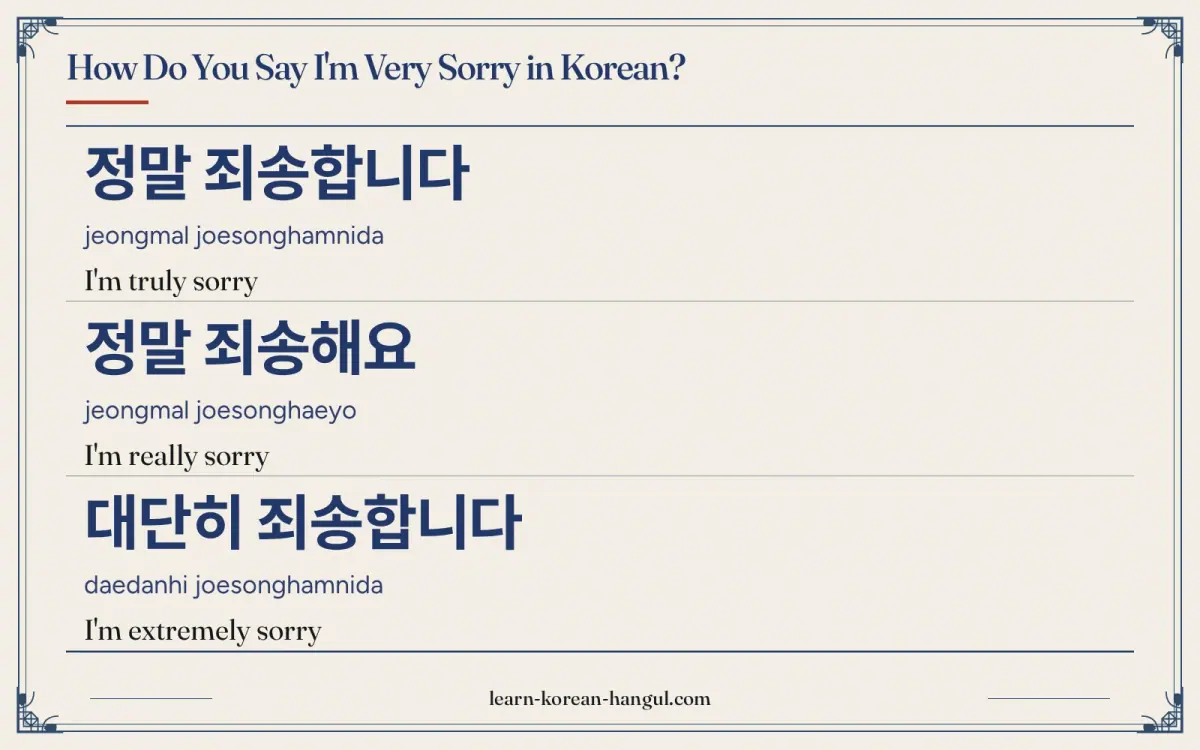
The standard formal way to say I'm very sorry in Korean is 정말 죄송합니다 (jeongmal joesonghamnida). The phrase has two parts: 정말 (jeongmal, "truly, really") and 죄송합니다 (joesonghamnida, "I am sorry"). The adverb 정말 raises the feeling, so the phrase sounds heavier than 죄송합니다 alone.
Six forms cover most situations.
| Korean | Revised Romanization | Meaning | Register |
|---|---|---|---|
| 정말 죄송합니다 | jeongmal joesonghamnida | I'm truly sorry | formal (합쇼체) |
| 정말 죄송해요 | jeongmal joesonghaeyo | I'm really sorry | polite (해요체) |
| 대단히 죄송합니다 | daedanhi joesonghamnida | I'm extremely sorry | formal, very strong |
| 진심으로 사과드립니다 | jinsimeuro sagwadeurimnida | I sincerely apologize | very formal |
| 너무 미안해요 | neomu mianhaeyo | I'm so sorry | polite (해요체) |
| 정말 미안해 | jeongmal mianhae | I'm really sorry | casual (반말) |
Revised Romanization (the South Korean government standard of 2000) is a reading aid only. The Hangul is the real spelling. The next section sorts the forms by listener.
What Are the Formal, Polite and Casual Ways to Say I'm Very Sorry?
Five forms are formal or polite and one is casual. Korean speech levels explain the endings: ㅂ니다 is formal, 요 is polite, and a bare ending is casual. The word 죄송 is humble, while 미안 is plain, so the choice also depends on whom you owe respect.
Formal: 정말 죄송합니다 (jeongmal joesonghamnida)
정말 죄송합니다 means "I'm truly sorry" and is the best default for a client, a boss, a teacher or a stranger you have wronged. The humble adjective 죄송하다 lowers you before the listener. Use it for a real mistake, such as a delay, a spill or a lost item.
Example: 늦어서 정말 죄송합니다. (neujeoseo jeongmal joesonghamnida.) "I'm very sorry I'm late."
Very Formal: 진심으로 사과드립니다 (jinsimeuro sagwadeurimnida)
진심으로 사과드립니다 means "I sincerely apologize" and is the strongest form on this page. The noun 진심 (jinsim) means "true heart," so the phrase says "from the bottom of my heart." Use it in a written apology, a public statement or a serious workplace error. The full form of the verb is explained on the page about I apologize in Korean.
Example: 실수에 대해 진심으로 사과드립니다. (silsue daehae jinsimeuro sagwadeurimnida.) "I sincerely apologize for the mistake."
Polite: 너무 미안해요 (neomu mianhaeyo)
너무 미안해요 means "I'm so sorry" and fits a friend, a coworker your age, a classmate or a family member you respect. The adverb 너무 (neomu) means "so" or "too," and in speech it works as a strong intensifier. Because 미안 is not humble, avoid it with a client or an elder.
Example: 약속에 늦어서 너무 미안해요. (yaksoge neujeoseo neomu mianhaeyo.) "I'm so sorry I was late for our appointment."
Casual: 정말 미안해 (jeongmal mianhae)
정말 미안해 means "I'm really sorry" and drops the polite 요, so it fits a close friend, a sibling or a partner. Never use it with a boss, a client or an elder, because the missing 요 sounds like a shrug.
Example: 어제 일은 정말 미안해. (eoje ireun jeongmal mianhae.) "I'm really sorry about yesterday."
Choosing a Form by Listener
The table gives one clear choice per listener.
| Listener | Best choice | Why |
|---|---|---|
| Client, boss, teacher, stranger | 정말 죄송합니다 | formal and humble |
| Serious error, written apology | 진심으로 사과드립니다 | strongest and formal |
| Colleague, friend your age | 너무 미안해요 | polite and warm |
| Shop staff, neighbour | 정말 죄송해요 | polite and humble |
| Close friend, sibling | 정말 미안해 | casual |
Once the form is chosen, the next step is how it sounds.
How Do You Pronounce 정말 죄송합니다?
정말 죄송합니다 is pronounced [정말 죄송함니다], roughly "jeong-mal joe-song-ham-ni-da," with seven syllables in two word groups. Play the slow clip, then the normal clip, and repeat each one aloud.
| Word | Spelled | Spoken | Revised Romanization |
|---|---|---|---|
| 정말 | 정-말 | [정말] | jeongmal |
| 죄송합니다 | 죄-송-합-니-다 | [죄송함니다] | joesonghamnida |
What Sound Changes Happen in 정말 죄송합니다?
Three sound details matter. They follow the Standard Pronunciation Rules (표준 발음법) of the National Institute of Korean Language (국립국어원).
- 합니 becomes [함니]. The final ㅂ of 합 sounds like ㅁ before the ㄴ of 니, so Revised Romanization writes hamnida.
- 죄 has the vowel ㅚ, which most speakers say like 웨, so [줴송함니다] is common. The standard rules (Article 4) list ㅚ as a simple vowel but allow the [we] pronunciation, so both [죄] and [줴] are correct.
- 사과드립니다 follows the same rule: the ㅂ of 립 sounds like ㅁ before ㄴ, giving [사과드림니다] and sagwadeurimnida.
The same nasal rule appears in every ㅂ니다 ending, so learning it once helps with the whole formal style. With the sounds clear, the next question is when to use each form.
When Should You Use 정말 죄송합니다, and When Should You Not?
Use 정말 or 너무 for a deeper apology, and move to 사과드립니다 in work emails and public statements. Each step up adds weight: 죄송합니다, then 정말 죄송합니다, then 진심으로 사과드립니다. Choose the step that matches the size of the mistake and the rank of the listener.
Situations Where 정말 죄송합니다 Fits
- A late delivery or a missed deadline. Say it to the client, then explain.
- Damaging something that belongs to someone. Say it at once, with a bow.
- A mistake in front of a boss. Say it, then say how you will fix it.
Situations to Avoid with 정말 죄송합니다
- Tiny slips. For a light bump, 죄송합니다 or 실례했습니다 is enough, and a heavy apology can embarrass the listener.
- Using only 미안해 in a serious apology to a client. The word is too plain. Fix: use 정말 죄송합니다.
- Talking to a close friend. The formal tone feels cold. Use 정말 미안해.
The dialogues below show the forms in context.
What Does I'm Very Sorry Sound Like in a Real Conversation?
Read each dialogue, play the clip, and say one role aloud.
Dialogue 1: A wrong order
- A: 고객님, 정말 죄송합니다. 주문이 잘못 나갔습니다. (gogaengnim, jeongmal joesonghamnida. jumuni jalmot nagatseumnida.) "Dear customer, I'm very sorry. Your order went out wrong."
- B: 괜찮아요. 바꿔 주실 수 있어요? (gwaenchanayo. bakkwo jusil su isseoyo?) "That's all right. Can you replace it?"
- A: 네, 바로 다시 보내 드리겠습니다. (ne, baro dasi bonae deurigetseumnida.) "Yes, I will send it again right away."
고객님, 정말 죄송합니다. 주문이 잘못 나갔습니다. 괜찮아요. 바꿔 주실 수 있어요? 네, 바로 다시 보내 드리겠습니다.
Dialogue 2: A late friend
- A: 약속에 늦어서 너무 미안해요. (yaksoge neujeoseo neomu mianhaeyo.) "I'm so sorry I was late."
- B: 아니에요, 괜찮아요. (anieyo, gwaenchanayo.) "No, it's fine."
- A: 오늘 커피는 제가 살게요. (oneul keopineun jega salgeyo.) "I will buy the coffee today."
약속에 늦어서 너무 미안해요. 아니에요, 괜찮아요. 오늘 커피는 제가 살게요.
Dialogue 3: Two close friends
- A: 어제 일은 정말 미안해. (eoje ireun jeongmal mianhae.) "I'm really sorry about yesterday."
- B: 괜찮아. 나도 미안해. (gwaenchana. nado mianhae.) "It's okay. I'm sorry too."
- A: 고마워. 화 풀렸어? (gomawo. hwa pullyeosseo?) "Thanks. Are you over it now?"
어제 일은 정말 미안해. 괜찮아. 나도 미안해. 고마워. 화 풀렸어?
In Dialogue 1, the staff member adds a promise to fix the problem, which is the habit the next section explains.
What Should You Know about the Culture behind I'm Very Sorry?
Korean workplaces often expect an apology plus a promise to do better, such as 앞으로 조심하겠습니다 (apeuro josimhagetseumnida, "I will be careful from now on"). The apology alone can sound unfinished. A common longer promise is 다시는 이런 일이 없도록 하겠습니다 (dasineun ireon iri eopdorok hagetseumnida, "I will make sure this does not happen again").
A slight bow often goes with a heavy apology, and a low voice shows that you take the mistake seriously. The pattern is apology, reason in one sentence, promise, and then silence while the other person speaks. With the custom clear, the common mistakes are easy to spot.
What Mistakes Do Learners Make with I'm Very Sorry in Korean?
The most common mistake is using only 미안해 in a serious apology to a client. Five mistakes appear again and again:
- Using 미안해 with a client or a boss. Fix: say 정말 죄송합니다.
- Using 정말 죄송합니다 with a close friend. It sounds cold. Fix: say 정말 미안해.
- Stopping after the apology. Fix: add a promise, such as 앞으로 조심하겠습니다.
- Missing the nasal sound. Saying "hap-ni-da" sounds foreign. Fix: say [함니다].
- Using 너무 in a formal letter. 너무 sounds spoken. Fix: use 정말 or 대단히 in writing.
These slips come from carrying English habits into Korean, where "very sorry" fits every setting. Several related searches ask the same thing in other words, so they are answered next.
Is It the Same as Really Sorry, Deeply Sorry or so Sorry?
Not exactly, because Korean changes the intensifier and the humble word together. Six searches lead to this page, so each gets a short answer.
- Really sorry in Korean and very sorry in Korean: 정말 죄송합니다 (formal) or 정말 미안해요 (polite).
- So sorry in Korean: 너무 미안해요 or 너무 죄송해요, both spoken.
- Extremely sorry in Korean: 대단히 죄송합니다 (daedanhi joesonghamnida), a formal and strong phrase.
- Deeply sorry in Korean and sorry from the bottom of my heart in Korean: 진심으로 죄송합니다 (jinsimeuro joesonghamnida) or 진심으로 사과드립니다.
For the basic apology, see sorry in Korean. After the answers, the next pages continue the path.
Related Phrases to Learn Next
Four phrases help you finish an apology:
- Sorry in Korean: the everyday apology that this page makes stronger.
- Forgive me in Korean: the request that follows a serious apology.
- Sorry I'm late in Korean: the most common specific apology.
- Sorry for bothering you in Korean: the light apology for a small interruption.
The complete list sits in the polite Korean phrases collection.
Practice: Say It Aloud
Spend five minutes on this routine.
- Play the slow clip of 정말 죄송합니다 and repeat it three times.
- Say it again with the nasal sound: [죄송함니다], not "joe-song-hap-ni-da."
- Say the ladder aloud: 죄송합니다, 정말 죄송합니다, 진심으로 사과드립니다, and say which mistake each one fits.
- Hide the Romanization with the toggle and read the six forms from Hangul only.
- Drill the cluster with the phrase flashcards.
When the ladder comes out smoothly, you can say I'm very sorry in Korean at exactly the size that the mistake needs.
Frequently Asked Questions
The answers below add details about how to say I'm very sorry in Korean beyond the sections above.
How do you say I'm very sorry in Korean?
The standard formal phrase is 정말 죄송합니다 (jeongmal joesonghamnida), meaning "I'm truly sorry." In polite speech, say 정말 죄송해요 or 너무 미안해요. With a close friend, say 정말 미안해. For a serious mistake, use 진심으로 사과드립니다. The adverbs 정말 and 너무 add depth to any apology.
How do you pronounce 정말 죄송합니다?
Say it as [정말 죄송함니다], roughly jeong-mal joe-song-ham-ni-da. The final ㅂ of 합 sounds like ㅁ before the ㄴ of 니. Most speakers say 죄 like 웨, and the standard rules allow [줴송함니다] too. The Revised Romanization is jeongmal joesonghamnida. Play the slow clip first, then repeat at normal speed.
What is the difference between 정말 죄송합니다 and 진심으로 사과드립니다?
정말 죄송합니다 says "I'm truly sorry" and describes your feeling. 진심으로 사과드립니다 says "I sincerely apologize" and names the act of apologizing, so it sounds heavier and more official. Use the first for most workplace and daily mistakes, and the second for serious errors, written apologies and public statements.
Is 정말 죄송합니다 formal or casual?
정말 죄송합니다 is formal, in the 합쇼체 style, and humble. The polite version is 정말 죄송해요. The casual version, 정말 미안해, is only for close friends, siblings and partners. Because 죄송 is humble, the formal version is the safe choice for clients, bosses and anyone you owe respect.
Can I use 정말 죄송합니다 with friends, elders and strangers?
It suits elders, clients, bosses and strangers. With friends it can sound cold, so use 너무 미안해요 or 정말 미안해 instead. With an elder, never use 미안해 alone, because the word is plain and the missing 요 sounds casual. Choose 죄송 for people above you and 미안 for equals.
What is the most common mistake with I'm very sorry in Korean?
Learners use only 미안해 in a serious apology to a client or boss. The word is too plain and the ending too casual. Say 정말 죄송합니다 and add a promise, such as 앞으로 조심하겠습니다. A second frequent slip is stopping after the apology without a promise or a plan to fix the problem.