How Do You Say Hajima in Korean?
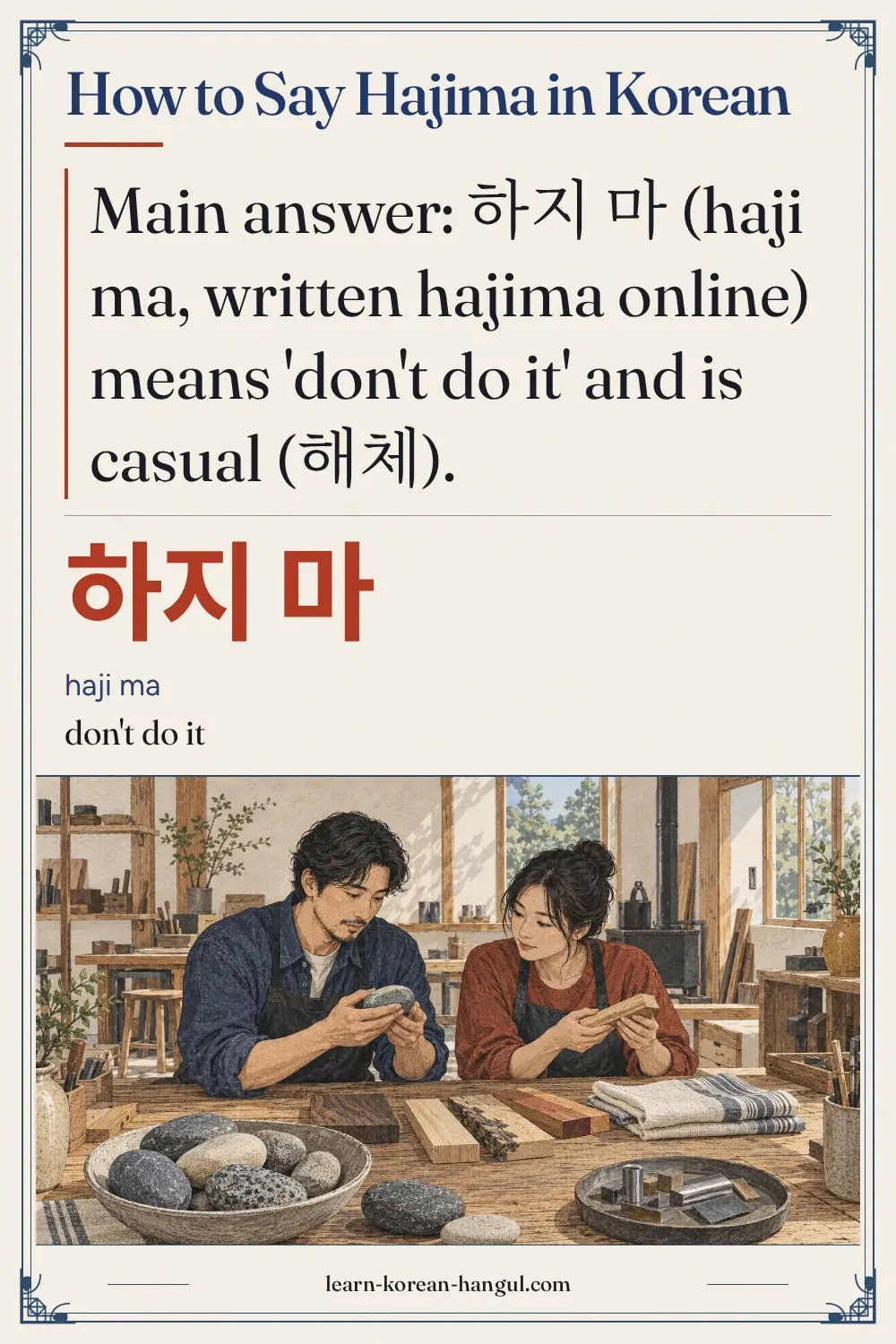
The standard casual way to say hajima in Korean is 하지 마 (haji ma). The phrase has three parts: 하 (ha, the stem of 하다, "to do"), 지 (ji, a link before the command) and 마 (ma, from 말다, "to refrain"). Together they say "refrain from doing it." Online you will often see the romanization hajima, written as one word.
The pattern matters more than the single phrase. Add 지 마 to any action verb stem and you get "don't." 가지 마 (gaji ma) means "don't go," 먹지 마 (meokji ma) means "don't eat," and 울지 마 (ulji ma) means "don't cry." So hajima is the pattern applied to the most common verb.
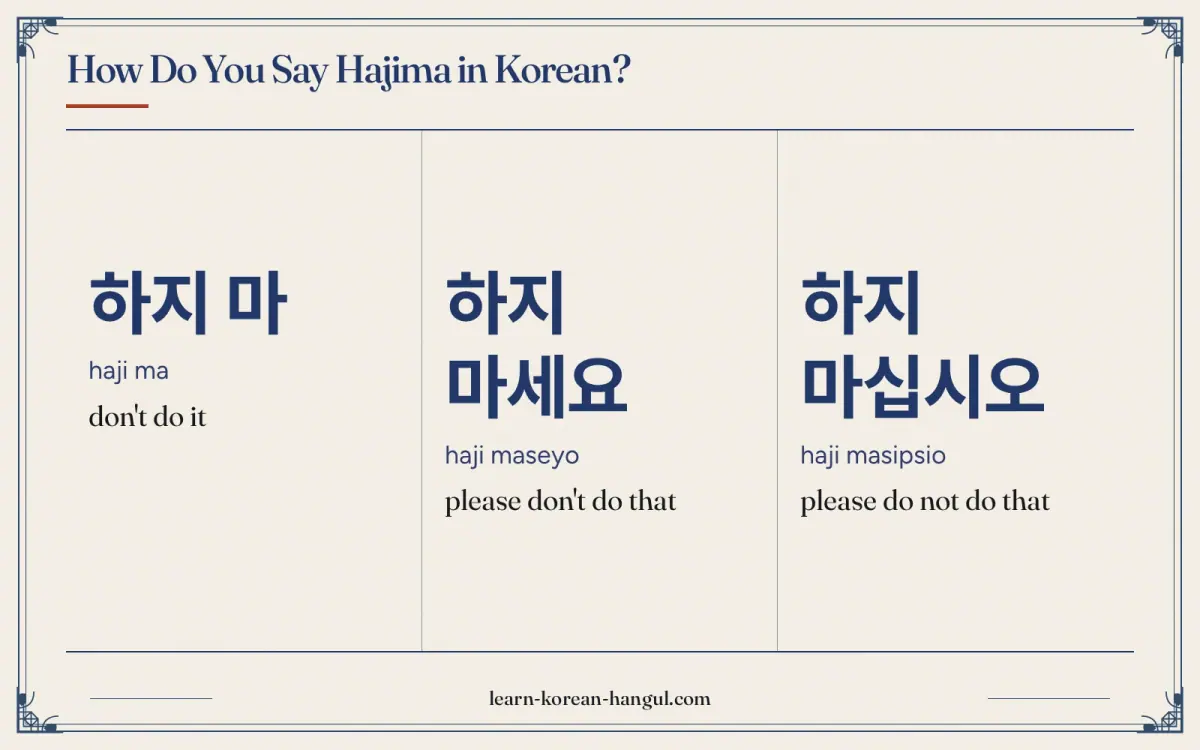
Four forms cover most situations.
| Korean | Revised Romanization | Meaning | Register |
|---|---|---|---|
| 하지 마 | haji ma | don't do it | casual (해체) |
| 하지 마세요 | haji maseyo | please don't do that | polite (해요체) |
| 하지 마십시오 | haji masipsio | please do not do that | formal (합쇼체) |
| 가지 마 | gaji ma | don't go | casual (해체) |
Revised Romanization (the South Korean government standard of 2000) is a reading aid only. The Hangul is the real spelling. The next section shows who each form fits.
What Are the Formal, Polite and Casual Ways to Say Hajima?
Korean changes the sentence ending to match the listener, and the Korean speech levels explain how. A command is the most face-threatening kind of sentence, so the level matters more here than for a greeting. The same words can be playful with a friend and rude to a boss.
Casual: 하지 마 (haji ma)
하지 마 is the form drama fans know. It has no 요, so it belongs to close friends, partners, siblings and children. The meaning depends on the voice. A laugh makes it playful ("stop it, that tickles"), and a low voice makes it serious.
Example: 하지 마. 간지러워! (haji ma. ganjireowo!) "Stop it. That tickles!"
Polite: 하지 마세요 (haji maseyo)
하지 마세요 adds the polite request ending 세요. It suits a stranger, a coworker, a customer or an older person. Because it sounds like a request, it works well for warnings, and a short reason softens it further.
Example: 그건 하지 마세요. 위험해요. (geugeon haji maseyo. wiheomhaeyo.) "Please don't do that. It's dangerous."
In fast speech, many people also say 하지 마요 (haji mayo), a softer colloquial polite form. It is common in conversation, but 하지 마세요 is the safer choice in writing.
Formal: 하지 마십시오 (haji masipsio)
하지 마십시오 uses the formal ending -십시오 (합쇼체). It appears in notices, announcements and service speech. On signs, the plain formal prohibition is 하지 마시오 (haji masio), as in 피우지 마시오 ("do not smoke").
Example: 이곳에서는 담배를 피우지 마십시오. (igoseseoneun dambaereul piuji masipsio.) "Please do not smoke here."
How Strong Is Hajima in Korean?
The strength of a refusal grows step by step. The table orders common options from softest to strongest.
| Phrase | Revised Romanization | Strength |
|---|---|---|
| 하지 마세요 | haji maseyo | soft, polite request |
| 하지 마요 | haji mayo | soft, colloquial |
| 하지 마 | haji ma | firm, casual |
| 하지 말라고! | haji mallago | angry, "I said don't" |
| 그만해 | geumanhae | "stop it" |
| 안 돼 | an dwae | "no, it's not allowed" |
The page on stop it in Korean covers 그만해, and andwae in Korean covers 안 돼. The written blunt order is 하지 마라 (haji mara), which appears in books and reported speech more than in daily talk.
Once the strength is clear, the next step is to hear the words.
How Do You Pronounce 하지 마?
하지 마 is pronounced [하지 마], roughly "ha-ji ma," with three syllables. Play the slow clip, then the normal clip, and repeat each one aloud.
| Word | Spelled | Spoken | Revised Romanization |
|---|---|---|---|
| 하지 마 | 하-지-마 | [하지 마] | haji ma |
| 하지 마세요 | 하-지-마-세-요 | [하지 마세요] | haji maseyo |
| 하지 마십시오 | 하-지-마-십-시-오 | [하지 마십씨오] | haji masipsio |
| 찍지 마 | 찍-지-마 | [찍찌 마] | jjikji ma |
What Sound Changes Happen in the Hajima Phrases?
The phrase 하지 마 itself has no sound change. The verb 하 ends in a vowel, so the ㅈ of 지 stays plain, and it is voiced between the two vowels, like a soft "j" in "haji." The ㅎ at the start is a light breath. The two parts run together as one rhythm.
Tensing appears with other verbs. When the verb stem ends in a stop sound, the Standard Pronunciation Rules (표준 발음법) of the National Institute of Korean Language (국립국어원) make the ㅈ of 지 tense (Article 23). So 찍지 마 is spoken [찍찌 마], and 먹지 마 is spoken [먹찌 마]. A stem ending in ㄵ behaves the same way: 앉지 마 is [안찌 마] (Article 24). Revised Romanization does not show tensing that comes from a neighbouring sound, so these stay jjikji ma, meokji ma and anji ma.
The page on tensification lists the other cases. In the formal 마십시오, the ㅅ of 시 is tense, so the word is [마십씨오].
Intonation carries the meaning. A short, falling 하지 마 sounds firm, and a longer, softer one sounds like a plea. It is a command, not a question, so it does not rise. With the sounds clear, the next question is when to say it.
When Should You Use Hajima, and When Should You Not?
Use 하지 마 with people you are close to, in moments of play, fear or strong feeling. Use 하지 마세요 with everyone else. Both work best when a short reason or a name follows.
Situations Where Hajima Fits
- A friend is teasing you. Say 하지 마 with a laugh.
- A child reaches for something hot. Say 하지 마 firmly, then explain.
- A stranger touches your things. Say 하지 마세요 in a clear voice.
Situations to Avoid
- A boss or teacher, in the casual form. Say 하지 마세요, or rephrase as a request: 안 하시면 좋겠습니다 (an hasimyeon joketseumnida, "it would be better if you did not").
- An argument you want to calm. 하지 말라고 raises the temperature. Use 그만하세요 (geumanhaseyo, "please stop").
- Written instructions. Use 하지 마십시오 or 하지 마시오 on signs.
If unsure, use the polite form and add a reason. The dialogues below show both tones.
What Does Hajima Sound Like in a Real Conversation?
Read each dialogue, play the clip, and say one role aloud.
Dialogue 1: A drama-style farewell
- A: 가지 마. 제발. (gaji ma. jebal.) "Don't go. Please."
- B: 미안해. 나 가야 해. (mianhae. na gaya hae.) "I'm sorry. I have to go."
가지 마. 제발. 미안해. 나 가야 해.
Dialogue 2: Two friends
- A: 야, 내 사진 찍지 마! (ya, nae sajin jjikji ma!) "Hey, don't take my picture!"
- B: 왜? 예쁜데. (wae? yeppeunde.) "Why? You look pretty."
야, 내 사진 찍지 마! 왜? 예쁜데.
In Dialogue 1, 가지 마 is the pattern with the verb 가다, and 제발 (jebal, "please, I beg you") adds the plea. In Dialogue 2, 찍지 마 has the tense [찍찌], and the question 왜? falls, as wh-questions usually do. The phrase has a cultural place too.
What Should You Know about the Culture behind Hajima?
In Korean dramas, 하지 마 and 가지 마 often mark the peak of a scene: a character stops a loved one at the door, or begs someone not to speak. Song lyrics use the same short commands. The effect comes from contrast. Korean speakers usually soften requests with 요 and with reasons, so a bare 하지 마 stands out as raw feeling.
Because of this, learners who copy drama lines can sound too intense. In daily life, Koreans prefer to say 그만해 줘요 or 하지 마세요 with a smile, and they use the bare 하지 마 mostly with people they know. Hajima is a good phrase to recognise at once and to use with care. That gap leads to some typical mistakes.
What Mistakes Do Learners Make with Hajima in Korean?
The most common mistake is using the casual form with the wrong person. Six mistakes appear again and again:
- Using 하지 마 with a boss or an elder. Fix: say 하지 마세요.
- Mixing up 하지 마 and 하지만. 하지만 (hajiman) means "but." Fix: listen for the final ㄴ.
- Missing the tense sound. Saying [찍지 마] instead of [찍찌 마]. Fix: tense the ㅈ after a stop sound.
- Writing 하지마 in school work. Fix: the standard spelling keeps a space, 하지 마.
- Adding the command to an adjective. The pattern normally takes action verbs. Fix: use a verb, such as 걱정하지 마 for "don't worry."
- Adding 안 as well. 안 하지 마 is a double negative. The -지 마 pattern already carries the "don't", so say only 하지 마.
All six come from copying the phrase without its grammar. A few related searches ask the same thing in other words, so they are answered next.
Short Answers on Hajima Meaning, Gajima and Don't Go
Three searches lead to this page, so each gets a short answer.
- Hajima meaning: 하지 마 means "don't do it." It is a casual command.
- Gajima in Korean: Say 가지 마 (gaji ma) for "don't go," and 가지 마세요 (gaji maseyo) for the polite form.
- Don't go in Korean: The same pattern, 가지 마세요. For "don't go there," say 거기 가지 마세요 (geogi gaji maseyo).
To reassure someone after saying no, the page on don't worry in Korean uses the same pattern, and don't cry in Korean does too.
Related Phrases to Learn Next
Three pages follow the same layout and pair well with this one:
- Stop it in Korean: a stronger way to end an action.
- Andwae in Korean: the "no, not allowed" cry.
- Don't worry in Korean: the gentle use of the same pattern.
The complete list sits in the K-drama phrases cluster.
Practice: Say It Aloud
Spend five minutes on this routine.
- Play the slow clip of 하지 마 and repeat it three times, with a falling voice.
- Say 하지 마, then 하지 마세요, and name the listener for each.
- Swap the verb: 가지 마, 먹지 마, 찍지 마, and tense the ㅈ after the stop sounds.
- Hide the Romanization with the toggle and read the four forms from Hangul only.
- Drill the cluster with the phrase flashcards.
When the pattern comes out quickly with any verb, you can say hajima in Korean and know when it fits.
Frequently Asked Questions
The answers below add details about how to say hajima in Korean beyond the sections above.
What does hajima mean in Korean?
Hajima is the romanization of 하지 마, which means "don't do it" or "stop." It comes from the verb 하다 ("to do") and the command pattern -지 마 ("don't"). In dramas and songs it is a short, emotional order: don't leave, don't touch, don't say that.
How do I say gajima or "don't go" in Korean?
Say 가지 마 (gaji ma) in the casual style and 가지 마세요 (gaji maseyo) in the polite style. The pattern is the verb stem plus 지 마. In dramas, 가지 마 is a classic plea to someone who is leaving. With an elder or a stranger, add 세요 for politeness.
Is 하지 마 rude?
It can be, depending on the voice and the listener. 하지 마 is casual (해체), so it is fine with close friends, but it sounds blunt or angry with a senior or a stranger. Say 하지 마세요 to be polite, and soften it with a short reason, such as 위험해요 ("it's dangerous").
What is the difference between 하지 마 and 하지만?
하지 마 (haji ma) is a command that means "don't do it." 하지만 (hajiman) is a conjunction that means "but." They sound close, but the last syllable differs: 마 ends in a vowel, and 만 ends in ㄴ. Listen for the final "n" in hajiman.
Should I write 하지마 or 하지 마?
The standard spelling is 하지 마, with a space, because 마 comes from the verb 말다 and works as a separate word. In messages, subtitles and social media you will often see 하지마 with no space. Use the spaced form in school writing and anywhere formal.
What is the most common mistake with hajima in Korean?
Learners often use the casual 하지 마 with a boss, a teacher or a stranger. The words are short and sharp, so they can sound like an order. Another slip is forgetting the tense sound after a stop consonant, as in 찍지 마 [찍찌 마], where the ㅈ becomes tense.