그만하세요
그만하세요
What you'll learn
- Say 그만하세요 aloud and ask someone to stop what they are doing.
- Choose between 그만하세요, 그만해, 하지 마세요, 멈춰요 and 그만 좀 해.
- Tell apart stopping an action in progress (그만하세요) and forbidding it in advance (하지 마세요).
- Avoid using 멈춰 when you mean "stop doing that".
Before you start: knowing don't worry in Korean helps, because you often soften a request to stop with a kind phrase afterwards. Time: about 10 minutes. Audio plays only when you press a button.
How Do You Say Stop It in Korean?
The standard way to say stop it in Korean is 그만하세요. 그만 (geuman) is an adverb meaning "enough, that much", and 하세요 is the polite request form of 하다 (to do), so the phrase says "please do no more". Add 제발 (jebal, please, for goodness' sake) for urgency or 좀 (jom, a bit) for a softer tone. English uses "stop" for everything, but Korean splits the idea into ending a behavior (그만하다), forbidding it (하지 말다) and halting movement (멈추다).
| Form | Romanization | Register | Say it to |
|---|---|---|---|
| 그만하세요 | geumanhaseyo | Polite (해요체) | Strangers, elders and coworkers |
| 그만하십시오 | geumanhasipsio | Formal (합쇼체) | Announcements and strict public wording |
| 하지 마세요 | haji maseyo | Polite (해요체) | Strangers, to forbid an action |
| 멈춰요 | meomchwoyo | Polite (해요체) | Anyone moving, to halt them |
| 그만해 | geumanhae | Casual (해체) | Close friends and younger people |
| 그만 좀 해 | geuman jom hae | Casual, annoyed | Close friends who keep teasing |
Three of the six forms are polite, so you can use them safely with most people. The next section takes the main forms one by one.
What Are the Polite and Casual Ways to Say Stop It?
Stop it follows the Korean speech levels, explained in the guide to Korean speech levels. The same request can sound gentle or sharp depending on the ending, so the choices below are about the listener and your mood.
Polite: 그만하세요 (geumanhaseyo)
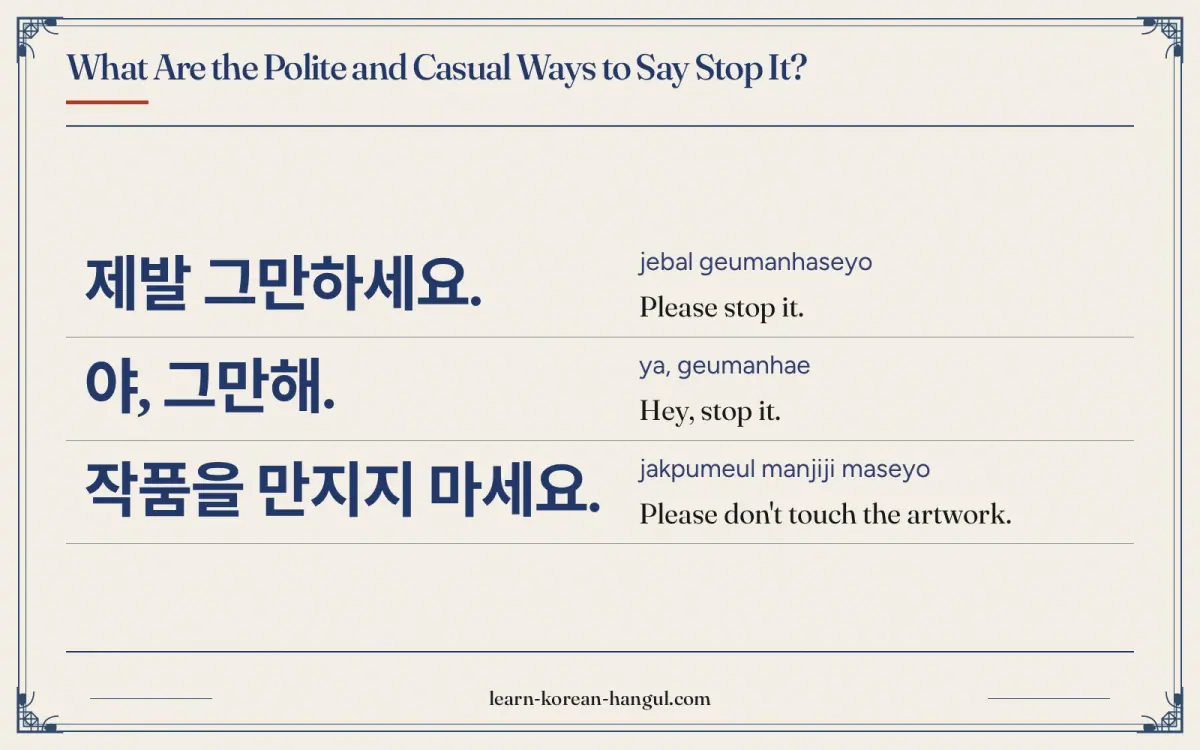
Polite · 해요체그만하세요 stops something that is already going on, such as teasing, noise or an argument. It is polite and firm, and works with strangers, elders and coworkers. Add 제발 (please) if the person keeps going.
제발 그만하세요.
jebal geumanhaseyo
Please stop it.
Casual: 그만해 (geumanhae)
Casual · 반말그만해 drops the polite ending, so it is casual (해체). Use it with a close friend, a sibling or someone younger. A short 야 (ya, hey) in front is common between friends. Do not use it with elders or strangers, because it sounds like an order.
야, 그만해.
ya, geumanhae
Hey, stop it.
Polite: 하지 마세요 (haji maseyo)
Polite · 해요체하지 마세요 forbids an action: -지 마세요 means "please don't do it". Put the action verb in front of it, such as 만지지 마세요 (manjiji maseyo, please don't touch). It fits signs, museum staff and anyone about to do something. The casual form is 하지 마, covered in hajima in Korean.
작품을 만지지 마세요.
jakpumeul manjiji maseyo
Please don't touch the artwork.
Polite: 멈춰요 (meomchwoyo)
Polite · 해요체멈춰요 comes from 멈추다 (meomchuda), to stop or halt. It is about movement: a car, a person walking, a machine. Used for behavior, such as teasing, it sounds odd. Use it when someone must stand still, and say 그만하세요 when someone must end an action.
거기서 멈춰요.
geogiseo meomchwoyo
Stop right there.
Casual: 그만 좀 해 (geuman jom hae)
Casual · 반말그만 좀 해 adds 좀 (jom), which here sounds impatient rather than soft. It means "knock it off" or "come on, enough". Use it only with close friends who keep going after you asked once, since it shows annoyance.
이제 그만 좀 해.
ije geuman jom hae
Knock it off already.
Stop it is a strong request, so the sounds matter, and they come next.
How Do You Pronounce 그만하세요?
그만하세요 is written with five syllables and pronounced [그만하세요], geumanhaseyo. Say it as two beats: 그만, then 하세요. The five syllables sound like this.
- 그 (geu): a soft g and the vowel ㅡ, with spread lips and unrounded, like "geu".
- 만 (man): "mahn", with a clear n at the end.
- 하 (ha): "hah" with a light h.
- 세 (se): "seh".
- 요 (yo): "yoh".
Sound Changes to Listen For
Four details from the National Institute of Korean Language Standard Pronunciation Rules (표준 발음법) and natural speech matter here.
- Light ㅎ in 하. After the final ㄴ of 만, the ㅎ is weak. In careful speech it is [그만하세요], and in fast speech the ㄴ links to the next vowel, so 그만해 can sound like [그마내] and 그만하세요 like [그마나세요].
- ㅡ is unrounded. The vowel ㅡ in 그 is made with spread lips. Rounding the lips turns it into the vowel ㅜ, and the word changes.
- Tense sound in 찍지 마세요. In 찍지 마세요 (jjikji maseyo, please don't take photos), the verb stem ends in ㄱ, so the ㅈ after it becomes tense: [찍찌 마세요]. Revised Romanization does not show tensing caused by a neighbouring sound.
- 마세요 has no ㄹ. The verb 말다 drops its ㄹ before ㅅ, so 하지 마세요 is never written 하지 말세요. Say [하지 마세요].
With the sounds clear, the next question is which form to use with which person.
When Should You Use 그만하세요, and When Should You Not?
Use 그만하세요 to end something that is already going on. Use 하지 마세요 to say don't before something happens. Use 그만해 or 그만 좀 해 only with close friends.
Situations Where It Fits
- Teasing or jokes that went too far. 그만하세요. 불편해요. (Please stop. It makes me uncomfortable.)
- A child or friend repeating a noise. 그만해. (Stop it.)
- A museum or shop. 만지지 마세요. (Please don't touch.)
- Someone running into danger. 멈춰요. (Stop.)
Situations to Avoid
- With elders or bosses, as 그만해. The casual form sounds like an order to a superior.
- With 그만 좀 해 to a stranger. The impatient 좀 sounds hostile.
- As a joke. Tone matters, and in a serious moment a flat voice shows you mean it.
- In real danger. Call for help with help in Korean and use 112 for police or 119 for fire and ambulance.
Short scenes show how the forms sound in real talk.
What Does Stop It Sound Like in a Real Conversation?
A request to stop has a reaction and often an apology. Each scene below keeps the ending that fits the people.
Between Friends
Friend A
야, 그만해.
ya, geumanhae
Hey, stop it.
Friend B
알았어, 미안해.
arasseo, mianhae
Okay, sorry.
What to notice: the casual 그만해 and 알았어 match the close friendship.
In a Museum
Staff
작품을 만지지 마세요.
jakpumeul manjiji maseyo
Please don't touch the artwork.
Visitor
아, 죄송합니다.
a, joesonghamnida
Oh, I'm sorry.
What to notice: 마세요 forbids the action, and 죄송합니다 is the formal apology.
Asking a Coworker to Stop Teasing
You
그만하세요. 불편해요.
geumanhaseyo. bulpyeonhaeyo
Please stop. It makes me uncomfortable.
Coworker
미안해요. 알겠어요.
mianhaeyo. algesseoyo
Sorry. Got it.
What to notice: the polite 그만하세요 is firm without being rude, and the reason follows in a short sentence.
What Should You Know about the Culture behind Stop It?
A request to stop is a strong act in Korean, so the wording shows respect even when you are firm.
- Polite plus a reason. Asking a stranger to stop is done with the polite 세요 ending, often with 좀 to soften and a short reason, since a bare command is a strong act.
- Age and rank matter. Between friends of the same age 그만해 is normal, but the same words to an older person feel disrespectful.
- Tone does the work. A calm, low voice with 그만하세요 sounds firm. A raised voice makes the same words sound angry.
- Signs use the formal style. Public signs often read 하지 마십시오 (haji masipsio, do not), which is the formal command form.
An expert insight: the English "stop" covers three Korean ideas. 그만하다 ends a behavior, 하지 말다 forbids one before it begins, and 멈추다 halts movement. A learner who uses 멈춰 for teasing is understood but sounds strange, so match the verb to the situation. The mistakes below show where the words collide.
What Mistakes Do Learners Make with Stop It in Korean?
Most mistakes with stop it come from the verb choice and from the register of the command.
| Mistake | Why it is a problem | Fix |
|---|---|---|
| Saying 멈춰 for "stop doing that" | 멈추다 means halt or stop moving | Say 그만하세요 |
| Saying 그만두세요 | 그만두다 means quit or give up | Say 그만하세요 |
| Using 그만해 with a boss or elder | Casual speech is too direct | Say 그만하세요 |
| Using 그만하세요 before an action starts | It ends something in progress | Say 하지 마세요 |
| Saying 하지 말세요 | 말다 drops its ㄹ before ㅅ | Say 하지 마세요 |
Learners often assume that any short word works as a command. Actually, a bare 그만! is blunt, and Korean listeners hear it as anger. Adding 하세요 or 마세요 keeps the request polite.
Is It the Same as Stop?
The short answers below cover the other ways people search for this phrase.
- Stop in Korean: 그만하세요 for ending a behavior, 멈춰요 for halting movement, and 일시정지 (ilsijeongji, temporary stop) on road signs.
- Stop Korean: the same words, and 그만 alone means "enough" in a sentence.
- Stop doing that in Korean: 그러지 마세요 (geureoji maseyo, please don't do that) or 하지 마세요.
- Knock it off in Korean: 그만 좀 해, with close friends only.
- Cut it out in Korean: 그만해, in casual speech.
The related pages below continue the responses vocabulary.
Related Phrases to Learn Next
Stop it sits beside the other short responses you use in conversation.
- Shut up in Korean: a stronger and ruder way to end speech, with safe-use warnings.
- Don't worry in Korean: 걱정하지 마세요, a kind phrase that uses the same 마세요 pattern.
- Hajima in Korean: the casual 하지 마 in K-drama and daily talk.
- Help in Korean: what to say when stopping someone is not enough.
This guide belongs to the korean filler words collection. What this page does not cover: legal steps for harassment or scolding children. Say 그만하세요 to stop an action, 하지 마세요 to forbid one, and you can say stop it in Korean in any situation.
Practice: Say It Aloud
Play the slow clip of 그만하세요 and repeat it three times, then try 하지 마세요 and 그만해. Then choose the phrase for each case. Answers follow.
- A stranger keeps tapping your seat on the bus.
- A visitor is about to touch a display.
- Your best friend keeps teasing you.
- A runner is about to step into the road.
Answers
- 그만하세요.
- 만지지 마세요.
- 야, 그만해. or 그만 좀 해.
- 멈춰요.
The phrase flashcards drill the stop requests with audio.
Frequently Asked Questions
How do you say stop it in Korean?
Say 그만하세요 (geumanhaseyo), the polite request, or 그만해 (geumanhae) with close friends. To forbid something before it starts, say 하지 마세요 (haji maseyo). To halt a moving person or car, say 멈춰요 (meomchwoyo).
How do you pronounce 그만하세요?
Pronounce it [그만하세요]. It has five syllables. The ㅎ in 하 is weak after ㄴ, so in fast speech you may hear [그마나세요]. The vowel in 그 is ㅡ, with spread lips. The Revised Romanization is geumanhaseyo.
What is the difference between 그만하세요 and 그만해?
그만하세요 is polite, in the 해요체 style, and fits strangers, elders and coworkers. 그만해 is casual, in the 해체 style, and fits close friends and younger people. Both stop an action that is already going on.
Is 그만하세요 formal or casual?
It is polite, so it is neither formal nor casual. The formal version is 그만하십시오, used in announcements, and the casual version is 그만해. Between them, 그만하세요 is the safest choice.
Can I use 그만하세요 with friends, elders and strangers?
Yes with strangers and elders, because it is polite. With close friends, 그만해 is natural. With an elder or boss, keep the polite form and soften it with 죄송하지만 (sorry, but) or a short reason.
What is the most common mistake with stop it in Korean?
The most common mistake is using 멈춰 for "stop doing that". 멈춰 means halt or stop moving, so 그만하세요 is the right choice for ending a behavior. A second mistake is using the casual 그만해 with someone older.