How Do You Say Have a Nice Weekend in Korean?
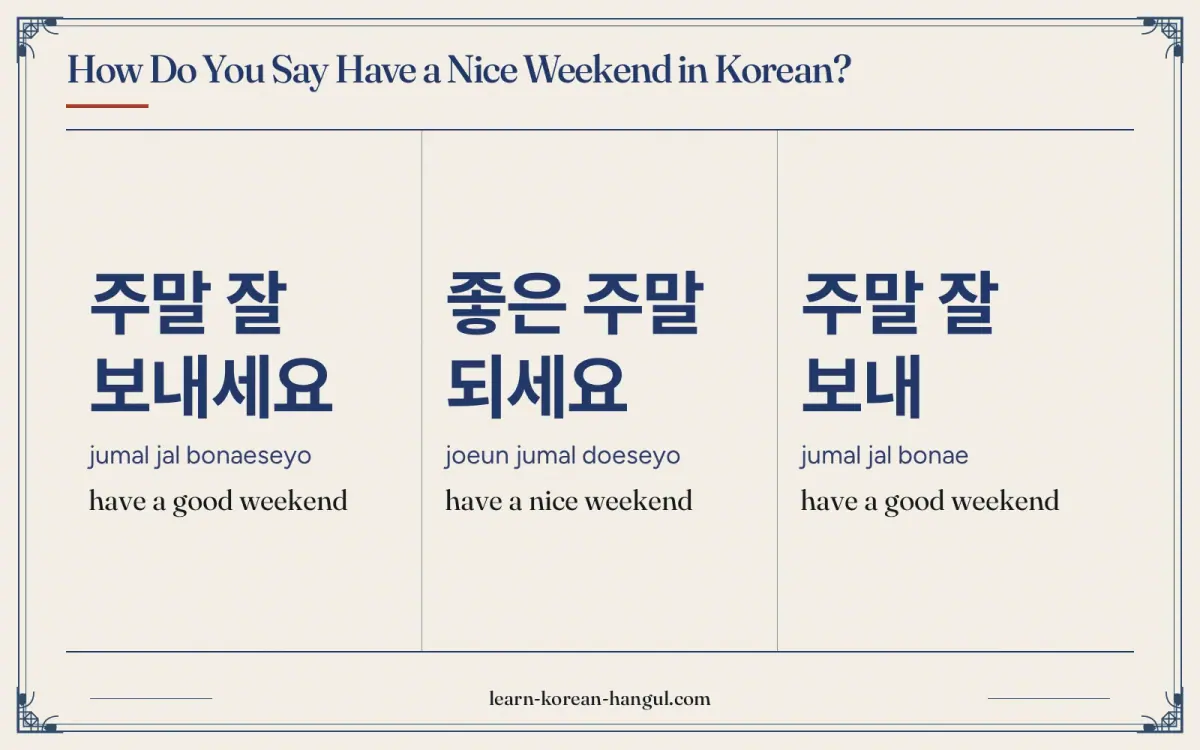
The standard polite way to say have a nice weekend in Korean is 주말 잘 보내세요 (jumal jal bonaeseyo). The phrase has three parts: 주말 (jumal, "weekend"), 잘 (jal, "well") and 보내세요 (bonaeseyo, "please spend"). Together they ask the listener to spend the weekend well.
Four forms cover most situations.
| Korean | Revised Romanization | Meaning | Register |
|---|---|---|---|
| 주말 잘 보내세요 | jumal jal bonaeseyo | have a good weekend | polite (해요체) |
| 좋은 주말 되세요 | joeun jumal doeseyo | have a nice weekend | polite |
| 주말 잘 보내 | jumal jal bonae | have a good weekend | casual (해체) |
| 주말 잘 쉬세요 | jumal jal swiseyo | have a good rest this weekend | polite |
Revised Romanization (the South Korean government standard of 2000) is a reading aid only. The Hangul is the real spelling. The next section sorts the four forms by listener.
What Are the Polite and Casual Ways to Say Have a Nice Weekend?
Korean weekend wishes follow the usual levels, and the Korean speech levels explain how the endings change. The polite level is the default for coworkers, neighbours and teachers, and the casual level belongs to friends and family of the same age or younger.
Polite: 주말 잘 보내세요 (jumal jal bonaeseyo)
주말 잘 보내세요 means "have a good weekend" and is the form to learn first. The verb 보내다 (bonaeda) means "to spend time," and the ending -세요 is the polite request form. It suits coworkers, teachers and neighbours.
Example: 팀장님, 주말 잘 보내세요. (timjangnim, jumal jal bonaeseyo.) "Team leader, have a good weekend."
Polite: 좋은 주말 되세요 (joeun jumal doeseyo)
좋은 주말 되세요 means "have a nice weekend." The verb 되다 (doeda) means "to become," so the phrase literally says "please become a good weekend." It is common in text messages, emails and service settings, and some speakers prefer 보내세요 in careful speech.
Example: 좋은 주말 되세요. 월요일에 봬요. (joeun jumal doeseyo. woryoire bwaeyo.) "Have a nice weekend. See you on Monday."
Casual: 주말 잘 보내 (jumal jal bonae)
주말 잘 보내 means "have a good weekend" with no 요, which makes it casual. Friends, siblings and younger coworkers hear it. The sentence is short and friendly, and it is rude to a boss.
Example: 주말 잘 보내. 월요일에 봐. (jumal jal bonae. woryoire bwa.) "Have a good weekend. See you Monday."
Polite: 주말 잘 쉬세요 (jumal jal swiseyo)
주말 잘 쉬세요 means "have a good rest this weekend." The verb 쉬다 (swida) means "to rest," and the phrase hints that the listener has worked hard and deserves a break. It fits coworkers after a busy week.
Example: 이번 주 수고하셨어요. 주말 잘 쉬세요. (ibeon ju sugohasyeosseoyo. jumal jal swiseyo.) "You worked hard this week. Have a good rest this weekend."
Choosing a Form by Listener
The table gives one clear choice per listener. When two listeners are present, speak to the one with higher rank.
| Listener | Best choice | Why |
|---|---|---|
| Boss or senior coworker | 주말 잘 보내세요 | polite and complete |
| Coworker after a busy week | 주말 잘 쉬세요 | shows care for their rest |
| Text or email to anyone | 좋은 주말 되세요 | common in writing |
| Friend, sibling, younger coworker | 주말 잘 보내 | casual |
Once the choice is clear, the next step is to hear the words.
How Do You Pronounce 주말 잘 보내세요?
주말 잘 보내세요 is pronounced [주말 잘 보내세요], roughly "ju-mal jal bo-nae-se-yo," with seven syllables in three word groups. Play the slow clip, then the normal clip, and repeat each one aloud.
| Word | Spelled | Spoken | Revised Romanization |
|---|---|---|---|
| 주말 | 주-말 | [주말] | jumal |
| 잘 | 잘 | [잘] | jal |
| 보내세요 | 보-내-세-요 | [보내세요] | bonaeseyo |
Sound Changes to Listen for in 주말 잘 보내세요
The phrase has no large spelling change, so each syllable is read as written. The final ㄹ of 주말 stays a light "l" sound and does not link to 잘, because 잘 starts with a consonant. Say "ju-mal" with the tongue touching the roof of the mouth, then start "jal" fresh. In Standard Pronunciation Rules (표준 발음법) of the National Institute of Korean Language (국립국어원) terms, nothing needs to change.
The standard pronunciation rules (Article 4) still list ㅐ and ㅔ as two vowels, but most Seoul speakers today pronounce them the same, so "bo-nae-se-yo" can sound like "bo-ne-se-yo." Write 보내세요 with ㅐ, and say it as you hear the clip. The variant 좋은 주말 되세요 adds one change: the ㅎ of 좋은 is silent before the vowel, so it is read [조은 주말 되세요]. With the sounds clear, the next question is when to say the wish.
When Should You Use 주말 잘 보내세요, and When Should You Not?
Coworkers say 주말 잘 보내세요 on Friday afternoon as they leave or end a call, and 잘 쉬세요 hints at rest after a hard week. The wish also closes a Friday email or a message to a neighbour or teacher.
Situations Where 주말 잘 보내세요 Fits
- Leaving the office on Friday. Say it to coworkers as you pack up.
- Ending a Friday call or message. Add it as the last line.
- Parting from a teacher or neighbour before a weekend. It is polite and warm.
Situations to Avoid with 좋은 주말 되세요
- A person who works that weekend. Saying 좋은 주말 되세요 to someone who works that weekend sounds out of touch, and 수고하세요 (sugohaseyo, "keep up the good work") fits better.
- A boss, in the casual form. 주말 잘 보내 is rude to a senior person.
- A Monday morning. The wish belongs to the end of the week. On Monday, ask about the weekend instead.
When unsure, pick 주말 잘 보내세요. The dialogues below show the wish in two settings.
What Does Have a Nice Weekend Sound Like in a Real Conversation?
Read each dialogue, play the clip, and say one role aloud.
Dialogue 1: Friday afternoon in the office
- A: 팀장님, 주말 잘 보내세요. (timjangnim, jumal jal bonaeseyo.) "Team leader, have a good weekend."
- B: 네, 주말 잘 보내세요. 월요일에 봬요. (ne, jumal jal bonaeseyo. woryoire bwaeyo.) "Yes, have a good weekend. See you Monday."
팀장님, 주말 잘 보내세요. 네, 주말 잘 보내세요. 월요일에 봬요.
Dialogue 2: Monday morning
- A: 안녕하세요. 주말 잘 보냈어요? (annyeonghaseyo. jumal jal bonaesseoyo?) "Hello. Did you have a good weekend?"
- B: 네, 푹 쉬었어요. (ne, puk swieosseoyo.) "Yes, I rested well."
안녕하세요. 주말 잘 보냈어요? 네, 푹 쉬었어요.
In Dialogue 1, the junior speaker wishes first and the senior speaker returns the wish, which is the polite order. In Dialogue 2, the question 주말 잘 보냈어요? (the past form of the wish) is the Monday partner of Friday's line. The guide to hello in Korean shows the greeting that opens the second scene. A small habit lies behind this pair.
What Should You Know about the Culture behind Have a Nice Weekend?
After weekends, people ask 주말 잘 보냈어요? on Monday, which makes it a pair of greetings. The Friday wish and the Monday question belong together: one looks forward, and the other looks back. A short answer, such as 네, 잘 보냈어요 (ne, jal bonaesseoyo, "yes, I had a good one") or 푹 쉬었어요, is enough, and a small detail about what you did is welcome.
In many offices, the weekend wish also marks the end of the work week, in the same way as a goodbye. A person who is staying late may answer 수고하세요 or 감사합니다, and a person who works on weekends may get 수고하세요 instead of a weekend wish. The wish shows awareness of the other person's schedule, which is part of why learners find the choice tricky.
What Mistakes Do Learners Make with Have a Nice Weekend in Korean?
The most common mistake is saying 좋은 주말 되세요 to someone who works that weekend, where 수고하세요 fits better. Five mistakes appear again and again:
- Wishing a weekend to someone who is working. Fix: use 수고하세요.
- Using the casual 주말 잘 보내 with a boss. Fix: add 세요.
- Dropping 잘. 주말 보내세요 is incomplete. Fix: keep 잘.
- Using the wish on Monday. Fix: ask 주말 잘 보냈어요? instead.
- Using 보내세요 for your own weekend. The -세요 ending asks the listener. Fix: for yourself, say 주말에 쉴 거예요 (jumare swil geoyeyo, "I will rest this weekend").
All five come from translating word by word. A few related searches ask the same thing in other words, so they are answered next.
Short Answers on Weekend, Nice Weekend and Good Weekend
Three searches lead to this page, so each gets a short answer.
- Weekend in Korean: The word is 주말 (jumal). The vocabulary entry for weekend in Korean lists related words such as 토요일 (toyoil, "Saturday") and 일요일 (iryoil, "Sunday").
- Nice weekend in Korean: 좋은 주말 되세요 or 주말 잘 보내세요 both work.
- Good weekend in Korean: The same two phrases cover "good weekend," and the casual form is 주말 잘 보내.
The related pages have a good day in Korean and take care in Korean give other parting wishes. After the answers, the next step is to keep building the cluster.
Related Phrases to Learn Next
Three pages follow the same layout and pair well with this one:
- Have a good day in Korean: the daily version of the wish.
- See you tomorrow in Korean: a farewell with a promise to meet again.
- Take care in Korean: a wish that fits a longer parting.
The complete list sits in the Korean greetings cluster.
Practice: Say It Aloud
Spend five minutes on this routine.
- Play the slow clip of 주말 잘 보내세요 and repeat it three times.
- Say it again at normal speed, with a small smile.
- Say 주말 잘 쉬세요 and 주말 잘 보내, and name the listener for each.
- Say the Monday question 주말 잘 보냈어요? and answer it aloud.
- Drill the cluster with the phrase flashcards.
When the phrase comes out without thinking, you can say have a nice weekend in Korean in the right form for each listener.
Frequently Asked Questions
The answers below add details about how to say have a nice weekend in Korean beyond the sections above.
What does 보내세요 mean in 주말 잘 보내세요?
보내세요 comes from the verb 보내다 (bonaeda), which means "to spend time" or "to send." In this phrase it means "please spend," so the whole sentence asks the listener to spend the weekend well. The ending -세요 makes the request polite and respectful.
What is the difference between 주말 잘 보내세요 and 좋은 주말 되세요?
Both mean "have a nice weekend" and both are polite. 보내세요 uses the verb "spend," while 되세요 uses "become." Some speakers prefer 보내세요 in careful speech, but 되세요 is very common in messages, so learners should recognise both and can use either.
Is 주말 잘 보내세요 formal or casual?
주말 잘 보내세요 is polite, in the 해요체 style, between formal and casual. The formal version is 주말 잘 보내십시오 (jumal jal bonaesipsio), used in written notices. The casual version is 주말 잘 보내, used with friends and younger people.
Can I use 주말 잘 보내세요 with friends, elders and strangers?
With elders, bosses and strangers, 주말 잘 보내세요 is the right choice. With close friends and younger coworkers, the casual 주말 잘 보내 sounds warmer. Never use the casual form with a boss, because dropping the 요 sounds rude to a senior person.
How do I reply when someone says have a good weekend to me?
Answer 네, 주말 잘 보내세요 (ne, jumal jal bonaeseyo), which returns the wish, or 감사합니다 (gamsahamnida, "thank you") and add 월요일에 봬요 ("see you Monday"). Between friends, 응, 너도 (eung, neodo, "yeah, you too") is enough and sounds friendly and natural.
What is the most common mistake with have a nice weekend in Korean?
Learners say 좋은 주말 되세요 to someone who works that weekend, where 수고하세요 fits better. A second frequent mistake is using the casual 주말 잘 보내 with a boss, which sounds rude. Check the person's schedule and rank before choosing the wish.