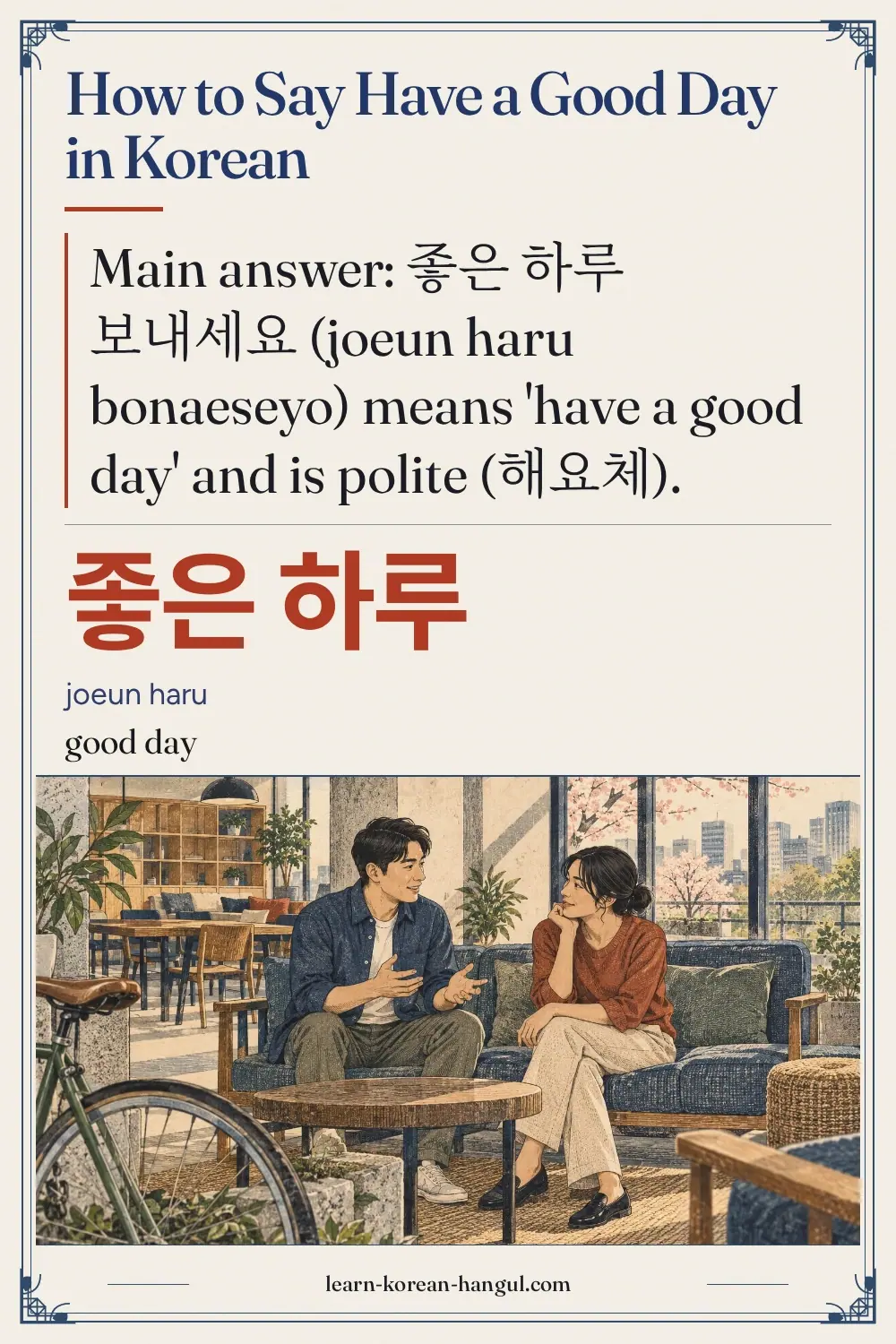
How Do You Say Have a Good Day in Korean?
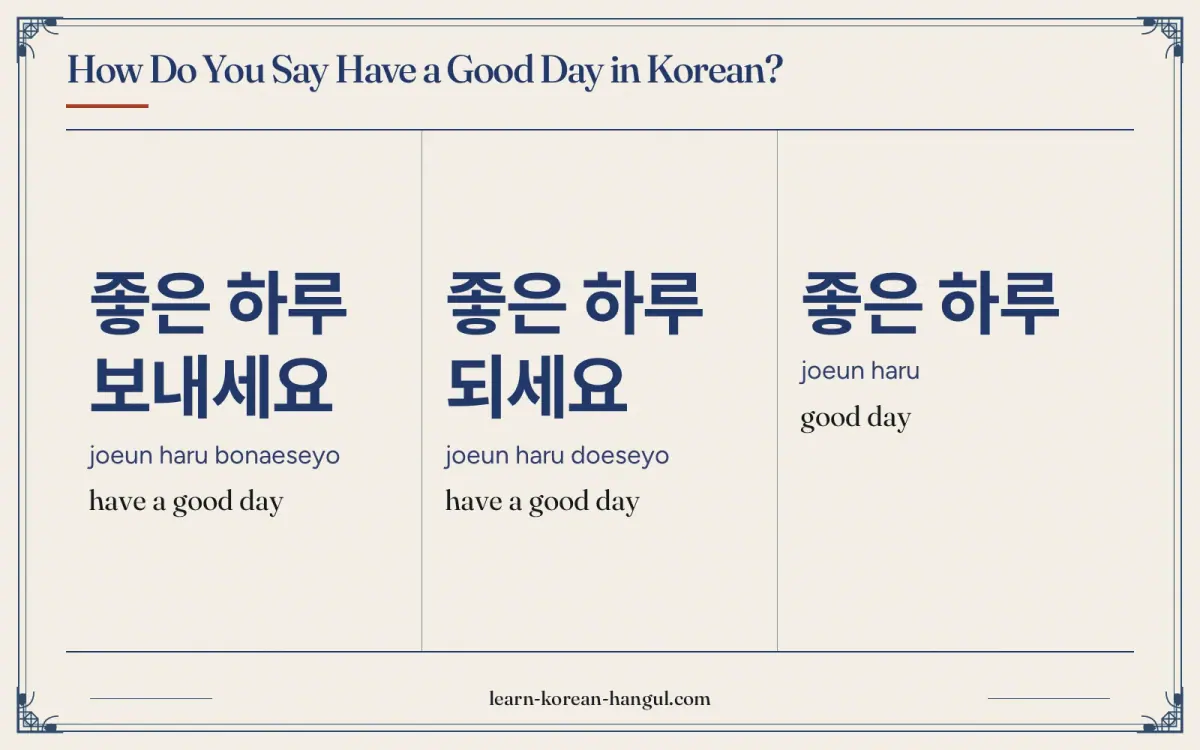
The standard polite way to say have a good day in Korean is 좋은 하루 보내세요 (joeun haru bonaeseyo). The phrase has three parts: 좋은 (joeun, "good"), 하루 (haru, "one day, a day") and 보내세요 (bonaeseyo, "please spend"). Together they ask the listener to spend the day well.
Three forms cover nearly every situation.
| Korean | Revised Romanization | Meaning | Register |
|---|---|---|---|
| 좋은 하루 보내세요 | joeun haru bonaeseyo | have a good day | polite (해요체) |
| 좋은 하루 되세요 | joeun haru doeseyo | have a good day | polite, common in service |
| 좋은 하루 | joeun haru | good day | casual |
Revised Romanization (the South Korean government standard of 2000) is a reading aid only; the Hangul is the real spelling. The next section sorts the three forms by listener.
What Are the Polite and Casual Ways to Say Have a Good Day?
Korean wishes follow the same levels as other sentences. The Korean speech levels decide whether the ending is polite (-세요), formal (-십시오) or casual (no 요, or no verb at all, as in 좋은 하루). For a farewell wish, the polite level is the one you will use most.
Polite: 좋은 하루 보내세요 (joeun haru bonaeseyo)
좋은 하루 보내세요 means "have a good day" and is the most complete polite version. The verb 보내다 (bonaeda) means "to spend time," and the ending -세요 is the polite request form. It suits teachers, neighbours, customers and coworkers.
Example: 감사합니다. 좋은 하루 보내세요. (gamsahamnida. joeun haru bonaeseyo.) "Thank you. Have a good day."
Polite: 좋은 하루 되세요 (joeun haru doeseyo)
좋은 하루 되세요 also means "have a good day," and it is very common in text and service settings. The verb 되다 (doeda) means "to become," so the phrase literally says "please become a good day." Some Korean speakers and style guides prefer 보내세요 for that reason, but 되세요 is widely heard, and learners will meet it in shops and in messages.
Example: 오늘도 좋은 하루 되세요. (oneuldo joeun haru doeseyo.) "Have a good day today, too."
Casual: 좋은 하루 (joeun haru)
좋은 하루 means "a good day" and works as a short wish between friends, in messages, or at the end of a note. It has no verb and no 요, which makes it casual. A friend can send 좋은 하루! with a smile symbol, and the other friend can answer with the same words.
Example: 나 이제 가. 좋은 하루! (na ije ga. joeun haru!) "I'm going now. Have a good day!"
Choosing a Form by Listener
The table gives one clear choice for each listener. When two listeners are present, speak to the one with higher rank.
| Listener | Best choice | Why |
|---|---|---|
| Customer leaving a shop | 좋은 하루 보내세요 or 좋은 하루 되세요 | polite and expected in service |
| Teacher or coworker | 좋은 하루 보내세요 | polite and complete |
| Text to a neighbour | 좋은 하루 되세요 | common in messages |
| Close friend | 좋은 하루 | casual and short |
| Foreign guest, written note | 좋은 하루 보내세요 | clear and widely understood |
After the choice is clear, the next step is to hear how the words sound.
How Do You Pronounce 좋은 하루 보내세요?
좋은 하루 보내세요 is pronounced [조은 하루 보내세요], roughly "jo-eun ha-ru bo-nae-se-yo," with eight syllables in three word groups. Play the slow clip, then the normal clip, and repeat each one aloud.
| Word | Spelled | Spoken | Revised Romanization |
|---|---|---|---|
| 좋은 | 좋-은 | [조은] | joeun |
| 하루 | 하-루 | [하루] | haru |
| 보내세요 | 보-내-세-요 | [보내세요] | bonaeseyo |
Sound Changes to Listen for in 좋은 하루 보내세요
Only one spelling change occurs. In 좋은, the letter ㅎ is written but silent, because a vowel follows it. The Standard Pronunciation Rules (표준 발음법) of the National Institute of Korean Language (국립국어원) cover this in Article 12, so 좋은 sounds like [조은]. The other two words are read as spelled. Learners often add a hidden "h" in "joh-eun," and the fix is to say the vowel sound directly after "jo."
In the polite ending 세요, the syllable 세 is a clear "se" and 요 is a quick "yo." The standard pronunciation rules (Article 4) still list ㅐ and ㅔ as two vowels, but most Seoul speakers today pronounce them the same, so 보내세요 can sound like "bo-ne-se-yo" to a beginner's ear; spell it with ㅐ, and say it as you hear the clip.
With the pronunciation in hand, the next question is when the wish fits.
When Should You Use 좋은 하루 보내세요, and When Should You Not?
Use 좋은 하루 보내세요 when leaving a shop, hanging up a call or ending a message. 좋은 하루 되세요 is very common in text and in service settings, so a clerk is likely to say it to you before you say it to anyone.
Situations Where 좋은 하루 보내세요 Fits
- Leaving a shop or cafe. Pay, say 감사합니다, then add 좋은 하루 보내세요.
- Ending a phone call with a customer or a neighbour. The wish closes the call politely.
- Closing a message or email. Put 좋은 하루 보내세요 as the last line of a short note.
Situations to Avoid with 좋은 하루 보내세요
- A close friend, face to face. Saying it to a close friend face to face sounds stiff, and a plain 잘 가 (jal ga, "go well") is more natural.
- Someone who is staying at work. For a person who stays behind to work, a different wish such as 수고하세요 (sugohaseyo, "keep up the good work") may fit better.
- A formal speech or written notice. Use the formal 좋은 하루 보내십시오 (joeun haru bonaesipsio) there instead of the polite form.
If you are unsure, pick 좋은 하루 보내세요 and add a smile. The short scenes below show the phrase in action.
What Does Have a Good Day Sound Like in a Real Conversation?
Read each dialogue, play the clip, and then say one role aloud.
Dialogue 1: Leaving a shop
- A: 감사합니다. 좋은 하루 보내세요. (gamsahamnida. joeun haru bonaeseyo.) "Thank you. Have a good day."
- B: 네, 감사합니다. 안녕히 계세요. (ne, gamsahamnida. annyeonghi gyeseyo.) "Yes, thank you. Goodbye."
감사합니다. 좋은 하루 보내세요. 네, 감사합니다. 안녕히 계세요.
Dialogue 2: Two friends parting
- A: 나 이제 가. 좋은 하루! (na ije ga. joeun haru!) "I'm going now. Have a good day!"
- B: 응, 너도 좋은 하루! (eung, neodo joeun haru!) "Yeah, you too!"
나 이제 가. 좋은 하루! 응, 너도 좋은 하루!
In Dialogue 1, the customer says 안녕히 계세요 (goodbye to the person who stays), which pairs naturally with the clerk's wish. The guide to goodbye in Korean explains both goodbyes. In Dialogue 2, both friends use the casual form and mirror each other with 너도 ("you too"). A cultural note explains why this wish is less common than it looks.
What Should You Know about the Culture behind Have a Good Day?
The wish sounds a bit like English, and many Koreans prefer to part with a more specific line, such as 안녕히 가세요 (annyeonghi gaseyo), a thanks for the person's effort, or a remark about what they are about to do. The phrase is understood everywhere and used in service settings, so a foreign visitor who says it will be welcomed. In casual speech among Koreans, the farewell often names the situation instead of wishing a general good day.
Messages differ from speech. In a text or an email, 좋은 하루 되세요 is a common sign-off, and the sign-off is read as friendly, not as a translation. A wish for the day is a safe, warm closing for foreigners, service staff and written notes, and a plain goodbye is safer between Korean friends. This difference between speech and writing produces a few steady mistakes.
What Mistakes Do Learners Make with Have a Good Day in Korean?
The most common mistake is saying 좋은 하루 보내세요 to a close friend face to face, where a plain 잘 가 is more natural. Five mistakes appear again and again:
- Using the polite form with a close friend. Fix: use 좋은 하루 or 잘 가.
- Using the casual 좋은 하루 with a teacher. Fix: add 보내세요.
- Dropping 하루. 좋은 보내세요 is incomplete. Fix: keep the noun 하루.
- Pronouncing ㅎ in 좋은. Reading it as "joh-eun" sounds wrong. Fix: say [조은].
- Treating the wish as a goodbye. The wish adds to a goodbye and does not replace it. Fix: say 안녕히 가세요 or 안녕히 계세요 and then the wish.
Each mistake comes from carrying English habits into Korean. A few related searches ask the same thing in other words, so they are answered next.
Short Answers on Have a Nice Day, Great Day and Enjoy Your Day
Four searches lead to this page, so each gets a short answer.
- Have a nice day in Korean: The same phrase, 좋은 하루 보내세요, covers "have a nice day."
- Have a great day in Korean: Add 정말 (jeongmal, "really") for emphasis: 정말 좋은 하루 보내세요.
- Good day in Korean: The short form 좋은 하루 is the casual "good day."
- Enjoy your day in Korean: 즐거운 하루 보내세요 (jeulgeoun haru bonaeseyo) uses 즐거운 ("enjoyable") in place of 좋은.
The related pages good luck in Korean and take care in Korean give other parting wishes. After the answers, practice comes next.
Related Phrases to Learn Next
Three pages follow the same layout and pair well with this one:
- Goodbye in Korean: the two goodbyes that come before the wish.
- Good luck in Korean: a wish for a specific event.
- See you tomorrow in Korean: a farewell with a promise to meet again.
The complete list sits in the Korean greetings cluster.
Practice: Say It Aloud
Spend five minutes on this routine.
- Play the slow clip of 좋은 하루 보내세요 and repeat it three times.
- Say it again at normal speed, with a small smile.
- Say 좋은 하루 되세요 and 좋은 하루, and name the listener for each.
- Hide the Romanization with the toggle and read the three forms from Hangul only.
- Drill the cluster with the phrase flashcards.
When the phrase comes out without thinking, you can say have a good day in Korean in the right form for each listener.
Frequently Asked Questions
The answers below add details about how to say have a good day in Korean beyond the sections above.
What does 보내세요 mean in 좋은 하루 보내세요?
보내세요 comes from the verb 보내다 (bonaeda), which means "to spend time" or "to send." In this phrase it means "please spend." The whole wish asks the listener to spend a good day, and the ending -세요 makes the request polite and respectful.
What is the difference between 좋은 하루 보내세요 and 좋은 하루 되세요?
Both mean "have a good day" and both are polite. 보내세요 uses the verb "spend," while 되세요 uses "become." Some speakers prefer 보내세요 for that reason, but 되세요 is very common in shops and messages, so learners should recognise both.
Is 좋은 하루 보내세요 formal or casual?
좋은 하루 보내세요 is polite, in the 해요체 style. The formal form is 좋은 하루 보내십시오 (joeun haru bonaesipsio), used in written notices. The casual form is 좋은 하루, used with close friends. Choose the ending by the person you are talking to.
Can I use 좋은 하루 보내세요 with friends, elders and strangers?
With elders, teachers and strangers, 좋은 하루 보내세요 is a safe choice. With close friends, the casual 좋은 하루 or a plain 잘 가 sounds more natural. A coworker is treated like a stranger until you know each other well, so the polite form is the default.
How do I reply when someone says have a good day to me?
Answer 네, 감사합니다 (ne, gamsahamnida, "yes, thank you"), and add 좋은 하루 보내세요 or 안녕히 가세요 if you want to wish them well back. Between friends, answer 너도 좋은 하루 (neodo joeun haru), which means "you too," with a smile or a wave.
What is the most common mistake with have a good day in Korean?
Learners say 좋은 하루 보내세요 to a close friend face to face, where a plain 잘 가 is more natural. A second frequent mistake is dropping 하루 and saying only 좋은 보내세요, which leaves the sentence without its noun and sounds broken.