How Do You Say Have a Safe Trip in Korean?
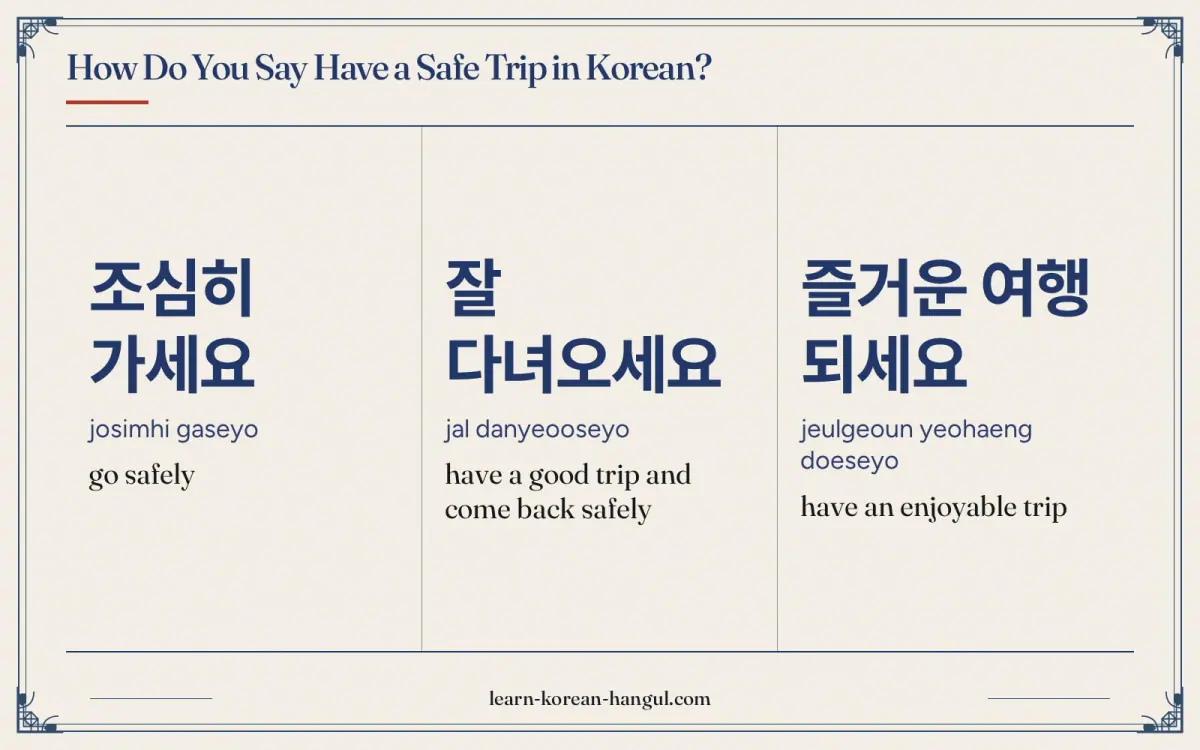
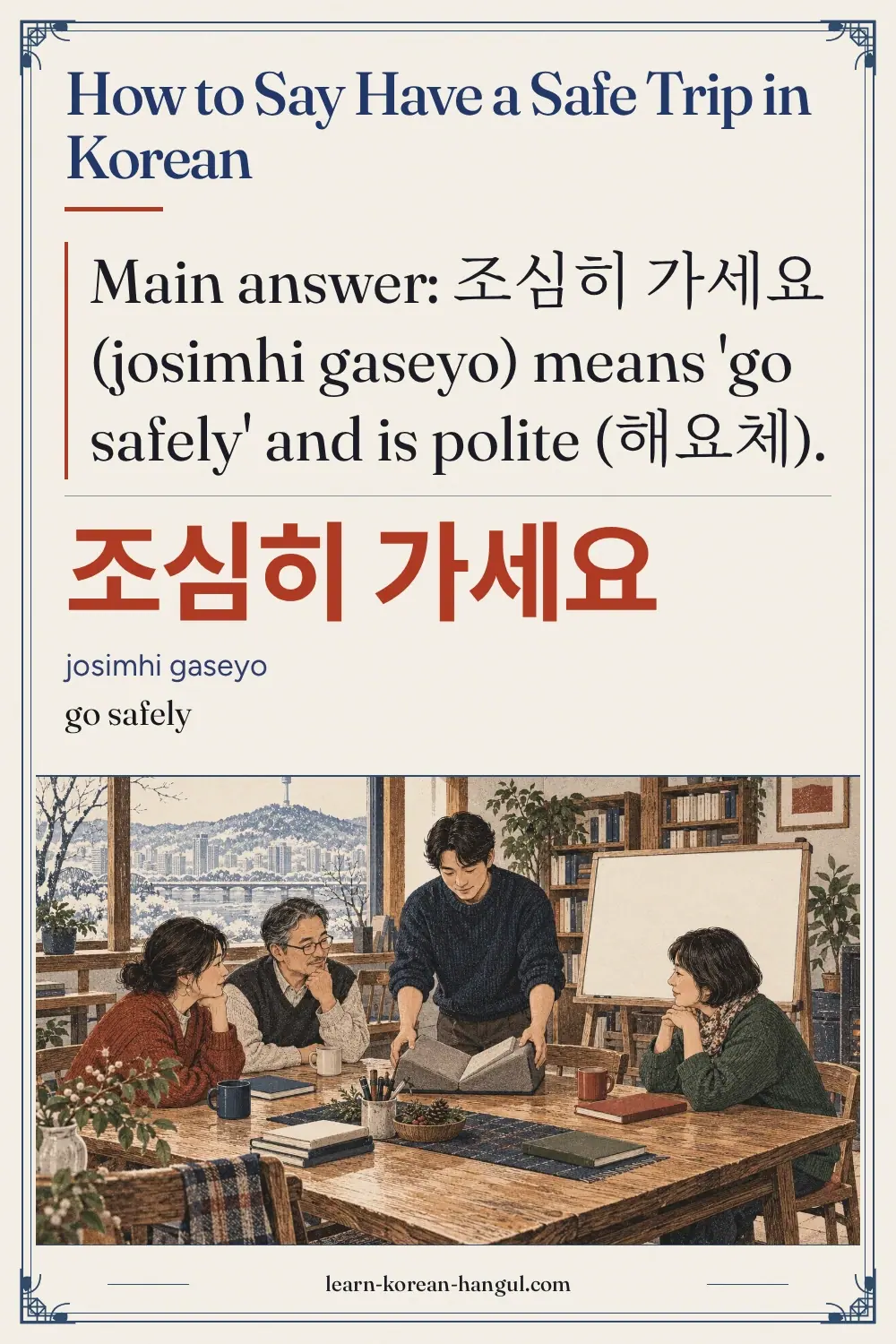
The everyday way to say have a safe trip in Korean is 조심히 가세요 (josimhi gaseyo). The phrase has three parts: 조심히 (josimhi, "carefully"), the verb stem 가 (ga, "go") and the polite honorific ending 세요 (seyo). Together they mean "please go carefully," and Koreans use them when a guest, friend or colleague leaves.
Four forms cover most situations.
| Korean | Revised Romanization | Meaning | Register |
|---|---|---|---|
| 조심히 가세요 | josimhi gaseyo | go safely | polite (해요체) |
| 잘 다녀오세요 | jal danyeooseyo | have a good trip and come back safely | polite (해요체) |
| 즐거운 여행 되세요 | jeulgeoun yeohaeng doeseyo | have an enjoyable trip | polite, formal wording |
| 조심히 가 | josimhi ga | go safely | casual (반말) |
Revised Romanization (the South Korean government standard of 2000) is a reading aid only. The Hangul is the real spelling. The next section sorts the four forms by listener.
What Are the Formal, Polite and Casual Ways to Say Have a Safe Trip?
Three of the four forms are polite, one is casual, and Korean speech levels explain why. Polite forms end in 요 or 세요 and suit strangers, colleagues and elders. The casual form drops that ending and suits close friends and younger people.
Polite: 조심히 가세요 (josimhi gaseyo)
조심히 가세요 means "go safely" and is the safest choice for anyone who is leaving. Use it when a guest walks out of your home, when a colleague heads home, or when a customer leaves your shop. It focuses on the journey itself, not on a holiday.
Example: 오늘 와 주셔서 감사합니다. 조심히 가세요. (oneul wa jusyeoseo gamsahamnida. josimhi gaseyo.) "Thank you for coming today. Go safely."
Polite: 잘 다녀오세요 (jal danyeooseyo)
잘 다녀오세요 means "have a good trip and come back safely." The verb 다녀오다 (danyeooda) means "to go somewhere and return," so the phrase promises that the speaker will be waiting. Say it to a family member leaving for work, a colleague going on a business trip, or a friend flying abroad who will come back.
Example: 내일 출장 가세요? 잘 다녀오세요. (naeil chuljang gaseyo? jal danyeooseyo.) "Are you leaving on a business trip tomorrow? Have a good trip and come back safely."
Formal: 즐거운 여행 되세요 (jeulgeoun yeohaeng doeseyo)
즐거운 여행 되세요 means "have an enjoyable trip" and uses careful wording that suits airline staff, hotel staff, teachers and elders. The ending 세요 is still the polite style (해요체). The strictly formal ending is 십시오, as in 즐거운 여행 되십시오 (jeulgeoun yeohaeng doesipsio), which you will hear in announcements. Some usage guides point out that "you become an enjoyable trip" is awkward grammar and suggest 즐거운 여행 하세요 instead, but the 되세요 version is what most Koreans say.
Example: 제주도에 가세요? 즐거운 여행 되세요. (jejudoe gaseyo? jeulgeoun yeohaeng doeseyo.) "Are you going to Jeju Island? Have an enjoyable trip."
Casual: 조심히 가 (josimhi ga)
조심히 가 means "go safely" and drops the polite ending, so it fits a close friend, a sibling or someone younger. Never use it with a stranger or an elder, because the missing 세요 sounds blunt.
Example: 도착하면 연락해. 조심히 가. (dochakamyeon yeollakae. josimhi ga.) "Text me when you arrive. Go safely."
Choosing a Form by Listener
The table gives one clear choice per listener.
| Listener | Best choice | Why |
|---|---|---|
| Guest leaving your home | 조심히 가세요 | polite and warm |
| Colleague, customer, stranger | 조심히 가세요 | safe at every level |
| Family or coworker who will return | 잘 다녀오세요 | promises a return |
| Traveller going on holiday, older person | 즐거운 여행 되세요 | wishes enjoyment, careful tone |
| Close friend or younger person | 조심히 가 | casual and short |
With the form chosen, the next step is how each one sounds.
How Do You Pronounce 조심히 가세요?
조심히 가세요 is pronounced [조심히 가세요], roughly "jo-sim-hi ga-se-yo," with six syllables in two word groups. Play the slow clip first, then repeat it at a normal pace.
| Word | Spelled | Spoken | Revised Romanization |
|---|---|---|---|
| 조심히 | 조-심-히 | [조심히] | josimhi |
| 가세요 | 가-세-요 | [가세요] | gaseyo |
What Sound Details Should You Listen For?
Four details matter. They follow the Standard Pronunciation Rules (표준 발음법) of the National Institute of Korean Language (국립국어원).
- 조심히 가세요 is spelled almost as it sounds. The ㅎ in 히 is light, so do not push air hard on it.
- 다녀오세요 is da-nyeo-o-se-yo, with each vowel kept separate. The syllable 녀 (nyeo) ends in the vowel ㅕ, and 오 (o) starts a new beat. Do not squeeze them into "da-nyoh."
- 즐거운 여행 is usually said [즐거운 여행]. When the two words run together, a light ㄴ occasionally appears before 여, giving [즐거운 녀행]; Article 29 of the rules allows this ㄴ insertion across two words said as one unit. Both are understood, and [여행] is the safer model.
- 되세요 has the vowel ㅚ, which most speakers say like 웨, so [뒈세요] is common; the standard rules allow both [되] and [뒈].
Clean separate syllables are the main goal. The next question is when to use each form.
When Should You Use 조심히 가세요, and When Should You Not?
Use 조심히 가세요 when someone is leaving and you are staying, and avoid it when the other person is not actually going anywhere. It wishes a safe journey, so it needs a journey: a walk home, a drive, a train or a flight.
Situations Where 조심히 가세요 Fits
- A guest leaves your home. Walk them to the door and say 조심히 가세요.
- A colleague leaves the office late. Say it at the elevator, especially at night or in bad weather.
- A customer leaves your shop. Staff often add 안녕히 가세요 (annyeonghi gaseyo), the standard "goodbye" for someone who is leaving.
Situations to Avoid with 조심히 가세요
- You are the one leaving. Say 먼저 가 볼게요 (meonjeo ga bolgeyo, "I will head off first") or 안녕히 계세요 instead.
- A stranger on the street. Total strangers do not need a send-off.
- Sending a traveller who will not return to you. 잘 다녀오세요 promises a return, so it does not fit someone moving away for good.
The dialogues below show these choices in a real exchange.
What Does Have a Safe Trip Sound Like in a Real Conversation?
Read each dialogue, play the clip, and say one role aloud.
Dialogue 1: A guest leaves
- A: 오늘 정말 감사했어요. (oneul jeongmal gamsahaesseoyo.) "Thank you so much for today."
- B: 아니에요. 조심히 가세요. (anieyo. josimhi gaseyo.) "Not at all. Go safely."
- A: 네, 또 올게요. (ne, tto olgeyo.) "Yes, I will come again."
오늘 정말 감사했어요. 아니에요. 조심히 가세요. 네, 또 올게요.
Dialogue 2: Leaving home for work
- A: 다녀오겠습니다. (danyeoogetseumnida.) "I will go and come back."
- B: 네, 잘 다녀오세요. (ne, jal danyeooseyo.) "Yes, have a good day and come back safely."
- A: 저녁에 봐요. (jeonyeoge bwayo.) "See you in the evening."
다녀오겠습니다. 네, 잘 다녀오세요. 저녁에 봐요.
Dialogue 3: Two friends part
- A: 나 이제 갈게. (na ije galge.) "I am going now."
- B: 응, 조심히 가. 도착하면 연락해. (eung, josimhi ga. dochakamyeon yeollakae.) "Okay, go safely. Text me when you arrive."
- A: 알겠어. 또 봐. (algesseo. tto bwa.) "Got it. See you."
나 이제 갈게. 응, 조심히 가. 도착하면 연락해. 알겠어. 또 봐.
Dialogue 2 shows a home ritual that gives these words their weight, and the next section explains it.
What Should You Know about the Culture behind Have a Safe Trip?
In Korean homes, the person leaving says 다녀오겠습니다 (danyeoogetseumnida, "I will go and come back"), and the people staying answer 다녀오세요 (danyeooseyo) or 잘 다녀오세요. The pair is a small daily ritual between family members, so the words show where you belong. A child leaving for school says 다녀오겠습니다 to a parent, and the parent answers in casual speech, 잘 다녀와 (jal danyeowa).
For that reason 다녀오세요 carries warmth that 조심히 가세요 does not always have. A guest hears 조심히 가세요 as courtesy, but a colleague who says 잘 다녀오세요 is telling you that your place is waiting. With the custom clear, the common mistakes are easy to spot.
What Mistakes Do Learners Make with Have a Safe Trip in Korean?
The most common mistake is using 다녀오세요 for someone who is not coming back to you. Five mistakes appear again and again:
- Using 다녀오세요 for a one-way goodbye. Fix: use 조심히 가세요 or 안녕히 가세요 for someone who will not return to you.
- Dropping 세요 with elders. 조심히 가 is casual. Fix: add 세요 for anyone older or unfamiliar.
- Saying 조심히 가세요 about yourself. The honorific -(으)시- honours the person doing the going, so it cannot describe you. Fix: say 먼저 갈게요 (meonjeo galgeyo, "I will go first").
- Squeezing 다녀오세요. The vowels collapse into "danyoseyo." Fix: say da-nyeo-o-se-yo slowly.
- Using 즐거운 여행 되세요 for a short walk home. The phrase suggests a holiday. Fix: use 조심히 가세요.
These slips come from carrying English habits into Korean, where one phrase fits every goodbye. Several related searches ask the same question in other words, so they are answered next.
Is It the Same as Have a Good Trip, Have a Good Flight or Drive Safe?
Not exactly, because Korean picks a phrase by the kind of journey. Five related searches lead to this page, so each gets a short answer.
- Have a good trip in Korean: 즐거운 여행 되세요 (jeulgeoun yeohaeng doeseyo) or 좋은 여행 되세요 (joeun yeohaeng doeseyo).
- Have a good flight in Korean: 편안한 비행 되세요 (pyeonanhan bihaeng doeseyo, "have a comfortable flight").
- Bon voyage in Korean: 즐거운 여행 되세요 is the closest match for a holiday send-off.
- Safe travels in Korean: 안전한 여행 되세요 (anjeonhan yeohaeng doeseyo, "have a safe journey").
- Drive safe in Korean: 운전 조심하세요 (unjeon josimhaseyo, "be careful driving").
For the goodbye itself, the guide to goodbye in Korean covers 안녕히 가세요 and 안녕히 계세요 in full. The pages below continue the path.
Related Phrases to Learn Next
Four pages help you finish the conversation:
- Goodbye in Korean: the two goodbyes, one for the person leaving and one for the person staying.
- Take care in Korean: the warm closing line that often follows a send-off.
- Welcome in Korean: the other side of the exchange, when the guest arrives.
- The full list sits in the Korean greetings collection.
Practice: Say It Aloud
Spend five minutes on this routine.
- Play the slow clip of 조심히 가세요 and repeat it three times.
- Say 잘 다녀오세요 with each vowel separate: da-nyeo-o-se-yo.
- Read the four forms in the register table and say who each one fits.
- Hide the Romanization with the toggle and read the forms from Hangul only.
- Drill the whole cluster with the phrase flashcards.
When these phrases come out smoothly, you can say have a safe trip in Korean to a guest, a colleague or a friend.
Frequently Asked Questions
The answers below add details about how to say have a safe trip in Korean beyond the sections above.
How do you say have a safe trip in Korean?
The everyday phrase is 조심히 가세요 (josimhi gaseyo), meaning "go safely," and it is polite. For a holiday trip, say 즐거운 여행 되세요 (jeulgeoun yeohaeng doeseyo). For someone who will come back to you, say 잘 다녀오세요 (jal danyeooseyo). With a close friend, shorten the first phrase to 조심히 가.
How do you pronounce 조심히 가세요?
Say it as jo-sim-hi ga-se-yo, with six even syllables and a light ㅎ in 히. No major sound change happens, so the spelling is a good guide. The Revised Romanization is josimhi gaseyo. Play the slow clip on this page first, then repeat at normal speed until the two word groups flow together.
What is the difference between 조심히 가세요 and 잘 다녀오세요?
조심히 가세요 wishes a safe journey to someone who is leaving, with no promise of a return. 잘 다녀오세요 uses the verb 다녀오다, "to go and come back," so it means the speaker expects the person back. Use the second for family, coworkers and friends who will return, and the first for guests.
Is 조심히 가세요 formal or casual?
조심히 가세요 is polite, in the 해요체 style, so it sits between formal and casual. The formal version is 조심히 가십시오 (josimhi gasipsio), used in announcements and formal service. The casual version, 조심히 가, is only for close friends and younger people.
Can I use 조심히 가세요 with friends, elders and strangers?
Yes. 조심히 가세요 works with elders, colleagues, guests and strangers who are leaving your company. With close friends or younger people, 조심히 가 is natural. With an elder who is about to travel for pleasure, 즐거운 여행 되세요 sounds more respectful. A total stranger on the street usually needs no send-off.
What is the most common mistake with have a safe trip in Korean?
Learners say 다녀오세요 to someone who is not coming back to them, such as a guest who is leaving for good. The verb 다녀오다 means "go and return," so the phrase expects a return. Use 조심히 가세요 or 안녕히 가세요 for a one-way goodbye. A second frequent slip is dropping 세요 with elders.