
어서 오세요
어서 오세요
What you'll learn
- Say 어서 오세요 aloud as [어서 오세요], and 환영합니다 as [화녕함니다].
- Choose between 어서 오세요, 환영합니다, 어서 와 and 잘 오셨어요 for a customer, a guest and a friend.
- Know who says 어서 오세요: the host or staff, not the visitor.
- Reply correctly when someone welcomes you in a shop, a home or an event.
Before you start: you need to read Hangul; romanization is shown as an aid and can be hidden. Time: about 10 minutes. Audio plays only when you press a button.
How Do You Say Welcome in Korean?
Korean says welcome with an invitation to come in. The most common phrase is 어서 오세요, which staff call out when a customer opens the door. Five forms cover shops, homes, events and friends, and the right one depends on who is speaking to whom.
| Form | Romanization | Register | Say it to |
|---|---|---|---|
| 어서 오세요 | eoseo oseyo | Polite (해요체, honorific) | Customers, guests, visitors; said by staff or hosts |
| 어서 오십시오 | eoseo osipsio | Very formal (합쇼체) | Department stores, hotels, formal service |
| 환영합니다 | hwanyeonghamnida | Formal (합쇼체) | Events, signs, speeches, groups of people |
| 어서 와 | eoseo wa | Casual (반말) | Close friends, family, younger people |
| 잘 오셨어요 | jal osyeosseoyo | Polite (해요체, honorific) | Guests whose visit you appreciate |
The table lists the choices. The next section shows each one in a sentence.
What Are the Formal, Polite and Casual Ways to Say Welcome?
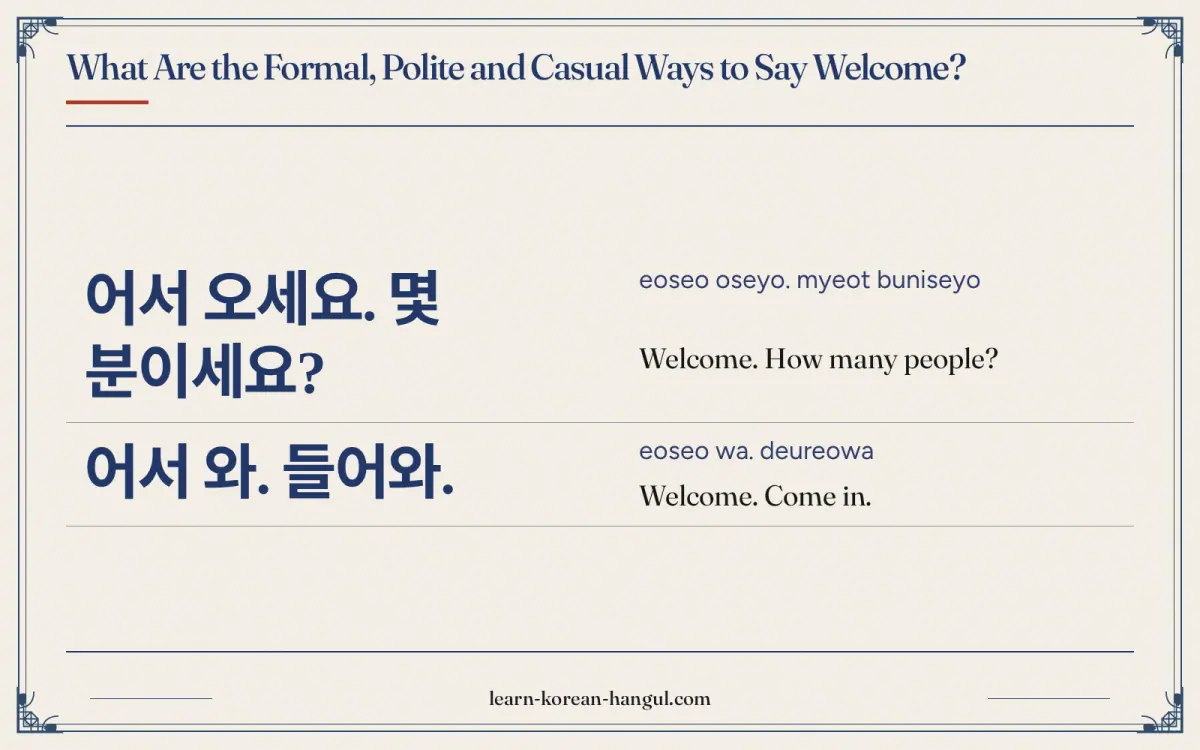
Korean changes the sentence ending to match the listener's age, status and closeness. These endings are called speech levels, and the guide to Korean speech levels explains them in full. A welcome is usually said by the host to the visitor, so the honorific -세요 appears in most forms.
Polite: 어서 오세요 (eoseo oseyo)
Polite · 해요체어서 오세요 joins 어서 (quickly) and 오세요 (please come), the honorific polite form of 오다. Cafe staff, restaurant staff and hosts say it the moment someone enters. You hear it at almost every shop in Korea, often from several people at once.
어서 오세요. 몇 분이세요?
eoseo oseyo. myeot buniseyo
Welcome. How many people?
Very Formal: 어서 오십시오 (eoseo osipsio)
Formal · 합쇼체어서 오십시오 uses the formal command ending -십시오 instead of the polite -세요. Doormen at hotels, staff at department stores and announcers use it. It sounds more ceremonial than 어서 오세요, and visitors rarely say it themselves.
어서 오십시오. 체크인 도와드리겠습니다.
eoseo osipsio. chekin dowadeurigetseumnida
Welcome. I will help you check in.
Formal: 환영합니다 (hwanyeonghamnida)
Formal · 합쇼체환영합니다 is the formal verb 환영하다 (to welcome), and it fits events, banners and speeches. It welcomes a person or a group rather than inviting them to step in. A common sign is 환영합니다 on a door or at an airport.
한국에 오신 것을 환영합니다.
hanguge osin geoseul hwanyeonghamnida
Welcome to Korea.
Casual: 어서 와 (eoseo wa)
Casual · 반말어서 와 drops the honorific and the polite ending. It is 반말 (casual speech) for close friends, family and younger people who arrive at your home. It is also the form for "welcome home" when a family member comes back.
어서 와. 들어와.
eoseo wa. deureowa
Welcome. Come in.
Polite: 잘 오셨어요 (jal osyeosseoyo)
Polite · 해요체잘 오셨어요 literally means "you came well", and it says that the visit is welcome. A host says it when a guest arrives at a house, a wedding or an office. It is warmer than 어서 오세요 and often comes with an invitation to sit.
잘 오셨어요. 편하게 앉으세요.
jal osyeosseoyo. pyeonhage anjeuseyo
Glad you came. Please sit comfortably.
Five phrases cover almost every arrival. Saying the main one cleanly comes next.
How Do You Pronounce 어서 오세요?
어서 오세요 is pronounced [어서 오세요], eoseo oseyo, in five syllables, with no sound change. The two sounds to practice are the open "eo" vowel and the clear break between the two words.
- 어 (eo): an open "uh" with the jaw relaxed, not "oh".
- 서 (seo): a soft "suh".
- 오 (o): a rounded "oh", clearly different from 어.
- 세 (se): "seh".
- 요 (yo): "yoh", with a gentle falling tone.
Sound Changes to Listen For
Four points matter here; the first two are rules of the National Institute of Korean Language Standard Pronunciation (표준 발음법).
- Liaison in 환영. The ㄴ at the end of 환 moves onto the next syllable, so 환영 is [화녕]. See liaison (resyllabification).
- Nasalization in -ㅂ니다. ㅂ becomes ㅁ before ㄴ, so 환영합니다 is [화녕함니다]. See ㅂ-to-ㅁ nasalization.
- Vowel contrast. 어 and 오 are different vowels. Saying 오서 오세요 changes the sound and sounds odd.
- Romanization follows spelling. Revised Romanization writes eoseo oseyo and hwanyeonghamnida, which show the letters but not the liaison in 환영.
With the sound set, the next question is who says welcome to whom.
When Should You Use 어서 오세요, and When Should You Not?
Staff and hosts say 어서 오세요 to people who arrive. A visitor mostly needs to recognize it, not say it.
Situations Where It Fits
- A cafe or restaurant. Staff call 어서 오세요 when you enter; a nod or 안녕하세요 is enough.
- Your home. When guests arrive, say 어서 오세요 or 잘 오셨어요 to them.
- An event or conference. 환영합니다 on a banner or in a speech welcomes everyone.
- A friend or family member at your door. 어서 와 is warm and natural.
Situations to Avoid
- Replying 어서 오세요 when you enter a shop. It is the staff phrase, so the visitor does not say it.
- Saying 어서 와 to an elder. The casual form skips the respect they expect.
- Using 환영합니다 for a quick hello. It is formal, and sounds heavy for a friend at your door.
These choices are easier to feel in real exchanges, so here are four.
What Does Welcome Sound Like in a Real Conversation?
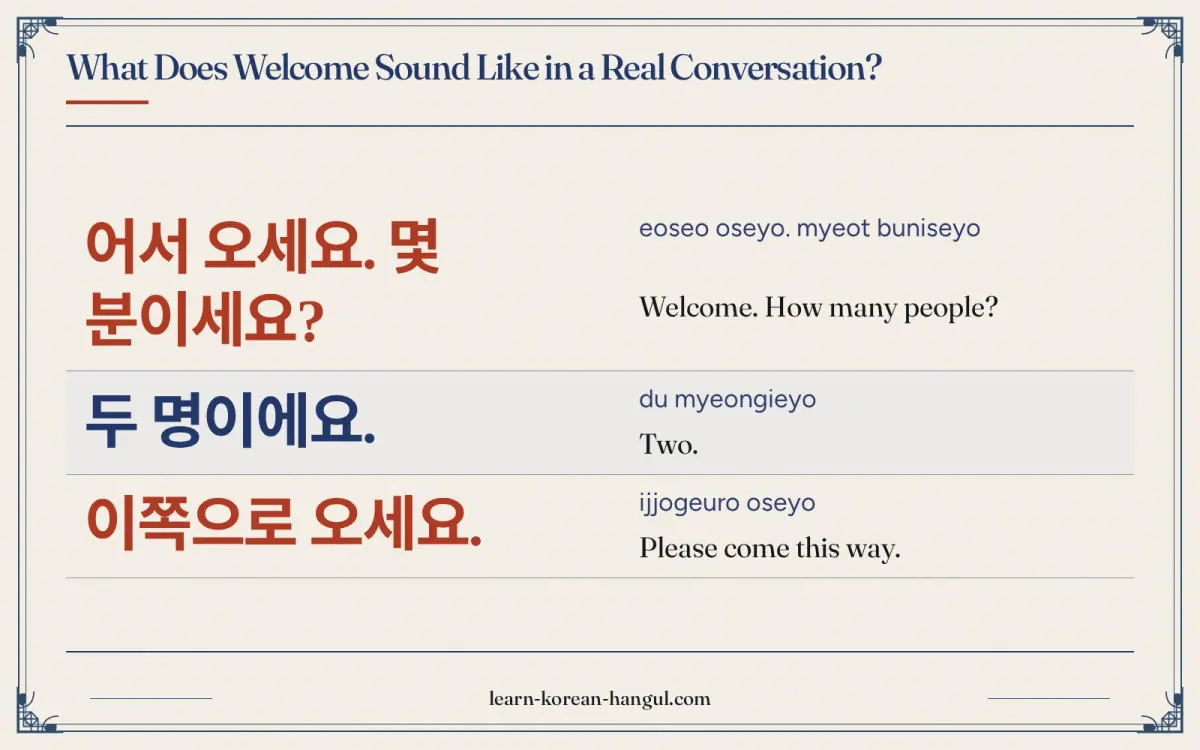
A Korean welcome exchange is short. The host welcomes first, and the visitor answers with a greeting rather than the same phrase.
Entering a Restaurant
Staff
어서 오세요. 몇 분이세요?
eoseo oseyo. myeot buniseyo
Welcome. How many people?
Customer
두 명이에요.
du myeongieyo
Two.
Staff
이쪽으로 오세요.
ijjogeuro oseyo
Please come this way.
What to notice: the customer does not repeat 어서 오세요 and answers the staff's question.
A Child Comes Home
Child
다녀왔어요.
danyeowasseoyo
I'm home.
Mother
어서 와. 밥 먹었어?
eoseo wa. bap meogeosseo
Welcome home. Have you eaten?
What to notice: 다녀왔어요 is what the person says on arriving home, and the family answers 어서 와. The question 밥 먹었어? is a typical Korean way to show care.
A Guest at a New Colleague's Home
Host
잘 오셨어요. 편하게 앉으세요.
jal osyeosseoyo. pyeonhage anjeuseyo
Glad you came. Please sit comfortably.
Guest
초대해 주셔서 감사합니다.
chodaehae jusyeoseo gamsahamnida
Thank you for inviting me.
What to notice: the guest answers with thanks, in line with thank you in Korean.
At an International Event
Host
여러분, 환영합니다.
yeoreobun, hwanyeonghamnida
Everyone, welcome.
Guests
감사합니다.
gamsahamnida
Thank you.
What to notice: 여러분 means everyone, and the formal 환영합니다 suits a group. This leads to the culture around welcoming.
What Should You Know about the Culture behind Welcome?
Welcoming is a duty of the host or the shop in Korea, so the words come with a sense of service. Knowing the rhythm helps you respond naturally.
- Staff greet everyone. In shops and restaurants, staff say 어서 오세요 to each customer who enters, often in chorus.
- No reply is needed. Visitors usually nod, smile or say 안녕하세요, as in hello in Korean.
- Shoes at home. After the host's welcome at the door, guests take off their shoes in the entrance area (현관) before stepping inside.
- Seats and drinks. The host often points to a seat and offers a drink after the welcome.
- Welcome signs. 환영합니다 appears at airports, hotels and events, and can be paired with 한국에 오신 것을 환영합니다 for Welcome to Korea.
An expert tip: learners hear 어서 오세요 constantly and assume it is a greeting they should return. It is not a greeting between equals; it is a service phrase. Replying with 안녕하세요 is the natural move. This page covers everyday welcomes. Formal protocol greetings, such as at state events, and written welcome letters are not covered here.
What Mistakes Do Learners Make with Welcome in Korean?
Most mistakes with welcome come from who says it and from confusing it with you're welcome.
| Mistake | Why it is a problem | Fix |
|---|---|---|
| Saying 어서 오세요 when entering a shop | It is the staff phrase to a visitor | Say 안녕하세요 or nod |
| Saying 환영합니다 to reply to thanks | That means welcome, not you're welcome | Use 아니에요 or 천만에요 |
| Saying 어서 와 to an elder | Casual ending | Use 어서 오세요 or 잘 오셨어요 |
| Saying 오서 오세요 | 오 and 어 are different vowels | Say 어서 with an open mouth |
| Using 어서 오세요 to call someone over | 어서 means quickly, so in a sharp tone it can sound like hurry up | Use 이리 오세요 (come over here) |
Learners often think welcome and you're welcome share a word. In Korean they do not: welcome is 어서 오세요 or 환영합니다, and you're welcome is covered in you're welcome in Korean.
Is It the Same as Welcome Home or Welcome to Korea?
Partly. The short answers below cover the other ways people search for this phrase.
- Welcome formal in Korean: 환영합니다 or 어서 오십시오.
- Welcome to Korea in Korean: 한국에 오신 것을 환영합니다, literally "we welcome your coming to Korea".
- Welcome home in Korean: 어서 와 for family, after the person says 다녀왔어요 or 다녀왔습니다.
- Welcome casual in Korean: 어서 와, or 환영해 (hwanyeonghae) when you want to emphasize that the person is welcome.
Reading the forms is one thing; producing them on cue is another, so practise now.
Practice: Say It Aloud
Play the slow clip of 어서 오세요, repeat it three times, then try 환영합니다 and 어서 와. Then choose a phrase for each situation. Answers follow.
- You are a cafe worker and a customer walks in.
- You are at an airport and see a big sign for visitors.
- Your best friend arrives at your door.
- You walk into a shop and hear 어서 오세요. What do you do?
Answers
- 어서 오세요.
- 환영합니다 or 한국에 오신 것을 환영합니다.
- 어서 와.
- Nod or say 안녕하세요; do not repeat the phrase.
The phrase flashcards drill all five forms with audio.
Related Phrases to Learn Next
Welcome sits among the greetings and invitations learners meet first.
- Hello in Korean: 안녕하세요, the greeting for a reply.
- Come in in Korean: 들어오세요, the invitation to step inside.
- Thank you in Korean: the natural answer to a warm welcome.
- You're welcome in Korean: a different phrase that learners often mix up.
This guide belongs to the Korean greetings collection. What this page does not cover: written welcome letters and state-event protocol. Pick 어서 오세요 for arrivals and 환영합니다 for events, and you can say welcome in Korean to almost anyone.
Frequently Asked Questions
What is the difference between 어서 오세요 and 환영합니다?
Both mean welcome. 어서 오세요 invites someone to come in and is said by staff and hosts. 환영합니다 welcomes a person or group and fits events, signs and speeches. The first is polite and personal, while the second is formal and public.
Is 어서 오세요 formal or casual?
It is polite, in the 해요체 style with the honorific -세요. It is neither stiff nor casual. For a very formal setting, such as a hotel, staff say 어서 오십시오. For close friends, drop it to 어서 와. Hosts use the same polite form when guests arrive at home.
Can I use 어서 오세요 with friends, elders and strangers?
Yes with elders and strangers who arrive at your place or shop. With close friends it sounds a little formal, so say 어서 와. Visitors do not use it when they walk into someone else's shop; that is the staff's phrase.
How do you pronounce 어서 오세요?
It is pronounced [어서 오세요], with five syllables and no sound change. Say 어 with an open mouth and 오 with rounded lips, so the two vowels sound different. Keep the tone friendly and let it fall slightly on 요. Revised Romanization writes eoseo oseyo.
What is the most common mistake with welcome in Korean?
The most common mistake is saying 어서 오세요 when you walk into a shop, because it is the staff phrase. The second is mixing welcome with you're welcome. Reply to 어서 오세요 with a nod or 안녕하세요, and answer thanks with 아니에요.