요금이 얼마예요?
요금이 얼마예요?
What you'll learn
- Say 요금이 얼마예요?, 얼마 나와요?, 카드 돼요? and 거스름돈은 괜찮아요 and match each one to a moment in a taxi ride.
- Pronounce 요금이 as [요그미] and 괜찮아요 as [괜차나요].
- Ask about the fare before, during and after a ride.
- Avoid the most common mistake, which is using 얼마 걸려요? to ask about price.
Before you start: you only need basic Hangul and the polite ending 요. If you also need to tell the driver where to stop, see stop here please in Korean. Time: about 12 minutes. Audio plays only when you press a button.
How Do You Say How Much Is the Fare in Korean?
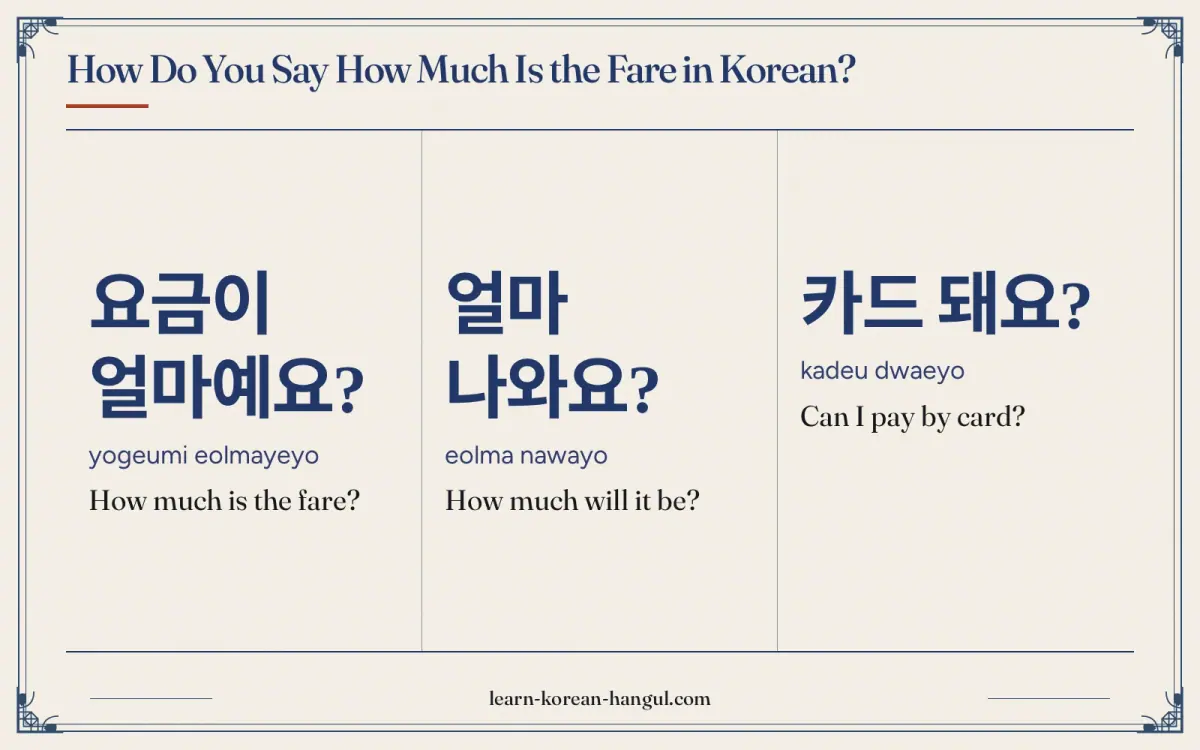
The most useful way to say how much is the fare in Korean is 요금이 얼마예요? Word by word, 요금 (yogeum) means "fare" or "fee", the subject particle 이 attaches to it, and 얼마예요 (eolmayeyo) means "how much is it?". So the whole question is "How much is the fare?"
| Korean | Romanization | Meaning | Where you hear it |
|---|---|---|---|
| 요금이 얼마예요? | yogeumi eolmayeyo | How much is the fare? | Taxi, bus counter, ticket desk |
| 얼마 나와요? | eolma nawayo | How much will it be? | Before a ride, to estimate |
| 카드 돼요? | kadeu dwaeyo | Can I pay by card? | At the end of a ride |
| 거스름돈은 괜찮아요 | geoseureumdoneun gwaenchanayo | Keep the change | Rounding up, rarely |
Revised Romanization (the South Korean government standard of 2000) is only a reading aid here. Learn the Hangul first. The next section shows how each form fits a moment in the ride.
What Are the Polite Ways to Say How Much Is the Fare?
How much is the fare in Korean has several polite forms, and the moment in the ride decides which one fits. All of them end in 요, so they suit drivers and clerks alike.
Polite: 요금이 얼마예요? (yogeumi eolmayeyo)
Polite · 해요체요금이 얼마예요? is the safe default at the end of a ride or at a ticket counter. To get the driver's attention, you can start with 기사님 (gisanim), a respectful word for a driver.
기사님, 요금이 얼마예요?
gisanim, yogeumi eolmayeyo
Driver, how much is the fare?
Polite: 얼마 나와요? (eolma nawayo)
Polite · 해요체얼마 나와요? literally means "How much comes out?". It fits a question before you get in, because the meter has not run yet. Name the place first, then ask.
명동까지 얼마 나와요?
myeongdongkkaji eolma nawayo
How much will it be to Myeongdong?
Polite: 카드 돼요? (kadeu dwaeyo)
Polite · 해요체카드 돼요? means "Does a card work?". It is the short, natural way to ask whether you can pay by card. The word 돼요 (dwaeyo) comes from 되다 (doeda, "to be OK" or "to work").
카드 돼요?
kadeu dwaeyo
Can I pay by card?
Polite: 거스름돈은 괜찮아요 (geoseureumdoneun gwaenchanayo)
Polite · 해요체거스름돈 (geoseureumdon) means "change", and 괜찮아요 here means "it's fine". Together they say "Keep the change." It is rare, because tipping is not expected, and it is used only to round up a small amount.
여기 있어요. 거스름돈은 괜찮아요.
yeogi isseoyo. geoseureumdoneun gwaenchanayo
Here you are. Keep the change.
Other Levels: Formal and Casual
For a very formal setting, the question becomes 요금이 얼마입니까? (yogeumi eolmaimnikka), pronounced [요그미 얼마임니까]. With a close friend who is splitting a taxi, drop the ending: 얼마 나와? (eolma nawa). For everyone else, stay with 요.
Choosing a form is half the job. The other half is saying 요금이 얼마예요 with the right sounds, which the next section breaks down.
How Do You Pronounce 요금이 얼마예요?
요금이 얼마예요 is pronounced [요그미 얼마예요]. The question has two words and seven syllables. The first word links across a syllable, and the second ends in a vowel sound that is often relaxed. Play the slow clip and follow along.
- 요 (yo): a short y glide and ㅛ.
- 금 (geum): the unrounded vowel ㅡ, with flat lips, and a final ㅁ.
- 이 (i): a short ㅣ.
- 얼 (eol): ㅓ with relaxed lips and a light final ㄹ.
- 마 (ma): a plain ㅁ and ㅏ.
- 예요 (ye-yo): two short syllables; in careful speech [예요], and many people say [에요].
Sound Changes to Listen For
- Linking in 요금이. The final ㅁ of 금 moves to the front of the next syllable. So 요금이 sounds like [요그미], with the ㅁ opening the last syllable.
- Linking in 거스름돈은. The same happens here: 거스름돈은 is [거스름도는].
- Silent ㅎ in 괜찮아요. The ㅎ in 찮 is not said before a vowel, and the ㄴ moves forward, so 괜찮아요 sounds like [괜차나요]. Revised Romanization writes gwaenchanayo.
- Tense sound in 할증. When you read about a night surcharge, 할증 (haljeung) is pronounced [할쯩]. In Sino-Korean words the ㅈ becomes tense after ㄹ (Standard Pronunciation Rules, Article 26). Revised Romanization does not show it.
- 예요 and 에요. The standard form is [예요], and [에요] is a very common everyday variant.
- Question word and tone. 얼마 is a question word, so the question usually falls or rises and falls at the end. 카드 돼요? has no question word, so it ends with a rise.
The most common slip is to say the ㅁ of 금 separately, as in "yo-geum-i". Link it forward: [요그미]. Once the sound is right, the next question is when to ask.
When Should You Use 요금이 얼마예요?, and When Should You Not?
Ask 요금이 얼마예요? at the end of a ride, at a ticket counter or when a posted rate is unclear. Use 얼마 나와요? when you want an estimate before you go. The key difference is timing: before the ride you ask what it will be, and after the ride you ask what it is.
Situations Where It Fits
- Before getting in. You say the place and ask 얼마 나와요? to get an idea.
- At the end of the ride. The meter has stopped, and you ask 요금이 얼마예요?
- When paying. You ask 카드 돼요? before you take out your card.
- At a bus or train counter. The same question works for other fares.
Situations to Avoid
- Using 얼마 걸려요? for the price. It means "How long does it take?"
- Offering a tip. Drivers do not expect one, and a large amount can confuse them.
- Casual 얼마 나와? with a driver. It drops the polite ending.
Short scenes make these choices clearer. The next section shows three real exchanges.
What Does How Much Is the Fare Sound Like in a Real Conversation?
Taxi talk is short and practical. Listen for the question and the answer.
Asking before the Ride
Tourist
기사님, 명동까지 얼마 나와요?
gisanim, myeongdongkkaji eolma nawayo
Driver, how much will it be to Myeongdong?
Driver
미터기에 나와요. 보통 이십 분쯤 걸려요.
miteogie nawayo. botong isip bunjjeum geollyeoyo
It shows on the meter. It usually takes about twenty minutes.
Tourist
네, 알겠어요.
ne, algesseoyo
Okay, I see.
What to notice: the driver answers with the meter, because the fare depends on the road and the time. The driver also adds how long the trip takes, using 걸려요 (geollyeoyo), the verb you should not use for price.
Paying at the End
Tourist
도착했어요. 요금이 얼마예요?
dochakaesseoyo. yogeumi eolmayeyo
We've arrived. How much is the fare?
Driver
미터기를 보세요.
miteogireul boseyo
Please look at the meter.
Tourist
카드 돼요?
kadeu dwaeyo
Can I pay by card?
Driver
네, 돼요.
ne, dwaeyo
Yes, you can.
What to notice: 도착했어요 is pronounced [도차캐써요], because the ㄱ at the end of 착 blends with the ㅎ of 했 into ㅋ. Revised Romanization writes dochakaesseoyo.
Rounding Up
Tourist
여기 있어요. 거스름돈은 괜찮아요.
yeogi isseoyo. geoseureumdoneun gwaenchanayo
Here you are. Keep the change.
Driver
감사합니다. 안녕히 가세요.
gamsahamnida. annyeonghi gaseyo
Thank you. Goodbye.
What to notice: the driver says 안녕히 가세요, the goodbye to someone who is leaving while the speaker stays. This is the right form here, because the passenger leaves and the driver stays with the car.
What Should You Know about the Culture behind How Much Is the Fare?
Taxis in Korea run on a meter, and these habits are general. Details such as rates and hours change, so check the fare notice in the taxi.
- The meter decides. The driver starts the meter at the beginning, and the fare comes from distance and time. You do not usually bargain.
- Night surcharge. At night there is usually an extra charge, called 할증 (haljeung). The hours and the rate depend on the city and can change.
- No tip. Tipping is not expected, so 거스름돈은 괜찮아요 is rare and only used to round up a small amount.
- Cards and apps. Many taxis take cards or a transit card, and many people call a taxi through an app. Ask 카드 돼요? if you are not sure.
An expert tip: keep the destination written in Hangul on your phone and show it along with the fare question. Because Korean puts respect in the ending, a clear 요 matters more than speed. For the structure behind the endings, see Korean speech levels, which explains why 요 makes the question polite. If you also need to know the price of other things, how much is it in Korean covers the general question.
What Mistakes Do Learners Make with How Much Is the Fare in Korean?
Most mistakes come from mixing up price and time.
| Mistake | Why it is a problem | Fix |
|---|---|---|
| Saying 얼마 걸려요? | It asks how long it takes | Say 요금이 얼마예요? |
| Saying 얼마예요? with no noun | The driver may not know what you mean | Add 요금이 or the place |
| Saying the ㅁ of 금 separately | The sound is [요그미] | Link the ㅁ forward |
| Offering a big tip | Tipping is not expected | Say 감사합니다 |
| Using 얼마 나와? with a driver | It drops the polite ending | Add 요 |
| Ending a 얼마 question with a sharp rise | Question word questions usually fall | Let the voice fall or rise-fall |
Learners often reach for one word that means "fare". In Korean, 요금 covers fares and fees, and 얼마예요 asks how much.
Is It the Same as Taxi Fare, Fare or How Much Is the Taxi in Korean?
Mostly yes. These searches all point to the same small set of phrases.
- Taxi fare in Korean: 택시 요금 (taeksi yogeum) or 택시비 (taeksibi). 택시비 is pronounced [택씨비], with a tense ㅅ. Ask 택시비가 얼마예요? (taeksibiga eolmayeyo).
- Fare in Korean: 요금 (yogeum) is the general word, and 차비 (chabi) is the casual "fare money". For other transport, say 버스 요금 or 지하철 요금.
- How much is the taxi in Korean: 택시가 얼마예요? is understood, but 얼마 나와요? after the place name sounds more natural.
Practice: Say It Aloud
Play the slow clip and repeat 요금이 얼마예요? three times, then choose the best phrase for each moment. Answers follow.
- You want a price before getting in.
- The ride is over and you want the fare.
- You want to pay by card.
- How is 요금이 pronounced?
Answers
- 명동까지 얼마 나와요?
- 요금이 얼마예요?
- 카드 돼요?
- [요그미]: the ㅁ of 금 moves to the front of the next syllable.
The phrase flashcards drill these questions with audio.
Related Phrases to Learn Next
Paying for a ride connects to several travel phrases.
- stop here please in Korean: what to say when you reach your stop.
- do you take cards in Korean: the wider question about card payment.
- how much is it in Korean: the general price question for shops and food.
This guide belongs to the korean taxi phrases collection. What this page does not cover: current taxi rates, ride-hailing apps and long-distance fares. Learn 요금이 얼마예요? for the end of the ride and 얼마 나와요? for the start, and you can say how much is the fare in Korean to anyone.
Frequently Asked Questions
How do you say how much is the fare in Korean?
Say 요금이 얼마예요? (yogeumi eolmayeyo). 요금 (yogeum) means "fare" or "fee", and 얼마예요 means "how much is it?" Before a ride you can also ask 얼마 나와요? (eolma nawayo), which means "How much will it come to?" Both are polite and fit a taxi driver.
How do you pronounce 요금이 얼마예요?
It is pronounced [요그미 얼마예요]. The ㅁ at the end of 금 links to the vowel of 이, so 요금이 sounds like "yo-geu-mi". Many speakers say the last syllable 예요 as [에요]. Revised Romanization writes yogeumi eolmayeyo.
What is the difference between 요금이 얼마예요? and 얼마 나와요?
요금이 얼마예요? asks the price of a fare, and it fits the end of a ride or a posted rate. 얼마 나와요? asks what the total will be, so it suits a question before the ride, such as 명동까지 얼마 나와요? Both are polite and neither is more formal.
Can I use 요금이 얼마예요? with friends, elders and strangers?
Yes for taxi drivers, shop staff, elders and strangers, because the ending 요 is polite. With a close friend, say 요금이 얼마야? or 얼마 나와? If a very formal setting needs it, use 요금이 얼마입니까?
What is the most common mistake with how much is the fare in Korean?
Using 얼마 걸려요?, which asks how long a trip takes, not how much it costs. For the price, say 요금이 얼마예요? or 얼마 나와요? A second slip is leaving a tip. In Korea tipping is not expected, so a plain thank-you is enough.
How do you ask the taxi fare or how much is the taxi in Korean?
Ask 택시비가 얼마예요? (taeksibiga eolmayeyo) for the taxi fare in general, or 요금이 얼마예요? once you are in the car. To find out the price before you go, say the place and then 얼마 나와요? For other transport, replace 택시비 with 버스 요금 or 지하철 요금.