여기서 세워 주세요
여기서 세워 주세요
What you'll learn
- Say 여기서 세워 주세요 aloud and ask a driver to stop at the spot you choose.
- Choose between 여기서 세워 주세요, 여기서 내려 주세요, 저기서 세워 주세요 and 다음 정류장에서 내릴게요.
- Tell 세우다 (to stop a vehicle) from 멈추다 (to stop, halt) and 내리다 (to get off).
- Hear why 정류장 is pronounced [정뉴장].
Before you start: knowing take me to the airport in Korean helps, because you start the ride by naming where you are going. Time: about 10 minutes. Audio plays only when you press a button.
How Do You Say Stop Here Please in Korean?
The standard way to say stop here please in Korean is 여기서 세워 주세요. 여기 (yeogi) means here, and the particle 서 (a short form of 에서) marks the place where something happens. 세우다 (seuda) means to make something stop, so the phrase literally says "please stop it here". Add 좀 (jom) for a softer tone, or 잠깐 (jamkkan, for a moment) for a quick stop. This is the phrase people use in a taxi, and together with 내려 주세요 (let me out) it covers get off here and let me off.
| Form | Romanization | Register | Say it to |
|---|---|---|---|
| 여기서 세워 주세요 | yeogiseo sewo juseyo | Polite (해요체) | Taxi drivers and rideshare drivers |
| 여기서 내려 주세요 | yeogiseo naeryeo juseyo | Polite (해요체) | Taxi drivers, when you want to get out |
| 저기서 세워 주세요 | jeogiseo sewo juseyo | Polite (해요체) | Taxi drivers, for a spot further on |
| 다음 정류장에서 내릴게요 | daeum jeongnyujangeseo naerilgeyo | Polite (해요체) | Bus drivers and people nearby |
| 여기서 세워 줘 | yeogiseo sewo jwo | Casual (해체) | Friends driving you, never a stranger |
All the forms for strangers are polite, so the choice depends on the spot and the vehicle. The next section takes the four main forms one by one.
What Are the Polite Ways to Say Stop Here Please?
Stop here please follows the Korean speech levels, explained in the guide to Korean speech levels. With a driver you will always use the polite style, so the choices below are about where and how you want to stop.
Polite: 여기서 세워 주세요 (yeogiseo sewo juseyo)
Polite · 해요체여기서 세워 주세요 asks the driver to stop at the place you are passing. 세워 is the -어 form of 세우다 (to stop a vehicle), which joins 주세요. Name a landmark first if the stop is not obvious: 저 건물 앞에서 (in front of that building).
저 건물 앞에서 세워 주세요.
jeo geonmul apeseo sewo juseyo
Please stop in front of that building.
Polite: 여기서 내려 주세요 (yeogiseo naeryeo juseyo)
Polite · 해요체내려 is the -어 form of 내리다 (to get off, to go down), so 내려 주세요 means "let me out". Use it at the moment you want to step out, for instance at a crosswalk or a corner. It is the natural pair of 세워 주세요: first the car stops, then you get out.
횡단보도 앞에서 내려 주세요.
hoengdanbodo apeseo naeryeo juseyo
Please let me out in front of the crosswalk.
Polite: 저기서 세워 주세요 (jeogiseo sewo juseyo)
Polite · 해요체저기 (jeogi) means over there, a spot away from both of you. Use it when your stop is ahead and you can point at it. Add 조금만 더 가 주세요 (jogeumman deo ga juseyo, please go a little further) if you need the driver to keep going first.
저기 신호등에서 세워 주세요.
jeogi sinhodeungeseo sewo juseyo
Please stop at that traffic light.
Polite: 다음 정류장에서 내릴게요 (daeum jeongnyujangeseo naerilgeyo)
Polite · 해요체다음 (daeum) means next, 정류장 (jeongnyujang) means a stop and 내릴게요 is a promise form, "I will get off". On a bus you rarely ask the driver to stop. You press the bell before your stop, and say this phrase if the driver or a neighbour asks where you are going.
기사님, 다음 정류장에서 내릴게요.
gisanim, daeum jeongnyujangeseo naerilgeyo
Driver, I'll get off at the next stop.
A driver has only a few seconds to react, so the sounds matter, and they come next.
How Do You Pronounce 여기서 세워 주세요?
여기서 세워 주세요 is written with eight syllables and pronounced [여기서 세워 주세요], yeogiseo sewo juseyo. Say it as three beats: 여기서, 세워, 주세요. The eight syllables sound like this.
- 여 (yeo): an open "yuh", with a y glide.
- 기 (gi): "gee".
- 서 (seo): "suh", an unrounded vowel.
- 세 (se): "seh".
- 워 (wo): a quick w glide into the open "uh" of ㅓ, so "wuh", written "wo" in Revised Romanization.
- 주 (ju): a soft j and "oo".
- 세 (se): "seh".
- 요 (yo): "yoh".
Sound Changes to Listen For
Four details from the National Institute of Korean Language Standard Pronunciation Rules (표준 발음법) matter in these phrases.
- No change in 여기서 세워. The phrase has no linking or tensing, so each syllable keeps its spelling. In a taxi it is said quickly as one unit, but the syllables stay even.
- ㄹ becomes ㄴ in 정류장. After the final ㅇ of 정, the ㄹ is nasalized to ㄴ (Article 19), so 정류장 is pronounced [정뉴장] and romanized jeongnyujang. The next-stop phrase is [다음 정뉴장에서].
- Tense sound in 내릴게요. After the ending -ㄹ, the ㄱ of 게요 is usually tense, so 내릴게요 is pronounced [내릴께요]. Revised Romanization keeps the spelling, naerilgeyo.
- ㅓ is open. In 서, the vowel ㅓ is an unrounded "uh", not the rounded "oh" of ㅗ. The same open sound sits inside 여 and 워.
With the sounds clear, the next question is when to use each phrase.
When Should You Use 여기서 세워 주세요, and When Should You Not?
Use 여기서 세워 주세요 when you want the vehicle to stop. Use 내려 주세요 when you want to leave it. Say it a little before the stop, because a driver needs time to pull over.
Situations Where It Fits
- A taxi near your hotel. 저 건물 앞에서 세워 주세요. (Please stop in front of that building.)
- A corner or crosswalk. 여기서 내려 주세요. (Please let me out here.)
- A spot further on. 저기서 세워 주세요. (Please stop over there.)
- A bus ride. 다음 정류장에서 내릴게요. (I'll get off at the next stop.)
Situations to Avoid
- With 멈춰 주세요. 멈추다 means to halt, and 멈춰 sounds like an order to stop dead; 세워 is the natural request for a vehicle.
- With a casual 세워 줘. Casual speech is for friends. Use 요 forms with drivers.
- At the last second. A driver may not be able to stop safely, so ask early and name the place.
- Where stopping is not allowed. Drivers may say 여기는 안 돼요 (not here) and pull up at a safe spot.
Short scenes show how the phrases work in a ride.
What Does Stop Here Please Sound Like in a Real Conversation?
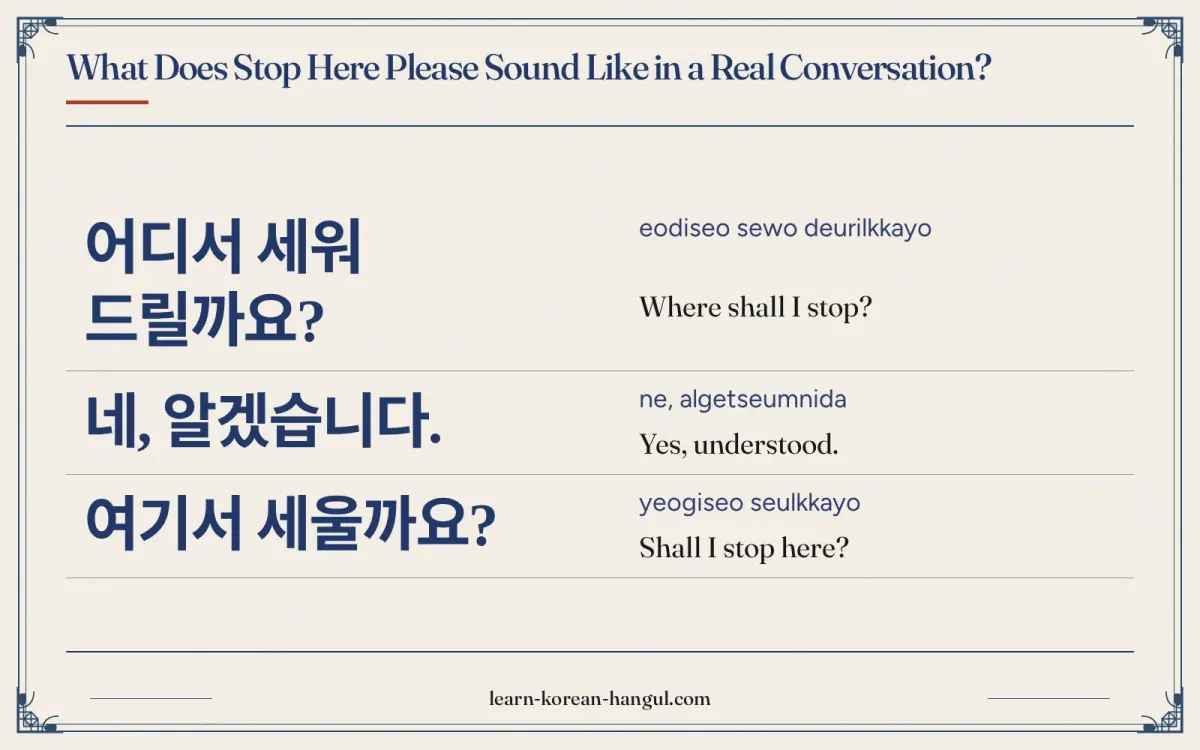
A ride has a question, a request and a reply. Each scene below keeps the polite ending 요 or the formal 습니다.
Asking a Taxi Driver to Stop
Driver
어디서 세워 드릴까요?
eodiseo sewo deurilkkayo
Where shall I stop?
You
저 건물 앞에서 세워 주세요.
jeo geonmul apeseo sewo juseyo
Please stop in front of that building.
Driver
네, 알겠습니다.
ne, algetseumnida
Yes, understood.
What to notice: the driver's question uses 어디서 (where), a wh-word, so it does not end with a sharp rise.
Going a Little Further
Driver
여기서 세울까요?
yeogiseo seulkkayo
Shall I stop here?
You
조금만 더 가 주세요.
jogeumman deo ga juseyo
Please go a little further.
You
네, 여기서 내려 주세요.
ne, yeogiseo naeryeo juseyo
Yes, please let me out here.
What to notice: 세울까요? offers to stop, and a yes/no question like this rises at the end.
Getting off a Bus
You
기사님, 다음 정류장에서 내릴게요.
gisanim, daeum jeongnyujangeseo naerilgeyo
Driver, I'll get off at the next stop.
Driver
네, 벨 눌러 주세요.
ne, bel nulleo juseyo
Yes, please press the bell.
What to notice: 눌러 주세요 asks you to press the bell, which is how Korean buses are told to stop.
What Should You Know about the Culture behind Stop Here Please?
Rides in Korea run on short, clear instructions, and the driver is called by a title.
- Say it early. Taxi drivers in Korea expect clear instructions near your stop, so give the request a little before the place.
- Use the title 기사님. 기사님 (gisanim, driver) is the polite way to address a taxi or bus driver. 아저씨 is common but less respectful.
- Press the bell on buses. Bus riders press the stop bell before their stop, and the driver stops without being asked.
- Cards and apps. Many riders pay with a transport card or an app, and the rider usually taps the card again when getting off a bus in a city system. Check the signs on the bus.
An expert insight: English speakers say "stop" and look for one Korean word. Korean separates the jobs: 세우다 stops a vehicle on purpose, 멈추다 describes halting, 서다 describes standing or stopping on its own, and 내리다 is for getting off. A passenger needs 세우다 and 내리다. The mistakes below show where the words collide.
What Mistakes Do Learners Make with Stop Here Please in Korean?
Most mistakes with stop here please come from the verb choice and from the polite ending.
| Mistake | Why it is a problem | Fix |
|---|---|---|
| Saying 멈춰 주세요 | 멈추다 means halt and sounds like an order to stop dead | Say 세워 주세요 |
| Saying 서 주세요 | 서다 means to stand or to stop by itself, so it is less natural as a request to a driver | Say 세워 주세요 |
| Saying 여기서 내려요 to a driver | It states "I get off here" | Say 여기서 내려 주세요 |
| Saying 세워 only | Without 주세요 it is a bare command | Say 여기서 세워 주세요 |
| Pronouncing 정류장 as jeong-ryu-jang | ㄹ becomes ㄴ after ㅇ | Say [정뉴장] |
Learners often assume that 세워 and 내려 mean the same thing. Actually, 세워 asks the vehicle to stop, while 내려 asks to let you out, so the two usually come as a pair.
Is It the Same as Stop Here?
The short answers below cover the other ways people search for this phrase.
- Stop here in Korean: 여기서 세워 주세요 for a taxi, or the casual 여기서 세워 줘 with a friend who is driving.
- Get off here in Korean: 여기서 내려 주세요 (let me out), or 여기서 내릴게요 (I'll get off here).
- Let me off in Korean: 내려 주세요, with the place first.
- Taxi phrases: see where is the taxi stand in Korean and how much is the fare in Korean.
The related pages below continue the taxi vocabulary.
Related Phrases to Learn Next
Stop here please sits beside the other lines you use in a ride.
- Take me to the airport in Korean: 공항으로 가 주세요 to start the ride.
- How much is the fare in Korean: 요금이 얼마예요? before you pay.
- Where is the taxi stand in Korean: 택시 승강장 to find a ride.
This guide belongs to the Korean taxi phrases collection. What this page does not cover: paying the fare, tipping and bus routes. Name the spot, add 세워 주세요, and you can say stop here please in Korean in any taxi.
Practice: Say It Aloud
Play the slow clip of 여기서 세워 주세요 and repeat it three times, then try 여기서 내려 주세요 and 다음 정류장에서 내릴게요. Then choose the phrase for each case. Answers follow.
- You see your hotel on the right and want the taxi to stop.
- The taxi has stopped and you want to get out.
- You want the taxi to stop at the traffic light ahead.
- The bus driver asks where you are getting off.
Answers
- 여기서 세워 주세요.
- 여기서 내려 주세요.
- 저기 신호등에서 세워 주세요.
- 다음 정류장에서 내릴게요.
The phrase flashcards drill the four requests with audio.
Frequently Asked Questions
How do you say stop here please in Korean?
Say 여기서 세워 주세요 (yeogiseo sewo juseyo). It is polite and works with taxi and rideshare drivers. To get out, say 여기서 내려 주세요, and on a bus, say 다음 정류장에서 내릴게요.
How do you pronounce 여기서 세워 주세요?
Pronounce it [여기서 세워 주세요]. It has eight syllables, and nothing is linked or tensed. The vowel ㅓ in 서 is an open "uh", and the same sound sits inside 여 and 워. The Revised Romanization is yeogiseo sewo juseyo.
What is the difference between 여기서 세워 주세요 and 여기서 내려 주세요?
여기서 세워 주세요 asks the driver to stop the vehicle. 여기서 내려 주세요 asks the driver to let you out. In a taxi the two often follow each other: first the car stops, then you get out.
Can I use 여기서 세워 주세요 with friends, elders and strangers?
Yes with strangers and elders, because it is polite. With a close friend who is driving, the casual 여기서 세워 줘 is fine. Do not use 세워 줘 with a taxi driver, since it sounds rude to a service worker.
What is the most common mistake with stop here please in Korean?
The most common mistake is saying 멈춰 주세요. 멈추다 means to halt, and 멈춰 sounds like an order to stop dead. The natural request to stop a vehicle is 세워 주세요. A second mistake is dropping 주세요, which turns the request into an order.