
오늘 어땠어요?
오늘 어땠어요?
What you'll learn
- Say 오늘 어땠어요?, 오늘 하루 어땠어요? and 오늘 하루 어땠어? and match each one to the listener.
- Pronounce 어땠어요 as [어때써요], with two tense sounds.
- Answer with a short past-tense summary such as 괜찮았어요 or 피곤했어요.
- Avoid the most common mistake, which is mixing up 어땠어요 and 어떻게 했어요.
Before you start: knowing the polite ending 요 helps, so see Korean speech levels if it is new. Time: about 12 minutes. Audio plays only when you press a button.
How Do You Say How Was Your Day in Korean?
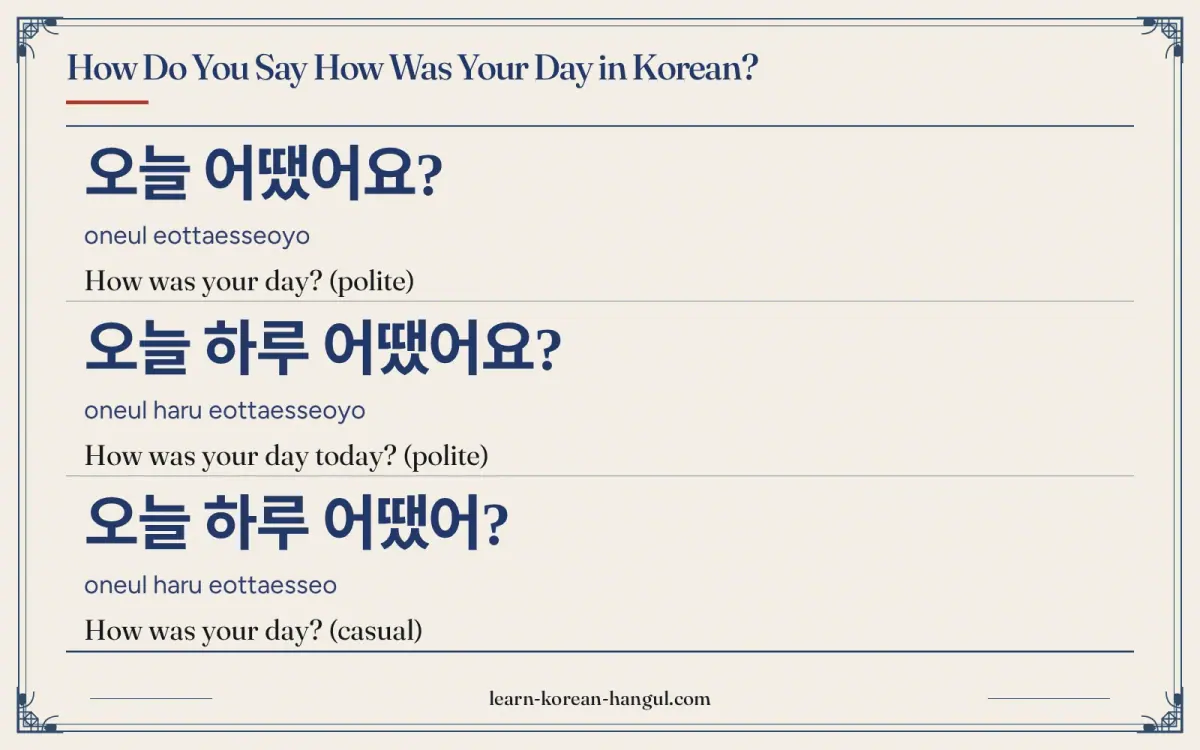
The most useful way to say how was your day in Korean is 오늘 어땠어요? Word by word, 오늘 (oneul) means "today", and 어땠어요 (eottaesseoyo) means "how was it?". So the whole question is "how was today?". Korean does not need a word for "your": 오늘 alone, or 오늘 하루 (oneul haru, "today as a whole day"), carries the meaning of "your day".
| Korean | Romanization | Meaning | Where you hear it |
|---|---|---|---|
| 오늘 어땠어요? | oneul eottaesseoyo | How was your day? (polite) | Coworkers, classmates |
| 오늘 하루 어땠어요? | oneul haru eottaesseoyo | How was your day today? (polite) | A warmer, fuller version |
| 오늘 하루 어땠어? | oneul haru eottaesseo | How was your day? (casual) | Friends, partners, family |
| 고생했어요 | gosaenghaesseoyo | You worked hard (polite) | After the answer |
Revised Romanization (the South Korean government standard of 2000) is only a reading aid here. Learn the Hangul first. The next section shows how to choose between the forms.
What Are the Polite and Casual Ways to Say How Was Your Day?
How was your day in Korean has polite and casual choices, and the listener decides. The question stays the same, and only the ending changes.
Polite: 오늘 어땠어요? (oneul eottaesseoyo)
Polite · 해요체오늘 어땠어요? is the safe default. Use it with a coworker at the end of a shift or a classmate after a long lesson. It is short, friendly and not too personal.
오늘 어땠어요? 많이 바빴어요?
oneul eottaesseoyo? mani bappasseoyo
How was your day? Were you very busy?
Polite: 오늘 하루 어땠어요? (oneul haru eottaesseoyo)
Polite · 해요체Adding 하루 (haru, "one day") makes the question about the whole day. It sounds a bit more caring, so it fits a roommate, a host family or a neighbour you like.
오늘 하루 어땠어요? 피곤하지 않아요?
oneul haru eottaesseoyo? pigonhaji anayo
How was your whole day? Aren't you tired?
Casual: 오늘 하루 어땠어? (oneul haru eottaesseo)
Casual · 반말오늘 하루 어땠어? drops the polite ending 요, so it is for close friends, partners and family. It is what a parent might ask a child after school.
오늘 하루 어땠어? 학교 재미있었어?
oneul haru eottaesseo? hakgyo jaemiisseosseo
How was your day? Was school fun?
Polite: 고생했어요 (gosaenghaesseoyo)
Polite · 해요체고생했어요 is not a question. It is what you say after you hear the answer, and it means "you went through a lot" or "you worked hard". It shows you care about the effort.
오늘도 고생했어요.
oneuldo gosaenghaesseoyo
You worked hard today too.
For a boss or an elder, add the honorific -시-: 오늘 하루 어떠셨어요? (oneul haru eotteosyeosseoyo) and 고생하셨어요 (gosaenghasyeosseoyo). Choosing a form is half the job. The other half is saying 어땠어요 with the right sounds, which the next section breaks down.
How Do You Pronounce 오늘 어땠어요?
오늘 어땠어요 is pronounced [오늘 어때써요]. The question has two words and six syllables, and the second word is the hard one. Play the slow clip and follow along.
- 오 (o): a rounded ㅗ.
- 늘 (neul): the unrounded vowel ㅡ, with flat lips, and a light ㄹ.
- 어 (eo): ㅓ with relaxed lips and a half-open jaw.
- 땠 (ttae): a tense ㄸ, tighter than ㄷ and with no puff of air, then ㅐ.
- 어 (eo): written as 어, but it takes the ㅆ from the end of 땠, so you hear "sseo".
- 요 (yo): a short, light ending.
Sound Changes to Listen For
- The ㅆ moves forward. The ㅆ at the end of 땠 slides to the front of the next syllable, so 땠어요 sounds like "ttae-sseo-yo" and not "ttaes-eo-yo".
- Two tense sounds. Both ㄸ and ㅆ are tense. Revised Romanization shows them as tt and ss, so you can see them in eottaesseoyo.
- Where the form comes from. 어떻다 (eotteota, "to be how") has a ㅎ that drops out. The present is 어때요 (eottaeyo) and the past is 어땠어요. Do not say 어떻었어요, which is not a standard form.
- Vowel ㅐ. The standard pronunciation rules still list ㅐ and ㅔ as two vowels, but most Seoul speakers today pronounce them the same, like the "e" in "bed".
- A question word. 어땠어요 carries the question word "how", so the question usually falls or rise-falls at the end instead of ending in a sharp rise.
The most common slip is to say the ㅆ twice or to stress the first syllable. Keep the rhythm even. See Korean tensification for how tense sounds work in other words. Once the sound is right, the next question is when to ask it.
When Should You Use 오늘 어땠어요?, and When Should You Not?
Ask 오늘 어땠어요? when the day is over or nearly over and you know the person a little. Use the casual form with people you are close to, and the honorific form with a boss or an elder. The key difference is the level of closeness: the question invites a story, so it suits people who would share one.
Situations Where It Fits
- After work or school. You meet a coworker or a classmate and ask how the day went.
- At home. A roommate, a host parent or a partner comes back in the evening.
- A video call at night. You catch up with a friend in another time zone.
Situations to Avoid
- With a stranger. A question about their whole day can feel too personal.
- In the morning. The day has not happened yet. Ask 잘 잤어요? (jal jasseoyo, "did you sleep well?") instead.
- Casual 어땠어? with a boss. Dropping 요 sounds too familiar.
Short scenes make these choices clearer. The next section shows three real exchanges.
What Does How Was Your Day Sound Like in a Real Conversation?
Korean evening talk is usually short. Listen for the question and the caring reply that follows it.
Two Colleagues at the End of Work
Ji-Hyeon
오늘 어땠어요?
oneul eottaesseoyo
How was your day?
Min-Su
좀 바빴어요. 회의가 세 개 있었어요.
jom bappasseoyo. hoeuiga se gae isseosseoyo
A bit busy. I had three meetings.
Ji-Hyeon
고생했어요. 얼른 쉬세요.
gosaenghaesseoyo. eolleun swiseyo
You worked hard. Go and rest soon.
What to notice: Min-su answers in the past tense (바빴어요) and Ji-hyeon replies with 고생했어요. The pair of lines, a question and a caring reply, is the usual pattern.
Two Close Friends at Night
Su-Bin
오늘 하루 어땠어?
oneul haru eottaesseo
How was your day?
Ji-Ho
완전 피곤했어.
wanjeon pigonhaesseo
I was totally exhausted.
Su-Bin
왜? 무슨 일 있었어?
wae? museun il isseosseo
Why? Did something happen?
Ji-Ho
점심 먹을 시간도 없었어.
jeomsim meogeul sigando eopseosseo
I had no time even to eat lunch.
Su-Bin
고생했어. 얼른 와서 저녁 먹어.
gosaenghaesseo. eolleun waseo jeonyeok meogeo
You had a hard day. Come over soon and eat dinner.
What to notice: no line has the ending 요, because the friends are close. The question 왜? is a wh-question, so it does not need a sharp rise at the end.
Asking a Boss Politely
Junior
부장님, 오늘 하루 어떠셨어요?
bujangnim, oneul haru eotteosyeosseoyo
Director, how was your day?
Boss
바빴어요. 그래도 괜찮았어요.
bappasseoyo. geuraedo gwaenchanasseoyo
It was busy. But it was fine.
Junior
고생하셨어요.
gosaenghasyeosseoyo
You worked hard.
Boss
고마워요.
gomawoyo
Thank you.
What to notice: the junior uses -시- (어떠셨어요, 고생하셨어요) to raise the boss, while the boss uses the plain polite style. The honorific marks the one who is being respected.
What Should You Know about the Culture behind How Was Your Day?
Asking about someone's day is a small act of care in Korean. These are general habits, and families and workplaces differ.
- Food first. Many people greet each other with 밥 먹었어요? ("did you eat?") before they ask about the day, so asking 오늘 어땠어요? can feel a step more personal.
- Short answers. The answer is usually a short summary, such as 피곤했어요, 괜찮았어요 or 바빴어요. People do not usually narrate the whole day.
- Caring replies. After the answer, a caring friend or partner often adds 고생했어요. It praises the effort, not only the result.
- Evening only. The question belongs to the end of the day, at home or after work.
An expert tip: listen for the past tense in the answer. Because Korean marks time on the verb, 좋았어요 (joasseoyo, "it was good") is the natural reply, while 좋아요 sounds like you are describing the present moment. For small talk in general, the korean small talk collection lists more openers.
What Mistakes Do Learners Make with How Was Your Day in Korean?
Most mistakes come from the verb, not from pronunciation.
| Mistake | Why it is a problem | Fix |
|---|---|---|
| Saying 어떻게 했어요? | It asks how you did something | Say 어땠어요? |
| Answering 좋아요 | It is present tense | Say 좋았어요 |
| Spelling 어떻었어요 | The ㅎ drops from 어떻다 | Say 어땠어요 |
| Using 어땠어? with a boss | It drops the polite ending | Use 어떠셨어요? |
| Asking in the morning | The day has not happened yet | Ask later, or use 잘 잤어요? |
| Ending with a sharp rise | Question word questions usually fall | Let the voice fall or rise-fall |
Learners often translate "How was your day?" word for word and miss the verb. In Korean, the verb 어땠어요 already means "how was it", so you do not need a separate word for "was".
Is It the Same as How's Your Day in Korean?
Almost. "How's your day" is about a day that is still going on, so it uses the present tense.
- How's your day in Korean: 오늘 하루 어때요? (oneul haru eottaeyo) asks how today is going so far. It fits the afternoon, or a phone call in the middle of the day.
- How was your day in Korean: 오늘 하루 어땠어요? is for after the day is done.
Both questions use the same verb 어떻다, and the only change is the tense.
Practice: Say It Aloud
Play the slow clip and repeat 오늘 어땠어요? three times, then choose the best question for each person. Answers follow.
- A coworker walks out of the office with you.
- Your best friend calls in the evening.
- Your manager returns from a long trip.
- How is 어땠어요 pronounced?
Answers
- 오늘 어땠어요?
- 오늘 하루 어땠어?
- 오늘 하루 어떠셨어요?
- [어때써요]: the ㅆ moves to the front of the next syllable, and both ㄸ and ㅆ are tense.
The phrase flashcards drill these questions with audio.
Related Phrases to Learn Next
Asking about the day connects to several small-talk phrases.
- how are you in Korean: the general greeting that comes before this question.
- I'm tired in Korean: a common answer to 오늘 어땠어요?
- did you eat in Korean: the other caring question Koreans ask all the time.
This guide belongs to the korean small talk collection. What this page does not cover: long stories about your day, workplace chat rules and texting abbreviations. Learn one polite and one casual question, and you can say how was your day in Korean to anyone you know.
Frequently Asked Questions
How do you say how was your day in Korean?
Say 오늘 어땠어요? (oneul eottaesseoyo) to ask a coworker, a classmate or someone you know a little. Say 오늘 하루 어땠어요? to ask about the whole day, and 오늘 하루 어땠어? to a close friend or family member. Ask it in the evening, when the day is finished.
How do you pronounce 오늘 어땠어요?
It is pronounced [오늘 어때써요]. The last three syllables flow together: the ㅆ of 땠 moves to the front of 어, so you hear eo-ttae-sseo-yo. Both ㄸ and ㅆ are tense sounds, said with a tight throat and no puff of air. Revised Romanization writes oneul eottaesseoyo.
What is the difference between 오늘 어땠어요? and 오늘 하루 어땠어요?
Both ask how today went. 오늘 어땠어요? is shorter and can be about one event, such as a first day at work. 오늘 하루 어땠어요? uses 하루 (haru, "the whole day") and sounds a little warmer and more caring, as if you want the full story.
Is 오늘 어땠어요? formal or casual?
It is polite. The ending 요 makes it fit most adults, including coworkers and people you meet for the first time. The casual form is 오늘 어땠어?, for friends and family. For a boss or an elder, use the honorific 오늘 하루 어떠셨어요?
Can I use 오늘 어땠어요? with friends, elders and strangers?
Yes for coworkers and acquaintances. With a close friend, drop the 요 and say 오늘 어땠어? With a boss or an older person, use 어떠셨어요? to show respect. With a stranger, it is unusual, because the question assumes you know something about their day.
What is the most common mistake with how was your day in Korean?
Using 어떻게 했어요?, which asks how you did something, not how the day went. A second slip is answering in the present tense. Use a past form such as 좋았어요 or 피곤했어요, because the day has already happened.