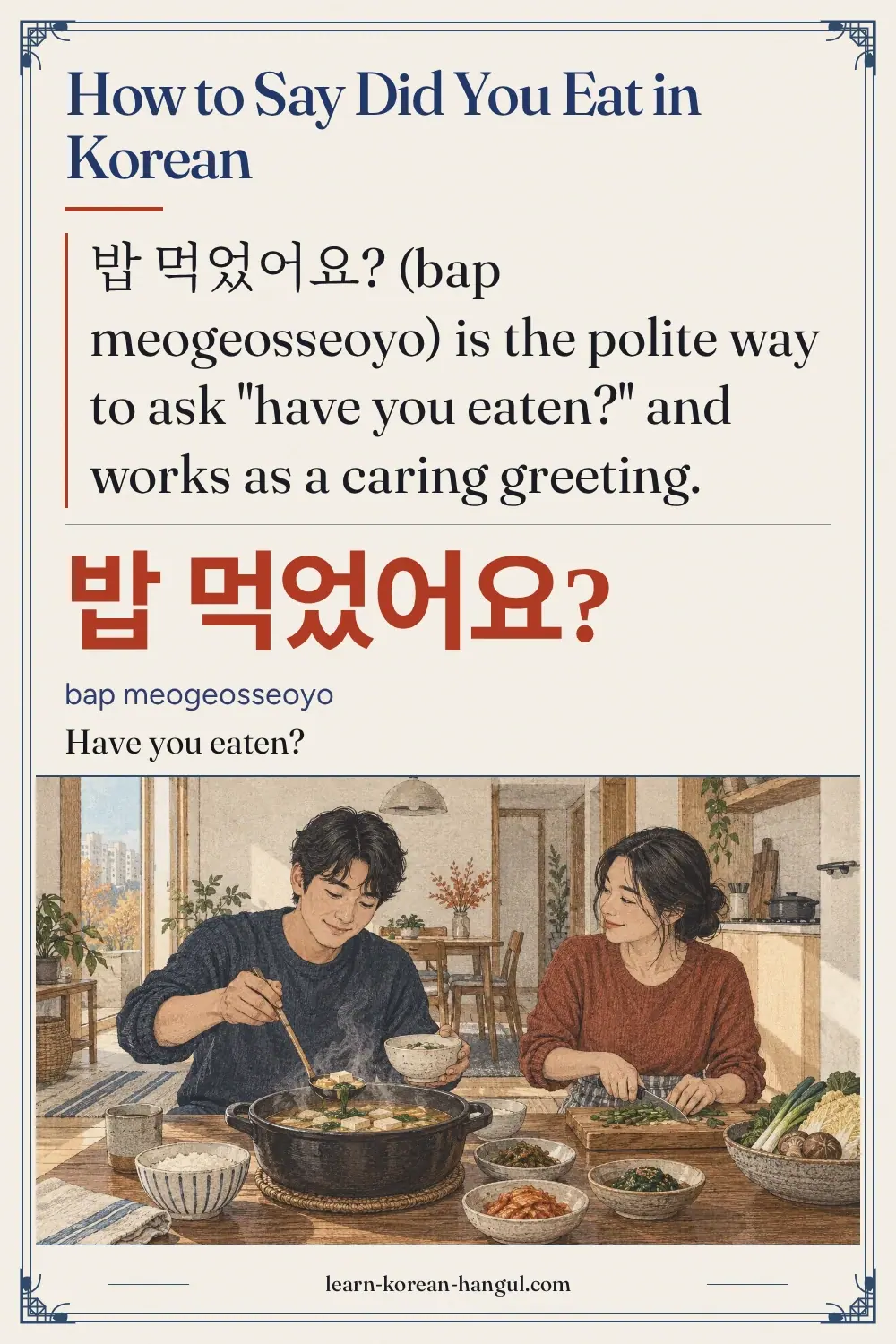
밥 먹었어요?
밥 먹었어요?
What you'll learn
- Ask did you eat with 밥 먹었어요?, 식사하셨어요? and 밥 먹었어?
- Answer the question with 네, 먹었어요 or 아직 안 먹었어요.
- Pronounce 밥 먹었어요 as [밤 머거써요].
- Understand why Koreans ask about meals as a greeting.
Before you start: the endings below follow the levels explained in Korean speech levels. If you want a different greeting, see how are you in Korean. Time: about 12 minutes. Audio plays only when you press a button.
How Do You Say Did You Eat in Korean?
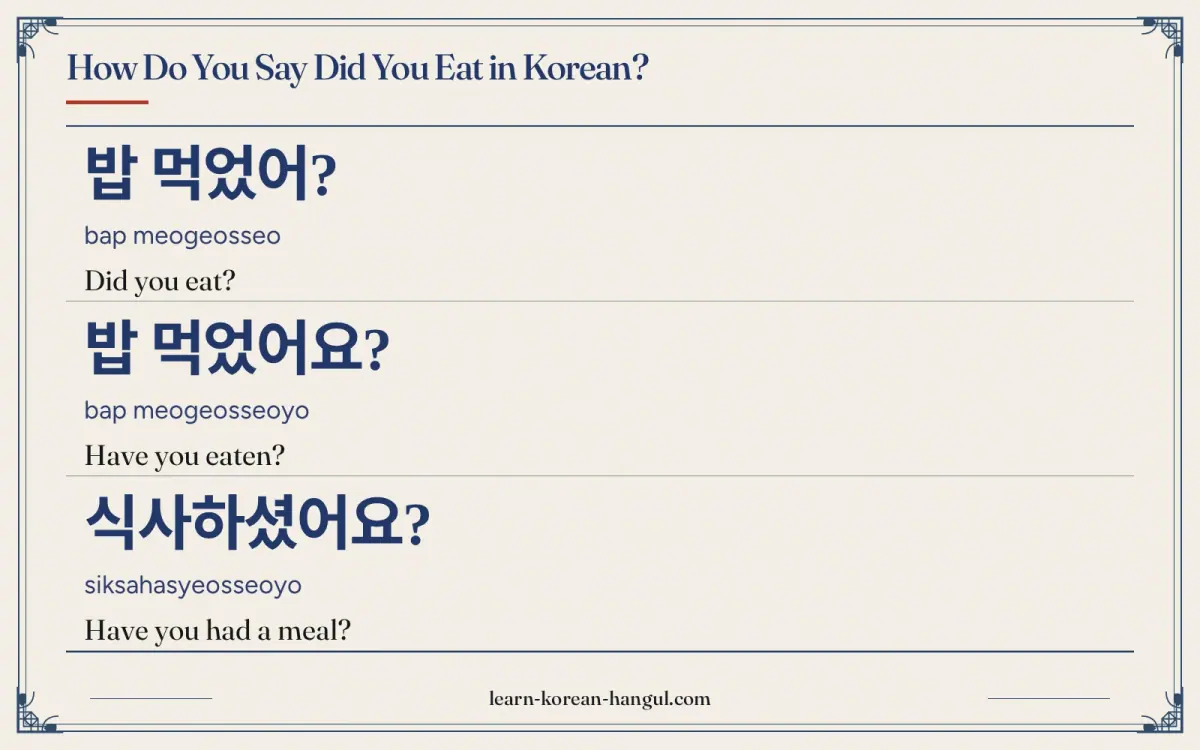
The standard way to say did you eat in Korean is 밥 먹었어요?, built from 밥 (rice, a meal) and 먹었어요 (ate). The verb is 먹다 (to eat), and the past ending -었- is used because the meal is already over.
| Listener | Korean | Romanization | Meaning |
|---|---|---|---|
| Friend, sibling, younger person | 밥 먹었어? | bap meogeosseo | Did you eat? |
| Coworker, acquaintance | 밥 먹었어요? | bap meogeosseoyo | Have you eaten? |
| Boss, teacher, elder | 식사하셨어요? | siksahasyeosseoyo | Have you had a meal? |
| Announcement, formal writing | 식사하셨습니까? | siksahasyeotseumnikka | Have you had a meal? |
| Elder to a child | 밥 먹었니? | bap meogeonni | Did you eat? |
Revised Romanization (the South Korean government standard of 2000) is a reading aid here. Learn the Hangul first. Some materials write the phrase as it sounds, bam meogeosseoyo. The next section explains each form.
What Are the Polite and Casual Ways to Say Did You Eat?
Did you eat has four everyday forms, and the listener decides which one fits. The meal word, the verb and the ending change.
Polite: 밥 먹었어요? (bap meogeosseoyo)
Polite · 해요체밥 먹었어요? is the default question. It is safe with coworkers, neighbours and relatives around your age. Name the meal to make it specific: 점심 (lunch), 아침 (breakfast) or 저녁 (dinner).
점심 먹었어요? 같이 가요.
jeomsim meogeosseoyo? gachi gayo
Have you had lunch? Let us go together.
Respectful: 식사하셨어요? (siksahasyeosseoyo)
Polite · 해요체식사하셨어요? swaps 밥 for 식사 (a meal) and adds the honorific -시-. Use it with bosses, teachers, customers and anyone clearly older. For a very old relative, families may say 진지 드셨어요? (jinji deusyeosseoyo), using the honorific words 진지 and 드시다.
선생님, 식사하셨어요?
seonsaengnim, siksahasyeosseoyo
Teacher, have you had your meal?
The most formal version, 식사하셨습니까?, appears in announcements and formal writing.
Casual: 밥 먹었어? (bap meogeosseo)
Casual · 반말밥 먹었어? drops the polite -요. It is for friends, siblings, partners and classmates. Adding 같이 먹자 ("let's eat together") turns the greeting into an invitation.
밥 먹었어? 같이 먹자.
bap meogeosseo? gachi meokja
Did you eat? Let us eat together.
Elder to Child: 밥 먹었니? (bap meogeonni)
Casual · 반말밥 먹었니? ends in the soft question ending -니, which parents, grandparents and teachers use with children. Learners should understand it, but not use it with adults.
밥은 먹었니? 많이 먹어.
babeun meogeonni? mani meogeo
Did you eat? Eat a lot.
Four forms cover most meal questions. The sounds are the next challenge, because several letters change.
How Do You Pronounce 밥 먹었어요?
밥 먹었어요? is pronounced [밤 머거써요], bam meo-geo-sseo-yo, in five syllables. The question mark in writing matches a rising pitch in speech.
- 밥 (bap) → 밤 (bam): the final ㅂ becomes [ㅁ] before the ㅁ of 먹.
- 먹 (meok) → 머 (meo): the final ㄱ moves to the next syllable.
- 었 (eot) → 거 (geo): the ㄱ from 먹 lands here and joins the vowel.
- 어 (eo) → 써 (sseo): the final ㅆ of 었 moves onto 어.
- 요 (yo): a short "yo", with the pitch rising for a question.
Sound Changes to Listen For
Four features shape this phrase and its relatives:
- Nasalization. A final ㅂ before ㅁ is said [ㅁ], so 밥 먹었어요 is [밤 머거써요] in connected speech. The rule is covered in Korean nasalization.
- Liaison. A final consonant moves onto a following vowel, so 먹었어요 is [머거써요], not [먹었어요].
- Tensification. In 식사하셨어요, the ㅅ of 사 turns tense after the ㄱ of 식, giving [식싸하셔써요]. Revised Romanization does not show tensing caused by a neighbouring sound. See Korean tensification.
- Casual endings. 먹었니 is said [머건니], because the final ㅆ is said [ㄷ] and then becomes [ㄴ] before ㄴ.
Raise the last syllable to ask. A flat 밥 먹었어요 sounds like the statement "I ate". The right question also depends on who is listening.
When Should You Use 밥 먹었어요?, and When Should You Not?
Use 밥 먹었어요? with people you already know, as a warm check-in. Avoid it with strangers, because it is a greeting between people with a relationship.
Situations Where It Fits
- A coworker passes your desk at noon. 점심 먹었어요?
- A relative calls you on the phone. 밥 먹었니? or 밥 먹었어요?
- A friend meets you after school or work. 밥 먹었어?
- A teacher or boss walks by. 식사하셨어요?
Situations to Avoid
- A boss or elder, with 밥 먹었어요? The honorific 식사하셨어요? is expected.
- A stranger. The question can feel intrusive.
- A formal speech, with 밥 먹었어? Use the polite or formal form.
The answer is usually short. The table shows common replies.
| Reply | Korean | Romanization | Meaning |
|---|---|---|---|
| Yes | 네, 먹었어요 | ne, meogeosseoyo | Yes, I ate |
| Not yet | 아직 안 먹었어요 | ajik an meogeosseoyo | I have not eaten yet |
| Just now | 방금 먹었어요 | banggeum meogeosseoyo | I just ate |
| Casual yes | 응, 먹었어 | eung, meogeosseo | Yeah, I ate |
Three short dialogues show how the question and the answers sound.
What Does Did You Eat Sound Like in a Real Conversation?
Did you eat is usually the first line of a short exchange. Listen for the rising tone on the question and the falling tone on the answer.
A Junior Asks the Department Head
Junior
부장님, 식사하셨어요?
bujangnim, siksahasyeosseoyo
Sir, have you had your meal?
Department Head
아직 안 먹었어요. 같이 가요.
ajik an meogeosseoyo. gachi gayo
Not yet. Let's go together.
What to notice: the junior uses the honorific, and the boss answers with the plain polite form.
Two Coworkers after Lunch
Dae-Ho
밥 먹었어요?
bap meogeosseoyo
Have you eaten?
Eun-Ji
네, 먹었어요. 커피 마실래요?
ne, meogeosseoyo. keopi masillaeyo
Yes, I ate. Do you want some coffee?
What to notice: Eun-ji gives a short answer and then moves the conversation forward with a new invitation.
A Grandmother and Her Grandson
Grandmother
민수야, 밥 먹었니?
minsuya, bap meogeonni
Min-su, did you eat?
Min-Su
네, 먹었어요. 할머니는요?
ne, meogeosseoyo. halmeonineunyo
Yes, I ate. What about you, Grandma?
What to notice: the child answers politely, and asks back with 은/는요 ("and you?"), a habit that keeps the conversation warm.
What Should You Know about the Culture behind Did You Eat?
Asking about meals is a way of showing care, and it carries more meaning than the words suggest.
- A greeting, not a survey. Between people who know each other, 밥 먹었어요? often means "how are you doing?" A short "yes" is enough.
- Not always an invitation. The question does not mean the speaker will pay or share a meal. If they want to eat together, they add 같이 먹을래요? ("do you want to eat together?").
- Elders ask it as concern. A parent or grandparent who asks 밥은 먹었니? is asking whether you are looking after yourself.
- Meals build relationships. The word 식구 (sikgu) means "family member" and is written with Chinese characters for "eat" and "mouth", which shows how closely meals and family are linked.
An expert insight: the particle 은 in 밥은 먹었니? can add a sense of "at least", so the speaker is checking the basics first. The mistakes below come from missing this friendly tone.
What Mistakes Do Learners Make with Did You Eat in Korean?
Most mistakes come from register, tone and answers that are too long.
| Mistake | Why it is a problem | Fix |
|---|---|---|
| 밥 먹었어요? to a boss | Not respectful enough | Ask 식사하셨어요? |
| 밥 먹었니? to an adult | Sounds as if you are talking to a child | Ask 밥 먹었어요? |
| A long list of foods as the answer | The question is a greeting | Say 네, 먹었어요 |
| Flat tone | Sounds like the statement "I ate" | Raise the last syllable |
| Reading [밥 먹었어요] letter by letter | Misses the nasal [밤] | Say [밤 머거써요] |
Learners often assume the question needs the word for "yet", but Korean uses the past tense alone, so 밥 먹었어요? already means "have you eaten yet?".
Is It the Same as Have You Eaten, Did You Eat yet and Eat yet in Korean?
Yes. The searches "have you eaten in Korean", "did you eat yet in Korean", "have you eaten yet in Korean" and "eat yet in Korean" all lead to 밥 먹었어요? The short answers below cover each one.
- Have you eaten in Korean: 밥 먹었어요?, the same phrase, because Korean past tense covers both "did" and "have".
- Did you eat yet in Korean: 밥 먹었어요?, with no word for "yet". The reply uses 아직 (not yet): 아직 안 먹었어요.
- Have you eaten yet in Korean: also 밥 먹었어요? If you are surprised that someone has eaten already, ask 벌써 먹었어요? (beolsseo meogeosseoyo), "have you already eaten?"
- Did you eat Korean: the English search term for the same question, with 밥 먹었어요?
Now practise the tone and the sounds with your own voice.
Practice: Say It Aloud
Play the slow clip and repeat 밥 먹었어요? three times, saying [밤 머거써요] and raising the last syllable. Then choose the right question for each listener. Answers follow.
- Your teacher walks into the staff room.
- Your friend texts you at noon.
- A coworker your age passes your desk.
- How do you say "not yet" in your reply?
Answers
- 식사하셨어요?
- 밥 먹었어?
- 밥 먹었어요?
- 아직 안 먹었어요.
The phrase flashcards drill these questions with audio.
Related Phrases to Learn Next
Did you eat connects to the phrases for greeting and eating together.
- How are you in Korean: the more direct way to ask about someone's day.
- Let's eat together in Korean: the invitation that often follows.
- Delicious in Korean: what to say during the meal.
- I'm hungry in Korean: the reply when you have not eaten.
This guide belongs to the Korean small talk collection. What this page does not cover: ordering food and restaurant phrases. Ask with a rising tone and the right ending, and you can say did you eat in Korean as a real greeting.
Frequently Asked Questions
How do you say did you eat in Korean?
Say 밥 먹었어요? (bap meogeosseoyo) with a rising tone. To a boss, teacher or elder, say 식사하셨어요? To a friend, say 밥 먹었어? An elder speaking to a child says 밥 먹었니? Korean uses the past tense here, so no word for "yet" is needed.
How do you pronounce 밥 먹었어요?
Say bam meo-geo-sseo-yo, written [밤 머거써요]. The final ㅂ of 밥 becomes [ㅁ] before the ㅁ of 먹. The ㄱ of 먹 moves to the next syllable, and the ㅆ of 었 moves with it to give [써]. Raise your pitch on the last syllable to ask the question.
What is the difference between 밥 먹었어요? and 식사하셨어요?
밥 먹었어요? is polite and uses the plain word 밥. 식사하셨어요? uses 식사 (a meal) and the honorific -시-, so it respects the listener. Use 식사하셨어요? with a boss, a teacher, a customer or anyone clearly older. Use 밥 먹었어요? with peers.
Is 밥 먹었어요? formal or casual?
밥 먹었어요? is polite but not formal. It suits coworkers, relatives and people around your age. The casual form is 밥 먹었어?, and the respectful form is 식사하셨어요? A fully formal written version is 식사하셨습니까?, which you will mostly see in announcements.
Can I use 밥 먹었어요? with friends, elders and strangers?
You can use it with friends, though 밥 먹었어? is more natural, and with coworkers. With elders, switch to 식사하셨어요?, and with a very old relative, 진지 드셨어요? With strangers, avoid the question, because it is a greeting between people who already know each other.
What is the most common mistake with did you eat in Korean?
Asking a boss or elder 밥 먹었어요?, when 식사하셨어요? is expected. A second mistake is answering with a long list of foods, when 네, 먹었어요 is enough. A third is reading the question as an invitation, and a fourth is saying [밥 먹었어요] without the nasal [밤].