괜찮습니다
괜찮습니다
What you'll learn
- Decline an offer with 괜찮습니다, 괜찮아요 or 아니요, 괜찮아요 according to the listener.
- Avoid the two classic traps: a blunt 아니요 and an ambiguous 괜찮아요.
- Pronounce 괜찮습니다 as [괜찬씀니다].
- Handle a host who offers again after your first refusal.
Before you start: this page builds on it's okay in Korean, because no thank you uses the same word, 괜찮다. Time: about 10 minutes. Audio plays only when you press a button.
How Do You Say No Thank You in Korean?
The standard way to say no thank you in Korean is 괜찮습니다, which literally means "it's fine (without it)". Korean declines by saying you are fine rather than by saying "no" and "thanks" separately.
| Offer | Best reply | Romanization | Why |
|---|---|---|---|
| A clerk offers a bag | 괜찮습니다 | gwaenchanseumnida | Formal, neutral |
| A friendly vendor offers a sample | 아니요, 괜찮아요 | aniyo, gwaenchanayo | Clear and warm |
| A colleague offers coffee | 괜찮아요, 감사해요 | gwaenchanayo, gamsahaeyo | Polite, with thanks |
| A pushy seller asks a third time | 됐어요 | dwaesseoyo | Firm |
| A close friend offers more chips | 아니, 괜찮아 | ani, gwaenchana | Casual |
Adding thanks after the refusal is optional but kind: 괜찮습니다, 감사합니다. The next section takes each form in turn.
What Are the Formal and Polite Ways to Say No Thank You?
No thank you follows the Korean speech levels, the endings that change with the listener, explained in the guide to Korean speech levels. Most refusals go to strangers, so the formal and polite forms matter most.
Formal: 괜찮습니다 (gwaenchanseumnida)
Formal · 합쇼체괜찮습니다 uses the formal -습니다 ending, so it suits clerks, older strangers, colleagues at work and anyone in a service setting. It is polite without being warm, which makes it the safest default.
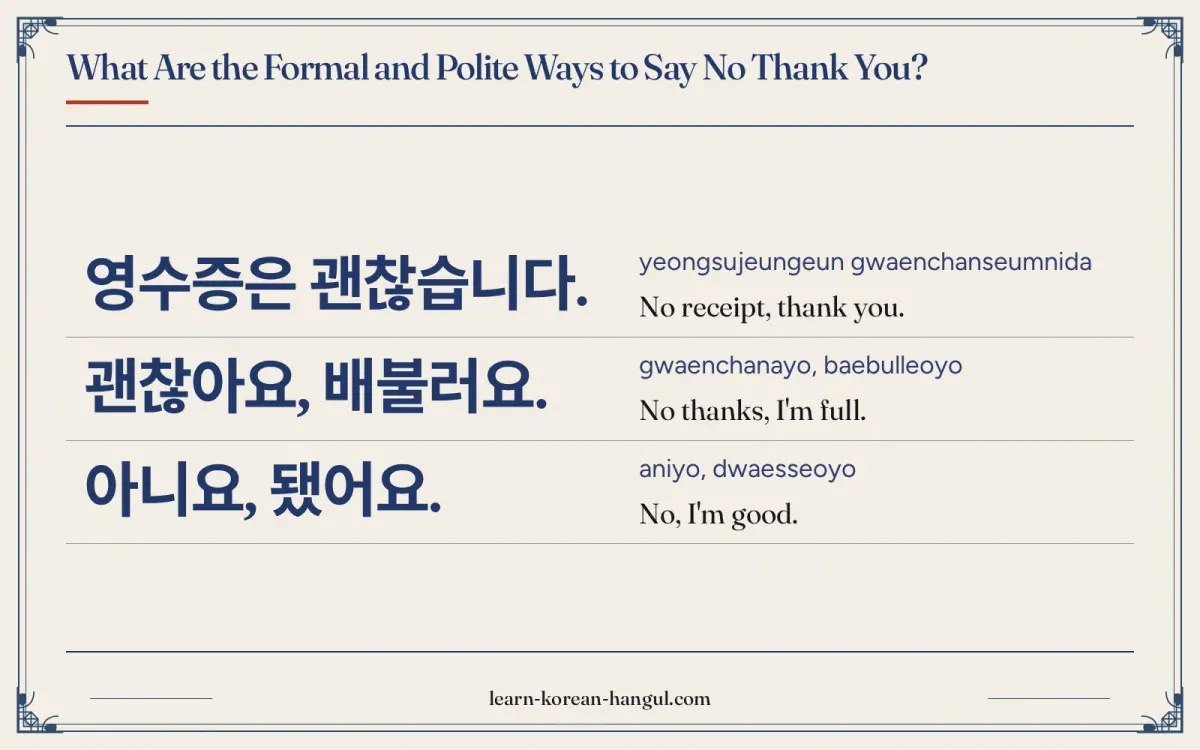
영수증은 괜찮습니다.
yeongsujeungeun gwaenchanseumnida
No receipt, thank you.
Putting the item first with 은/는 (영수증은) makes clear what you are declining.
Polite: 괜찮아요 (gwaenchanayo)
Polite · 해요체괜찮아요 is softer and friendlier. It fits peers, friendly vendors and acquaintances. Its weakness is ambiguity: it can mean "no thanks" or "that's fine, go ahead".
괜찮아요, 배불러요.
gwaenchanayo, baebulleoyo
No thanks, I'm full.
Polite: 아니요, 괜찮아요 (aniyo, gwaenchanayo)
Polite · 해요체아니요, 괜찮아요 adds 아니요 (no) to remove any doubt. It is the clearest polite refusal and the one to use when a yes-or-no question is involved, such as "Do you need a bag?" The spoken contraction 아뇨 is also common. More on the word for no is on no in Korean.
아니요, 괜찮아요. 안 주셔도 돼요.
aniyo, gwaenchanayo. an jusyeodo dwaeyo
No, I'm fine. You don't need to give me one.
Polite: 됐어요 (dwaesseoyo)
Polite · 해요체됐어요 means "I'm good" or "that's enough". It is grammatically polite but firm, and it can sound curt. Keep it for a second or third refusal, or for pushy street sellers.
아니요, 됐어요.
aniyo, dwaesseoyo
No, I'm good.
Casual: 아니, 괜찮아 (ani, gwaenchana)
Casual · 반말With close friends and siblings, drop the polite endings: 아니, 괜찮아 (nah, I'm fine). The casual 됐어 sounds annoyed, so use it only when you mean it.
These forms cover nearly every offer. The formal one has the most surprising pronunciation.
How Do You Pronounce 괜찮습니다?
괜찮습니다 is pronounced [괜찬씀니다], gwaen-chan-sseum-ni-da, in five syllables. Two sound changes hide behind the spelling.
- 괜 (gwaen): a soft g gliding into "weh", ending in n.
- 찬 (chan): written 찮; the ㅎ leaves this syllable.
- 씀 (sseum): written 습; the ㅎ joins ㅅ to make tense ㅆ, and ㅂ becomes ㅁ.
- 니 (ni): "nee".
- 다 (da): a soft d and "ah".
Sound Changes to Listen For
These changes follow the National Institute of Korean Language Standard Pronunciation rules (표준 발음법, articles 12 and 18):
- ㅎ + ㅅ becomes ㅆ. The ㅎ of the cluster ㄶ merges with the following ㅅ into a tense ㅆ. Tense consonants are explained in Korean tensification.
- ㅂ before ㄴ becomes ㅁ. 습니다 is said [씀니다].
- Before a vowel, the ㅎ disappears. 괜찮아요 is [괜차나요].
- 됐어요 is [돼써요]. The ㅆ moves to the next syllable.
Sound is the easy part; the harder part is choosing a refusal that will not be misread.
When Should You Use 괜찮습니다, and When Should You Not?
Use 괜찮습니다 with clerks, older strangers and anyone in a formal or service setting. Do not use it alone when the offer is a yes-or-no question that could be misread, and do not use it with close friends, where it sounds stiff.
Situations Where It Fits
- A cashier offers a receipt or a bag. 괜찮습니다, often with a small hand wave.
- A salesperson offers help in a store. 괜찮습니다, 그냥 볼게요 (I'll just look).
- A senior colleague offers to pay. 괜찮습니다, 제가 낼게요 (it's fine, I'll pay).
Situations to Avoid
- A question like "Shall I add sauce?" 괜찮아요 could mean "yes, that's fine". Say 아니요, 괜찮아요 or 소스는 빼 주세요 (please leave out the sauce).
- A close friend. Say 아니, 괜찮아.
- A first refusal with 됐어요. It can feel like a door closing; start softer.
The conversations below show refusals in three common places.
What Does No Thank You Sound Like in a Real Conversation?
A Korean refusal is usually short and often followed by a reason or thanks. Watch how the reason softens it.
At the Till
Cashier
봉투 드릴까요?
bongtu deurilkkayo?
Would you like a bag?
Customer
아니요, 괜찮습니다.
aniyo, gwaenchanseumnida
No, thank you.
What to notice: 아니요 plus 괜찮습니다 is clear and polite.
More Food at a Friend's Home
Host
더 드세요. 많이 남았어요.
deo deuseyo. mani namasseoyo
Have some more. There's plenty left.
Guest
괜찮아요, 정말 배불러요.
gwaenchanayo, jeongmal baebulleoyo
I'm fine, I'm really full.
Host
조금만 더 드세요.
jogeumman deo deuseyo
Just a little more.
Guest
아니에요, 진짜 많이 먹었어요. 감사합니다.
anieyo, jinjja mani meogeosseoyo. gamsahamnida
No, really, I've eaten a lot. Thank you.
What to notice: the host offers twice, and the second refusal repeats the reason with thanks. That pattern is part of the culture of declining.
What Should You Know about the Culture behind No Thank You?
Korean refusals aim to decline the offer without rejecting the person. A gentle tone and a reason do most of the work.
- Ritual refusal at homes. Hosts may offer again after a first refusal, out of hospitality. A second smiling refusal with a reason is usually accepted.
- One clear refusal in shops. Clerks do not expect a ritual; one 괜찮습니다 is enough.
- Gestures. A small side-to-side wave of the open hand signals no thanks.
- Thanks after refusing. Adding 감사합니다 shows you appreciate the offer.
An expert insight: a bare 아니요 to an offer often sounds blunter in Korean than "no" does in English. Wrapping it as 아니요, 괜찮아요 costs two syllables and changes the whole tone.
What Mistakes Do Learners Make with No Thank You in Korean?
Most refusal mistakes come from being too blunt or too vague.
| Mistake | Why it is a problem | Fix |
|---|---|---|
| A bare 아니요 | Sounds blunt | Say 아니요, 괜찮아요 |
| A bare 괜찮아요 to a yes-or-no offer | Can mean "go ahead" | Add 아니요 or 안 주셔도 돼요 |
| Starting with 됐어요 | Sounds curt | Start with 괜찮습니다 |
| Accepting by saying 괜찮아요 | Heard as a refusal | Say 네, 주세요 |
| Pronouncing every letter of 괜찮습니다 | ㅎ merges and ㅂ nasalizes | Say [괜찬씀니다] |
Learners often assume 감사합니다 alone works as no thank you, as "thanks" can in English. Actually, 감사합니다 alone usually sounds like acceptance; you need 괜찮습니다 or 아니요 to decline.
Is It the Same as No Thanks?
Yes. "No thanks" and "no thank you" are both 괜찮습니다 or 괜찮아요 in Korean. The short answers below cover the other searches folded into this page.
- No thanks in Korean: 괜찮아요, or casual 아니, 괜찮아.
- No thank you formal in Korean: 괜찮습니다, optionally followed by 감사합니다.
- No thanks politely in Korean: 아니요, 괜찮아요, with a reason such as 배불러요 (I'm full).
Now practise refusing aloud.
Practice: Say It Aloud
Play the slow clip of 괜찮습니다 three times, then 아니요, 괜찮아요. Then choose a reply. Answers follow.
- A department-store clerk asks if you need help.
- A server asks 물 더 드릴까요? (more water?) and you have enough.
- A street seller offers a flyer for the third time.
- Why can a bare 괜찮아요 be confusing?
Answers
- 괜찮습니다, 그냥 볼게요.
- 아니요, 괜찮아요.
- 됐어요.
- Because it can mean "no thanks" or "that's fine, go ahead".
The phrase flashcards drill these refusals with audio.
Related Phrases to Learn Next
Declining sits beside accepting and thanking in everyday exchanges.
- It's okay in Korean: every meaning of 괜찮아요.
- Thank you in Korean: 감사합니다 to close a refusal kindly.
- Please in Korean: 주세요 for when you do want something.
This guide belongs to the polite Korean phrases collection. What this page does not cover: refusing invitations, business negotiations and turning down romantic offers. Add 아니요, give a reason when you can, and you can say no thank you in Korean without any confusion.
Frequently Asked Questions
How do you say no thanks, I'm just looking in a Korean shop?
Say 괜찮아요, 그냥 보는 거예요 (it's okay, I'm just looking). Shop staff in clothing and cosmetics stores often greet you and offer help, and this answer politely declines without sounding cold. A smile and a small nod help. Staff usually leave you to browse after that.
How do you turn down a gift politely in Korean?
A gracious formula is 마음만 받을게요 (I'll accept just your kind thought), followed by 감사합니다. It declines the object while honouring the gesture. Be aware that a Korean host may offer again; if you truly cannot accept, repeat the phrase gently with a reason, such as a rule at work.
Is 됐어요 rude?
됐어요 is not rude in itself, but it is firm and can sound curt, like I said no or enough already. It fits when you have already declined once, or with pushy street sellers. With a friendly host, shop clerk or elder, 괜찮습니다 or 아니요, 괜찮아요 is softer and safer.
How do you say no thank you to more food in Korean?
Say 괜찮아요, 배불러요 (I'm fine, I'm full) or, more formally, 괜찮습니다, 많이 먹었습니다 (I've eaten plenty). Giving the reason makes the refusal feel kind rather than dismissive. At a Korean home, hosts may insist once; a second smiling refusal with the same reason is usually accepted.
What gesture goes with no thank you in Korea?
A small wave of the open hand from side to side at chest height, often with a slight smile, signals no thanks. People also lift one hand, palm out, to wave off a flyer or sample. Shaking your head works too. Avoid crossing your arms, which looks stronger than a polite refusal.