
그렇군요
그렇군요
What you'll learn
- Say 그렇군요 aloud as [그러쿤뇨], with the aspirated ㅋ, as it is commonly spoken.
- Choose between 그렇군요, 그렇구나, 그렇네요 and 알겠어요.
- React to news so you sound interested and not sarcastic.
- Avoid replying 맞아요 when you only mean "I see".
Before you start: you need to read Hangul; romanization is shown as an aid and can be hidden. Time: about 9 minutes. Audio plays only when you press a button.
How Do You Say I See in Korean?
The direct answer is 그렇군요. It comes from the adjective 그렇다 (to be so, to be like that) and the ending -군요, which means "so that is how it is". The ending carries the surprise of learning something. Korean has several reactions of this kind, and the table shows how they differ.
| Form | Romanization | Meaning | Use it for |
|---|---|---|---|
| 그렇군요 | geureokunyo | I see | News from a senior or a stranger |
| 그렇구나 | geureokuna | I see (casual) | News from a friend |
| 아, 그렇네요 | a, geureonneyo | Ah, that's right | Noticing something agrees with what you see |
| 알겠어요 | algesseoyo | I understand | Instructions and explanations |
| 아, 그래요? | a, geuraeyo | Oh, really? | Showing you want more detail |
The first four are the core set. The next section shows each in a sentence.
What Are the Polite, Casual and Formal Ways to Say I See?
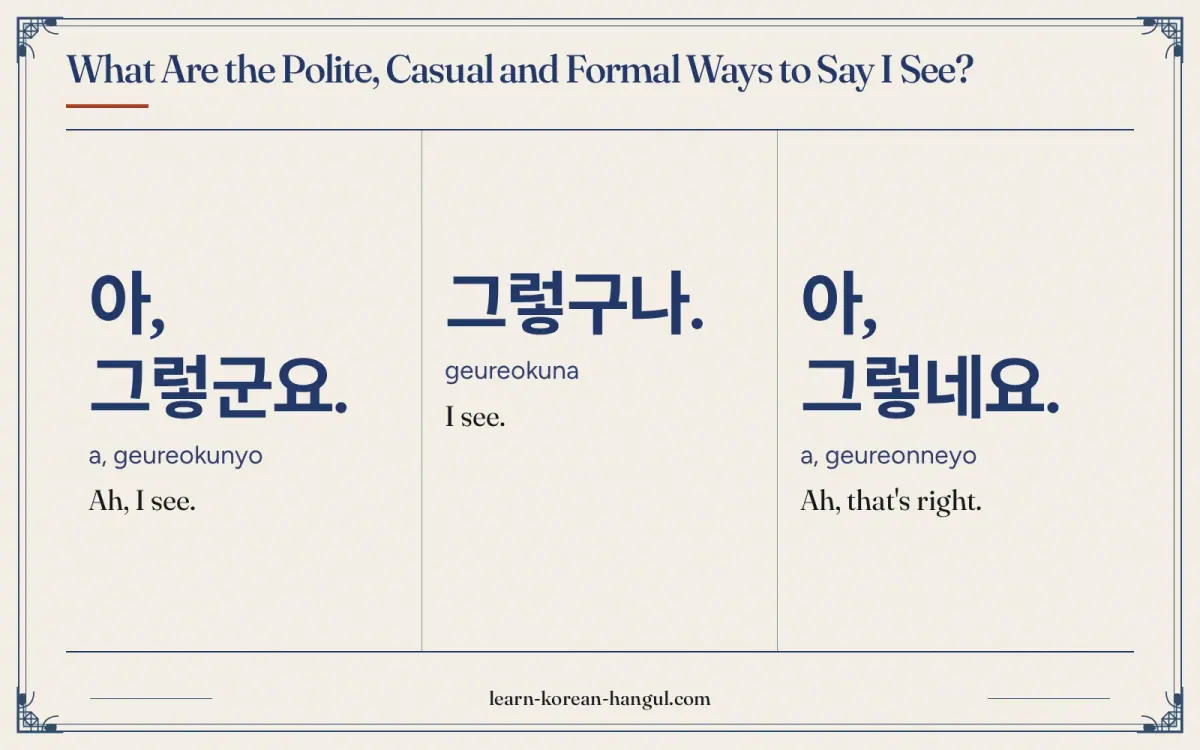
These reactions follow the Korean speech levels, the endings that change with the listener, explained in the guide to Korean speech levels. The meaning stays the same while the tone shifts.
Polite: 그렇군요 (geureokunyo)
Polite · 해요체그렇군요 is the best general answer to something new. It suits a colleague, a teacher, a new acquaintance or a host. Say it with a short 아 (ah) in front for more feeling.
아, 그렇군요.
a, geureokunyo
Ah, I see.
Casual: 그렇구나 (geureokuna)
Casual · 반말그렇구나 drops the -요 ending and replaces -군요 with -구나. Use it with friends and younger people. It sounds like thinking aloud, so a quiet voice suits it.
그렇구나.
geureokuna
I see.
Polite: 아, 그렇네요 (a, geureonneyo)
Polite · 해요체The ending -네요 notices something in front of you. 그렇네요 means "ah, so it is" or "that's right", and it fits an observation more than news. You often hear it when someone points out something you can check yourself.
아, 그렇네요.
a, geureonneyo
Ah, that's right.
Polite: 알겠어요 (algesseoyo)
Polite · 해요체알겠어요 comes from the verb 알다 (to know) and the ending -겠-, which here makes the reply sound considerate, so it means "I understand" or simply "understood". It answers an instruction, a rule or an explanation you will follow.
네, 알겠어요.
ne, algesseoyo
Yes, I understand.
Formal: 그렇습니까? (geureoseumnikka)
Formal · 합쇼체그렇습니까 is the formal question "is that so?", used in meetings, interviews and broadcasts. In customer service, 알겠습니다 is the formal "understood".
아, 그렇습니까?
a, geureoseumnikka
Ah, is that so?
Asking for More: 아, 그래요? (a, geuraeyo)
Polite · 해요체아, 그래요? ends with a rise because it is a yes/no question: "Oh, really?". It invites the speaker to tell you more. Compare it with 그렇군요, which is a statement and falls or stays level. The page on really in Korean goes further.
Each form reacts differently, so the sounds in the main phrase come next.
How Do You Pronounce 그렇군요?
In everyday speech 그렇군요 is pronounced [그러쿤뇨], and it is written geureokunyo in Revised Romanization, the official system for writing Korean in Latin letters.
- 그 (geu): the vowel ㅡ, said with unrounded lips, like a flat "uh".
- 러 (reo): a light tap of the tongue and "uh".
- 쿤 (kun): an aspirated k with a puff of air, then "oon" and n.
- 뇨 (nyo): "nyo". In common speech an n sound is added before 요.
Sound Changes to Listen For
- Aspiration (격음화). The ㅎ in 렇 meets the ㄱ of 군, and the two merge into an aspirated ㅋ. So 그렇군 is [그러쿤]. The ㅎ is not heard as a separate sound. See the lesson on aspiration.
- ㄴ before 요. After a final consonant, 요 is commonly said with an added ㄴ, so 군요 sounds like [군뇨]. The standard pronunciation rules do not codify this added ㄴ (without it, the ㄴ of 군 simply links: [구뇨]), and Revised Romanization does not write it.
- Same rule in 그렇구나. The ㅎ and ㄱ merge again, giving [그러쿠나].
- ㅎ and ㄴ in 그렇네요. The ㅎ before ㄴ turns into ㄴ, so 그렇네요 is [그런네요], written geureonneyo.
Sounding right is half the job. Knowing when to react aloud is the other half.
When Should You Use 그렇군요, and When Should You Not?
Use 그렇군요 when someone tells you something you did not know. React right after the new information, and keep your voice warm so the listener feels heard.
Situations Where It Fits
- Meeting someone new. They tell you where they live or work.
- At work. A colleague explains a schedule change.
- In class. A teacher explains a new rule, and you acknowledge it.
Situations to Avoid
- Facts you already knew. The ending -군요 shows surprise, so it sounds odd when you knew it.
- Instructions. If you are told to do something, say 알겠어요 or 알겠습니다.
- With a flat voice. A cold 그렇군요 can sound sarcastic, like "if you say so".
Hearing the difference in conversation makes it easier to choose, so here are three exchanges.
What Does I See Sound Like in a Real Conversation?
Each reaction fits a specific kind of turn. Listen for what the first speaker says and how the second one answers.
Meeting Someone New
Person
저는 서울에 살아요.
jeoneun seoure sarayo
I live in Seoul.
You
아, 그렇군요.
a, geureokunyo
Ah, I see.
What to notice: 서울에 is said [서우레] and 살아요 is said [사라요], because final consonants link to the next vowel.
A Friend Shares News
Friend
오늘은 가게가 쉬어.
oneureun gagega swieo
The shop is closed today.
You
그렇구나. 몰랐어.
geureokuna. mollasseo
I see. I didn't know.
What to notice: 그렇구나 follows the new information, and 몰랐어 adds that it was new. The casual register fits two friends.
A Boss Gives Information at Work
Boss
이번 주 금요일은 휴일이에요.
ibeon ju geumyoireun hyuirieyo
This Friday is a holiday.
You
아, 그렇군요. 알겠습니다.
a, geureokunyo. algetseumnida
Ah, I see. Understood.
What to notice: you first show that you took in the news, then confirm that you will plan around it. 금요일은 is [그묘이른] in the standard pronunciation, although many speakers add a ㄴ, [금뇨이른]. These small reactions are part of a wider listening culture.
What Should You Know about the Culture behind Saying I See?
Korean conversation expects the listener to react often. Short reactions, called backchannels (맞장구), show that you are listening and are not interrupting.
- Frequent reactions. Listeners say 네, 아, 그렇군요 and 아, 그래요? many times in a conversation.
- Silence can mislead. A silent listener may look uninterested, so a small reaction is polite.
- At work. 그렇군요 signals that you took in an explanation. 알겠습니다 signals that you will act on it.
- Tone matters. The same words can sound warm or cold, so smile or nod when you say them.
An expert insight: learners often use the English habit of saying nothing while someone explains. Actually, Korean speakers expect small sounds, and a well-placed 아, 그렇군요 makes you sound attentive. The mistakes below show where learners trip.
What Mistakes Do Learners Make with I See in Korean?
Most mistakes come from picking the wrong kind of "I see".
| Mistake | Why it is a problem | Fix |
|---|---|---|
| Replying 맞아요 to news | Means "that's right" and agrees | Say 그렇군요 |
| 알겠어요 after news | Sounds like accepting an order | Say 그렇군요 |
| 그렇구나 to a boss | Too casual for the listener | Say 그렇군요 |
| Saying geu-reot-gun-yo | Misses the aspirated ㅋ | Say 그러-쿤-요, as in the clip |
| A flat tone | Can sound sarcastic | Add 아 and a warmer voice |
Learners often assume that 그렇군요 means "you are right". Actually, it only shows that you have understood, and you can say it while still disagreeing.
Other Ways People Search for I See in Korean
People search for this idea in a few forms. The short answers below cover each one.
- I get it in Korean: 이해했어요 (ihaehaesseoyo), "I understood the meaning", or 알겠어요.
- Oh I see in Korean: 아, 그렇군요, or 아, 그렇구나 with friends.
- Got it in Korean: 알겠어요, or the casual 알았어 (arasseo).
- Romanized: geureokunyo, following the Revised Romanization of Korean; romanization is an aid, not the real spelling.
Reading the forms is one thing; reacting on cue is another, so practise now.
Practice: Say It Aloud
Play the slow clip of 그렇군요 and repeat it three times, with a clear aspirated ㅋ. Then say 그렇구나 as you would to a friend. Choose a reaction for each situation, and check the answers below.
- A teacher tells you the class moves to another room.
- A friend says the café closes at nine.
- A new colleague says they come from Busan.
Answers
- 알겠어요, or 알겠습니다 if you want to be more formal.
- 그렇구나.
- 아, 그렇군요.
Drill these lines with the phrase flashcards, which include audio for each form.
Related Phrases to Learn Next
Reacting to news connects to a set of short answers.
- Of course in Korean: a stronger agreement.
- Really in Korean: asking for more.
- Wow in Korean: a reaction to surprise.
- That's right in Korean: agreeing, the other half of 그렇군요.
This guide belongs to the Korean filler words collection. What this page does not cover: long listener responses and written chat reactions. Show you have understood with 그렇군요, save 알겠어요 for instructions, and you will say I see in Korean the way Koreans do.
Frequently Asked Questions
How do you say I see in Korean?
Say 그렇군요 (geureokunyo) to a boss, an elder or someone you have just met. With friends, say 그렇구나. For "I understand, I'll do it", say 알겠어요. The ending -군요 shows that you just realized something, so it sounds natural right after someone tells you new information.
How do you pronounce 그렇군요?
In everyday speech it sounds like [그러쿤뇨]. The ㅎ of 렇 joins the ㄱ of 군 to form an aspirated ㅋ, so you hear 그러-쿤. Then 요 after a consonant is commonly said with an added ㄴ, [뇨], though the standard rules do not require it. Revised Romanization writes the ㅋ but not that ㄴ: geureokunyo.
What is the difference between 그렇군요 and 그렇구나?
They mean the same, "I see", but they differ in politeness. 그렇군요 uses the polite -요, so it suits strangers, seniors and colleagues. 그렇구나 drops the -요 and is casual, for friends and younger people. Using 그렇구나 with a boss would sound too familiar, even though the meaning is identical.
Is 그렇군요 formal or casual?
It is polite, not formal. It sits in the everyday 해요 style, which is safe with most listeners. For a formal setting such as a meeting or a news interview, say 그렇습니까? or 알겠습니다. For friends, say 그렇구나. In a normal conversation with an adult, 그렇군요 is the best choice.
Can I use 그렇군요 with friends, elders and strangers?
Yes, with elders and strangers it is a good choice. With friends it is also acceptable but slightly polite, so 그렇구나 sounds more natural. Whatever the listener, 그렇군요 should sound warm. A flat tone can sound sarcastic, as if you do not believe what you heard.
What is the most common mistake with I see in Korean?
The most common mistake is replying 맞아요, which means "that's right" and agrees. 그렇군요 only shows you have taken in the information. A second mistake is using 알겠어요 after news, because it means "understood, I'll do it" and sounds like you accept an order.