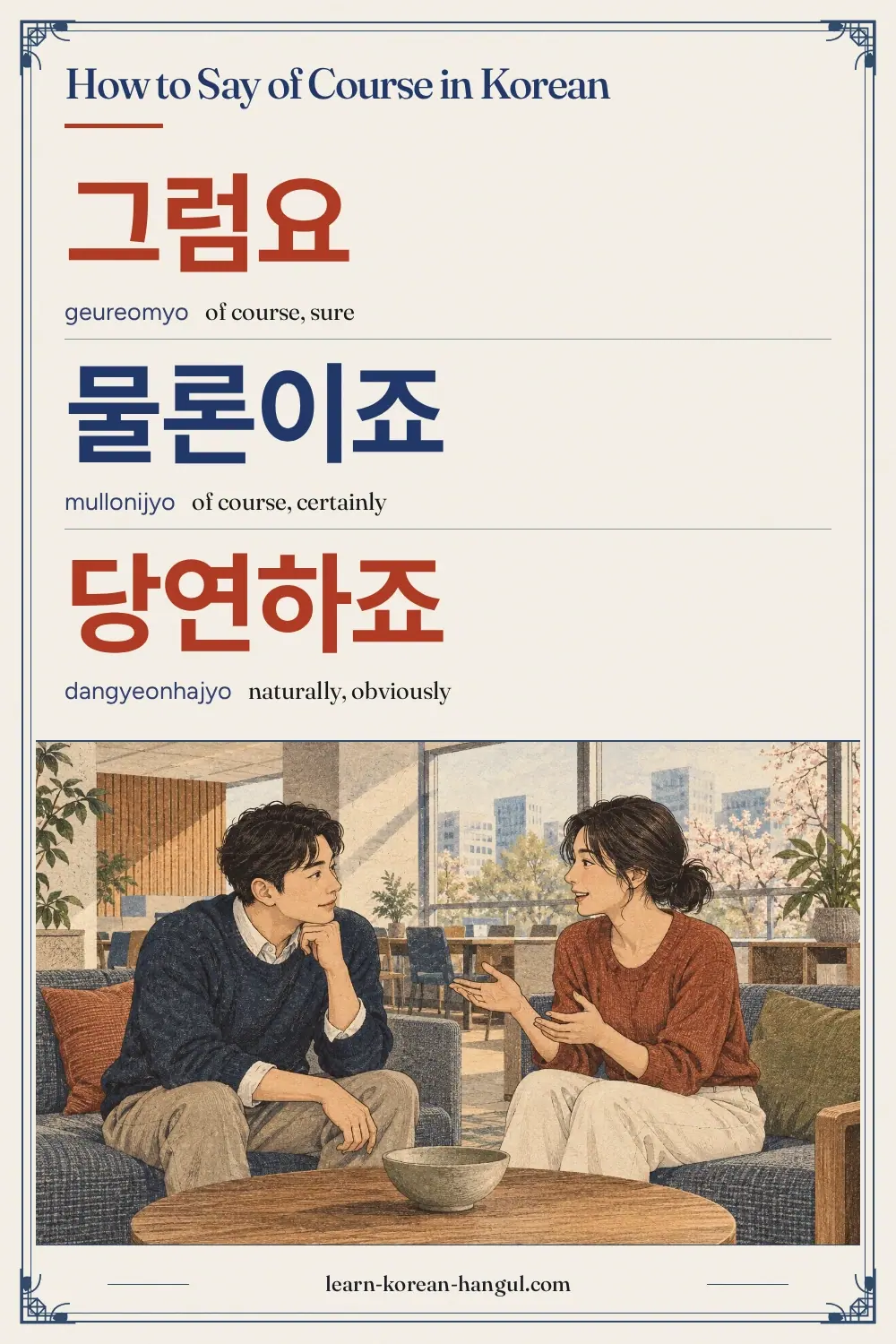
그럼요
그럼요
What you'll learn
- Say "of course" with 그럼요, 물론이죠 and 당연하죠 for polite listeners.
- Switch to 그럼 or 당연하지 with friends.
- Hear why 물론이죠 sounds like [물로니죠].
- Avoid the two common slips: a clipped 물론 and 그럼요 after a negative question.
Before you start: you should know that 요 makes Korean polite. The guides to yes in Korean and okay in Korean are good companions. Time: about 11 minutes. Audio plays only when you press a button.
Key facts
- 그럼요 (geureomyo) is the warm, everyday polite form of "of course".
- 물론이죠 (mullonijyo) is firmer, and 물론입니다 is the formal version.
- 당연하죠 (dangyeonhajyo) means "naturally", and 당연하지 is casual.
- 그럼 (geureom) alone is casual and also means "then".
- 물론이죠 is pronounced [물로니죠].
How Do You Say of Course in Korean?
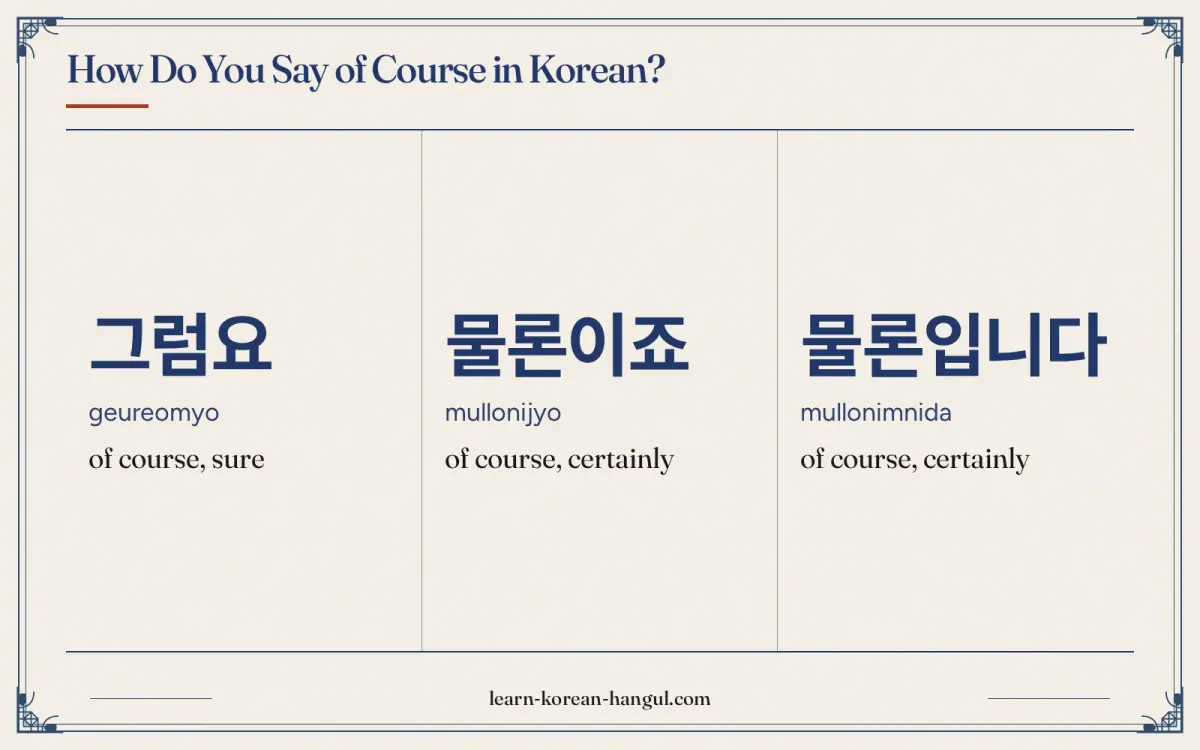
The everyday answer is 그럼요. You use it when someone asks a question and the answer is an easy, friendly yes: "Can I sit here?", "Do you take cards?" or "You're coming, right?". The word 그럼 originally means "then" or "in that case", and adding 요 makes it a polite agreement.
| Korean | Romanization | Meaning | Style |
|---|---|---|---|
| 그럼요 | geureomyo | of course, sure | polite, warm |
| 물론이죠 | mullonijyo | of course, certainly | polite, firm |
| 물론입니다 | mullonimnida | of course, certainly | formal |
| 당연하죠 | dangyeonhajyo | naturally, obviously | polite |
| 당연하지 | dangyeonhaji | of course | casual |
| 그럼 | geureom | sure | casual |
The word 물론 (mullon) is a noun-like word that means "of course" or "certainly". Adding 이죠 (ijyo) makes it a polite sentence, "it is of course". The word 당연 (dangyeon) means "natural" or "only right", and 당연하다 (dangyeonhada) is the adjective "to be natural". Its polite form is 당연해요, but 당연하죠 is the usual reaction, because the ending -죠 (a short form of -지요) invites the listener to agree: "naturally, isn't it?"
What Are the Polite and Casual Ways to Say of Course?
Choose the form by listener and by feeling. The guide to Korean speech levels explains the three levels. In short, 요 endings are polite, -ㅂ니다 endings are formal and bare endings are casual.
Polite: 그럼요 (geureomyo)
Polite · 해요체그럼요 is the one to learn first. Staff say it to reassure a guest, and a nod makes it warmer.
그럼요, 앉으세요.
geureomyo, anjeuseyo
Of course, please sit.
Polite and Firm: 물론이죠 (mullonijyo)
Polite · 해요체물론이죠 sounds more businesslike, and it suits an answer to a clear request such as a payment question.
물론이죠. 카드도 돼요.
mullonijyo. kadeudo dwaeyo
Certainly. Cards are fine too.
Formal: 물론입니다 (mullonimnida)
Formal · 합쇼체물론입니다 is for announcements, presentations and very formal service. You will hear it from airline staff and bank clerks more than from friends.
Polite: 당연하죠 (dangyeonhajyo)
Polite · 해요체당연하죠 says that the answer is obvious. Said warmly, it means "naturally!". Said sharply, it can sound as if the question was not needed.
Casual: 당연하지 (dangyeonhaji)
Casual · 반말With friends and family, drop the polite 요 and say 당연하지. The same meaning appears in the short 그럼, which also works as "sure".
당연하지! 같이 가자.
dangyeonhaji! gachi gaja
Of course! Let's go together.
The sounds are simple, but two of them change from the spelling.
How Do You Pronounce 그럼요?
그럼요 has three syllables: geu-reom-yo. The first syllable ㅡ is an unrounded vowel, so spread your lips a little and do not say "goo". The ㅓ in 럼 is also unrounded: open your mouth a little, spread your lips and say a sound close to the "u" in "cut", not an "o".
Sound Changes to Listen For
- 그럼요 is often said [그럼뇨] in common speech. A final consonant before 요 can bring an n sound with it, so ㅁ + 요 can sound like [뇨]. Others link the ㅁ straight into 요: [그러묘]. Revised Romanization adds no n and writes geureomyo.
- 물론이죠 is [물로니죠]. The final ㄴ of 론 moves into the empty first slot of 이 (liaison). Revised Romanization writes mullonijyo.
- 물론입니다 is [물로님니다]. The ㄴ moves forward, and ㅂ before ㄴ turns into ㅁ, which is nasalization.
당연하죠 has a soft ㅎ in 하. After ㄴ the ㅎ is light, and in fast speech it can almost disappear ([당여나죠]), but the standard keeps it: [당연하죠]. The ending 죠 sounds like "jyo". The next section places each form in a real situation.
When Should You Use 그럼요, and When Should You Not?
Use 그럼요 when you gladly agree, and use a firmer or casual form when the listener or mood changes. A good rule is to match the warmth of the question: a friendly question gets 그럼요, and a formal request gets 물론이죠.
Situations Where It Fits
- A guest asks if something is allowed. A host says 그럼요 to put the guest at ease.
- A customer asks about a service. Shop staff say 그럼요 or 물론이죠.
- A friend asks for a promise. Say 당연하지 to show loyalty.
- A colleague asks for help. 그럼요, 도와 드릴게요 ("of course, I will help") is a friendly offer.
Situations to Avoid
- After a thank-you. If someone thanks you, 그럼요 is not the answer. Say 아니에요 (anieyo) or 별말씀을요 (byeolmalsseumeuryo, "don't mention it").
- Before an elder with a short 물론. Add 이죠 or 이에요.
- After a negative question. If someone asks 안 가요? ("aren't you going?"), 그럼요 can mean "of course I'm going" or "of course not", so repeat the verb: 가요 (gayo) or 안 가요 (an gayo).
- With a sharp tone of 당연하죠. It can sound proud, as if the question was silly.
What Does of Course Sound Like in a Real Conversation?
In real talk, "of course" is quick and follows a question at once. Listen for the warm tone on 그럼요 in the first dialogue, the firmer tone of 물론이죠 in the second and the bright, fast 당연하지 in the third.
Asking to Sit
Guest
여기 앉아도 돼요?
yeogi anjado dwaeyo
May I sit here?
Host
그럼요, 앉으세요.
geureomyo, anjeuseyo
Of course, please sit.
Guest
감사합니다.
gamsahamnida
Thank you.
What to notice: 앉아도 돼요 means "may I sit?" and rises at the end because it is a yes/no question. 앉으세요 is the polite invitation, and it is pronounced [안즈세요].
Paying at a Shop
Customer
카드로 계산해도 돼요?
kadeuro gyesanhaedo dwaeyo
May I pay by card?
Clerk
물론이죠.
mullonijyo
Certainly.
Customer
여기 있어요.
yeogi isseoyo
Here you are.
What to notice: the clerk uses the firmer 물론이죠, a professional answer. 계산해도 돼요 means "is it all right if I pay".
Two Friends
Minji
너도 갈 거지?
neodo gal geoji
You're coming too, right?
Jihun
당연하지! 빠질 수 없지.
dangyeonhaji! ppajil su eopji
Of course! I can't miss it.
What to notice: 갈 거지 is said [갈꺼지], with a tense ㄱ after the future ending -(으)ㄹ (Article 27). 빠질 수 없지 means "I can't be left out".
What Should You Know about the Culture behind of Course?
In Korean service culture, quick, warm agreement is a form of care. A host or shop owner who says 그럼요 is also saying "no trouble at all", so the word carries more kindness than the English "of course".
- Warmth matters. A nod, a smile and 그럼요 together make a guest feel welcome.
- Firmness suits business. 물론이죠 gives a clear, reliable answer to a request.
- Friends show loyalty with 당연하지. It is the answer to "will you come?" and "do you trust me?".
- The tone does the work. A bright tone on 당연하죠 sounds friendly, and a flat tone sounds proud.
- Age and rank still count. Even a warm 그럼요 keeps the polite ending 요 with elders.
An expert note: Korean often answers a question by repeating its verb, so 가요? can be answered with 가요 ("I'm going"). Learners who rely on 그럼요 alone miss this very natural pattern.
How Can You Make Your Answer Sound More Natural?
A bare 그럼요 is correct, but Koreans often add a second short phrase that does the next job. Add an offer, an invitation or a small thanks, and the answer feels complete.
- Add an offer: 그럼요, 도와 드릴게요 (geureomyo, dowa deurilgeyo, "of course, I will help you").
- Add an invitation: 그럼요, 들어오세요 (geureomyo, deureooseyo, "of course, please come in").
- Add reassurance: 그럼요, 걱정 마세요 (geureomyo, geokjeong maseyo, "of course, don't worry").
- Add the verb: 가도 돼요? 그럼요, 가도 돼요 ("May I go? Of course, you may").
In each pair the first word shows the mood and the second part carries the information. Learners who copy this two-part pattern sound much more fluent than learners who repeat a single word.
What Mistakes Do Learners Make with of Course in Korean?
Most mistakes are about register and about the question you are answering.
| Mistake | Why it is a problem | Fix |
|---|---|---|
| 물론 alone to an elder | It sounds clipped | 물론이죠 or 물론이에요 |
| 그럼요 to "thank you" | It does not answer thanks | 아니에요 or 별말씀을요 |
| 그럼요 after a negative question | The answer can be read two ways | Repeat the verb |
| Sharp 당연하죠 to an elder | It can sound proud | Use 그럼요 instead |
| Saying "geurumyo" | The vowel ㅓ is not ㅜ | Say geu-reom-yo with an unrounded ㅓ |
The key to avoiding all five is to choose the form after you decide who is listening. One more habit is to write 그럼요 as one word. Putting a space before 요 is a spelling error.
Is It the Same as Sure?
Not exactly. English "sure", "certainly" and "absolutely" share the idea of agreement, but Korean sorts them by strength and listener. The related searches map as follows.
- Sure in Korean: 그럼요, or the casual 그럼. For "sure, okay" you can also say 좋아요 (joayo).
- Certainly in Korean: 물론이죠 or the formal 물론입니다.
- Absolutely in Korean: 당연하죠, or a stronger 그럼요, 당연하죠.
Related Phrases to Learn Next
Agreement words usually travel together, so learn them as a set:
- Yes in Korean: 네 and 예, the basic answer.
- Okay in Korean: 괜찮아요 and 좋아요 for permission and approval.
- That's right in Korean: 맞아요 for confirming a fact.
- Really in Korean: 정말요? for checking surprising news.
This guide belongs to the Korean filler words and responses collection. What this page does not cover: the longer ways to say "naturally" in writing, and the grammar of -죠 and -지, which are taught in separate grammar lessons.
Practice: Say It Aloud
Play the slow clip of 그럼요 and repeat it three times, then 물론이죠 and 당연하지.
Then answer each situation. Answers follow.
- A guest asks if they may sit next to you.
- A customer asks the clerk whether cards work.
- A close friend asks if you will definitely come.
- A grandparent asks if you ate well.
Answers
- 그럼요, 앉으세요.
- 물론이죠.
- 당연하지!
- 그럼요, 잘 먹었어요. (jal meogeosseoyo, "I ate well")
The phrase flashcards drill these answers with audio. Choose 그럼요 as your default, and you can say of course in Korean in every polite situation.
Frequently Asked Questions
How do you say of course in Korean?
The most common way is 그럼요 (geureomyo). It is polite, warm and fits almost any situation, from a shop to a family dinner. For a firmer answer say 물론이죠 (mullonijyo), and with close friends say 당연하지 (dangyeonhaji) or simply 그럼.
How do you pronounce 그럼요?
Say geu-reom-yo, with a relaxed ㅓ that is not rounded. In everyday speech many people add an n sound before 요 and say [그럼뇨]. Revised Romanization writes geureomyo. Keep the ㅁ closed for a moment before the 요, and do not add an extra vowel after it.
What is the difference between 그럼요 and 물론이죠?
그럼요 is a warm agreement, like "sure thing" or "of course, happily". 물론이죠 is firmer, like "certainly", and often sounds businesslike. Shop staff use both. With a guest you want to reassure, 그럼요 feels friendlier, and 물론이죠 feels more professional.
Is 그럼요 formal or casual?
그럼요 is polite, which sits between casual and formal. The ending 요 makes it fit elders and strangers. Remove 요 and you get the casual 그럼, which is for friends. The very formal choice is 물론입니다 (mullonimnida), used in announcements and business talk.
Can I use 그럼요 with friends, elders and strangers?
Yes for elders and strangers, because the ending 요 is polite. With close friends, 그럼 or 당연하지 sounds more natural, and 그럼요 can sound a little formal. Avoid using 당연하죠 with an elder in a sharp tone, because it can sound as if the question was silly.
What is the most common mistake with of course in Korean?
The most common mistake is saying 물론 alone to an elder, which sounds clipped. Add 이죠 or 이에요 and say 물론이죠 or 물론이에요. A second mistake is answering a negative question with 그럼요, which can be unclear, so repeat the verb instead.