한국에 가고 싶어요
한국에 가고 싶어요
What you'll learn
- Say 한국에 가고 싶어요 aloud as [한구게 가고 시퍼요], with the linked sounds.
- Use the pattern -고 싶어요 with other verbs and other places.
- Choose 에, the standard destination marker, instead of 을 or 에서.
- Tell the difference between 가고 싶어요 and 가 보고 싶어요.
Before you start: you need to read Hangul; romanization is shown as an aid and can be hidden. Time: about 9 minutes. Audio plays only when you press a button.
How Do You Say I Want to Go to Korea in Korean?
The direct answer is 한국에 가고 싶어요. It has four parts: 한국 (Korea), 에 (to, the destination marker), 가고 (going) and 싶어요 (want). The verb 가다 means "to go", and -고 싶다 adds the wish. This pattern also fits other places, other verbs and other wishes, and the table shows common versions.
| Form | Romanization | Meaning | Use it for |
|---|---|---|---|
| 한국에 가고 싶어요 | hanguge gago sipeoyo | I want to go to Korea | The standard polite wish |
| 한국에 가 보고 싶어요 | hanguge ga bogo sipeoyo | I'd like to visit Korea | A first trip, with curiosity |
| 서울에 가고 싶어요 | seoure gago sipeoyo | I want to go to Seoul | A specific city |
| 한국에 살고 싶어요 | hanguge salgo sipeoyo | I want to live in Korea | A bigger dream |
| 한국에 가고 싶어 | hanguge gago sipeo | I want to go to Korea (casual) | Friends and family |
All five state a personal wish. The next section shows each in a sentence.
What Are the Polite, Casual and Formal Ways to Say I Want to Go to Korea?
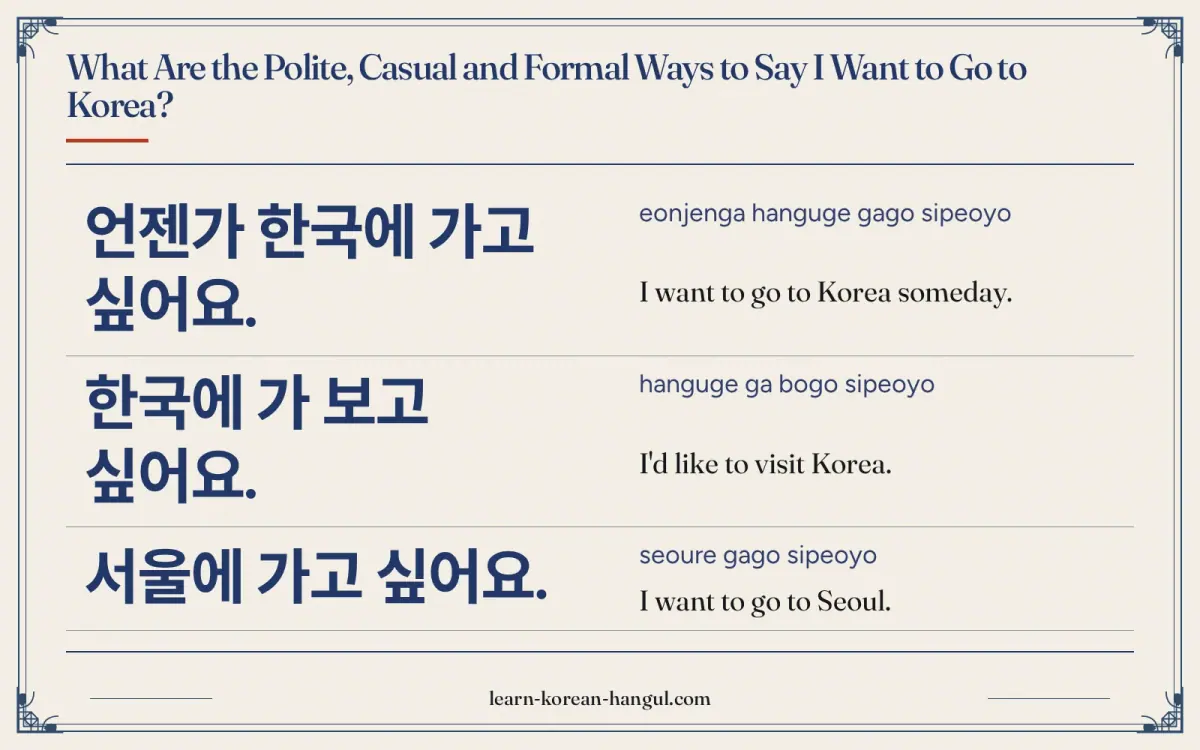
The forms follow the Korean speech levels explained in the guide to Korean speech levels. Only the ending changes with the listener, and the pattern stays the same.
Polite: 한국에 가고 싶어요 (hanguge gago sipeoyo)
Polite · 해요체This is the standard form for teachers, hosts, colleagues and strangers. Add 언젠가 (someday) or 꼭 (definitely) to make the wish stronger.
언젠가 한국에 가고 싶어요.
eonjenga hanguge gago sipeoyo
I want to go to Korea someday.
Polite: 한국에 가 보고 싶어요 (hanguge ga bogo sipeoyo)
Polite · 해요체보다 means "to see", and after a verb it means "to try". 가 보다 is "to go and see for yourself". Use it when you have never been, because it sounds curious and open.
한국에 가 보고 싶어요.
hanguge ga bogo sipeoyo
I'd like to visit Korea.
Polite: 서울에 가고 싶어요 (seoure gago sipeoyo)
Polite · 해요체Replace the country with a city, such as 서울 (Seoul), 부산 (Busan) or 제주도 (Jeju Island). The particle stays 에.
서울에 가고 싶어요.
seoure gago sipeoyo
I want to go to Seoul.
Polite: 한국에 살고 싶어요 (hanguge salgo sipeoyo)
Polite · 해요체Swap 가다 for 살다 (to live) to say you want to live there. Notice that 살다 takes 에 here, to mark the place you live.
한국에 살고 싶어요.
hanguge salgo sipeoyo
I want to live in Korea.
Casual: 한국에 가고 싶어 (hanguge gago sipeo)
Casual · 반말Without -요, the wish is casual. Use it with friends and family, and add a time such as 방학에 (in the school holidays).
방학에 한국에 가고 싶어.
banghage hanguge gago sipeo
I want to go to Korea in the holidays.
Formal: 한국에 가고 싶습니다 (hanguge gago sipseumnida)
Formal · 합쇼체In a speech, an interview or an application, use the formal ending: 한국에 가고 싶습니다. It sounds like [한구게 가고 십씀니다].
한국에 가고 싶습니다.
hanguge gago sipseumnida
I want to go to Korea.
The forms share a pattern, and the next question is how it sounds.
How Do You Pronounce 한국에 가고 싶어요?
한국에 가고 싶어요 is pronounced [한구게 가고 시퍼요], hanguge gago sipeoyo in Revised Romanization, the official system for writing Korean in Latin letters.
- 한 (han): "hahn", with a soft h.
- 구게 (guge): written 국에, said "goo-geh", because ㄱ moves forward.
- 가고 (gago): "ga-go", with plain, voiced g sounds between vowels.
- 시퍼요 (sipeoyo): written 싶어요, said "shee-puh-yo", because ㅍ moves forward.
Sound Changes to Listen For
- Liaison in 한국에. The final ㄱ of 국 moves onto the silent ㅇ of 에, so 한국에 is [한구게]. See the lesson on liaison.
- Liaison in 싶어요. The final ㅍ of 싶 moves onto the silent ㅇ of 어, so 싶어요 is [시퍼요]. The ㅓ is said with unrounded lips, like "uh".
- Same rule in 서울에. The final ㄹ moves forward, so 서울에 is [서우레].
Clear sounds make your wish easy to follow, and the next section looks at when to use it.
When Should You Use 한국에 가고 싶어요, and When Should You Not?
Use 한국에 가고 싶어요 to talk about your own dream or plan, especially when you meet a Korean person. It is safe, friendly and often starts a longer conversation.
Situations Where It Fits
- Introducing yourself. After saying where you are from, add that you want to visit.
- With a language partner. It explains why you study Korean.
- Planning a trip. Talk about the city you want to see.
Situations to Avoid
- Talking about another person. -고 싶다 states your own wish. For a third person, say 한국에 가고 싶어 해요 (they want to go to Korea).
- Suggesting a trip together. For "let's go", use 가요 or, with friends, 가자, not -고 싶어요.
- Very formal writing. In an application or a speech, use 가고 싶습니다 instead.
Hearing the pattern in context makes it easier to use, so here are three exchanges.
What Does I Want to Go to Korea Sound Like in a Real Conversation?
The wish often comes after a question about your studies, your plans or your holidays. Listen for the pattern in each reply.
A Korean Person Asks Where You Learn
Person
한국어를 어디에서 배워요?
hangugeoreul eodieseo baewoyo
Where do you learn Korean?
You
온라인으로 배워요. 한국에 가고 싶어요.
onrainuro baewoyo. hanguge gago sipeoyo
I learn online. I want to go to Korea.
Person
와, 한국에 오면 연락하세요.
wa, hanguge omyeon yeollakaseyo
Wow, contact me when you come to Korea.
What to notice: the question 어디에서 has a wh-word, so it ends with a fall or a rise-fall. 연락하세요 is said [열라카세요], where ㄴ becomes ㄹ and ㄱ meets ㅎ to form ㅋ.
Friends Planning the Holidays
Friend
방학에 뭐 하고 싶어?
banghage mwo hago sipeo
What do you want to do in the holidays?
You
한국에 가고 싶어. 케이팝 콘서트도 보고 싶어.
hanguge gago sipeo. keipap konseoteudo bogo sipeo
I want to go to Korea. I want to see a K-pop concert too.
What to notice: 뭐 하고 싶어? is a wh-question, so it does not end with a sharp rise. Also note that 보고 싶어 can mean "I miss you" when the object is a person.
A Colleague Asks about the Summer Holiday
Colleague
여름휴가에 어디 가고 싶어요?
yeoreumhyugae eodi gago sipeoyo
Where do you want to go on your summer holiday?
You
한국에 가 보고 싶어요. 한 번도 안 가 봤어요.
hanguge ga bogo sipeoyo. han beondo an ga bwasseoyo
I'd like to visit Korea. I have never been.
What to notice: the speaker uses 가 보다 twice, once to wish and once to say they have never tried it. Such conversations are common, and they reveal how Koreans react.
What Should You Know about the Culture behind Saying You Want to Visit?
Telling a Korean person that you want to visit Korea is a warm opening. It signals interest and often leads to advice.
- Warm reactions. Many people respond with suggestions of places and food, so be ready with a follow-up.
- Cities and regions. Naming a place, such as 부산 or 제주도, shows real interest.
- Your wish, not theirs. -고 싶다 states a first-person wish. For others, use -고 싶어 해요, as in 친구가 한국에 가고 싶어 해요 (my friend wants to go to Korea).
- 보고 싶어 is special. With a person as the object, 보고 싶어 means "I miss you", so avoid it with someone you barely know.
An expert insight: learners often use 원해요 for "I want" because it matches the English verb. Actually, 원하다 sounds stiff and bookish in everyday talk. The natural way to voice a personal wish is -고 싶어요. The mistakes below show other traps.
What Mistakes Do Learners Make with I Want to Go to Korea in Korean?
Most mistakes come from the particle or from the verb for "want".
| Mistake | Why it is a problem | Fix |
|---|---|---|
| 한국을 가고 싶어요 | Heard in casual speech, but 에 is the clear, standard destination marker | Say 한국에 가고 싶어요 |
| 한국에서 가고 싶어요 | 에서 means "at" or "from" | Say 한국에 가고 싶어요 |
| 원해요 for a personal wish | Sounds stiff and bookish in conversation | Say 가고 싶어요 |
| 친구가 가고 싶어요 | -고 싶다 is for your own wish | Say 친구가 가고 싶어 해요 |
| Saying han-guk-e | Misses the liaison | Say [한구게] |
Learners often assume that 가고 싶어요 and 가 보고 싶어요 are the same. Actually, the second means you want to see it yourself, and it fits a first visit better.
Other Ways People Search for I Want to Go to Korea in Korean
People search for this idea in a few shapes. The short answers below cover each one.
- Want to visit Korea in Korean: 한국을 방문하고 싶어요 (hangugeul bangmunhago sipeoyo) is more formal; 한국에 가 보고 싶어요 is natural in speech.
- Travel to Korea in Korean: 한국으로 여행 가고 싶어요 (hangugeuro yeohaeng gago sipeoyo); 여행 is a trip.
- I want to visit in Korean: 가 보고 싶어요, with the place first.
- Romanized: hanguge gago sipeoyo, following the Revised Romanization of Korean; romanization is an aid, not the real spelling.
Reading the forms is one thing; saying them on cue is another, so practise now.
Practice: Say It Aloud
Play the slow clip of 한국에 가고 싶어요 and repeat it three times, linking [한구게] and [시퍼요]. Then replace 한국 with 서울 and say it again. Choose a phrase for each situation, and check the answers below.
- A new Korean friend asks about your plans.
- You tell a friend you want to live in Korea.
- You write in a formal application that you want to study in Korea.
Answers
- 한국에 가 보고 싶어요.
- 한국에 살고 싶어.
- 한국에 가고 싶습니다.
Drill these lines with the phrase flashcards, which include audio for each form.
Related Phrases to Learn Next
Talking about a trip leads to other small-talk phrases.
- I'm learning Korean in Korean: why you want to go.
- Where are you from in Korean: the usual question that follows.
- I'm lost in Korean: a useful phrase once you arrive.
This guide belongs to the Korean small talk collection. What this page does not cover: visa, flight and hotel vocabulary. Use 한국에 가고 싶어요 with 에, swap the verb for other wishes, and you will say I want to go to Korea in Korean naturally.
Frequently Asked Questions
How do you say I want to go to Korea in Korean?
Say 한국에 가고 싶어요 (hanguge gago sipeoyo). 한국 is Korea, 에 marks the destination, 가다 is to go and -고 싶어요 means "want to". To say you want to visit and see it, use 한국에 가 보고 싶어요. With friends, drop the -요 and say 한국에 가고 싶어.
How do you pronounce 한국에 가고 싶어요?
It sounds like [한구게 가고 시퍼요]. The final ㄱ of 국 moves onto the silent ㅇ of 에, giving [한구게], and the final ㅍ of 싶 moves onto 어, giving [시퍼요]. Revised Romanization writes the linked sounds as hanguge gago sipeoyo.
What is the difference between 한국에 가고 싶어요 and 한국에 가 보고 싶어요?
한국에 가고 싶어요 says you want to go there. 한국에 가 보고 싶어요 adds 보다, "to try", so it means you want to go and experience it, often for the first time. Both are polite. The second sounds curious and a little warmer, so Koreans often react to it with suggestions of places to see.
Is 한국에 가고 싶어요 formal or casual?
It is polite, in the everyday 해요 style. For a formal setting, such as a speech or an interview, say 한국에 가고 싶습니다. For friends and family, say 한국에 가고 싶어. The polite form is the best default with teachers, hosts and new acquaintances.
Can I use 한국에 가고 싶어요 with friends, elders and strangers?
Yes. The polite -요 ending suits elders and strangers, and it also works with friends if you want to be gentle. Drop the -요 only with close friends. The phrase states your own wish, so it is safe in every setting and often starts a pleasant conversation.
What is the most common mistake with I want to go to Korea in Korean?
The most common mistake is 한국에서 가고 싶어요. The particle 에서 marks where an action happens or starts, so it cannot mark where you go; say 한국에 가요. A second mistake is translating "want" as 원해요, which sounds stiff in conversation. Use -고 싶어요, the natural pattern for a personal wish.