How Do You Say I'm Fine in Korean?
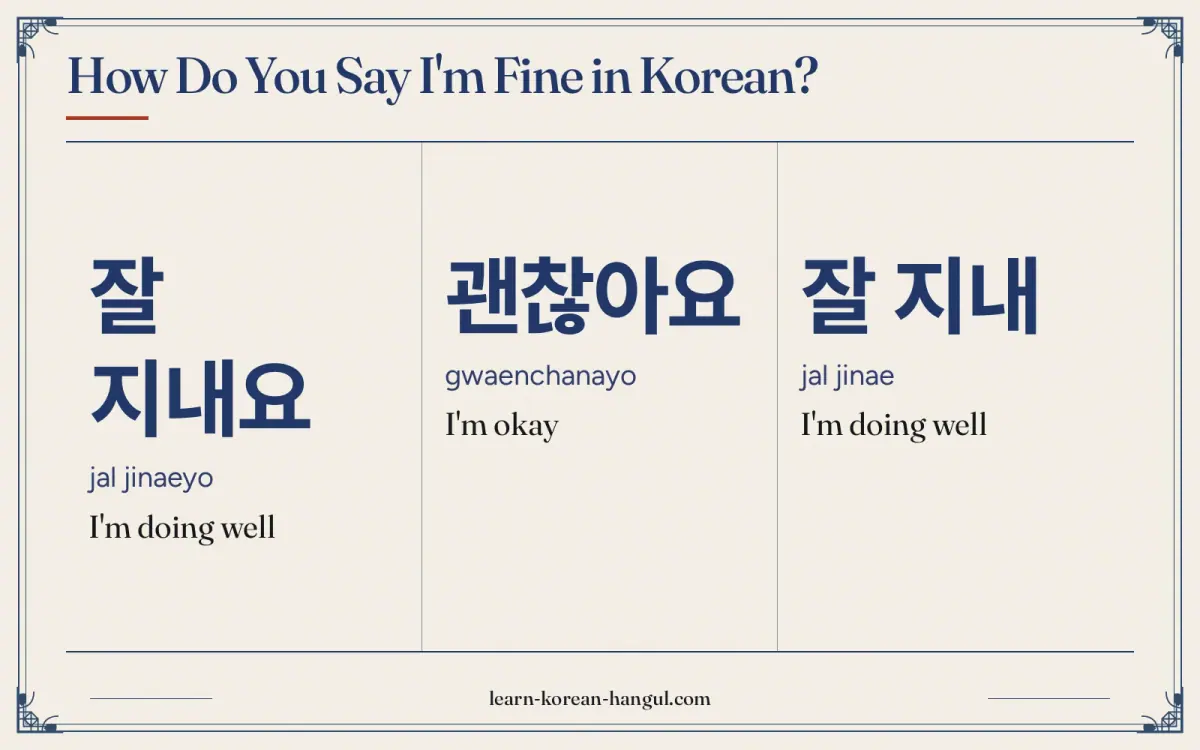
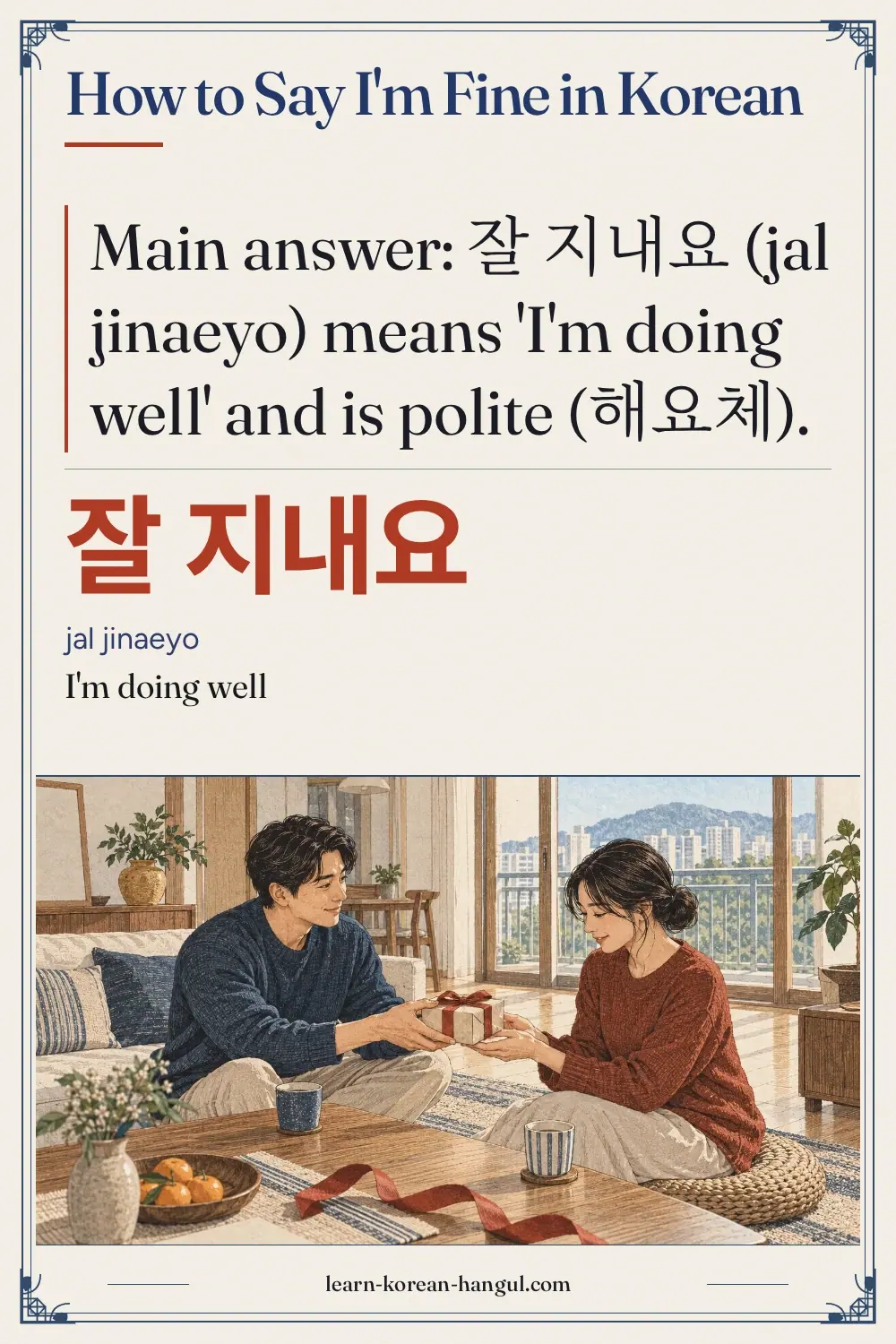
The standard polite way to say I'm fine in Korean is 잘 지내요 (jal jinaeyo). The phrase has two parts: 잘 (jal, "well") and 지내요 (jinaeyo, "get along, spend time"). Together they mean "I'm getting along well," and Koreans use them to answer a question about how they have been.
Five forms cover most situations.
| Korean | Revised Romanization | Meaning | Register |
|---|---|---|---|
| 잘 지내요 | jal jinaeyo | I'm doing well | polite (해요체) |
| 괜찮아요 | gwaenchanayo | I'm okay | polite (해요체) |
| 잘 지내 | jal jinae | I'm doing well | casual (반말) |
| 저는 잘 지내요 | jeoneun jal jinaeyo | I'm doing well | polite, with a subject |
| 잘 지냅니다 | jal jinaemnida | I'm doing well | formal (합쇼체) |
Revised Romanization (the South Korean government standard of 2000) is a reading aid only. The Hangul is the real spelling. The next section sorts the forms by listener.
What Are the Polite and Casual Ways to Say I'm Fine?
Three forms are polite, one is casual and one is formal. Korean speech levels explain the pattern: polite forms end in 요, the casual form drops it, and the formal form ends in ㅂ니다. Match the form to the person who asked, not to your mood.
Polite: 잘 지내요 (jal jinaeyo)
잘 지내요 means "I'm doing well" and is the best answer to 잘 지내세요? (jal jinaeseyo, "are you doing well?"). It suits teachers, neighbours, coworkers and acquaintances. Add a question back to keep the talk going.
Example: 네, 잘 지내요. 선생님은요? (ne, jal jinaeyo. seonsaengnimeunyo?) "Yes, I'm doing well. And you, teacher?"
Polite: 괜찮아요 (gwaenchanayo)
괜찮아요 means "I'm okay" and is softer than 잘 지내요. It answers "Are you all right?" and "How is it going?" when things are fine but not wonderful. The same word also means "it's fine" or "no problem," so listen to the question that came before.
Example: 괜찮아요. 조금 피곤해요. (gwaenchanayo. jogeum pigonhaeyo.) "I'm okay. I'm a little tired."
Casual: 잘 지내 (jal jinae)
잘 지내 means "I'm doing well" and drops the polite 요, so it fits a close friend, a sibling or someone younger. Never use it with a teacher, an elder or a stranger, because the missing 요 sounds too direct.
Example: 잘 지내. 너는? (jal jinae. neoneun?) "I'm doing well. And you?"
Polite with a Subject: 저는 잘 지내요 (jeoneun jal jinaeyo)
저는 잘 지내요 means "I'm doing well" and adds the humble pronoun 저 with the topic particle 는. Korean drops the subject when it is clear, so the pronoun adds contrast: "I am doing well" (even if others are not). Use it when you compare yourself with someone else.
Example: 저는 잘 지내요. (jeoneun jal jinaeyo.) "I'm doing well."
Formal: 잘 지냅니다 (jal jinaemnida)
잘 지냅니다 means "I'm doing well" in the formal style. Use it in a speech, a business meeting or a polite letter. The ㅂ of 냅 sounds like ㅁ before the ㄴ of 니, so the romanization is jinaemnida.
Example: 네, 잘 지냅니다. 감사합니다. (ne, jal jinaemnida. gamsahamnida.) "Yes, I'm doing well. Thank you."
Choosing a Form by Listener
The table gives one clear choice per listener.
| Listener | Best choice | Why |
|---|---|---|
| Teacher, elder, neighbour | 잘 지내요 | polite and warm |
| Coworker, acquaintance | 괜찮아요 or 잘 지내요 | polite, relaxed |
| Close friend, younger person | 잘 지내 | casual |
| Business meeting, speech | 잘 지냅니다 | formal |
| Comparing yourself with others | 저는 잘 지내요 | adds contrast |
Once the form is chosen, the next step is how it sounds.
How Do You Pronounce 잘 지내요?
잘 지내요 is pronounced [잘 지내요], roughly "jal ji-nae-yo," with four syllables in two word groups. Play the slow clip, then the normal clip, and repeat each one aloud.
| Word | Spelled | Spoken | Revised Romanization |
|---|---|---|---|
| 잘 | 잘 | [잘] | jal |
| 지내요 | 지-내-요 | [지내요] | jinaeyo |
| 괜찮아요 | 괜-찮-아-요 | [괜차나요] | gwaenchanayo |
What Sound Changes Happen in 잘 지내요 and 괜찮아요?
Three sound details matter. They follow the Standard Pronunciation Rules (표준 발음법) of the National Institute of Korean Language (국립국어원).
- 잘 지내요 is spelled almost as it sounds. The ㅈ of 지 stays soft after the ㄹ of 잘 when you say it as two words, so there is no tense sound. The vowel ㅐ in 내 is close to the "e" in "bed."
- 괜찮아요 becomes [괜차나요]. The ㅎ in the final ㄶ is silent before a vowel, and the ㄴ links forward, so you hear gwaen-cha-na-yo with no "h."
- 잘 지냅니다 becomes [잘 지냄니다]. The ㅂ sounds like ㅁ before ㄴ.
The second change is the one learners miss most often, so say it slowly twice. With the sounds clear, the next question is when to use each phrase.
When Should You Use 잘 지내요, and When Should You Not?
Use 잘 지내요 as the reply to 잘 지내세요? and add 감사합니다 or 덕분에요 for warmth. The question and the answer share the verb 지내다, so the reply feels natural: 잘 지내세요? "Are you doing well?" gets 잘 지내요 "I'm doing well." To learn the question itself, see the guide to how are you in Korean.
Situations Where 잘 지내요 Fits
- Meeting a teacher or neighbour. Answer 잘 지내세요? with 잘 지내요 and ask back.
- A message from an old friend. Reply with 잘 지내 and tell one detail.
- After a long time. Pair it with 오랜만이에요 (oraenmanieyo), as in the guide to long time no see in Korean.
Situations to Avoid with 잘 지내요
- Answering with 안녕하세요. The greeting repeats hello and does not answer the question.
- Saying it when you are not well. Use 그저 그래요 (geujeo geuraeyo, "so-so") or 괜찮아요.
- Using the casual form with an elder. Add 요.
The dialogues below show the answer in context.
What Does I'm Fine Sound Like in a Real Conversation?
Read each dialogue, play the clip, and say one role aloud.
Dialogue 1: A student and a teacher
- A: 선생님, 잘 지내세요? (seonsaengnim, jal jinaeseyo?) "Teacher, are you doing well?"
- B: 네, 잘 지내요. 민지 씨는요? (ne, jal jinaeyo. minji ssineunyo?) "Yes, I'm doing well. And you, Minji?"
- A: 덕분에 잘 지내요. (deokbune jal jinaeyo.) "Thanks to you, I'm doing well."
선생님, 잘 지내세요? 네, 잘 지내요. 민지 씨는요? 덕분에 잘 지내요.
Dialogue 2: Two coworkers
- A: 요즘 어떻게 지내요? (yojeum eotteoke jinaeyo?) "How have you been lately?"
- B: 괜찮아요. 조금 바빠요. (gwaenchanayo. jogeum bappayo.) "I'm okay. I'm a little busy."
- A: 건강 잘 챙기세요. (geongang jal chaenggiseyo.) "Take care of your health."
요즘 어떻게 지내요? 괜찮아요. 조금 바빠요. 건강 잘 챙기세요.
Dialogue 3: Two friends
- A: 잘 지내? (jal jinae?) "Are you doing well?"
- B: 응, 잘 지내. 너는? (eung, jal jinae. neoneun?) "Yes, I'm doing well. And you?"
- A: 나도 잘 지내. (nado jal jinae.) "I'm doing well too."
잘 지내? 응, 잘 지내. 너는? 나도 잘 지내.
In Dialogue 1, the student adds 덕분에, a small phrase with a cultural meaning that the next section explains.
What Should You Know about the Culture behind I'm Fine?
Koreans often answer an elder or a senior with 덕분에요 (deokbuneyo, "thanks to you"), which shows politeness and gratitude. The word 덕분 means "thanks to someone's help or kindness," so 덕분에 잘 지내요 turns your good news into a compliment for the listener. Students use it with teachers, and younger coworkers use it with managers.
Replies are also often short and modest. A reply such as 괜찮아요 or 그럭저럭 지내요 (geureokjeoreok jinaeyo, "I'm getting by") is normal, and long complaints are saved for close friends. With the custom clear, the common mistakes are easy to spot.
What Mistakes Do Learners Make with I'm Fine in Korean?
The most common mistake is answering 안녕하세요 to a question about how you are. Five mistakes appear again and again:
- Repeating 안녕하세요. The greeting does not answer 잘 지내세요?. Fix: reply 잘 지내요.
- Using 괜찮아요 for "I'm great." It means "okay." Fix: say 잘 지내요 for good news.
- Dropping 요 with elders. 잘 지내 is casual. Fix: add 요.
- Saying the ㅎ in 괜찮아요. The ㅎ is silent. Fix: say gwaen-cha-na-yo.
- Translating "fine" with 좋아요 alone. 좋아요 (joayo) means "it's good" or "I like it." Fix: use 잘 지내요 for "I'm well."
These slips come from carrying English habits into Korean, where "fine" fits every answer. A few related searches ask the same thing in other words, so they are answered next.
Is It the Same as I Am Fine, I'm Good or Fine Thank You?
Not exactly, because Korean picks the word by meaning. Five searches lead to this page, so each gets a short answer.
- I am fine in Korean and im fine in Korean: both mean 잘 지내요 or 괜찮아요.
- I'm good in Korean and I am good in Korean: use 잘 지내요 for "I'm well." To decline an offer ("I'm good, thanks"), say 괜찮아요. To accept one ("sounds good"), say 네, 좋아요.
- Fine thank you in Korean: say 잘 지내요. 감사합니다. and add a question back, such as 선생님은요?.
After the answers, the next pages continue the conversation.
Related Phrases to Learn Next
Four phrases help you keep the conversation going:
- How are you in Korean: the question that this answer replies to.
- Thank you in Korean: the usual second sentence after a reply.
- It's okay in Korean: the other meaning of 괜찮아요.
- Long time no see in Korean: the greeting that often comes before a question about how you are.
The complete list sits in the Korean greetings collection.
Practice: Say It Aloud
Spend five minutes on this routine.
- Play the slow clip of 잘 지내요 and repeat it three times.
- Say 괜찮아요 with the silent ㅎ: [괜차나요].
- Answer 잘 지내세요? aloud with 잘 지내요 and ask back with 선생님은요?.
- Hide the Romanization with the toggle and read the five forms from Hangul only.
- Drill the cluster with the phrase flashcards.
When the answer comes out smoothly, you can say I'm fine in Korean in a way that fits every listener.
Frequently Asked Questions
The answers below add details about how to say I'm fine in Korean beyond the sections above.
How do you say I'm fine in Korean?
The standard polite answer is 잘 지내요 (jal jinaeyo), meaning "I'm doing well." When you only mean "I'm okay," say 괜찮아요 (gwaenchanayo). With a close friend, say 잘 지내. In formal speech, say 잘 지냅니다. Add a question back, such as 선생님은요?, to keep the conversation going.
How do you pronounce 잘 지내요?
Say it as jal ji-nae-yo, with four syllables in two word groups. No major sound change happens, so the spelling is a good guide. The Revised Romanization is jal jinaeyo. For 괜찮아요, the ㅎ is silent and the sound is [괜차나요]. Play the slow clip first, then repeat at normal speed.
What is the difference between 잘 지내요 and 괜찮아요?
잘 지내요 means you are doing well, so it answers a question about how you have been. 괜찮아요 means you are okay or that something is fine, and it also answers "Is it all right?" Use the first for good news and the second when things are neutral or when you decline an offer.
Is 잘 지내요 formal or casual?
잘 지내요 is polite, in the 해요체 style, so it sits between formal and casual. The formal version is 잘 지냅니다 (jal jinaemnida), used in speeches and business meetings. The casual version, 잘 지내, is only for close friends and younger people. If you are unsure, the polite version is the safe choice.
Can I use 잘 지내요 with friends, elders and strangers?
Yes. 잘 지내요 works with elders, teachers, neighbours and strangers who ask how you are. With a close friend, 잘 지내 is natural. With an elder, add 덕분에 ("thanks to you") to show gratitude. Avoid the casual form with anyone older or anyone you have just met.
What is the most common mistake with I'm fine in Korean?
Learners answer 잘 지내세요? with 안녕하세요, which repeats the greeting and does not answer the question. The correct reply is 잘 지내요. A second frequent slip is saying the ㅎ in 괜찮아요, which is silent. A third is dropping 요 with elders.