How Do You Say I'm Home in Korean?
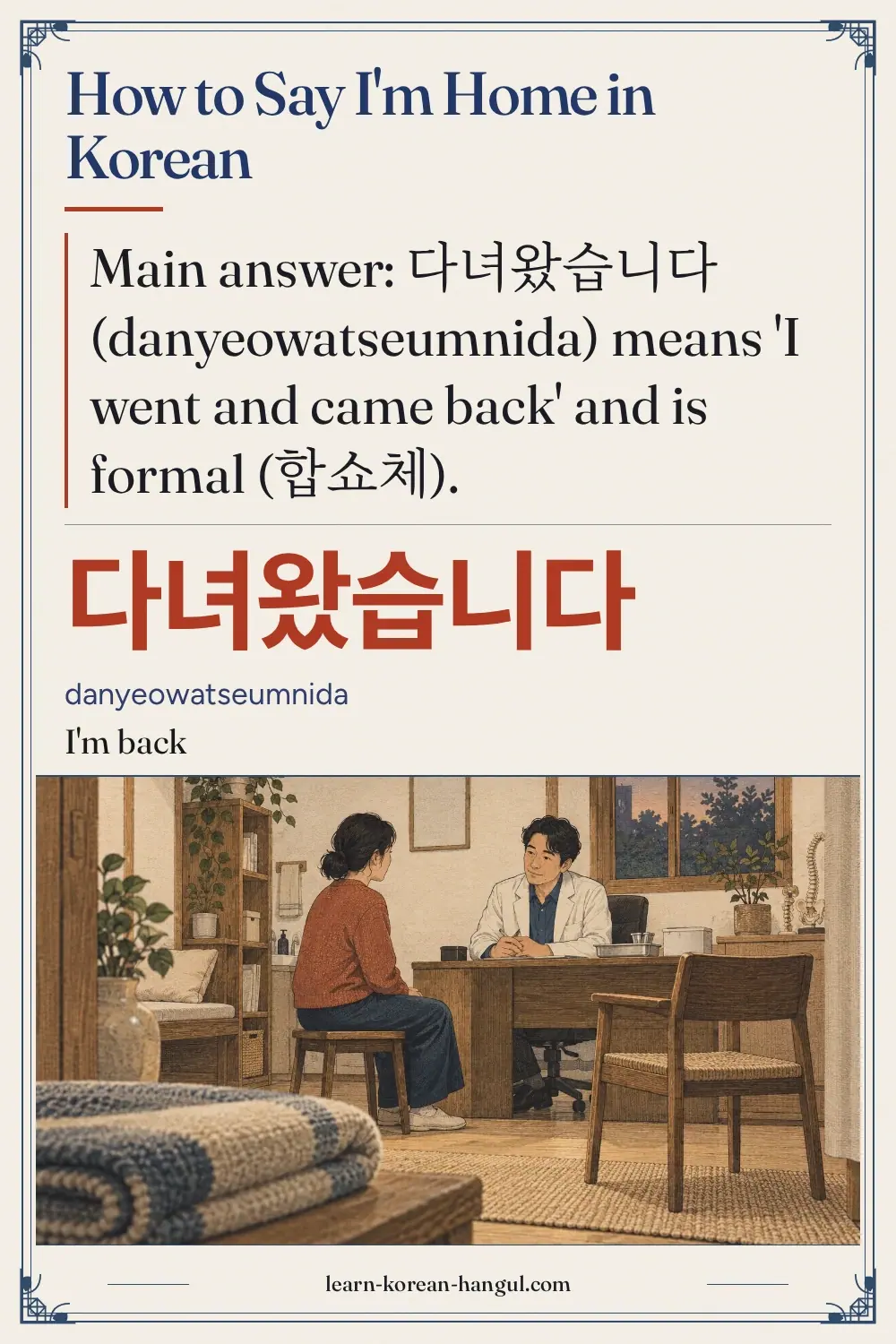
The standard way to say I'm home in Korean is 다녀왔습니다 (danyeowatseumnida). The word has three parts: 다녀오다 (danyeooda, "go and come back"), the past marker 았 (-at-) and the formal ending 습니다 (-seumnida). Korean has no direct word-for-word match for "I'm home," so speakers announce that they went out and returned.
Four forms cover most situations.
| Korean | Revised Romanization | Meaning | Register |
|---|---|---|---|
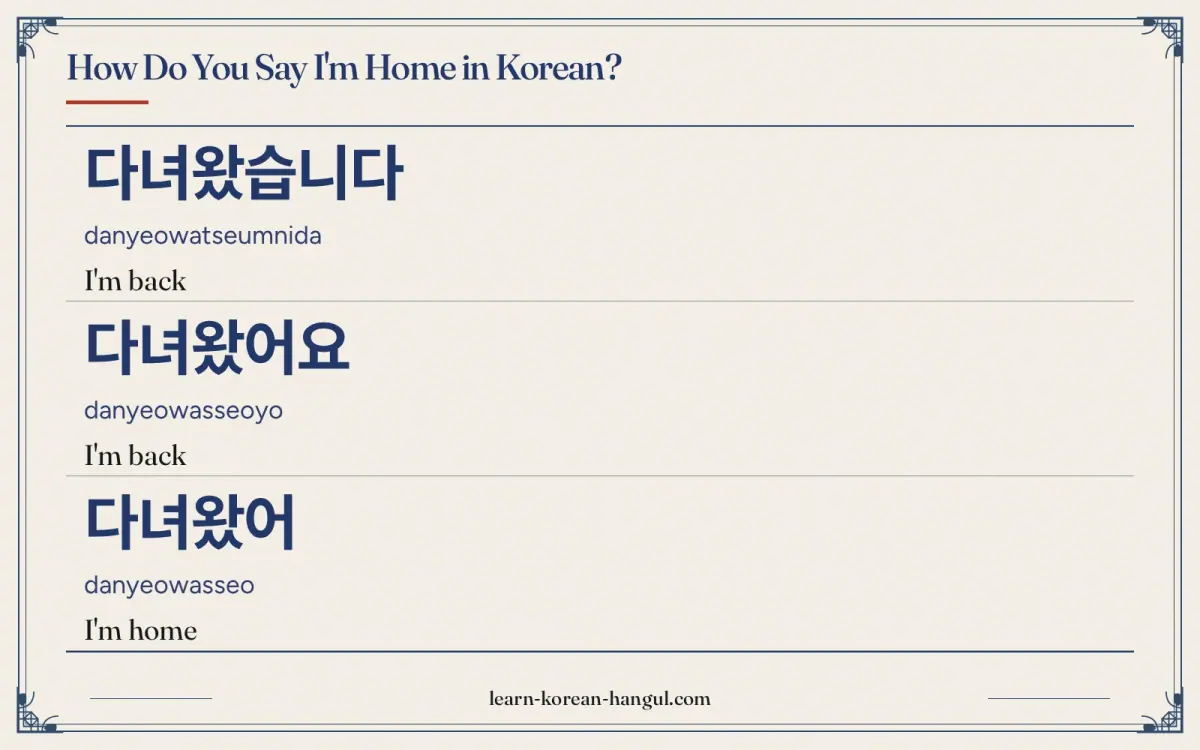
| 다녀왔습니다 | danyeowatseumnida | I'm back | formal (합쇼체) |
| 다녀왔어요 | danyeowasseoyo | I'm back | polite (해요체) |
| 다녀왔어 | danyeowasseo | I'm home | casual (반말) |
| 다녀오겠습니다 | danyeoogetseumnida | I'm leaving, I will be back | formal (합쇼체) |
Revised Romanization (the South Korean government standard of 2000) is a reading aid only. The Hangul is the real spelling. The next section sorts the forms by listener.
What Are the Formal, Polite and Casual Ways to Say I'm Home?
Three forms announce your return and one announces your departure. Korean speech levels explain the endings: ㅂ니다 is formal, 요 is polite, and a bare ending is casual. The pair 다녀오겠습니다 and 다녀왔습니다 works like a door: one word goes out, and the other comes in.
Formal: 다녀왔습니다 (danyeowatseumnida)
다녀왔습니다 means "I'm back" and is the careful form for parents, grandparents, a boss or an office. Use it when you return from school, work or an errand. At work, say it when you come back from a meeting outside or a client visit.
Example: 할머니, 다녀왔습니다. (halmeoni, danyeowatseumnida.) "Grandmother, I'm home."
Polite: 다녀왔어요 (danyeowasseoyo)
다녀왔어요 means "I'm back" and is the everyday form in many homes. Use it with parents, relatives, a host family or a roommate you respect. It sounds softer than 다녀왔습니다.
Example: 엄마, 다녀왔어요. 배고파요. (eomma, danyeowasseoyo. baegopayo.) "Mom, I'm home. I'm hungry."
Casual: 다녀왔어 (danyeowasseo)
다녀왔어 means "I'm home" and drops the polite 요, so it fits a sibling, a close friend or a partner. Never use it with a boss, a teacher or an elder.
Example: 다녀왔어! 저녁 뭐야? (danyeowasseo! jeonyeok mwoya?) "I'm home! What's for dinner?"
Leaving: 다녀오겠습니다 (danyeoogetseumnida)
다녀오겠습니다 means "I will go and come back," and it is what you say when you leave the house, not when you return. The ending -겠- states a plan. In daily speech, 다녀올게요 (danyeoolgeyo) is the polite version, and 다녀올게 (danyeoolge) is casual.
Example: 아버지, 다녀오겠습니다. (abeoji, danyeoogetseumnida.) "Father, I'm leaving, and I will be back."
Choosing a Form by Listener
The table gives one clear choice per listener.
| Listener | Best choice | Why |
|---|---|---|
| Grandparents, a boss, an office | 다녀왔습니다 | formal and respectful |
| Parents, a host family | 다녀왔어요 | polite and warm |
| Sibling, partner, close friend | 다녀왔어 | casual |
| Leaving the house or office | 다녀오겠습니다 or 다녀올게요 | announces a return |
Once the form is chosen, the next step is how it sounds.
How Do You Pronounce 다녀왔습니다?
다녀왔습니다 is pronounced [다녀왇씀니다], roughly "da-nyeo-wat-sseum-ni-da," with six syllables. Play the slow clip, then the normal clip, and repeat each one aloud.
| Word | Spelled | Spoken | Revised Romanization |
|---|---|---|---|
| 다녀 | 다-녀 | [다녀] | danyeo |
| 왔습니다 | 왔-습-니-다 | [왇씀니다] | watseumnida |
What Sound Changes Happen in 다녀왔습니다?
Three sound details matter. They follow the Standard Pronunciation Rules (표준 발음법) of the National Institute of Korean Language (국립국어원).
- 왔 is read [왇] before a consonant. The double ㅆ at the end of a syllable is sounded as [ㄷ].
- 왔습 becomes [왇씀]. After [ㄷ], the ㅅ of 습 turns tense, so you hear "ssum." The page on Korean tensification explains this change.
- 습니 becomes [씀니]. The ㅂ sounds like ㅁ before ㄴ, which is why the romanization is seumnida.
In the polite form 다녀왔어요, the ㅆ moves forward with the vowel and you hear [다녀와써요]. With the sounds clear, the next question is when to use the phrase.
When Should You Use 다녀왔습니다, and When Should You Not?
Say 다녀오겠습니다 when you leave and 다녀왔습니다 when you return. The family replies with 다녀오세요 (danyeooseyo, "go and come back") to the first and 어서 와 (eoseo wa, "welcome back") to the second. Together, the four lines make one small ritual, and a skipped line feels noticeable.
Situations Where 다녀왔습니다 Fits
- Coming home from school or work. Say it at the door, before you take off your shoes.
- Returning to the office. Say it to the team after a meeting, a lunch or a client visit.
- Coming back from a trip. Say it to family after a holiday or a business trip.
Situations to Avoid with 다녀왔습니다
- Entering a shop or a stranger's home. Say 안녕하세요 or 실례합니다 instead.
- Describing a trip to a friend. Use 갔다 왔어요 (gatda wasseoyo, "I went there and came back") to tell a story.
- Using 집에 왔어요. The sentence states a fact. It does not perform the ritual.
The Four-Line Ritual, Line by Line
Each line has a speaker and a reply, so learn them as a set.
| Step | Who speaks | Korean | Meaning |
|---|---|---|---|
| 1. Leaving | the person going out | 다녀오겠습니다 | I will go and come back |
| 2. Answer | the people staying | 잘 다녀오세요, or 잘 다녀와 to a child | Go and come back well |
| 3. Returning | the person coming in | 다녀왔습니다 | I'm back |
| 4. Welcome | the people at home | 어서 와 or 어서 와요 | Welcome back |
At step 4, a parent often adds a question, such as 밥 먹었어? (bap meogeosseo?, "did you eat?"). Answer it in one short line. The dialogues below show the whole ritual.
What Does I'm Home Sound Like in a Real Conversation?
Read each dialogue, play the clip, and say one role aloud.
Dialogue 1: Leaving and returning at home
- A: 다녀오겠습니다. (danyeoogetseumnida.) "I'm leaving, and I will be back."
- B: 그래, 잘 다녀와. (geurae, jal danyeowa.) "Okay, have a good day and come back safely."
- A: 다녀왔습니다. (danyeowatseumnida.) "I'm home."
- B: 어서 와. 학교는 어땠어? (eoseo wa. hakgyoneun eottaesseo?) "Welcome back. How was school?"
다녀오겠습니다. 그래, 잘 다녀와. 다녀왔습니다. 어서 와. 학교는 어땠어?
Dialogue 2: Back at the office
- A: 다녀왔습니다. (danyeowatseumnida.) "I'm back."
- B: 수고하셨어요. 회의는 잘 됐어요? (sugohasyeosseoyo. hoeuineun jal dwaesseoyo?) "Thank you for your hard work. Did the meeting go well?"
- A: 네, 잘 끝났습니다. (ne, jal kkeunnatseumnida.) "Yes, it ended well."
다녀왔습니다. 수고하셨어요. 회의는 잘 됐어요? 네, 잘 끝났습니다.
Dialogue 3: Two siblings
- A: 다녀왔어! (danyeowasseo!) "I'm home!"
- B: 어서 와. 저녁 먹었어? (eoseo wa. jeonyeok meogeosseo?) "Welcome back. Did you eat dinner?"
- A: 아직 안 먹었어. (ajik an meogeosseo.) "Not yet."
다녀왔어! 어서 와. 저녁 먹었어? 아직 안 먹었어.
In Dialogue 1, the pair of lines before and after school shows why the phrase carries more weight than its words. A cultural idea sits behind it.
What Should You Know about the Culture behind I'm Home?
Children usually learn these lines early, often before longer greetings. A child says 다녀오겠습니다 at the door in the morning and 다녀왔습니다 in the afternoon, and a parent answers each time. The exchange tells everyone that a family member left and returned safely.
The same pair appears at work, where a colleague who goes out for a meeting says 다녀오겠습니다 and reports 다녀왔습니다 on return. Which form people use at home varies: many families keep 다녀왔습니다 for grandparents and use 다녀왔어요 or 다녀왔어 day to day. With the custom clear, the common mistakes are easy to spot.
What Mistakes Do Learners Make with I'm Home in Korean?
The most common mistake is saying 집에 왔어요 as a greeting. Five mistakes appear again and again:
- Translating "I am home" word for word. 집에 왔어요 (jibe wasseoyo) means "I came home" and is a statement. Fix: say 다녀왔습니다 or 다녀왔어요.
- Using 다녀왔습니다 when leaving. Fix: say 다녀오겠습니다 or 다녀올게요 on the way out.
- Using the casual form with an elder. 다녀왔어 sounds blunt to a grandparent. Fix: add 요 or use 습니다.
- Missing the tense sound. Saying "sum" with a soft s sounds foreign. Fix: say [씀].
- Staying silent after the reply. Fix: answer 어서 와 with a short line, such as 배고파요 or 학교 재미있었어요.
These slips come from carrying English habits into Korean. A few related searches ask the same thing in other words, so they are answered next.
Is It the Same as I'm Back, I'm Leaving or I'll Be Back?
Not exactly, because Korean uses one phrase for coming and a different one for going. Five searches lead to this page, so each gets a short answer.
- I'm back in Korean and I am back in Korean: 다녀왔습니다 is the closest match at home and at work.
- I'm leaving in Korean: 다녀오겠습니다 when you will return, or 먼저 가 볼게요 (meonjeo ga bolgeyo, "I will head off first") when you leave a gathering.
- I'll be back in Korean: 다녀올게요, or 금방 올게요 (geumbang olgeyo, "I will be right back").
- I'm home formal in Korean: 다녀왔습니다.
After the answers, the next pages continue the conversation.
Related Phrases to Learn Next
Four phrases help you finish the exchange:
- Welcome in Korean: the family's reply to your return.
- Have a safe trip in Korean: the matching line for the person who is leaving.
- Hello in Korean: the greeting for someone you meet at the door.
- Come in in Korean: the invitation to step inside.
The complete list sits in the Korean greetings collection.
Practice: Say It Aloud
Spend five minutes on this routine.
- Play the slow clip of 다녀왔습니다 and repeat it three times.
- Say it again with the tense sound: [왇씀니다], not "wat-sum-ni-da."
- Say the four-line ritual aloud with a partner: 다녀오겠습니다, 다녀오세요, 다녀왔습니다, 어서 와.
- Hide the Romanization with the toggle and read the four forms from Hangul only.
- Drill the cluster with the phrase flashcards.
When the ritual comes out smoothly, you can say I'm home in Korean in a way that fits every listener.
Frequently Asked Questions
The answers below add details about how to say I'm home in Korean beyond the sections above.
How do you say I'm home in Korean?
The standard phrase is 다녀왔습니다 (danyeowatseumnida), meaning "I went and came back." Use 다녀왔어요 (danyeowasseoyo) in polite speech and 다녀왔어 (danyeowasseo) with a sibling or friend. The family usually answers 어서 와 (eoseo wa), which means "welcome back." At work, the same pair works between colleagues.
How do you pronounce 다녀왔습니다?
Say it as [다녀왇씀니다], roughly da-nyeo-wat-sseum-ni-da. The ㅆ at the end of 왔 is sounded as [ㄷ], the ㅅ of 습 turns tense, and the ㅂ of 습 sounds like ㅁ before ㄴ. The Revised Romanization is danyeowatseumnida. Play the slow clip first, then repeat at normal speed.
What is the difference between 다녀왔습니다 and 다녀왔어요?
Both announce that you are back. 다녀왔습니다 uses the formal 합쇼체 ending and suits grandparents, bosses and offices. 다녀왔어요 uses the polite 해요체 ending and sounds softer, so it suits parents, relatives and a host family. Many families use the polite form every day.
Is 다녀왔습니다 formal or casual?
다녀왔습니다 is formal, in the 합쇼체 style. The polite version is 다녀왔어요, and the casual version, 다녀왔어, is only for siblings, partners and close friends. At home, the choice depends on the family, so listen to what the household uses and copy it. If you stay with a host family, ask once which form they prefer.
Can I use 다녀왔습니다 with friends, elders and strangers?
It suits elders, bosses and colleagues. With a friend or sibling, 다녀왔어 is natural. With a stranger, do not use it, because the phrase is a ritual between people who share a home or an office. In a shop or a visit, say 안녕하세요 instead.
What is the most common mistake with I'm home in Korean?
Learners say 집에 왔어요, which means "I came home" and states a fact without performing the greeting. Say 다녀왔어요 instead. A second frequent mistake is using 다녀왔습니다 when leaving; for leaving, say 다녀오겠습니다 or 다녀올게요. The pair works as a set, so learning only one half leaves the ritual incomplete.