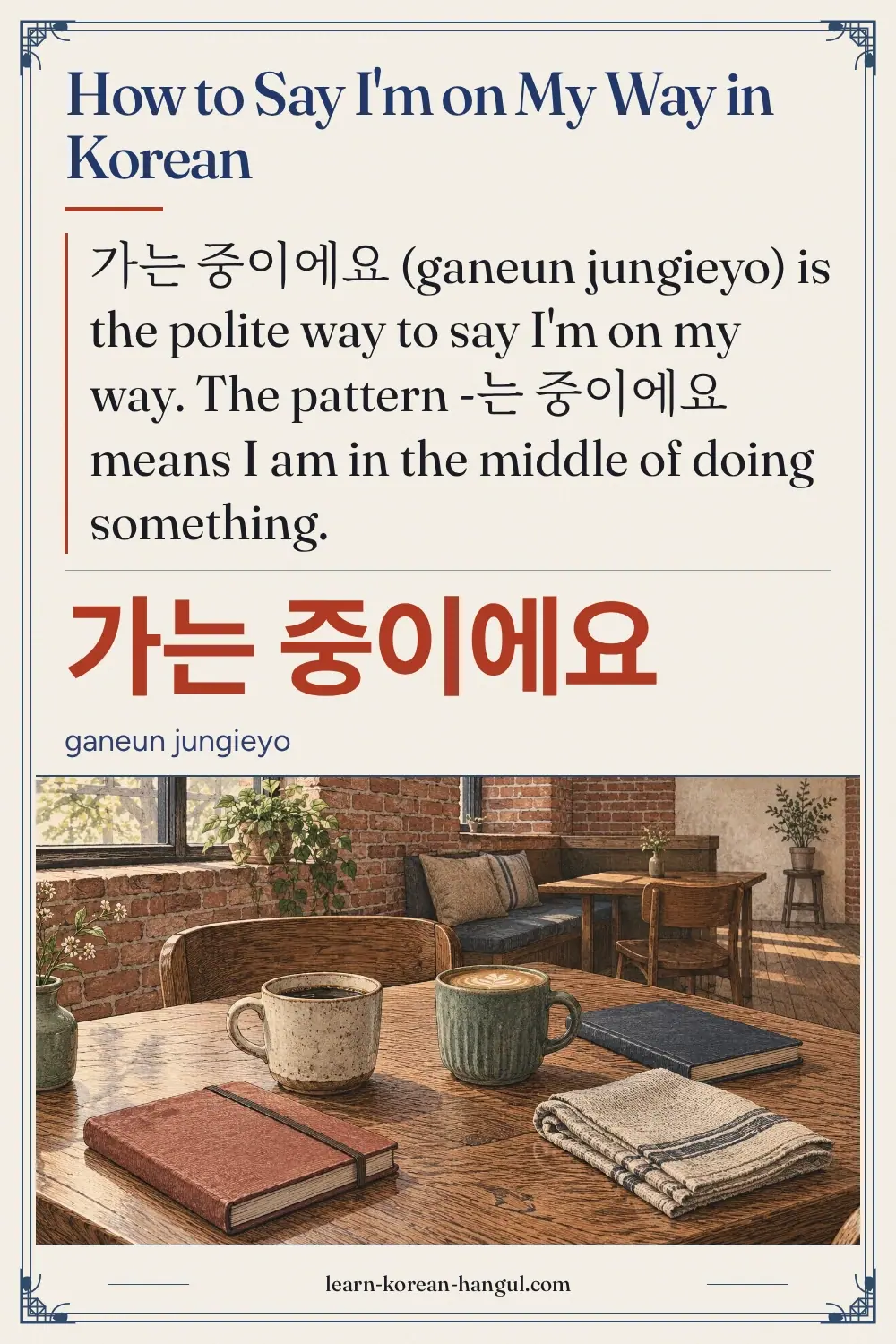
가는 중이에요
가는 중이에요
What you'll learn
- Say I'm on my way with 가는 중이에요 and 지금 가고 있어요.
- Say almost there, I'll arrive soon and I've arrived.
- Choose between 갈게요 and 올게요.
- Pronounce 도착해요 as [도차캐요].
Before you start: you only need to read Hangul. If you are already late, learn sorry I'm late in Korean. Time: about 10 minutes. Audio plays only when you press a button.
How Do You Say I'm on My Way in Korean?
The standard way to say I'm on my way in Korean is 가는 중이에요. The verb 가다 (gada) means "to go", the ending -는 turns it into a modifier, 중 (jung) means "middle", and 이에요 means "is". So the phrase says "I am in the middle of going". Korean usually drops "I", so 가는 중이에요 alone is a full sentence.
| Situation | Best form | Romanization | Why |
|---|---|---|---|
| Texting a colleague | 가는 중이에요 | ganeun jungieyo | Polite, natural |
| Texting a close friend | 가는 중이야 | ganeun jungiya | Casual |
| Quick text to a friend | 가는 중 | ganeun jung | Shortest |
| Reporting your status | 지금 가고 있어요 | jigeum gago isseoyo | Going now |
| Close to the place | 거의 다 왔어요 | geoui da wasseoyo | Almost there |
| Arrival in a few minutes | 곧 도착해요 | got dochakaeyo | Arrive soon |
| You are there | 도착했어요 | dochakaesseoyo | Arrived |
The next section sorts these forms by moment.
What Are the Polite, Formal and Casual Ways to Say I'm on My Way?
The phrases below belong to different moments on the same trip. For the full system of speech levels, read the guide to Korean speech levels.
Polite: 가는 중이에요 (ganeun jungieyo)
Polite · 해요체가는 중이에요 is the form to learn first. It suits family, friends' families, colleagues and strangers. The pattern works with other action verbs too: 먹는 중이에요 (meongneun jungieyo, I'm eating) and 공부하는 중이에요 (gongbuhaneun jungieyo, I'm studying).
지금 지하철 타고 가는 중이에요.
jigeum jihacheol tago ganeun jungieyo
I am on the subway on my way now.
Polite: 지금 가고 있어요 (jigeum gago isseoyo)
Polite · 해요체지금 가고 있어요 uses the progressive -고 있다, "to be doing", and adds 지금 (now). It sounds a bit more like a status report, and it is pronounced [지금 가고 이써요].
Polite: 곧 도착해요 (got dochakaeyo)
Polite · 해요체곧 (got) means "soon", and 도착하다 (dochakada) means "to arrive". Use it when you can estimate the time left. It is pronounced [곧 도차캐요].
곧 도착해요. 조금만 기다려 주세요.
got dochakaeyo. jogeumman gidaryeo juseyo
I will arrive soon. Please wait a little.
Polite: 거의 다 왔어요 (geoui da wasseoyo)
Polite · 해요체거의 다 왔어요 means "I have almost come all the way". The past tense 왔어요 is used because the trip is nearly done: Korean says 왔어요, "I have come", when you are close to the place. 거의 is pronounced [거의] or [거이], and 왔어요 is [와써요].
Polite: 도착했어요 (dochakaesseoyo)
Polite · 해요체도착했어요 is "I have arrived". It is the text you send when you are at the door. It is pronounced [도차캐써요].
건물 앞에 도착했어요.
geonmul ape dochakaesseoyo
I have arrived in front of the building.
Casual: 가는 중이야 (ganeun jungiya)
Casual · 반말가는 중이야 drops the polite ending. Use it with close friends, siblings and people younger than you. In a text, 가는 중 alone is enough.
나 지금 가고 있어. 조금만 기다려.
na jigeum gago isseo. jogeumman gidaryeo
I am on my way now. Wait a little.
The formal form is 가는 중입니다 (ganeun jungimnida), used in workplace reports and with customers.
Behind these phrases sits a question of direction.
Why Do Koreans Say 갈게요 and Not 올게요?
Korean verbs of motion follow the speaker's view of the place. 가다 (to go) moves away from you or toward the listener's place, and 오다 (to come) moves toward where you are or where you belong. So when you walk to a friend's house, you say 갈게요 (galgeyo), "I'll go", even though in English you might say "I'm coming".
- Going toward the listener: 지금 가요, 갈게요.
- Coming back to where you are: 금방 올게요 (geumbang olgeyo, I'll be right back).
- Asking someone to come to you: 이쪽으로 오세요 (ijjogeuro oseyo, come this way).
Both 갈게요 and 올게요 are promises made with -(으)ㄹ게요, and they do not say that you are already underway. To report progress, use 가는 중이에요.
How Do You Pronounce 가는 중이에요?
가는 중이에요 is pronounced [가는 중이에요], ga-neun jung-i-e-yo, in six syllables. It sounds as it is written, with a short pause only at the space between 가는 and 중.
- 가 (ga): a soft g and open "ah".
- 는 (neun): the vowel ㅡ is unrounded, so keep your lips flat.
- 중 (jung): "joong" ending in ng.
- 이 (i): a short "ee".
- 에 (e): a short "eh".
- 요 (yo): a short "yo".
Sound Changes to Listen For
These changes follow the National Institute of Korean Language standard pronunciation rules (표준 발음법):
- Aspiration across ㄱ and ㅎ. 도착해요 is [도차캐요] and 도착했어요 is [도차캐써요]. The final ㄱ of 착 and the ㅎ of 해 merge into an aspirated ㅋ (Article 12). Romanization shows this in verbs and adjectives, so it writes dochakaeyo and dochakaesseoyo. See aspiration in Korean.
- Linking. 앞에 is [아페], and 있어요 is [이써요], because the final consonant moves onto the next vowel (Article 13).
With the sound clear, here is when each form fits.
When Should You Use 가는 중이에요, and When Should You Not?
Use 가는 중이에요 when you have left and are in transit. Do not use it before you leave.
Situations Where It Fits
- Meeting a friend. 지금 가는 중이야.
- Running a little late for a meeting. 죄송해요, 가는 중이에요.
- Telling a taxi driver or host you are close. 거의 다 왔어요.
Situations to Avoid
- You have not left yet. If you are still at home, say 지금 나가요 (jigeum nagayo, I'm leaving now) or 출발할게요 (chulbalhalgeyo, I'll set off), not 가는 중이에요.
- A long delay. If you will be very late, add an apology first, as in sorry I'm late in Korean.
- You are already there. Say 도착했어요 (dochakaesseoyo), not 가는 중이에요.
Two short conversations show how it sounds.
What Does I'm on My Way Sound Like in a Real Conversation?
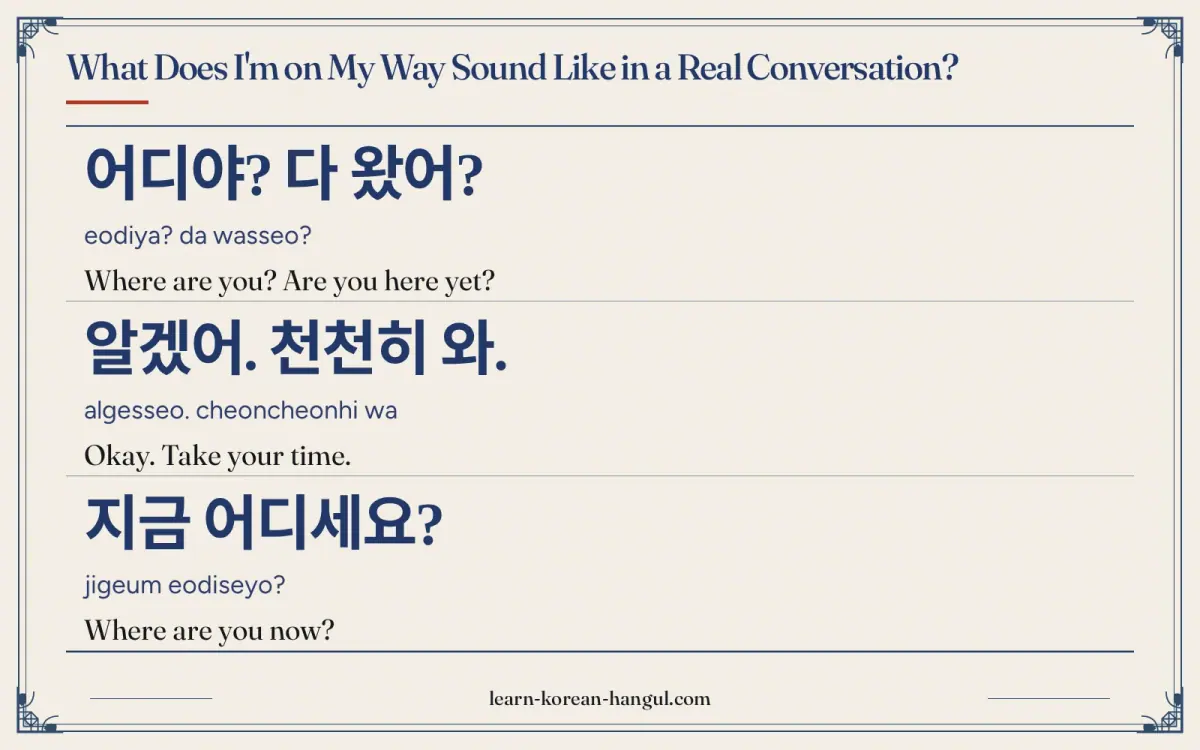
In real life the line comes in a message thread or on the phone. Notice the answers.
Texting a Friend
Minseo
어디야? 다 왔어?
eodiya? da wasseo?
Where are you? Are you here yet?
Jihun
지금 가는 중이야. 오 분만 기다려.
jigeum ganeun jungiya. o bunman gidaryeo
I'm on my way. Wait five minutes.
Minseo
알겠어. 천천히 와.
algesseo. cheoncheonhi wa
Okay. Take your time.
What to notice: 어디야? is a wh-question, so it does not end with a sharp rise, and 다 왔어? is a yes/no question and rises. Minseo uses 와 (come), because Jihun is coming to her.
Running Late for a Meeting
Team Leader
지금 어디세요?
jigeum eodiseyo?
Where are you now?
Employee
죄송해요. 지금 가는 중이에요. 십 분 정도 걸려요.
joesonghaeyo. jigeum ganeun jungieyo. sip bun jeongdo geollyeoyo
Sorry. I'm on my way. It takes about ten minutes.
Team Leader
네, 조심해서 오세요.
ne, josimhaeseo oseyo
Okay, come carefully.
What to notice: the employee apologises first, then reports progress and a time. 십 분 is pronounced [십뿐], with a tense ㅂ in 분 after the final ㅂ of 십.
What Should You Know about the Culture behind I'm on My Way?
Being on time matters in Korean work and school life, so a message such as 거의 다 왔어요 is normal when you are running late. The habit is to send a short status update before the other person has to ask. Messaging apps, above all KakaoTalk, are where this happens, and the message is often one line.
People also give time and distance: 오 분 거리예요 (o bun georiyeyo, it's five minutes away) or 십 분이면 도착해요 (sip bunimyeon dochakaeyo, I'll arrive in ten minutes). Naming a number makes your update more useful than saying "soon".
If a friend cannot find you, a common move is to share a pin with the phone's map or the messaging app and write 위치 보냈어요 (wichi bonaesseoyo, I sent my location). For texting shortcuts used in these chats, see Korean texting abbreviations.
An expert tip: when you are very close, add 앞이에요 (apiyeyo, I'm in front), as in 문 앞이에요 (mun apiyeyo, I'm in front of the door).
What Mistakes Do Learners Make with I'm on My Way in Korean?
Most mistakes come from direction verbs and from the ending after 중.
| Wrong | Why it is a problem | Correct |
|---|---|---|
| 지금 올게요 when heading to the listener's place | 오다 moves toward the speaker's position | 지금 갈게요 or 가는 중이에요 |
| 가는 중이예요 | 이에요 follows a consonant; 예요 follows a vowel | 가는 중이에요 |
| 갈 거예요 for "I'm on my way" | Means "I will go", not "I have left" | 가는 중이에요 |
| 가는 중이야 to a boss | Too casual | 가는 중이에요 |
| Saying 도착해요 with a separate ㄱ and ㅎ | They merge into ㅋ | [도차캐요] |
| 가는 중이에요 when you have arrived | You are no longer in transit | 도착했어요 |
Another trap is the honorific. The ending -시- shows respect for the person you talk about, so 오세요 means "please come" to the listener. You never use it for your own coming.
How Do You Ask Someone If They Are on Their Way?
Turn the same words into a question. To a friend, say 가는 중이야? (ganeun jungiya?) or 다 왔어? (da wasseo?) with a rise, because these are yes/no questions. To a colleague, say 가는 중이에요? (ganeun jungieyo?) or 거의 다 왔어요? (geoui da wasseoyo?).
To ask where someone is, use a question word: 지금 어디예요? (jigeum eodiyeyo?) or, to an elder, 지금 어디세요? (jigeum eodiseyo?). The stress goes on 어디, and the pitch falls or rises and falls, not a sharp rise. A sharp rise would turn 어디 into "somewhere", which makes the question sound like "are you somewhere?". The page about where are you going in Korean covers the other side of the exchange.
Is It the Same as Omw, on the Way, Almost There, I'm Here or Arrived?
Close, but each one marks a different moment. The short answers below cover the other searches folded into this page.
- OMW in Korean: the common text is 가는 중 or 가는 중이야. There is no fixed letter abbreviation like "omw", although short messages are normal.
- On the way in Korean: 가는 길이에요 (ganeun giriyeyo) also means "I'm on the way", with 길 (road) in place of 중.
- Almost there in Korean: 거의 다 왔어요.
- I'm here in Korean: 도착했어요 or 왔어요 (wasseoyo, I've come).
- Arrived in Korean: 도착했어요.
Related Phrases to Learn Next
- If you are late, learn sorry I'm late in Korean.
- To ask someone to move faster, use hurry up in Korean.
- To ask someone's direction, see where are you going in Korean.
- For chat shortcuts, read Korean texting abbreviations.
Every phrase in this group lives in the Korean texting phrases collection.
Practice: Say It Aloud
Play the slow clip of 가는 중이에요 three times and keep the six syllables even. Then choose a phrase. Answers follow.
- You text a close friend while on the bus.
- You tell your team leader politely.
- You are at the door.
- You can see the building and are almost there.
Answers
- 가는 중이야.
- 가는 중이에요.
- 도착했어요.
- 거의 다 왔어요.
Drill these with the phrase flashcards. Saying i'm on my way in Korean is easiest when you match the phrase to the moment of the trip.
Frequently Asked Questions
How do you say I'm on my way in Korean?
Say 가는 중이에요 (ganeun jungieyo) in polite speech, 가는 중이야 (ganeun jungiya) to a close friend, and 가는 중입니다 (ganeun jungimnida) in formal speech. In a quick text, many people write just 가는 중. A common alternative is 지금 가고 있어요 (jigeum gago isseoyo), which means I'm going now.
How do you pronounce 가는 중이에요?
가는 중이에요 is pronounced [가는 중이에요], ga-neun jung-i-e-yo, with six syllables, and sounds just as it is written. The ending 이에요 is pronounced as it is spelled. The related word 도착해요 has a sound change: ㄱ and ㅎ combine into an aspirated ㅋ, so it is [도차캐요].
What is the difference between 가는 중이에요 and 지금 가고 있어요?
Both tell the listener that you are underway. 가는 중이에요 stresses that you are in the middle of the trip, and it is the usual phrase in texts. 지금 가고 있어요 uses the general progressive -고 있다 and adds 지금 (now), so it sounds a little more like a status report.
Can I use 가는 중이에요 with friends, elders and strangers?
Yes. With friends use 가는 중이야 or 가는 중, and with elders, colleagues and strangers use 가는 중이에요. For a boss or a customer, add an apology or the formal ending: 지금 가는 중입니다. The honorific -시- is not used about yourself.
Should I say 갈게요 or 올게요 when I'm heading to the other person?
Use 갈게요 (galgeyo), "I'll go", when you move toward the listener's place, because Korean marks the direction from your own position. 올게요 (olgeyo) means "I'll come" toward where you are or where you belong. Both are promises, not progress reports. For progress, use 가는 중이에요.
What is the most common mistake with I'm on my way in Korean?
Learners say 올게요 when heading to the listener's place, write 가는 중이예요 with the wrong ending, or use 갈 거예요, which means I will go and does not say that you have already left. The correct polite form is 가는 중이에요.